From the NFL to vending: How Jon Corto built a winning team at Buffalo Strive
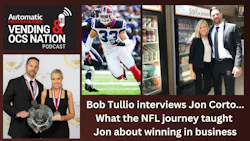




The qualities that helped Jon Corto reach the NFL — discipline, resilience, coachability, sacrifice and relentless preparation — are the same qualities he relies on to lead Buffalo Strive, his successful convenience services business.
In this first part of a two-part series of Automatic Merchandiser’s Vending & OCS Nation podcast, host Bob Tullio sits down with Jon Corto, founder and CEO of Buffalo Strive, Markets and Vending.
In part one, we learn about Corto’s remarkable journey from an undersized linebacker at Sacred Heart University to playing in the National Football League for his hometown Buffalo Bills, and along the way, the drive he harnessed to grow Buffalo Strive from the ground up. (Learn more about that in part 2.)
Corto wasn’t a highly touted prospect. He wasn’t drafted. He admits that at different points in his career he wasn’t the biggest, fastest or strongest player on the field. What he did have was a goal — and an extraordinary willingness to work for it.
Corto shares the unlikely chain of events that helped open the door to his NFL opportunity and why he was willing to leave college early and go “all in” on his dream. For Corto, years of preparation, sacrifice and discipline ultimately paid off.
What happened along the way and how those lessons continue to shape the way he runs Buffalo Strive today — that’s the real story in this podcast.
In this episode, Bob and Jon discuss:
- Why talent alone is never enough in professional sports or business
- The importance of developing habits that continually improve performance
- Why Corto says he will “fail five times before someone else even swings the bat”
- The danger of paralysis and fear of failure in business
- Why Corto would choose a coachable employee over the most talented employee
- What his best coaches taught him about leadership, respect and getting the most out of people
- Lessons Corto learned from his Buffalo Bills teammates about competition and supporting the people around you
- The memorable NFL moment when a teammate told him, “Don’t end on that. You’re up again.”
- What playing under constant NFL pressure taught him about handling business challenges
- Why every successful organization needs people who understand and embrace their role
- The remarkable similarities between becoming a professional athlete and building a successful company
Ultimately, Corto says both pursuits demand many of the same things: hard work, discipline, sacrifice and relentlessness. It is a philosophy reflected today in Buffalo Strive’s mission: “Relentless pursuit to serve others.”
Corto’s biggest lesson from both football and business is remarkably simple: “If you want to get ahead, you have to be willing to pay the price.”

Miss an episode?
Listen to all past episodes of Vending & OCS Nation.
No time to listen? Prefer to read? Here is an edited podcast transcript:
Bob Tullio: On today’s episode of Automatic Merchandiser’s Vending & OCS Nation podcast, we’re talking football — but this is really a conversation about business.
My guest is Jon Corto, founder and CEO of Buffalo Strive. Before building one of the fastest-growing convenience services companies, Jon accomplished something very few athletes ever do. He made it to the NFL, playing for his hometown Buffalo Bills. Jon wasn’t a highly touted draft pick. His road to the NFL required sacrifice, discipline, resilience, a willingness to take some chances, a little divine intervention and an incredible amount of hard work.
As I talked with Jon, what became fascinating was how closely those same qualities apply to building a successful business. We talked about coaches and teammates who influenced him, dealing with failure and distractions, knowing your role, performing under pressure, and why talent alone is never enough. What does it really take to make it to the NFL? And what can business leaders learn from someone who did? Here’s my conversation with Jon Corto.
Jon, fascinating story in terms of your journey, getting to the National Football League and going into business. And you came out of a college that a lot of people probably have not heard of.
Jon Corto: Sacred Heart. Right below Division One. It’s not your big-time schools like Alabama and LSU, but it’s decent football, and it’s gotten progressively better.
Bob Tullio: But I mean, I love the fact that you grew up a Buffalo Bills fan, and you live really close to the stadium. You had this great year in 2006 where you were an All-American. And what position were you playing at that time? Not safety.
Jon Corto: I was a linebacker, but in a safety’s body. So, if you look at me, you’re like, “Wow, that guy’s a standard prototypical NFL safety size,” but I played like a linebacker — or hit like a linebacker. So, I predominantly played in the box. But when I went to the NFL, I literally knew that I didn’t pass the eye test. So, I knew that they’d be like, “Hey, look at this guy. This guy’s not a linebacker.” So I went in as a safety, even though I never really played safety. That was a big learning curve. But they saw enough in me at that safety position to keep me.
Long story short, when someone got hurt as a linebacker, they’re like, “Well, this guy hits as safety.” And that’s when I was like, “Yes, this plan worked.” It’s now their decision to move me from safety to linebacker, and that’s how I eventually made the team.
Bob Tullio: Wow, that’s pretty wild. So, you’re undrafted, and that’s what, 2007, 2006?
Jon Corto: Yeah, so I took a — and I don’t recommend this for anybody — I actually left college early, and it wasn’t like I was on anyone’s radar per se.
I mean, I did well at Sacred Heart. I was an All-American there, but it was always my dream since I was three years old to play in the NFL. And I remember going through junior and senior year and being like, “Hmm, maybe this is it for me. Maybe this is my last year of playing — senior year — that I’ll ever play football again.” And I had enough guys on my team say, “Hey, man, we think you’re good enough. We think you should try it.”
But I was like, “How do you even go about trying out for the NFL and even getting a look from them if you’re not — you come from a smaller school, and your team’s doing okay, and you’re doing okay, but it’s not like you’re on all these radars.”
And so, it was an interesting story. I had a dog at that point, and the dog was — it had juvenile diabetes. And so, I get this dog in college, and it’s hard to take care of because you’ve got to give it two shots a day. And basically, my mom and dad had just bought a house down in Florida, and they were like, “Hey, bring the dog down here. We’ll take care of it.” So, it was one of those typical scenarios that the kid gets the dog, and then the parents have to take care of it.
But anyway, my dad’s walking the dog one day, and he sees this other guy, this gentleman who has two basset hounds. They get to talking. My dad goes, “Oh, you know, where do you live?” [The man replies,] “I live right over here... blah, blah, blah. What do you do for a living?” My dad’s like, “Oh, well, I run these salons and day spas up in Buffalo, N.Y. What do you do?”
And the gentleman said, “Well, it’s kind of unique. I actually train people — prospects — that are going to go into the NFL. I literally work with their agents, and I train them to get into pro days and to get looked at through the NFL. And a lot of them are draft picks at that point.”
So, at this point, I had no idea how to explore [or] how to get into the NFL. It’s my senior year. My dad calls me up and is like, “You got to get down here. You’ll never believe it, but I ran into this guy and [he] literally does exactly what you’re looking to do.”
So, I left like a semester or two early, and I went down to Sarasota, Fla., to start training. I took a leap of faith. And looking back at all the things that had to happen for me to actually make the team from that exact point — man, oh man, I mean, that was a bold strategy. It paid off for me, but it was one of those scenarios where it was like chips all in, and I went for it.
Bob Tullio: Totally fortuitous — that he runs into this guy, points you in the right direction.
Jon Corto: Oh yeah, on our street.
There was a big faith component for that, for me, because the only reason I got that dog was I was — I was looking for classes to take. Looking at [the guide], I’m like, “Oh, Catholicism in America, I’ll take that. I’m a Catholic. I’ll get a B just for showing up, right?”
I take that class. I learned a ton about the faith that I grew up in and literally wrote my mom and dad a nice note. I said, “Hey, thanks for bringing me up in the faith, and I really appreciate all you’ve done for me. And P.S., I wanted a dog.”
Well, that dog is the one that kind of had the issues, went down to Florida — that literally ran into Mike Goff. So, you know, I think it was a little divine intervention. God had a plan for my life. And that’s what he wanted for me right then and there.
But yeah, [it was] always a goal since I was three years old. I’d be running hills. I do whatever it takes to get better. You know, I had a lot of discipline from that standpoint. And I think sports teaches you that, right? Sports teaches you discipline. It teaches you hard work. It teaches you, hey, you got to show up even when you’re sore, you’re hurt, you know, you’re down. And so much of that translates into business because there [are] times where things are rough, especially in this business.
Bob Tullio: There are a lot of people with talent. How much of you getting there has to do with being willing to do things that other people aren’t willing to do along the way?
Jon Corto: I talk to my son about this often. My son’s a pretty good athlete. He’s a quarterback. We talk about, “Hey, look, there are a lot of people that have talent, and a lot of people can maybe throw the ball, but it is, ‘How hard are you willing to work for it?’ How hard are you willing to work in the gym, become a better leader, better person, make all those throws and do it like at game-like speed, the nutrition part of things. There’s a lot that goes into optimizing your ability.”
And so, what you see in sports a lot is a kid with natural ability when they’re younger, a lot of times gets passed up when they’re in middle school, then high school, then college, because some athletes have developed great habits that help them continually get better. Other athletes that were gifted maybe out the gate, didn’t have to work as hard when they were younger. And that also catches up with them because people continually get better.
You’ve got to take those God-given talents and optimize them if you want to be elite. And I think it’s Nick Saban that says, “Hey, if you want to do elite things, you’ve got to do things that no one is willing to do.”
And I think that’s very true. I mean, there [were] not a lot of kids like running hills at six years old, like I was, you know what I mean? I was very driven, and I was very focused on achieving that goal since I was at a young age. And I tell people to this day, I was like, obviously I was given enough talent to make it there, but I also optimized that talent.
And there were times, like even in high school, it was like, man, we had some really good athletes in our high school team. And it was like a competition just to start at high school. And you’re like scratching your head, and you’re like, “If I’m having trouble here, like how am I going to make it into the NFL?" There’s a real reality check there. So, you continually work hard.
They still tell this story to this day. When I was a freshman, they didn’t have a JV football team. And at that point, I had been playing Pop Warner football. So, I knew how to like play and use my body pretty well. But we ran a 40-yard dash. We ran the shuttle. We ran, we did a bench press test with 95 pounds, and I couldn’t do the bench press one time. I was slow, and I was weak. And at that point, I was pretty tough. So they had me cut freshman year — they still tell this story — that they had cut me, but then when we put on the pads, I was hitting people really hard. And they’re like, “We got to keep this kid.”
I wound up starting that year. I tell that story because at the end of the day, yes, I wasn’t the biggest. I wasn’t the fastest. And I kept going, and I had motivation and discipline, and I learned that hard work, but I knew I had to work at it.
Bob Tullio: One of my favorite sayings is, “There are sayers, and there are doers. Sayers have a lot of great ideas, and the doers actually get something done.” Jon, it’s pretty obvious you are a doer.
Jon Corto: Yeah, I’ll fail five times before someone even swings the bat. And I always say that, but then I learn from those mistakes and I keep going. I think sometimes, there’s people that get paralysis and they’re nervous about — this can be a failure, or this could not work, or they’re trying to crunch certain numbers. And sometimes, you got to go with your gut intuition.
Now, I think as the company gets bigger, you need more and more people to support you with numbers and to back up those gut intuitions, right? Certainly, I think speed in business and reacting and intuition are extremely important.
Bob Tullio: If you were building a management team today, would you rather hire the most talented person, or the most coachable person?
Jon Corto: Certainly, the most coachable. I think I’d be looking at someone that has computer skills and really knows AI. We are doing a lot with AI, and in regard to developing systems, and working through Codex and Claude and building systems to make our company better. What you can do on these platforms is absolutely incredible.
Bob Tullio: Who’s the best coach you ever played for? Not necessarily the most famous, but the person who got the most out of you.
Jon Corto: That’s hard. You know, I would go back to my high school coaches. I’ve had a lot of great coaches in the NFL too.
Some of my high school coaches, Gene Tundo, Tony Agnello, they were just good people, but they got the best out of you. They were motivational, and they taught you about hard work, being tough. And they had a component to them that they were kind to everyone on that team, whether they were a star player on that team, or on the bench. They treated everyone with the same type of respect and love. And they kept some of those guys that, at the point in time when I was playing, I’m like, “Man, why is this guy just trying to get a jersey?” But when I look back at that, I look at it like, “Hey, he kept that kid off the street. He kept that kid a part of something,” and I thought that was really cool and admirable.
Bob Tullio: Were there any players that really influenced you most positively, and what did you learn from them?
Jon Corto: Yeah, the NFL was full of people that were high character, quality people. Now, you only hear about the ones that maybe have a run-in with the law or some kind of issue, right? But I would say the large majority of people are high performing individuals that I had the pleasure to play with.
I remember my first time we were sitting at the lunch table, and before anyone was to eat their meal, they’d be saying a prayer, which I was shocked by, [but] which was inspiring.
But also these guys were competitors. I remember one time I got beat on a play. It was one of the fastest guys I was going against. He was running a slant-fade drill, which is really hard to defend. Like you have a fast guy coming at you. He’s either running a slant or a fade. And you kind of have to have really good technique, and you got to catch up to this guy. And it was a goal-line type of drill, so you didn’t have a lot of room for error. And the guy just gave me a great move to the inside on a slant. I think it was Terrence McGee. But then he ran the fade, and I got beat on it.
And as I was going to the back of the line — it was Jabari Greer — goes to me, he’s like, “Don’t end on that. You’re up again.”
It was a simple thing like that. Yeah, that’s competition. That’s confidence. That’s never giving up, and not getting down on yourself. And just by doing something as simple as that, and saying, “Hey, no, get back up. Don’t accept that.” I still remember that to this day.
Bob Tullio: And that’s building other people up and making them better around you, which is an amazing business trait. So, you learned from that.
Jon Corto: Yeah, 100%. And there were a lot of those moments in the NFL because you’re dealing with people who’ve had some great coaches, some great upbringings, and then have a great self-drive all around you that are competitors. It’s hard not for that to rub off on you.
And also too, I think when you look at the NFL, it’s like, there’s a decent amount of pressure. There are all these college teams — Alabama, LSU, Florida State — all these guys are shipping out new recruits every year, and they all want to play in the NFL. And depending on whether your team’s doing well or not, they could be shipping those guys in for your job. So, even when you make the 53-man roster, you never feel secure like your job’s going to be there tomorrow. And there’s a saying in the NFL, “You’re only as good as your last play.” It’s very true.
So, to have and experience that kind of level of pressure in business, like people [ask], “How do you stay kind of calm?” And we had this — we had someone back into the building, or this, or that — I’m like, in the grand scheme of things, we’ll get through it. And if you push yourself to levels, just like even working out, you push yourself to a new threshold, it allows you — like when you have a really good workout — to be like, “Yeah, I can handle it.”
Anytime you push yourself, whether it be fasting, whether it be working out hard, whether it be even mental stress, it expands your capacity to handle more.
Bob Tullio: What did football teach you about accepting a role or about putting people in the right role?
Jon Corto: There are certain roles in an organization that just need to be fulfilled. And it’s not always the glamour positions, but [they make] the overall company work.
I remember my sophomore year in high school, I was playing up on varsity at Orchard Park, and Orchard Park had a really good lacrosse team. And we were making a state championship run. And at that point in time, my main job — because I had two attackmen with me, Matt and Gene Tundo, that were unreal — my job on that team was to get every ground ball and fight for every ball that I could get and get it in those guys’ hands. That was my role that year. I was happy to be on that team and to contribute to the end goal of winning a state championship. But I knew that was where I was best suited because I didn’t have the skill that those guys did yet. They were older, they were seniors, and I would happily fall in line for the betterment of the team.
And I think that’s very important in business. And you have to have people in certain roles to make the organization work. Not everyone can be the CEO, and the guy that’s fully in charge of everything.
Bob Tullio: Suppose a 21-year-old comes to you and says, “I want to be a professional athlete.” And another says to you, “I want to build a great company.” How different is the advice you’d give them?
Jon Corto: I don’t think they’re totally different because there’s a lot of spillover. I think #1, setting the goal that you want to achieve — that is the most important because it’s like, okay, well, how do you get anywhere if you don’t know where you want to go?
And then, both require a tremendous amount of hard work. I mean, people always want to ask me about the NFL, but I would say, you know, starting this business from this, from nothing, may have been more challenging in a lot of ways. Both were very challenging.
Don’t get me wrong. Hard work is a part of both. Discipline is a part of both. Relentlessness is a part of both. And that is actually one of our missions here: Relentless pursuit to serve others. That is our mission.
I use that relentless word because I feel like that is how we started the company. Like when a compressor went down at 11 o’clock at night, I’d go out and fix it. There’s not a lot of people that are willing to do that. There were not a lot of people at a young age that were willing to sacrifice, and maybe not drink or go out and party all the time, when I’m eating right, running hills and lifting weights. And a lot of that has a lot of sacrifice, self-sacrifice, to get where you want.
I’d love for me to be taking a paycheck day one that I started my vending business, but it took five to seven years to actually start paying myself a decent wage. In order to get ahead, you have to be willing to pay the price. And so either one — whether it’s sports or business — you have to pay the price at some point to get ahead.
Bob Tullio: That’s it for now.
Next time, we turn our attention to Buffalo Strive, the company Jon built from the ground up, that today has about 100 employees and generates roughly $20 million in annual revenue. We’ll talk about what’s driving that growth, why Jon believes so strongly in fresh food and AI technology, the incredible opportunity he sees in office coffee and water filtration, and why Buffalo Strive’s mission — a relentless pursuit to serve others — is much more than just a slogan.
About the Author
 Bob Tullio
Bob Tullio
Bob Tullio is a content specialist, speaker, sales trainer, consultant and contributing editor of Automatic Merchandiser and VendingMarketWatch.com. He advises entrepreneurs on how to build a successful business from the ground up. He specializes in helping suppliers connect with operators in the convenience services industry — coffee service, vending, micro markets and pantry service specifically. He can be reached at 818-261-1758 and [email protected]. Tullio welcomes your feedback.
Subscribe to Automatic Merchandiser’s new podcast, Vending & OCS Nation, which Tullio hosts. Each episode is designed to make your business more profitable.