Buffalo Strive: Relentless growth, innovation and a mission to serve
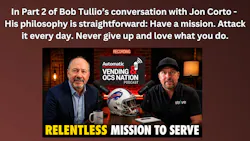




In this second part of a two-part series of Automatic Merchandiser’s Vending & OCS Nation podcast, Bob Tullio continues his conversation with the former Buffalo Bills linebacker turned entrepreneur, Jon Corto. The focus shifts from Corto’s unlikely journey to the National Football League in part 1 to the convenience services company he has built in New York.
Today, Buffalo Strive has approximately 100 employees and generates about $20 million in annual revenue across micro markets, AI coolers, fresh food, catering, office coffee and water filtration.
In today’s episode, Corto explains how the company got started, why Buffalo Strive embraced remote monitoring and cashless technology early, and how staying ahead of emerging technology continues to shape the organization.
But technology is only part of the story. Corto discusses Buffalo Strive’s mission — a relentless pursuit to serve others — and how it influences the company’s approach to customers, employees and the Buffalo community.
In this episode:
- How Buffalo Strive grew into a $20 million company
- Why Corto increasingly views Buffalo Strive as a food logistics company
- The decision to vertically integrate through a USDA-certified fresh food commissary
- Why Corto says operators considering their own commissary need to be fully committed —or consider outsourcing
- How customer entertainment and personal relationships can create a competitive advantage
- Buffalo Strive’s commitment to giving back, including donating unsold fresh food to St. Luke’s Mission of Mercy
- Why supporting local suppliers strengthens both the community and the company
- How community involvement can give employees a greater sense of purpose
- Why Buffalo Strive sells an “elevated market experience” rather than simply installing another micro market
- How Corto and his director of business development are generating significant new business while protecting the company’s ability to service that growth
- Why empowerment means allowing managers to “swing the bat” and sometimes make mistakes
- The three qualities Corto increasingly looks for when hiring
- Buffalo Strive’s growth in premium OCS and bean-to-cup coffee
- Why Corto calls water filtration a “cash cow”
- How AI is already increasing productivity inside Buffalo Strive
- Why Corto believes operators who refuse to embrace emerging technology risk being left behind
- The Buffalo Strive “secret sauce”
Corto also shares how he hopes to be remembered in Buffalo: It has nothing to do with football.
Before the conversation ends, Bob Tullio shows he can be relentless, too. He manages to get the former NFL player to offer a little fantasy football advice.
The takeaway
The same characteristic — relentlessness — that helped Jon Corto reach the NFL continues to define how he approaches business. Whether it is serving customers, developing employees, adopting technology, giving back to Buffalo or finding the next growth opportunity, Corto’s philosophy is straightforward:
Have a mission. Attack it every day. Never give up and love what you do.
Miss an episode?
Listen to all past episodes of Vending & OCS Nation.
No time to listen? Prefer to read? Here is an edited podcast transcript:
Bob Tullio: On this episode of Automatic Merchandiser’s Vending & OCS Nation podcast, it’s part two of my conversation with Jon Corto, founder and CEO of Buffalo Strive.
In part one, we talked about Jon’s remarkable journey to the NFL and the discipline, sacrifice, resilience, and relentless work ethic it took to get there. Today, we find out what happened when Jon took that same mindset into business.
Buffalo Strive has grown from the ground up into a $20 million convenience services company with about 100 employees, and Jon has some very definite ideas about what’s driving that growth. We’ll talk about customer service, company culture and giving back to the community. We’ll look at the opportunities Jon sees in fresh food, OCS and water filtration, and why he believes operators need to embrace AI and emerging technology.
Remember that mission that Jon talked about in part one? A relentless pursuit to serve others. We’ll hear how that mission influences the way Jon approaches his customers, his employees and the business every single day. Here’s part two of my conversation with Jon Corto.
Bob Tullio: Jon, I’ll tell you, we had such positive feedback on part one. People love your inspiring underdog story, hearing what it took to make it to the NFL, and personally, it was a fun episode for me. But let’s talk about the company you formed. Let’s talk about Buffalo Strive. Where are you at with the company today?
Jon Corto: Yeah, we’re around 100 employees, got about $20 million in revenue right now. We do catering, we do wholesale food, we do coffee, we do water, we do automated coolers and markets — grown a ton in markets and coolers — and even our wholesale and catering is starting to take off. We’ve invested a lot of money into our food production too, to also vertically integrate us.
We live in a world that’s constantly changing. So, the more that we can do, the better our company is going to be. But we consider ourselves almost like a food logistics company at this point.
Bob Tullio: You started this actually 2011, is that right, when you were injured during that season?
Jon Corto: You know, last season there, I had about three surgeries in my last year, and I was predominantly playing special teams. I started a couple games at linebacker when some guys got injured, but I played on special teams in every game. I had two shoulder surgeries, a wrist surgery, a couple concussions in my last year.
I was a pretty — like I was the number five on kickoff, which is the guy right in the middle. He’d be the guy running down full speed, breaking the wedge, going in between 350-pound linemen and trying to just run into him as fast as you could. So, maybe that’s why I got into the vending business there, Bob. I just spent it too many times, but certainly had the surgeries mounting up.
And so, I looked at [his wife] Jen, and I was like, “Hey, I was involved with the Play60 initiative,” which encourages kids to be active — play 60 minutes a day. And I was like, “Wow, this is — I always wanted to play in the NFL and then start my own business. So … this is a perfect transition.” Because [I’d] been talking to kids about, “Hey guys, get outside, make some healthier choices, play 60 minutes a day.”
And then I went to my high school, and I was like, “Man, the only thing that they have after their lunch meal, and sometimes it’s as early as 10 a.m., is a Snickers bar and the vending machine. I think there’s a chance to upgrade this.”
At that time, in 2011, that’s just when credit card readers were becoming a thing. So, nothing that left our business or our building went out without a credit card reader, which was a huge advantage because we came in at a critical time. Because most [other] people were running routes on their trucks, inventorying manually, and then going back and picking on their truck. And we started everything with remote monitoring out of the gate.
Bob Tullio: So, you had the right equipment. And then of course, that was right at the very, very beginning of the micro market industry. I mean, it was right around the corner at that point. Maybe hadn’t reached Buffalo much at that point, I would think.
Jon Corto: We’re usually 10 years behind like what people are doing out in California. However, we as Buffalo Stride are pretty innovative. So, we keep up with the trends. And as things — I think we’ve got maybe 80 AI coolers out there at this point. So, we’re pretty quick on the new trends that are emerging, even though we are in Buffalo. And then usually Buffalo catches up, right?
So, when I first started, they were like, “What is a micro market? That’s not going to work. Are people going to just steal everything?” They were very uneasy about it, whereas now it’s like, “We want a market.” Clients are asking us for a market as opposed to like, “Hey, this doesn’t work,” which is unique.
Bob Tullio: How invested are you in training on a regular basis — from sales training to operations training to technician training? Do you see that as important to have on an ongoing basis?
Jon Corto: Yeah, it is. And we have — Victoria does all of our HR, a lot of our training, [and] our general managers are doing a lot of our training. We also bring in people from the outside, outside professionals to come in and meet with our service techs and whatnot to train them on our machines so that they feel like they’re equipped. We also integrate AI so that they can use that as a sounding board when they’re going up to try to fix machines. And we have all of our databases logged in with all of our manuals on there, so that they can reference those. So, we have a lot of different things that we’re doing to help our people be successful.
Bob Tullio: Let’s talk about HR for a minute.
Jon Corto: Can we not talk about HR? [laughs]
Bob Tullio: Let’s talk about HR.
Jon Corto: I think it started off as a part-time deal. We used an outsourced HR at first. Now, we have that, and we have someone that’s doing it 20 hours in addition. But it’s becoming more and more of a full-time thing for Victoria as HR. When you have about 100 people, I think they say, you should have almost a full-time HR person on staff. And I think between the two of them, we kind of get there.
You know what? It helps. Because at the end of the day, having people take care of that part of the business allows me to focus on the stuff that helps grow it. And if I’m constantly in the weeds with some of the Mickey Mouse items — and sometimes they’re really big items that you really got to focus on — but it also helps me be in the right state of mind to focus on the future, where we need to grow.
Bob Tullio: David Henschel, you know Henschel from New York, and he once told me that ultimately, now that he looks back on the big picture, that [HR] is the most important person in his organization as you get bigger and bigger.
Jon Corto: Yeah, and it is extremely important. You gotta really trust that person. And also from a hiring standpoint, I think that’s where they… I see some of the most value in hiring and training. And Victoria does a nice job with that.
Bob Tullio: What do you think is the number one thing that’s driven your growth?
Jon Corto: I think it goes back to our mission. I think it goes back to relentless pursuit to serve others.
I think we give back to the community. I think our community then supports us.
I think we relentlessly attack each segment of our business. And so, not only do we have a USDA fresh food commissary, we’re constantly listening to what our people want in their markets and whatnot, but we’re challenging just even the norms of spending and how to generate revenue from vertically integrating our company, to seeing how we can source things differently, to working with manufacturers to get different deals in regards to rebates and whatnot, even advertising on the kiosk to generate multiple forms of revenue. We kind of leave no stone unturned in regard to attacking our business, which I think is the way you’ve got to be to be a successful business, to play in the NFL, or to do some of these things that we did. You’ve got to be relentless. And so, I love that word because I think that’s what it takes to run a business and do it effectively.
Bob Tullio: I want to talk about giving back in two directions. The first one is giving back to your clients, showing appreciation. How important do you think customer entertaining is, event-driven situations where you bring people together? Are you focused on that sort of thing?
Jon Corto: Yeah, we actually have a tailgate party coming up where we invite all of our clients in here. We have a band. We give them food. We really kind of wine-and-dine them. And we also do different catering-type events for our clients on occasion as well.
That customer rapport is so important. The customer matters, that relationship matters. Not only does it benefit you to have competitive advantages like your food and whatnot, but also to have that personal relationship. When someone else knocks on the door and is offering a similar service, they’re like, “You know what? I know Jon. He does a great job. We like what he’s doing here, and we’re happy with the services.”
Bob Tullio: Now let’s talk about giving back, showing appreciation to the community. How important is that for a company? What’s the impact of it, and what do you do?
Jon Corto: One of the main things that we do is we take all of our fresh food that doesn’t sell into our markets, and we donate it down to St. Luke’s Mission of Mercy, and we feed a large part of the east side of Buffalo down there. I mean thousands of meals a week, which is great because our meals are MAP-packaged, so they can last a lot longer than when we are pulling them. And so, all these people are getting a good quality meal.
It makes us feel good. And St. Luke’s has done such a great job in our community of taking care of the people in need. I could think of no better organization to be partnered with to help the Buffalo community.
But in addition to that, we also have strategic partnerships with where we get our rolls. We get our rolls from Costanzo’s, which is a local partner right here in Buffalo. And we go through a lot of rolls. And other local companies — Upstate Milk, that we are actually infusing — making Buffalo area, greater Buffalo area better. Our money’s not just leaving here. It’s not going to big corporations. It’s staying here. And it’s talked about a lot, but it’s really — we’re really kind of living it here with what we’re doing and what we’re building from the products we’re bringing in. And I think people really see that and support that.
Bob Tullio: Well, you look at Jon Holden, how big he is on supporting Michigan products and bringing people in, bringing those products in and building up small companies. So, you very much are aligned with that type of strategy as well.
Jon Corto: 100%. And it’s one of, it’s in our deck, supporting local and here’s the evidence of it. You can see it in our markets every day.
Bob Tullio: What kind of impact does it have on your company, on the people in your organization when they see you doing something good for the community?
Jon Corto: I think everyone wants to have a purpose in life and in work. So, when they come to work, it’s not just like, “Hey, I’m just punching a clock.” There’s more to it. They have purpose. When they see that, “Hey, we’re actually supporting the greater Buffalo community. Look at all the great things that we’re doing. Look at the schools that we’re supporting. Look at how we’re giving back to St. Luke’s, and look at how we gave to the P.U.N.T. Foundation [pediatric cancer collaboration], and that kind of stuff.”
These are all great things that we help support because it’s the right thing to do. But I think the spillover benefit is that it also gives our employees purpose within what they do here at work.
Bob Tullio: Let’s talk about your move into the commissary business. If I’m an operator and I come up to you and say, “Hey, Jon, I understand you’ve started a commissary operation. Do you think I should?” Would your answer be, “Absolutely, it’s a great idea, and it’s easy to do”? Would it be, “Well, it’s something you can certainly do, but you better be prepared for a challenge, and you better have the capital to do it”? Or would you say, “In retrospect, I don’t know if this is something that made sense”?
Jon Corto: It’s definitely made sense for us. Would it make sense for everyone? Based on what I’ve seen out there from the different types of operators out there, I would say no. You have to do it right, and you have to do it at a high level. And when you’re dealing with food, you have to be — there’s no margin of error here. You have to — we’re USDA certified, we’re cleaning everything, every day. Cleanliness is extremely important. You have to have the facility for it, and it does take capital. We’ve also invested in the management and the culinary to help support it.
So, if you can do those and you’re really invested in taking the company to the next level, then I would say yes, it’s worth it. But if you’re just to dip your toe in, I would say your best bet is to probably outsource something like that, because that will not go well.
Bob Tullio: So it sounds like you better be relentless if you’re going to do it.
Jon Corto: You gotta be relentless.
Bob Tullio: Let’s talk about workplace experience and premium refreshment. To what extent have you emphasized to your sales team that they need to focus on the fact that they’ve got to improve the overall workplace experience for customers?
Jon Corto: So, we have one, I would say, salesperson, but he’s not — he’s much more than that. Bill O’Brien is our director of business development, and he does most of the sales along with me. His ability to incorporate AI and everything else is second to none. I mean, he can really do the job of maybe two, three, even four sales guys. In the greater picture, he does an awesome job because I worked alongside him, kind of painting the picture.
Hey, when we come in, we even have it on our key asset — I believe it says “elevated market experience.” So, we don’t want to just have a market. We want to have custom cabinetry, the overall look and feel of our markets to be great, so that we can transform your break room — not only from the market, the fresh can offer, but from water filtration, the coffee, catering that we can do, anything you need for food and beverage, we’ve got your back, and we are one source for all of that.
We’ve been able, in the last couple of years, to generate almost $5 million a year between the two of us. And if we were to get any more than that, I don’t know, it’s very difficult to keep up with. I mean, even now we put in a market or a large account every week, if not two. So, you only have so much bandwidth in that. So, we don’t have a sales problem. And when we have a sales problem, then yeah, we’ll say, “Hey, we need more salespeople,” but we do not have a sales problem.
The only thing that I would say is like, hey, we throttle sometimes to try to keep up with the sales that are coming in. So we’ll say, “Hey, push this one out because we got two huge installs.” Our service techs can only be in so many places at once. If we have service techs dedicated in these different areas, we don’t want our service to fall behind because we have those service techs on installs. Sometimes even now, I’ll be jumping on a big install, even to this day. I like doing it. I mean, that’s fun for me.
Bob Tullio: Oh, customers love to see that, too. They love to see you out there.
Jon Corto: They do. They do. And it shows that you care and that their account is important to you.
Bob Tullio: Now, what about customer service? You have to have a dedicated customer service team.
Jon Corto: Yeah.
Bob Tullio: Don’t tell me — you and … is it Bill O’Brien?
Jon Corto: Bill. Yeah.
Bob Tullio: Don’t tell me that you and Bill go out there and handle all the customer service.
Jon Corto: Well, sure, we probably could. But you know, yeah, because he’s another professional athlete. He actually played for the Bandits. We actually went to school together. We played college football together. And he actually was training with me to play in the NFL. The NFL didn’t work out for him, but professional lacrosse did.
Bob Tullio: So, two relentless athletes do all the selling, but you’ve got a customer service team.
Jon Corto: We do have customer service people checking up on accounts. And then we have also our supervisors that are in charge of kind of checking up with the drivers and making sure they’re all on top of it. But then also, we have people that are customer retention as well, which is important.
Bob Tullio: That’s good. To what extent do you empower people to make decisions on their own?
Jon Corto: I think as the company gets bigger and bigger, it is more important for our management team to be making those decisions without me. And so, I think sometimes even just letting them swing the bat, whether it’s the way I would go or not, letting them swing the bat and maybe failing, and then… coming back and saying, “Hey, what did we learn from it?”
I mean, that’s how I learned. There wasn’t necessarily a school for vending to go through. It was trial and error. A lot of times you made the right decision, but there were a couple of times you’re like, “Aw, man, if I were to go back and do it all over, this is how I would do it.”
Bob Tullio: What are the qualities you look for when you’re hiring someone?
Jon Corto: Attitude and effort. We are looking for good people. We can train you in what it is that we do. I’m also looking for computer skills at this point, because I feel like that is a huge component of the future, so you gotta be able to be computer savvy, you gotta have a good attitude. And you got to show that you are a winner, and you have good effort, and that you’re motivated. I think that’s a winning recipe.
Bob Tullio: You didn’t start out in the coffee service business from day one, but you had to go into it, obviously, at some point. How has that gone for you from an OCS standpoint? And where’s your OCS operation right now from a coffee growth standpoint, from a premium coffee standpoint? Tell me a little bit about it.
Jon Corto: Yeah, coffee is really important to us at this point. We have actually our own Corto blend. We are pushing a lot of bean-to-cup machines at this point. I don’t even know off the top of my head how many we have out there. I would venture to say probably close to 150 bean-to-cup machines out there.
Our office coffee has grown tremendously. We do a little bit of pods as well because the environmentally friendly pod systems that — Newco does a nice job with some of their brewers, CX touch and stuff like that. But, a lot of growth in the bean-to-cup machines over the last five years. And we’ve gained some pretty big accounts. And it’s part of like, when we add a market, we’re trying to get that coffee business as well.
Bob Tullio: How much do you like the water filtration business?
Jon Corto: I love it.
Bob Tullio: I’m pretty sure you love the annuity nature of that business?
Jon Corto: Yeah, I mean, that’s the best, probably the best part of the business is the water filtration business because it’s — we’re so used to servicing stuff like every day or at least every other day, and the filtration is — You know, you’re looking at it once a quarter and whatnot, and just checking in with the customer. It’s very, I mean, the residuals are great, and the maintenance on it is limited. So that is just kind of like a cash cow, and we love that type of business. I wish I had 1,000 of those things out there.
Bob Tullio: A lot of companies talk about technology as a replacement for people. I see it as an enabler, making your company better. Let’s take a moment to discuss how technology is making your company better and who your key technology partners are.
Jon Corto: I believe that you’re going to be able to do — and I don’t believe it, I see it. I see it within our organization, the people that embrace it, which it’s not hard to embrace, it’s not overly complicated. You just need to dive in. You gotta be okay with change.
The people that embrace working with AI are gonna almost 10X what someone that doesn’t even dip their toe in. And a lot of people are just using web browsers, scratching the surface. I mean, they don’t even have codecs or anything downloaded on their desktop at this point. But if you can embrace it, you’re going to be able to do so much more with less.
And so, the people that embrace the technology will probably at least 3 to 5X their current productivity — at least save probably 2 hours a day. And so, what does that mean? Well, I think ultimately it means that companies will have more to give to the employees that actually embrace the technology because they’re able to do more.
Will it create jobs? I don’t know. I think it’ll create jobs. I mean, obviously there’s tons of data centers going out. You’ve had Aramark just announced Pat Liebler is literally just going out and trying to get these data centers and try to win that type of business because it’s so big. We’ve got one: It is big. And so, I think in the short term, when they’re building all this infrastructure out, I think there’ll be an increase in jobs.
It’s going to create a lot more freedom, a lot more leisure time. Cryptocurrency, AI and robotics converging all at once. And I think there’s never been a time where we’re going to see crazy change in our world in the next five years. And so, people that don’t think about that, those are the people that are going to be left behind. You got to dive in.
Bob Tullio: Talk to me about who your key technology partners are. How about on your AI coolers?
Jon Corto: 365 is our main partner with all of that, from the coolers to the micro market sector. They’ve been a good partner for us. They’re not the only game in town, but they’ve been good to us.
Bob Tullio: Any other key technology partners?
Jon Corto: We use VendSys for our software. They’re our VMS software, but they integrate with Lightspeed, and they’ve been good. What I liked about them is when we were small, they allowed us to grow with them.
Bob Tullio: What’s the secret sauce at Buffalo Strive?
Jon Corto: I think the hard work, perseverance, never giving up, being relentless, having a mission, and attacking it every day and loving what you do. I enjoy coming to work. I like building this company, and I like the people that I work with. So, it makes it an enjoyable journey. So, I think all those things combined make us successful.
Bob Tullio: How do you want to be remembered in the Buffalo community?
Jon Corto: A guy who gave back, who created jobs, and as a man of faith, that’s extremely important to me.
Bob Tullio: Do you play fantasy football at all?
Jon Corto: I’ve been asked a lot about fantasy. It’s funny. I was always a guy that loved to play the sport more than watch it. And I love watching the Bills, and I watch every Bills game. But fine, with three kids and the growing business, I feel like some of that type of stuff is distractions. And I focus my time on my business, my family and faith. And that’s where my effort and time go, that I think I’m getting — what I say is — it moves the needle the most, right?
Bob Tullio: Sure, but I’m not letting up on this. So, I need one good pick. I need one good pick at three positions. I need — what’s the running back that I have to have this year?
Jon Corto: I mean, I like our running back, James Cook. I think he’s good. I even like our quarterback, Josh Allen, but that’s a lot to put on one team. I think from a receiver standpoint, Justin Jefferson — can’t really go wrong with him.
Bob Tullio: Yeah. All right. So that’s helpful. At least now I can go to my fantasy draft on the 27th and say, “You guys are screwed. I got advice from Jon Corto.”
Jon Corto: Don’t blame me if you don’t win.
Bob Tullio: Oh, I understand. Believe me. Chances are I’ll be calling you to complain.
This transcript has been lightly edited for clarity and accuracy.
About the Author
 Bob Tullio
Bob Tullio
Bob Tullio is a content specialist, speaker, sales trainer, consultant and contributing editor of Automatic Merchandiser and VendingMarketWatch.com. He advises entrepreneurs on how to build a successful business from the ground up. He specializes in helping suppliers connect with operators in the convenience services industry — coffee service, vending, micro markets and pantry service specifically. He can be reached at 818-261-1758 and [email protected]. Tullio welcomes your feedback.
Subscribe to Automatic Merchandiser’s new podcast, Vending & OCS Nation, which Tullio hosts. Each episode is designed to make your business more profitable.