Clear advice from an HR expert: Invest in your frontline managers
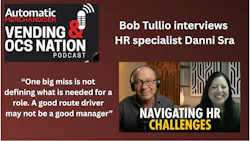




Danni Sra has enjoyed a successful career as a human resources manager, and she wants businesspeople to know that running an HR department goes well beyond rule enforcement — a common stereotype of what HR managers do. With years of experience in the convenience services industry, she has plenty of valuable advice for operators.
In this episode of Automatic Merchandiser’s Vending & OCS Nation, host Bob Tullio sits down with Danni Sra to unpack the evolving role of human resources in today’s fast-moving workplace, especially within the convenience services industry.
Drawing on her experience in helping grow Gourmet Coffee Service into a major market player, Danni shares practical, real-world insights on hiring, retention, compliance and the increasing complexity of managing a dispersed, frontline workforce.
From the rising expectations of Gen Z employees to the costly risks of compliance missteps, this conversation is a must-listen for operators and business leaders looking to build stronger teams and avoid expensive mistakes.
Related
 human resources advice re How to improve employee retention in convenience services and route-based operations
No time to listen? Prefer to read? Here is an edited podcast transcript:
Bob Tullio: Obviously, you’ve got an extensive background in human resources. And, you have a unique aspect about you, from my perspective, in the sense that you have very definite experience in the convenience services industry, in a company that you saw really grow. And that was the company that I was involved in: Gourmet Coffee Service. You saw that company go from a smaller company to a pretty medium-sized company within this market, and actually a pretty big player in the market overall before it was sold in 2017.
But, tell us a little bit about your professional journey in the world of HR.
Danni Sra: I grew up in operational environments, including convenience services, and you tend to deal with a lot of real-time issues, staffing, call-outs, customer demands. So, I feel like that foundation really shaped how I approach HR today.
I’ve always viewed HR as more of a business function, not just a support function. Over time, after I left Gourmet Coffee, I moved into more formal HR roles, but I still keep that operational viewpoint, whether it’s compliance, talent, strategy, culture. I still like to look at it as, “How is this going to work in the field and for frontline employees?” I think that’s especially important when your workforce isn’t sitting behind desks in a consolidated area: They’re all across the board.
Bob Tullio: It does create unique challenges, doesn’t it?
Danni Sra: Absolutely.
Bob Tullio: Talk to me about the issues that genuinely keep HR leaders up at night today — should be keeping business owners up at night — if they know about it.
Danni Sra: I think everything is moving a lot faster nowadays. Terminations, hiring, employee expectations and the consequences of getting it wrong are higher than ever because you have to balance multiple things. You’re balancing compliance risk. You’re balancing talent shortages. Culture fragmentation. And most of the time, you’re trying to balance all of them at the same time. So, it’s really important to make sure you try and get it right.
Bob Tullio: You know, interestingly enough, I did an interview with a guy named David Henschel in New York, and David’s become a good friend of mine over the years. And one of the things he told me, ultimately, as he looked back on his career with his company — he’s a large operator in Manhattan. One of the things he ultimately talked about was the fact that he realized that maybe the most important person in his organization ultimately was his HR director, and [he] realized that person has saved his bacon on a number of occasions. Can you expand on that? You think that’s a fair assessment?
Danni Sra: I think it is. You know, I think a lot of times HR gets cast as the rule enforcer, and we’re so much more than that. We are, you know, culture builders. We are there for guidance and support, and I think we just wear so many different hats in the HR role that we do become a big part of the culture — if we’re allowed to by the leadership.
Bob Tullio: So I’m going to ask you to paint with kind of a big brush here. Lay out the top five HR issues, would you say, in today’s workplace?
Danni Sra: I’d say talent acquisition in such a tight labor market. I think that would be my number one.
Retention and engagement, absolutely, especially for frontline employees.
Compliance. There are so many laws — state, federal, local — and they all require adhering to.
And then you have manager capability. I feel like a lot of companies underinvest in their managers. So, to me, that’s a big investment and HR issue when it’s not done correctly.
And I would say number five is communication and culture.
Bob Tullio: Would you say that you’re seeing more fear around compliance and legal exposure, or around the losing talent, culture breakdown? Where’s the bigger concern area today?
Danni Sra: I think it’s both. I would say that the emotional aspect is more around the talent and culture, but the financial risk is absolutely compliance.
I think companies feel the pain of turnover immediately. But at the same time, if you get hit with one big wage-and-hour issue or a misclassification claim, that’s going to cost a lot more than your total turnover ever will cost you.
Bob Tullio: So you would say, I would imagine, based on that comment, that certainly training is critically important. And not only the employees themselves, but obviously, the HR department itself as well.
Danni Sra: HR, frontline managers, leadership: I think everybody needs to play a role in that.
Bob Tullio: What would you say that small and medium-sized businesses are still getting wrong when it comes to hiring right now?
Danni Sra: I would say that they’re still hiring reactively versus strategically. A lot of times, companies will wait until there’s a gap, and then they rush that hiring process, and they prioritize filling the position over finding a good fit. And then they’re surprised when the turnover is high.
There’s also the issue of running too lean when you’re trying to attempt to reduce your labor costs. A lot of companies try to run lean, but that can backfire too when you lose a person, and you have that gap I just mentioned.
I think the other big miss is also not defining what’s good — or what looks good in that role. A good route driver may not be a good manager. And so, it’s important to define your needs and then find the right fit for the role, versus trying to fit that square peg in a round hole.
Bob Tullio: Common mistake. People used to say to us when we were a really small company, “Bob, Pete, thank you so much. You really empower us so much. You give us so much decision-making.”
We really had no choice when you’re a small company. You’ve got to depend on people and hope you’ve selected the right people.
Danni Sra: Absolutely.
Bob Tullio: Retention has almost become — it’s a buzzword. I don’t think we used to hear that term quite as much. What actually works in keeping employees engaged and staying, besides great coffee and great amenities?
Danni Sra: I don’t think it’s complicated, to be honest with you, but it’s difficult to execute it consistently.
In my opinion, you need a good manager. You need to set clear expectations and have that consistency.
Fair and competitive pay, absolutely. I think that’s where a lot of companies fall short.
And then, employees want to feel respected and heard.
You know, most turnover isn’t about the company itself. It’s usually about the day-to-day experience. And a lot of the time, it’s their experience with their direct supervisor.
Bob Tullio: Sure. And of course, we have a — I think, kind of a unique situation right now — with a multi-generational workplace. And there are even a few Baby Boomers still out there. But I mean, the workplace really has more generations in it than I can ever remember. And now you’ve really got Gen Z starting to step into the forefront, which has got to be an interesting experience, especially for the few Baby Boomers that are out there. How are the Gen Z employees forcing companies to rethink leadership and communications?
Danni Sra: I think Gen Z employees expect more transparency. They want to receive more feedback and also provide more feedback. And they also want things faster, like I mentioned earlier. They want faster communication. I’ve found that they’re less tolerant of that “Because I said so” leadership or “This is how we’ve always done it.” They tend to question that much more than other generations.
Purpose to their work — they’re looking for that. And I think supervisors often assume that younger workers know what’s expected without spelling it out, and I don’t think that’s accurate. I think the younger generation needs to be told what to do and how to do it, so they can do it going forward.
I think this approach is kind of forcing companies to level up their managers. Whether the companies are ready or not, I think it’s something that they just can’t avoid. Studies have shown that companies that adapt to this actually end up with stronger engagement in the long run.
Bob Tullio: Talk to us about what you saw as some of the unique challenges associated with the convenience services industry.
Danni Sra: So, I would say this industry is operationally intense and people-heavy. It’s all about the service that’s provided, but you’ve got early start times. There’s a lot of physical labor and physical work, tight route schedules, and customer-facing pressure. You know, you have to provide that great customer service while you’re lifting these heavy items. And I think that combination makes hiring and retention much harder than you would find in a typical office environment.
Bob Tullio: So, it’s something you would say managers certainly need to be cognizant of as they help them get through their work week.
Danni Sra: Absolutely.
Bob Tullio: And what does that mean? What are the steps that you think a manager can take? Is it about listening, or helping them take steps to make their job easier? What are your thoughts on that?
Danni Sra: I think there’s a variety of things. Route manageability, I think, is important. You want to make sure you’re not overloading your routes in an attempt to get more done. I think the respect from leadership is important. Schedule predictability, and then communication from the frontline leaders, I think, is really important —to have that two-way communication open and available for all the frontline employees.
Bob Tullio: With employees out in the field all day, what compliance or liability risks are operators maybe underestimating?
Danni Sra: I would say there’s a lot of communication gaps. I don’t think frontline supervisors are doing enough to communicate with their frontline employees.
I think there are inconsistent management practices that could be involved as well, you know, where one day you say A and the next day you say B.
And then, just a general lack of visibility in what’s actually happening day-to-day. I think that’s really important. If you don’t have those strong frontline supervisors, things are going to fall through the cracks, and then you’re also losing that insight into that day-to-day operational work and whatever issues might be cropping up. So, I think it’s really important to have.
Bob Tullio: A lot of owners try to get by without having a dedicated HR person. Some try to outsource it through their payroll and that sort of thing. But what’s the moment when that stops working?
Danni Sra: Usually, when something goes wrong. Whether there’s a termination, a complaint, a lawsuit: That’s usually when leadership realizes that they’ve been exposed to an HR issue. The other time is when you have a lot of growth, and it’s complex growth, where you’re bringing on too many employees, or you’re expanding from state to state, city to city, that have different laws and challenges.
You can outsource pieces of HR, like payroll and compliance, but you can’t outsource leadership and culture, and that’s something you really need HR in-house for.
Bob Tullio: Where do business owners unintentionally create their own HR problems?
Danni Sra: I would say inconsistency: Having different rules for different people or different rules for different departments. Sometimes, you have two managers with completely different sets of rules. That’s not okay.
Unclear, uncommunicated expectations as well. And then, you oftentimes have managers who want to avoid tough conversations, and that’s just not okay. Those types of things that are being avoided, those are what compound over time and end up turning into bigger issues.
Bob Tullio: How much more difficult is the challenge of being an HR person today than it was 10 years ago?
Danni Sra: It’s very, very different. Like I mentioned earlier, compliance has changed so much, and timelines are much quicker and faster now. So there’s a lot of adaptation that’s had to be done over the years to acclimate with all of those changes. And so, it is a different world in HR now than it was 10 years ago.
Bob Tullio: So, I think this is kind of an interesting question. What’s one situation where you thought, I wish I had known about this six months ago?
Danni Sra: I don’t even know where to start, but I’ll say the misclassification of employees and wage-and-hour practices.
Those would be the major things that most operators and HR people would say, “Hey, I wish I knew about this sooner, so we could have resolved it.” Oftentimes, by the time an issue arises, it’s already created the liability, and that could have been avoided with a simple audit or review earlier on. So, I think those are my two things that, I wish I had known about so-and-so was misclassified, or this person is being paid incorrectly, skipping breaks, missing lunches, whatever it is. I think those are the two top for me.
Bob Tullio: So, the bottom line is, when you don’t catch a problem right off the bat, it just compounds exponentially in terms of the damages and the problems and what has to be fixed down the line.
Danni Sra: Exactly. And, you know, I’m sure a lot of operators realize — if you did get caught in a claim or anything like that — they look back to see how long it’s been going on for. And so, it’s really important to nip these things in the bud early so you’re not having to suffer through those litigation situations where they’re looking at your last three years of records or anything like that.
Bob Tullio: If you could give one piece of advice to business owners and specifically convenience services operators, that’d be great. As we look at 2026 and the time ahead of us in this year and beyond, what would it be?
Danni Sra: The biggest piece of advice I could give is invest in your frontline managers. They are your eyes and ears to all of your frontline employees like your route drivers. They are the single biggest driver of your employee retention, your culture and your compliance.
So, you can have great policies and great intentions, but if your frontline leadership isn’t strong, none of that matters. So, you really want to make sure you’re putting, again, the round peg in the round hole versus a square peg in a round hole, and make sure that your frontline managers are what you need and who you want them to be.
Miss an episode?
Listen to all past episodes of Vending & OCS Nation.
About the Author
 Bob Tullio
Bob Tullio
Bob Tullio is a content specialist, speaker, sales trainer, consultant and contributing editor of Automatic Merchandiser and VendingMarketWatch.com. He advises entrepreneurs on how to build a successful business from the ground up. He specializes in helping suppliers connect with operators in the convenience services industry — coffee service, vending, micro markets and pantry service specifically. He can be reached at 818-261-1758 and [email protected]. Tullio welcomes your feedback.
Subscribe to Automatic Merchandiser’s new podcast, Vending & OCS Nation, which Tullio hosts. Each episode is designed to make your business more profitable.