Where hiring, retention and compliance break down for operators

Effective hiring, employee retention and compliance are three key management issues for any convenience services operator.
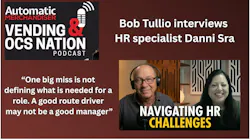
In a recent episode of Automatic Merchandiser’s Vending & OCS Nation podcast, human resources leader Danni Sra argued that the biggest HR risks are no longer isolated to the back office. They show up every day in route operations, frontline supervision and how consistently — or inconsistently — employees are managed in the field.
Sra’s experience is hard-earned. After working in operational roles, Sra focused on human resources, including more than 10 years at Gourmet Coffee in Los Angeles.
In convenience services, Sra says, early starts, physical work, customer demands and dispersed employees create a more complicated workplace than a traditional office setting. Her central message for operators is straightforward: if frontline managers are not equipped to lead well, even strong policies and good intentions will fall short.
Why HR deserves more operator attention right now
According to Sra, HR leaders and business owners today are dealing with a faster-moving workplace, where hiring, terminations, employee expectations and legal exposure all carry higher stakes.
Operators are not just balancing staffing shortages. They are also managing compliance risk, a fragmented culture and the challenge of leading employees who spend most of their day away from a central office.
Five questions to ask right now
- Are we hiring for fit, or just filling openings fast?
- Do frontline employees have clear expectations and consistent supervision?
- Are route workloads and schedules realistic enough to support retention?
- Have we reviewed wage-and-hour practices and employee classifications recently?
- Are our frontline managers strong enough to protect culture, retention and compliance?
That matters in convenience services because the workforce is dispersed, physically active and customer-facing. Route drivers, service technicians and other frontline employees work under schedule pressure and often with limited day-to-day contact from leadership. In that environment, communication gaps and inconsistent supervision can create both turnover problems and liability issues.
What are the five HR issues operators should be focused on?
There are five areas related to human resources that operators should focus on in 2026:
- Talent acquisition
- Retention and engagement
- Compliance
- Manager capability
- Communication and culture
Those issues are connected:
- Weak hiring creates turnover
- Weak managers hurt engagement
- Poor communication increases both operational friction and compliance risk
Among those five, compliance may carry the biggest financial downside. Sra notes that while turnover is painful and immediate, a single wage-and-hour problem or misclassification claim can end up costing more than the company’s total turnover. That is a useful reminder for operators who still view HR mainly as paperwork or payroll support.
Where are operators still getting hiring wrong?
Many small and mid-sized businesses still hire reactively instead of strategically, Sra says. They wait until there is a gap, rush to fill it and focus more on speed than fit. Then they are surprised when turnover stays high. Another common problem, Sra says, is trying to run too lean, which can reduce labor costs on paper but make a staffing loss much more disruptive.
You have to provide great customer service while doing physically demanding work — that combination makes hiring and retention much harder.
- Danni Sra
She also made an important distinction for operators promoting from within: a strong route driver is not automatically a strong manager. Defining what success looks like in each role, before the hiring or promotion decision, is critical. For operators, that means being more disciplined about role design, not just recruitment.
What actually improves retention?
Sra’s answer on retention was notably practical. She did not frame retention as a perks issue. Instead, she pointed to four basics: a good manager, clear expectations, fair and competitive pay, and employees feeling respected and heard. Most turnover, she said, is tied less to the company as a whole than to the employee’s day-to-day experience, especially with a direct supervisor.
For convenience services operators, that day-to-day experience also includes route manageability, schedule predictability, respect from leadership and open two-way communication from frontline leaders. Those factors are not soft issues. They affect whether an employee feels set up to succeed or set up to burn out.
Tune in to the podcast
How is Gen Z changing the management playbook?
Sra said younger employees are pushing companies toward more transparency, more frequent feedback and faster communication. They are less likely to accept “because I said so” leadership or vague expectations. In her view, that is forcing companies to strengthen their managers whether they are ready or not.
For operators, that does not mean overcomplicating management. It means spelling out expectations more clearly, coaching more consistently and giving frontline supervisors the tools to communicate in a more direct and timely way. Companies that adjust, Sra said, are likely to see stronger engagement over time.
What compliance risks are operators underestimating?
Sra highlighted three risks that can quietly grow in field-based operations: communication gaps, inconsistent management practices and a lack of visibility into what is really happening day to day. If supervisors are not communicating clearly, if expectations change from one day to the next or if no one is closely monitoring how work is being handled in the field, issues can compound before leadership even knows they exist.
Operator takeaways
- Stop hiring only when there is a crisis.
- Do not assume top performers will automatically become effective managers.
- Retention is shaped by the daily work experience, not just pay and perks.
- Frontline communication gaps can become compliance problems.
- Small audits now can prevent expensive claims later.
When does a business need more than outsourced HR support?
Sra’s answer was blunt: usually when something goes wrong, or when growth becomes more complex. Outsourcing can help with payroll or pieces of compliance, but not with leadership or culture. For operators expanding across states or cities, that distinction becomes more important because labor laws and management challenges become more complex as the footprint grows.
The bottom line for operators
If there is one takeaway operators should carry into the rest of 2026, it is Sra’s call to invest in frontline managers. In her view, they are the biggest driver of retention, culture and compliance. Operators can write strong policies, but policies do not manage people. Managers do.
About the Author
 Bob Tullio
Bob Tullio
Bob Tullio is a content specialist, speaker, sales trainer, consultant and contributing editor of Automatic Merchandiser and VendingMarketWatch.com. He advises entrepreneurs on how to build a successful business from the ground up. He specializes in helping suppliers connect with operators in the convenience services industry — coffee service, vending, micro markets and pantry service specifically. He can be reached at 818-261-1758 and [email protected]. Tullio welcomes your feedback.
Subscribe to Automatic Merchandiser’s new podcast, Vending & OCS Nation, which Tullio hosts. Each episode is designed to make your business more profitable.