Focused on luxury apartment buildings, Hunter Hebestreet built AI Vending from scratch
Key highlights
- How did Hunter Hebestreet grow AI Vending? He focused on one market — multifamily properties in Denver — and built accounts through direct outreach to property managers.
- Where does AI Vending place its smart coolers? The company targets high-traffic areas in apartment buildings, such as lobbies near elevators and primary exits.
- What does Hebestreet say new operators should expect? More rejection, more capital and more time than they may anticipate.
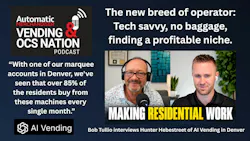




What happens when a successful healthcare technology salesperson decides that great money no longer makes up for burnout? For Hunter Hebestreet, it meant starting AI Vending from scratch and finding opportunity in Denver’s luxury apartment buildings. Today, his company operates 74 pieces of equipment across 45 locations.
On this episode of Automatic Merchandiser’s Vending & OCS Nation, host Bob Tullio talks with Hunter Hebestreet about building AI Vending with a focused sales strategy, earning the trust of property managers and securing equipment placement that turns foot traffic into smart cooler sales.
Hunter shares what is working with product selection, commissions, social media and financing. He explains why even an experienced salesperson had to get comfortable walking through doors, cold calling and hearing “no.” How did cold calling make him feel? “I was sick to my stomach — I was scared — and I just moved forward, and I did it scared,” he said.
Beyond the technology, Hunter’s story offers a candid look at the persistence required to build a convenience services business. He explains how focusing on one market helped his company sharpen its sales approach and earn opportunities across property portfolios. His advice for aspiring operators: Plan for more rejection, more capital and more time than you expect and find a strong business partner and suppliers to help you grow.
Miss an episode?
Listen to all past episodes of Vending & OCS Nation.
No time to listen? Prefer to read? Here is an edited podcast transcript:
Bob Tullio: What happens when an experienced healthcare technology salesperson takes a hard look at his career and decides that great money is no longer enough? For today’s guest on Automatic Merchandiser’s Vending & OCS Nation, that decision led to a new business and an opportunity in a location some convenience services operators might overlook: luxury apartment buildings.
Hunter Hebestreet. He built his Denver-based company, AI Vending, from the ground up: 74 pieces of equipment across 45 locations with a primary focus on multifamily residential properties.
This conversation goes well beyond smart coolers. We’ll explore how Hunter gets the attention of property managers, why equipment placement can make or break an account and what he’s learned about product selection, commissions and financing growth. And there’s an honest discussion about the transition from selling healthcare technology to prospecting, and walking through apartment building doors, introducing yourself, bearing gifts, but still hearing “No.” It’s a fresh approach from someone totally new to our industry, who’s making it work. Here’s my interview with Hunter Hebestreet.
You worked in enterprise sales, healthcare technology, before starting AI Vending. What led you to look at the vending business and say, “Hey, there’s opportunity here?”
Hunter Hebestreet: That’s right, Bob. I spent almost 10 years in sales. Most of that was in healthcare. There were a lot of highs. And, the last two years, I worked at the intersection of Silicon Valley, artificial intelligence and healthcare. I was the first sales hire and created the go-to-market strategy with the first organization that OpenAI ever invested in. And there were a lot of expectations. And I worked with the founders to create a go-to-market strategy to tackle the 200 largest health systems in the United States.
The money was great, but there were a few lows. I was working 70+ hours a week — not just at that job, at most of my healthcare career in the past 10 years. And I was burned out. Money was good, but it wasn’t worth it. What I learned was extremely valuable for what I do today, and that was learning how to fail, how to be uncomfortable, how to be relentless, just like Jon Corto said in a recent podcast with you.
Bob Tullio: I think it’s the word of the year. There’s no question about it.
Hunter Hebestreet: Absolutely. It’s a quality I see in this industry, and something that I think any entrepreneur needs to have. I needed to get out from my sales career, Bob, and I had a lot of bad bosses. I had a lot of operations teams that failed to get the job done. And it just wasn’t working for me.
I decided I was going to run my own company, and I didn’t have any good ideas. There was nothing original that I could come up with. Initially, I looked at acquiring some laundromats, and we ran our due diligence on a few here in Colorado. Met with distributors who built most of the laundromats in our state. And I found out that unless I could own three or more, I wasn’t making the money that I wanted. And there were usually not three or more good deals on the market every year. So, it was going to take a little bit too long to get to where I wanted.
Bob Tullio: That’s probably one of the closest businesses to a passive income — a laundromat. You really don’t have to move around a lot, that’s for sure.
Hunter Hebestreet: Yes. The only thing that would beat it would be parking lots. That is the final boss of passive income. Vending is more passive than what it used to be, but it is not.
Bob Tullio: So, you decided at a certain point: Too many hours, even though the money is great, I’m burning out, I’ve got to make a change of direction. And you ultimately ran into the vending business and saw an opportunity. Did you buy an existing business, or did you start from ground zero?
Hunter Hebestreet: No, this was all from ground zero. I spoke with one of my friends about other avenues aside from laundromats. And they told me that vending is a little bit like laundromats. You have these many assets in many different locations, and the problem to solve here for scaling is a sales problem.
I was tipped off to this more by Mike Hoffmann. I listened to one of his podcasts, and he talked about the ROI and the economics of these AI smart coolers, and that’s when it all clicked. That’s when I got really, really excited about this. So yeah, we went from zero, and now we have 74 pieces of equipment across 45 locations.
Bob Tullio: Fantastic. Now you’ve clearly gone to a niche approach from what I understand. Your primary focus is large residential, is that correct?
Hunter Hebestreet: That’s correct. We decided to go after multifamily in Denver for a few different reasons. The political environment in Colorado has been unique for multifamily, and it led to them overdeveloping some of these apartments in the past few years. There was a lot of green space. The prospecting process was more approachable than other environments. There’s an on-site team who has decision-making power or influential power to allow me to have a vending machine on site. I can connect with them.
More so, there’s the portfolio effect. If you land one of these locations, you can expand to many more. So, with green space, a big opportunity, we decided to go very deep right here, and we wanted to dominate one specific sector before we’re going to branch out and start working with other areas in the Denver market.
Bob Tullio: How big typically are these complexes?
Hunter Hebestreet: We typically go after a complex that is one building and has 150 units or more.
Bob Tullio: So, it was easy to find the locations. They were out there, they’re right in front of your face, right? The complexes are right out there. Internally, you’ve got two things you potentially deal with. One is a portfolio, and maybe a portfolio manager who’s calling the shots. But in many cases, it’s a single standing building, and there is a decision maker on the premises. And what you came in with, it sounds like, is the AI solution to dazzle them. What did you find in these locations?
Hunter Hebestreet: For most of them, there was nothing. We went after the most glamorous, the luxury buildings, where there weren’t micro markets or vending on site. Even in some of these Class C buildings where they might have vending, the AI coolers offered a better amenity and a better experience than some of the traditional machines.
And that’s not to say that traditional machines are going away anytime soon, but these AI coolers — they look beautiful. They’re a showpiece. If you have the best-looking equipment, you can put it in the most heavily foot-trafficked areas on a property and generate the most revenue.
Bob Tullio: Who is your leading technology partner from an AI cooler standpoint? Do you deal with one exclusively?
Hunter Hebestreet: We decided to go with Micromart. Everything is North American-built. They’re a software-first company. They have been a fantastic technology partner. Not everything is going to be perfect with anyone, but they have a team that shows up, and they help us make things right. I couldn’t have imagined this journey with anyone else.
Bob Tullio: Wow, that’s great. How many workplaces do you serve?
Hunter Hebestreet: We only have two offices, and we have two warehouses. The warehouses are Warespace. They’ve also been a fantastic partner. We’re expanding to our third unit in North Denver later this month because we outgrew the previous two. But we found that there is the strongest ROI with luxury apartments to date.
Bob Tullio: How does the product selection differ from a workplace as opposed to a luxury apartment?
Hunter Hebestreet: For us, this stone has mostly been left unturned. We haven’t optimized our products. We’ve created a very good sales engine at acquiring new accounts. We have dabbled into more fresh food with our two office locations, and it has resonated.
Bob Tullio: What about residential? What’s the product selection driven by?
Hunter Hebestreet: We want things that are familiar, and that’s going to generate 70% of our sales. Coke, Pepsi, Dr. Pepper, Twix and Snickers. But we also want things that are very unique and intriguing. And I think that attracts people to the coolers, but we found that those don’t tend to generate as much ROI for us to date. And we’re still trying to fine-tune in that area.
I don’t think our product selection is always the best, but we are starting to partner with more unique, healthy Colorado brands. And we’re seeing how those are going to do in the next few months.
Bob Tullio: Do you feel like the purchases that are occurring in these residential spaces are impulse purchases? Shortage-related? I mean, are you dabbling in things like milk, soap, any of those types of products? Or are you strictly beverage and snack products?
Hunter Hebestreet: Beverage, snack, some microwavable meals. We’ve tried perishables, and they are less than 1% of sales consistently. So, we avoid those altogether today.
These are impulse purchases. People are not necessarily thoughtful and going to go to a bad location in an apartment so that they could find some of these goods.
We need to make sure that we’re aggressive and thoughtful about finding the best location in the building, that has the most foot traffic, because it is impulse purchases that drive those. To date, I’d say 20% of all of our clients, we’re paying for new electrical work to be done just so we can install our Micromarts in the best location in the building, because the ROI will pay off in the long run.
Bob Tullio: What is the best location in the building typically look like?
Hunter Hebestreet: It’s always going to be wherever we have the most foot traffic. Typically, that’s going to be in the lobby next to a primary exit or next to a primary elevator, where we have a lot of foot traffic, but then also loitering.
Bob Tullio: So that really makes the aesthetics of the machine critically important.
Hunter Hebestreet: Yes. For these beautiful apartments, we couldn’t put these amazing machines there unless they looked fantastic. And we have replaced a lot of traditional machines. We’ve replaced other AI machines that look good, but with Micromart, we have the best-looking machines, and the service level is going to be the same. Ours is always excellent. I don’t see anyone replacing us.
Bob Tullio: I know it’s easy—easier, most people say, buying an existing company, having immediate cash flow, dipping your toe in the water in an entirely different way because the revenue’s coming right in, typically learning some lessons from the prior owner of the company. But, do you feel like in many ways, it was an advantage for you to start from ground zero in the sense that there’s no baggage, there’s no equipment on the shelf that you’re worried about placing, that sort of thought process?
Hunter Hebestreet: Initially, I thought I was going to acquire a company. I think that that’s the best option for most people for all the reasons that you mentioned. But, we couldn’t find something that was a good deal, was exciting and would give us the staying power that we were looking for.
AI coolers are very new in this industry, even more so in Denver. So, my unfair advantage starting this business was spending 10 years learning how to do sales, learning to be okay being uncomfortable, being told “No” 100 times and still being okay moving forward, and having the tenacity and relentlessness.
Bob Tullio: Is there really enough residential business in Denver to build this company dramatically?
Hunter Hebestreet: Based on our research earlier this year, we’ve found 370 different complexes that we could work with. We’re only in 45 today. So, we can continue to scale in this sector aggressively. We recently started working with developers, so that we can identify the best space before they bring any residents in. But, for where we want to take AI Vending, this is not enough. There is more money to be made if we go into recreation centers, universities, warehousing, manufacturing and offices. So that’s where we see ourselves evolving into.
Bob Tullio: So you truly see your company strictly working with smart coolers along the way. You don’t really see yourself ever operating vending equipment.
Hunter Hebestreet: I think vending is here to stay. I think that’s great traditional machines. Cash isn’t going away, but this is not for me.
While we do love AI coolers, micro markets are going to be the best asset for many of these other locations. Warehousing, manufacturing, offices and some of these apartments that we’ll be getting into in the near future. We’re installing our first micro market down in Colorado Springs in December.
Bob Tullio: You were happy to not have any of the theft issues, and you just can’t get away from it. You decided you want to try a traditional micro market.
Hunter Hebestreet: Yes, and I have learned from many other experts in the field how I can mitigate some of the theft. Can’t eliminate it completely, but we do expect the basket size to be bigger with some of those. In a workplace, we can end up mitigating more theft than I think we could in most luxury apartments.
Bob Tullio: When you get in front of a decision maker at a luxury residential community, is the priority the amenity itself? The potential commission and revenue that might come from it? What is the priority?
Hunter Hebestreet: I’ve had trouble getting an organization to prioritize this. And multifamily, this is the bottom priority for them. When we’ve tried convincing them of the financial ROI, and there’s many studies to prove this from GrayStar, they don’t believe it, and we get laughed at.
We’ve learned to be very creative with our follow-up, to become their friends, to understand the big picture. And today, we’ve created multiple case studies showing how often these amenities get used.
With one of our marquee accounts in Denver, we’ve seen that over 85% of the residents buy from these machines every single month. Over 16% of them bought from these machines 10+ times in the past month. When they see that this is going to be the most popular amenity that they have, and they trust the person serving it, that’s when we can get this prioritized.
Bob Tullio: I guess my main question is: Is there any way for you to avoid paying a commission?
Hunter Hebestreet: We almost always pay a commission.
Bob Tullio: That’s tragic, but I understand it. I mean, these property manager people, they’re not going to give up real estate for nothing. They’re going to want a little piece of that real estate that you’re taking up, and I fully get that.
Does the pricing structure then reflect it? I mean, do you put that option on the table? “If you go no commission, I can offer this pricing, but if you have to have a commission, it’s right on top.”
Hunter Hebestreet: When we’ve tried doing that, we’ve lost deals. We start out the bat with a commission, and we make less money on every account. But we get expanded into far more accounts than anyone else in our market.
The tuition you will pay for success in this industry is: more rejection than you would anticipate, more financial capital than you might have prepared for, and a lot more time than you expect.
- Hunter Hebestreet
Hunter Hebestreet: Yeah, that’s reasonable. For our average individual cabinet, we’re doing around $1,500. So, with about 74, 75 pieces of equipment today, we’re just past $1.3 million. For most of our locations, we’re trying to put two or three pieces of equipment in place. So $2,000 easily done. For most locations, we’re trying to get closer to $3,000. Our highest is doing $7,000 right now every month.
Bob Tullio: Now, you really didn’t know when you went into a residential location, you had no clue, you didn’t have true revenue figures. And in many cases, these places had nothing at all. Were you surprised at the reaction and the amount of usage?
Hunter Hebestreet: No, I don’t think that we were terribly surprised. Another one of the reasons that we went into multifamily is we saw success with many others online in very similar markets. And it seemed to be fairly predictable revenue. As long as we had the best location in the building, we ended up getting what we expected.
Bob Tullio: To what extent are you using social media to tell the story of your company to people that are prospective customers?
Hunter Hebestreet: When I went to NAMA in 2024, one of the most influential figures I met was Josh Rosenberg. And he told me, and an entire room, that when you’re starting a business, before you even have your first machine, you need to make sure that you are prepared to put your face on social media, tell people who you are, what you’re doing, and when you win an account, you need to show them.
So, when I brought on my business partner, who’s also my brother-in-law, he helped me find that voice, and he’s been the mastermind behind all of our social media. This has really taken us to the next level. It’s been a major unlock, and we’re not just talking about it online. We’re showing people who we are, how we show up, and it pays dividends.
Bob Tullio: The great thing is too, the industry that you’re after is pretty narrow. You’re not shooting it out to every office manager in the world. You’re focused on a specific area. Do you see other niche directions that your company might be going down the line?
Hunter Hebestreet: When we started this business, we didn’t want to have a broad swath of different location types that we were going after. I was heavily inspired by Peter Thiel. This podcast he gave was “How to start a startup.” His episode was “Competition Is for Losers,” and he was reminiscing about his days at PayPal. They wanted to dominate a very specific niche sector, and it just served them excellently before they expanded into anywhere else. So, while we could have gone anywhere else, we just wanted to start with apartments on Day One and become excellent. The obvious choice for all of Colorado, and I think we’ve become that. We’re going to do that for another sector sometime soon.
Bob Tullio: What do you think was the biggest stumble along the way as you got started? Biggest mistake you made that you learned from but obviously recovered from?
Hunter Hebestreet: Two big mistakes. Early on, I thought that I could use the technology that augmented my sales process in healthcare to guide me with what I’m doing in multifamily and vending. And that just wasn’t the case.
This wasn’t virtual selling. This wasn’t using a lot of technology. This was creating a flyer, walking in, introducing myself, and even bringing them a ton of gifts. Very uncomfortable at first, but we had to become good at it to end up acquiring a lot of these accounts.
The other mistake that we’ve made is not getting creative enough with our financing. We’ve partnered with Huntington Bank for an SBA loan, and that will be funding the next level of our growth. That’s something that I should have done a lot sooner. The cheapest money that we can get is going to be from a bank rather than anywhere else.
Bob Tullio: Let’s talk about capitalization. So, you learned the lesson of how important it is to be capitalized. Talk to me about that. What should operators who are starting out be thinking about in terms of what their capital needs are, relative to what they probably think they are?
Hunter Hebestreet: I liquidated a lot of my own investments to take care of what we were doing. We were creative and took out seven different 0% APR credit cards over various periods of time to fund a lot of our growth. And that’s been fantastic. We’ve worked with our manufacturer to get very low interest leasing rates and financing.
But ultimately, I should have spoken with a bank a lot sooner so that we can start planning for the future. And that is what I would recommend for any new entrepreneurs getting into this.
Bob Tullio: Guerrilla financing. I like that, Hunter. That’s good. Hitting those credit cards with 0%. Very impressive.
Hunter Hebestreet: They’ve been fantastic.
Bob Tullio: Good for you. I love it. That’s passion. So, if a 30-year-old entrepreneur called tomorrow and said, “Hunter, I’m thinking about getting into vending and unattended retail,” what would your advice be?
Hunter Hebestreet: The tuition you will pay for success in this industry is: more rejection than you would anticipate, more financial capital than you might have prepared for, and a lot more time than you expect.
The operations are simple. This is not passive unless you design it to be when you reach a certain level of scale. But for me, this has been easier than what I did in my career. The operations are very simple.
If you end up doing this, don’t go alone. I have a business partner, my brother-in-law. I couldn’t do it without him. Buy good equipment and don’t get the cheap bargain stuff.
Bob Tullio: I want to go back to something you said I thought was interesting. So, you said that you were a little uncomfortable. It was out of your comfort zone from a selling standpoint, that in your days selling healthcare, it was more virtual selling.
Hunter Hebestreet: Yeah, a lot of the prospecting would be done virtually. It would be done at trade shows. It would be done over dinner tables. We’d collaborate with health systems to solve some of the biggest problems that they had. It’s been a very different avenue than what we’ve done here in multifamily with vending.
We’ve borrowed from part of that, and we now go to a lot of trade shows, and that’s been very successful for us, but our bread and butter has been more kind of walking in, introducing ourselves, bringing a lot of gifts and making friends with the property management team.
Bob Tullio: So, you really moved into a direct hunter role, which was something you were not necessarily accustomed to. One way or another in the healthcare business, they were coming into the room to you, and now it was very much a hunter role. That’s quite an adjustment probably for a lot of people who go into this business.
Hunter Hebestreet: Yeah, I was sick to my stomach making that transition. I was scared. And I just moved forward, and I did it scared.
Bob Tullio: Now it’s like second nature to you.
Hunter Hebestreet: It’s become easier, and sometimes I’m still a little nervous, but I’m okay being nervous, and we keep on going.
Bob Tullio: I love it. So I guess the big question is, compared to when you were in the healthcare industry, selling products in that industry, are you a little calmer these days and are you a little more relaxed? Is it a better lifestyle?
Hunter Hebestreet: Yes, this has been easier. This has been more calm, but there was a lot of hard work that went into this. It’s been more fun. I will never go back to working for anyone else again.
About the Author
 Bob Tullio
Bob Tullio
Bob Tullio is a content specialist, speaker, sales trainer, consultant and contributing editor of Automatic Merchandiser and VendingMarketWatch.com. He advises entrepreneurs on how to build a successful business from the ground up. He specializes in helping suppliers connect with operators in the convenience services industry — coffee service, vending, micro markets and pantry service specifically. He can be reached at 818-261-1758 and [email protected]. Tullio welcomes your feedback.
Subscribe to Automatic Merchandiser’s new podcast, Vending & OCS Nation, which Tullio hosts. Each episode is designed to make your business more profitable.