Christine Cochran on CTW and NAMA's support of OCS
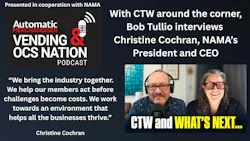




The workplace has changed, but the demand for dependable coffee, water, food and refreshment services remains strong. In this episode of Automatic Merchandiser’s Vending & OCS Nation podcast, presented in cooperation with NAMA, host Bob Tullio welcomes Christine Cochran, NAMA’s president and CEO, to discuss the opportunities ahead for OCS and pantry service operators.
Nearly a year into her role, Cochran shares what she’s learned from visiting member businesses nationwide. She discusses how operators are responding to changing customer expectations, rising costs and new technology — and why their ability to deliver personalized service remains so valuable.
The conversation also previews the 2026 Coffee, Tea and Water event, November 18-19 in Austin, Texas, where Tullio returns as emcee. Cochran highlights education focused on sales, executive leadership and operators new to pantry service along with the value of connecting with peers and suppliers in a more intimate setting.
With CTW not taking place in 2027, Cochran explains the thinking behind that decision and outlines NAMA’s plans to support the OCS and pantry community throughout the year. She also discusses advocacy work involving tariffs, PFAS, single-use plastics and caffeine labeling and why association involvement can help busy operators stay informed and prepared.
Miss an episode?
Listen to all past episodes of Vending & OCS Nation.
No time to listen? Prefer to read? Here is an edited podcast transcript:
Bob Tullio: On this episode of Automatic Merchandiser’s Vending & OCS Nation podcast, presented in cooperation with NAMA, I sat down with Christine Cochran, president and CEO of NAMA, to talk about an industry that continues to evolve and the opportunities ahead for OCS and pantry service operators.
Nearly one year into her leadership role, Christine has been out meeting members, visiting their businesses and listening to their concerns. She shares what she’s learned about the changing workplace, the entrepreneurial spirit of our industry and the value NAMA delivers through education, connections and advocacy.
We also look ahead to the CTW, Coffee, Tea and Water, November 18th and 19th in Austin, Texas, where I’m excited to return as emcee. From stronger sales strategies to a learning journey designed for operators due to pantry service, there talk about and plenty to bring back to your business after you attend the CTW. And we address an important question: With CTW not taking place in 2027, what comes next for NAMA’s support of the OCS and pantry community? Christine explains the decision and the direction ahead. Here’s my conversation with Christine Cochran.
Bob Tullio: One year on the job just about. Has it been everything you expected it would be?
Christine Cochran: Absolutely. It’s been a fabulous first year. I’m actually really excited to go back to CTW because I visited last year. So, it’s going to be fun for this to be my official first CTW, but my second go-around for me.
Bob Tullio: How exciting was the NAMA Show for you? It was your first NAMA Show. What was the impression that it left on you?
Christine Cochran: There’s this photograph that was taken of Kristen [Griffith] and I standing upstairs looking down on the show. And I really love that photograph because I remember that moment so vividly of standing up there, seeing the floor all come together, but it’s still empty of participants. And so, for me, it was a real moment to see the size and scale of not just the show, but the industry, really seeing all the different parts that were showing up, you know, and exhibiting. And then, as we watched the attendees flood the floor, like that too was just really, really exciting. I learned so much, and I had an opportunity to meet so many people that I really, really enjoyed my time in Los Angeles.
Bob Tullio: The industry has changed so much, and you’re coming on board at a time where technology is taking over in every facet of it. We have all kinds of new people coming in. I spoke today to a gentleman who was just starting up in Baltimore, and just realized that NAMA is something he needs to be involved in. He’s very excited about the first NAMA Show that he’s going to go to because he’s hungry for knowledge about the industry. He’s an AI cooler guy who’s just loving this industry, as there’s a lot of newcomers coming in embracing that technology. technology. So, the industry’s changed. NAMA itself, as an organization, has changed. Describe NAMA to me as it is today for listeners who aren’t familiar with it.
Christine Cochran: Thank you for asking that question because I actually think that really cuts to the heart of folks who are on the fence about joining NAMA, right? Like, as you say, just really understanding what it does. And the people who join, they have a deep appreciation of its value.
So, let me explain to you what NAMA does. Our job is fairly straightforward: We bring the industry together. We help our members act before challenges become costs, and we work towards an environment that helps all the businesses thrive.
So, let me decode that a little bit for you, right? What does that mean: We help the environment so all businesses thrive? Well, NAMA runs a fairly sophisticated advocacy program. We’re operating at the federal, state, and local levels to ensure that regulations and laws are fair and foster an environment that allow folks to thrive, whether they are starting or they’ve been around for generations. Like we are making sure that the business environment is positive for us. Whether you have AI coolers, you’re running micro markets, you’re doing pantry service, right? Like we’re trying to create that environment where all of these businesses can thrive.
But the other part about that — that I said was like — we really bring people together, and I don’t want to overlook that. That convening function is so, so important. And we learned in our surveys at the NAMA Show, it’s the No. 1 reason people come. They come to network and meet people and build relationships. So, if you’ve got a couple of coolers and you need some help, you know who to text or call, and get advice and counsel as you work to build out your business. Or, if you’re more established, you’re benchmarking yourself against others, learning different things. So, that relationship building only happens when we come together at places like the NAMA Show or CTW.
Bob Tullio: What themes, challenges, opportunities, statuses of business, are you hearing as you talk to members?
Christine Cochran: Yeah, so it’s my first year, and I spent most of that time really trying to get out and meet with our members, right? And see them in their workplaces, see their clients, interact and learn about the business. And Kristen Griffith on our team, who’s the SVP of member experience, she did a really good job helping me travel to different regions in the country, both urban and rural, big and small, really trying to get a nice sample. Now, obviously, I’m gonna keep doing this year over year, but in this first year, it’s been really great to meet with people and get a better grip on the industry and the challenges that it’s facing.
I would say one of the things I’m learning, especially in OCS and pantry, is just how central they are to helping employers create workplaces that help people stay productive, feel supported, connected and hopefully retained, right? And so, I think that is a really big theme, especially in 2026 and kind of looking forward. It’s creating those environments that are really hospitable for the employer, and we’re central for that.
The other thing we know is, and I’m learning as well as we go through this, is that workplace has changed, but the need has not. People still really value dependable coffee, water, food, refreshment services that just make their day easier. So yeah, we have new environments, we have new challenges, but the services are still very much valued.
Bob Tullio: On the OCS and pantry side, do you feel like operators are adapting to the changing workplace?
Christine Cochran: I do. And one question that I get is, why did you choose to come to NAMA? And one of the reasons I chose to come to NAMA was the entrepreneurship. And I think we really see it in the OCS and pantry space. Operators are incredibly ingenious, and they love solving problems. And so, what I really see them doing, right now, is adapting to a lot of new client expectations, but they’re also managing their business, right? So they’re adapting to the rising costs of products that we provide, but also the pressures that come with labor. And then you mentioned it earlier, the technology changing, and then the evolving footprint that they have in the workplace. There’s lots of things that they’re having to adapt to, and they’re all doing it in a way that is just, it’s really insightful and it’s not cookie-cutter. They’re responding to their clients’ needs in a way that services those clients.
Bob Tullio: What role does NAMA play in helping OCS and pantry operators navigate those changes?
Christine Cochran: Well, like I said, like our job is to bring people together, and it is to build relationships, but also by being a part of NAMA, what we work really hard to do day in and day out is ensure that our members have insights so they understand what’s coming before it comes. That’s a big part of what we do. We foster those connections so that you build not only relationships in the world of friendships, but also in terms of business. You’re able to make connections, you’re able to find service providers that you need, mentors that you may need, peers, all of that through NAMA. And then, as I said, that advocacy support that we provide, which is something most folks cannot do on their own.
Bob Tullio: CTW is coming up November 18th and 19th in Austin. I am personally very excited about that as I’m going to be acting as the emcee. And again, and you managed to get me back and I’m very excited about that. How about you? What are you most excited about and what can the attendees expect?
Christine Cochran: Well, Bob, thank you for asking that because I’m just going to just take the microphone from you for a second. And I really want to plug CTW. It is an event that’s designed specifically for OCS and pantry. Its value is in that concentrated access to peers, suppliers, ideas, business conversations. They’re all difficult to replicate in just day-to-day operating environment.
The workplace has changed, but the need has not. People still really value dependable coffee, water, food, refreshment services that just make their day easier.
- Christine Cochran
So, the word there I really want to emphasize is concentrate, right? Like we talked about the NAMA Show. The NAMA Show is big. It draws in 5,000 folks. CTW is not that. It’s much more intimate. Your ability to interact with people is not competitive, right? You’re going to have time and space to meet with all the people that you need to. And hopefully when you leave CTW, you leave with a real sense of satisfaction that you were able to make all those connections. And I think that that’s really, really important.
Our intent with the event is to create useful exchange. So what’s working, what clients are asking for, where technology is headed, how operators can build stronger relationships, all of that. And obviously you’re returning. And so, you really understand the community. You know the value that’s there.
There are a couple of highlights that I would call out beyond just the general value of attendance for the industry. And that is Nicole Cramer. I know we were talking about her before we actually started recording, but we’re really excited to have her. She comes directly from our industry, and she was twice ranked the No. 1 salesperson at a large operator.
So, her session is going to focus on moving away from product-focused pitches towards consultative relationship-driven selling. So, I think attendees will get a lot out of that with her.
We also have Learning Journeys. CTW has three focused tracks this year — Sales being one of them — but also Executive Leadership and New to Pantry Services. So, for folks who are just starting out, I think it’s really important that they have a special track. These sessions are, as you know Bob, from last year, they are designed to be peer-to-peer exchanges and also for everyone, when they walk out of the room, to really have a practical to-do list that they can take back to their business.
Let me emphasize a little bit around that New to Pantry Services. This is really relevant for unattended retail operators who are looking to add OCS to their business to increase their revenue. We see it as a very strong area for our industry, so we want to foster that again and help businesses grow in directions that benefit them.
Bob Tullio: The No. 1 area of free advice that I’ve been dispensing lately when people call me and want free advice, they ask me, “How do I get into the pantry service? how do I do this?” And I say, I recommend your first step should be CTW. But of course, that said, NAMA has announced that CTW will not take place in 2027. What led to that decision, and what does the future of NAMA’s support for the OCS and pantry community look like?
Christine Cochran: So, we’re really looking forward to CTW in 2026. The numbers are really strong. As we talked about, the education is really strong as well. So we think it’s actually going to be a really fabulous show in Austin later in November.
The reason we are pivoting in 2027 is because it’s actually what our members asked for. Our members at NAMA are wonderful, and they’re very direct in telling us what they need, and what they need has evolved a little bit. And so what you’re going to see is new programming taking shape around the way operators actually do their business today. The decision not to hold CTW reflects that feedback and that members — what they really are looking for is more relevant, timely value throughout the year. What you’re going to see is CTW branding press across the entire year. We view this more as an evolution of support, not a step back from OCS, but rather a leaning in. So elevated exposure and focus at the NAMA Show, newsletters, emphasis on all the advocacy work that we’re doing on behalf of OCS and pantry. These are types of things you’re going to see unfold in 2027.
Bob Tullio: Let’s talk about advocacy because that’s a big part of NAMA’s work that members may not always see. What are some of the issues NAMA is working on right now that could affect OCS and pantry business?
Christine Cochran: Advocacy is one of the real strengths of NAMA. And so, I would want your listeners really to understand that NAMA works to protect their ability to operate, innovate and serve their customers. But what a lot of folks in OCS and pantry don’t fully appreciate is some of that work that we’re doing on their behalf. So I’m going to kind of go through a list of topics that we — as just a course of business — are advocating for them on. And the first one is tariffs, which have been particularly active over the last couple of years. We also are engaged in PFAS and the efforts to remove PFAS, which has a lot of implications for coffee in particular. Single-use plastic, NAMA continues to track, and we alert folks on restrictions. Again, like I said, at the local, state and federal level when it comes to single use plastics, another very hot topic in the advocacy space. But we also work on things like caffeine labeling, which folks may not be aware of. So, NAMA maintains a close relationship with FDA, and we work hard again to advocate when it comes to some of the caffeine labeling regulations.
Bob Tullio: Why is now a good time to be part of the association and the broader industry community?
Christine Cochran: Running your own business is hard. The demands on your time can, at times, feel overwhelming. And as you mentioned earlier in our conversation, the pace of it isn’t slowing down. The pace of change is only accelerating. And so, what I have found in my first year at NAMA is that as the pace of change continues to accelerate, our members appreciate their membership because they’re working to navigate all of those changes, whether it’s workplace changes, technology changes, policy changes, labor changes, cost changes, like the list goes on and on of what the changes could be.
But they come to NAMA and it’s like a hack. They’re able to, in a very short period of time, get up to speed on all the things that they’re going to need for the next quarter, the next six months. So yeah, it takes time out of your schedule to maybe attend an event or participate in a webinar, but when they do it, they walk away and they’re like, “Oh, that was actually a really good use of my time. I was able to do these 10 things that otherwise I wouldn’t be able to do.” And so, I think that sort of practical intelligence that you get is really the reason for joining. Just like I said, it’s a hack for running your business and getting yourself in the best position that you can be.
Bob Tullio: And you’re right, things are moving quickly. Last year’s show, we had a speaker named Ethan King who was up there, and he was talking about AI, and you would think people had tasted ice cream for the first time —the way they were reacting to it. That was just November, for God’s sake. Look where we’ve gone with AI since November. We are moving like a locomotive. And looking at that, what do you see as the future of the industry over the next year? What’s your outlook?
Christine Cochran: Very optimistic. Because what I do see is people, they’re curious about those technology changes, they’re adopting them, they’re integrating them, they’re figuring out how it can help them.
But the other thing that I see is this really leaning in on that customized service. What does someone need from me and how can I provide that?
So, I’m incredibly optimistic, but I agree with you: Things are changing. How we’re running our businesses. I think you’re going to start to see efficiencies come in through technology adoption. But I also think you’re going to see the other piece of the business in service: really elevating the level of service and what service looks like and feels like for the client continuing to evolve as well. So it’s an exciting time to be part of the industry.
Bob Tullio: Christine, thank you so much for joining me, and I really look forward to catching up with you at the CTW on the 18th and 19th of November in Austin, Texas.
Christine Cochran: Can’t wait, Bob. It’s going to be great.
About the Author
 Bob Tullio
Bob Tullio is a content specialist, speaker, sales trainer, consultant and contributing editor of Automatic Merchandiser and VendingMarketWatch.com. He advises entrepreneurs on how to build a successful business from the ground up. He specializes in helping suppliers connect with operators in the convenience services industry — coffee service, vending, micro markets and pantry service specifically. He can be reached at 818-261-1758 and [email protected]. Tullio welcomes your feedback.
Subscribe to Automatic Merchandiser’s new podcast, Vending & OCS Nation, which Tullio hosts. Each episode is designed to make your business more profitable.