Why customer relationships still matter in an unattended retail business
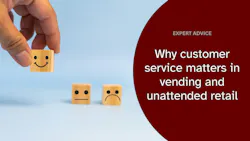
Micro markets, smart coolers and vending machines are designed to serve customers without an employee at the point of sale. But for convenience services operators, delivering a positive customer experience still depends on the people behind the equipment.
That distinction is at the heart of advice from Marty Cooper, a veteran communications strategist who began his career at Disneyland in 1963 and worked directly with Walt Disney.
On a recent episode of Automatic Merchandiser’s Vending & OCS Nation podcast, hosted by Bob Tullio, Cooper shared career lessons on customer relationships, employee training and the small interactions that shape how people perceive a business.
His central message: Customer service should be about more than completing a transaction. “We never talked about transactions. We’ve always talked about relationships,” Cooper said, recalling Disneyland’s approach to its visitors.
Customer service training shouldn’t end with onboarding
One of Cooper’s strongest lessons concerns how companies prepare employees to represent their businesses.
At Disneyland, employees were called cast members and trained to recognize that they represented the organization whenever they worked in the park.
Cooper recalled that Disneyland established an internal training program that reinforced those expectations throughout an employee’s tenure. “And that’s a key part, the retraining part,” he said.
Cooper believes many organizations assume that once employees complete onboarding, their training is finished. Instead, he argues, companies need to revisit expectations and reinforce the behaviors that contribute to a positive customer experience.
For convenience services operators, the lesson extends beyond sales representatives and account managers. Route drivers, technicians and other employees who visit customer locations also represent the business. They may stock machines, maintain equipment or resolve service issues, but their interactions also shape how the operator is perceived.
Small interactions shape the customer experience
Cooper talked about the importance of everyday interactions by sharing his experience at a bakery. He entered the store to order a cake and found four employees working behind the counter. Although he waited only about 90 seconds before someone offered assistance, none of the employees initially acknowledged his presence. The experience left him with a negative impression of the business.
“That’s such a little thing to acknowledge people’s presence, but it’s so important to people,” Cooper said.
His point was not that customers should expect immediate service in every situation. Rather, a simple acknowledgment can make a difference even when an employee is busy.
For convenience services personnel, whether they are handling a service request, discussing a recurring problem or making a routine delivery, how employees communicate can influence the customer’s impression of the company.
Listen to what customers actually want
Cooper also stressed the importance of listening before attempting to sell a product or service. He recalled advice from his father, who told him that speaking lets you repeat what you already know, while listening gives you a chance to learn something new.
“Listening is often more important than talking,” Cooper said.
For operators, that principle has applications beyond the initial sales call. For example, a customer considering a micro market may have priorities beyond the equipment or products being proposed. Understanding what the location wants to accomplish helps an operator evaluate which services are appropriate and how to deliver them.
The same applies to existing accounts. Conversations about changing workplace needs, employee preferences and service concerns can provide information that would not necessarily emerge from sales reports or equipment performance data alone.
Make the relationship personal
Cooper believes that establishing a personal connection is an important part of doing business. He recalled an assistant observing that he rarely began a business call or meeting by immediately discussing the work at hand. Instead, he typically started with something personal.
“I always try to create a connection before I do business,” Cooper said.
That approach matters especially for operators whose relationships with customer locations continue long after the initial sale. Equipment installations, product deliveries, and service visits are recurring opportunities for contact, but those interactions don't automatically build stronger relationships.
Cooper's advice emphasizes showing interest in the people behind an account, understanding their concerns and demonstrating that the relationship extends beyond the next order or service call. He also encouraged businesses to look for small ways to exceed expectations.
The human side of unattended retail
Technology can facilitate purchasing, but it does not replace the need to listen to customers, communicate effectively or prepare employees to represent the business.
For operators, the opportunity is to apply those principles consistently — through recurring employee training, attention to everyday interactions and a willingness to understand what customers value.

About the Author
 Bob Tullio
Bob Tullio is a content specialist, speaker, sales trainer, consultant and contributing editor of Automatic Merchandiser and VendingMarketWatch.com. He advises entrepreneurs on how to build a successful business from the ground up. He specializes in helping suppliers connect with operators in the convenience services industry — coffee service, vending, micro markets and pantry service specifically. He can be reached at 818-261-1758 and [email protected]. Tullio welcomes your feedback.
Subscribe to Automatic Merchandiser’s new podcast, Vending & OCS Nation, which Tullio hosts. Each episode is designed to make your business more profitable.