What Walt Disney can teach convenience services operators about customer experience
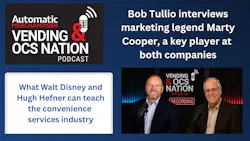




During this episode of Automatic Merchandiser’s Vending & OCS Nation, Bob Tullio sits down with communications strategist, author and public relations pioneer Marty Cooper, whose remarkable career includes working directly with Walt Disney at Disneyland, Hugh Hefner at Playboy, the Academy Awards and some of America’s most recognizable brands.
But this isn’t a conversation about nostalgia. It’s a masterclass in customer experience, relationship-building, leadership, philanthropy and the timeless principles that help businesses earn loyal customers and achieve lasting success.
Whether you operate vending, micro markets, office coffee service or any customer-focused business, you’ll find practical lessons that can immediately improve the way you serve customers and grow your business.
Lessons to be learned:
- Why Walt Disney insisted there was only one “Mr.” at Disneyland — and the leadership lesson behind it.
- How Disney created customer loyalty by treating every customer as a guest.
- The importance of building relationships instead of simply completing transactions.
- Why the smallest customer interactions often create the biggest impressions.
- The power of giving customers “a little more than they expected.”
- How remembering names and creating personal connections separates great businesses from average ones.
- Why listening is one of the most underrated sales skills.
- What Playboy magazine’s marketing strategy can teach businesses about understanding their audience.
- How Hollywood’s early pioneers built successful companies by continually seeking new opportunities.
- Why philanthropy isn’t just good for the community: it’s good for business.
- The biggest professional mistake Marty ever made (very amusing) and the valuable lesson it taught him.
Cooper’s newest book, “The ‘Reel’ Hollywood: The San Fernando Valley,” explores a century of filmmaking and filmmakers as well as the rich history of the people and places that shaped the entertainment industry. All profits from the sale of the book go to the Boys & Girls Club of the West Valley, of which Cooper is chairman emeritus.

Miss an episode?
Listen to all past episodes of Vending & OCS Nation.
No time to listen? Prefer to read? Here is an edited podcast transcript:
Bob Tullio: If you are a regular listener, then you know that once in a while, I like to step outside the convenience services industry and interview fascinating people who bring us insights we can use.
On this episode of Automatic Merchandiser’s Vending & OCS Nation, I interview Marty Cooper, who has spent decades helping organizations communicate, persuade and build relationships. He worked at Disneyland, Playboy and founded a successful communications firm. As it turns out, the lessons he learned from people like Walt Disney himself may be exactly what our industry needs right now.
A couple of other things about Martin Cooper. He’s an accomplished author. In fact, his latest book, “The ‘Reel’ Hollywood: The San Fernando Valley,” was just recently released. And as you will hear, he is a storyteller, and every story has a message — a valuable lesson to be learned — which is a big reason why he is a guest on this show.
Bob Tullio: Marty, my audience doesn’t know you from a hill of beans, so probably a good idea to learn a little bit about your journey. How did you end up in the PR business, communications, marketing? Where did that come from?
Marty Cooper: Actually, when I was at UCLA, my expectation was that I would go into the newspaper business. I wanted to be a crusading reporter to solve all the world’s ills. And I had a professor in my last semester at UCLA who said, “I’ve got a good friend who’s the director of marketing at Disneyland. I’d like you to go chat with him.”
So, I went and met with him, and he asked me to come back a second time. I’m still in UCLA at this point, a senior. And they offered me a job —and the Los Angeles Times had offered me a job also as a reporter — for $92 a week, I would add —
Bob Tullio: Wow.
Marty Cooper: Disneyland seemed like it would be fun. That was how I got started. And instead of going into the newspaper business — journalism — I wound up in advertising, marketing and PR.
Bob Tullio: Give me a date perspective as to when you went on board with Disneyland.
Marty Cooper: My last final at UCLA was a Saturday-morning geology class that I had to take to graduate: June 1, 1963.
And Monday morning, I put on a glen plaid suit and went out to Disneyland. So, my first day there was June 3, 1963.
I’d been working there about a week, and I’m sitting in the office of the director of marketing with the door shut. There’s a little knock on the door, and the door opens, and in walks the most famous man in the world, Walt Disney. My boss says, “Walt, I want you to meet Marty Cooper, who just joined us right out of UCLA.” And I stand up and I stuck out my hand and said, “It’s a pleasure to meet you, Mr. Disney.” And Walt’s hand was glued firmly to his side. And I’m thinking, “Oh my God, what have I done wrong?”
Now remember, I’m probably 22 years old. Walt finally shakes my hand and says, “Marty, it’s Walt, not Mr. Disney. Around here, the only Mr. is Mr. Toad on Mr. Toad’s Wild Ride.”
And I learned from that lesson: Address people the way they want to be addressed. Be formal when someone wants to be formal, and informal when they want to be informal. And I carried that lesson with me wherever I went. So that was the beginning of my career.
Bob Tullio: What was Disneyland marketing like before computers and social media?
Marty Cooper: It was very heavily into understanding the customer, but we never called them the customer. The person who came to Disneyland was always our guest. We thought of him as our guest. We treated him as our guest. And I think that’s part of the secret sauce. There were other elements to that secret sauce, but that’s one of them.
It’s how you treat people, no matter what business you’re in. How you treat people should be the foundation of your business. And the concept of treating people right is a basic tenet of every single major religion. Christianity, Hinduism, Judaism, [Islam], all of them. Treat others as you would like to be treated. And that was really one of the secret sauces of Disneyland’s success.
Bob Tullio: What did Disneyland understand about creating experiences that other companies missed? And I’ll say something, too, to just clarify it. It’s the biggest thing in our industry right now. As far as the break time at the office, we want to create an experience — a destination. What did they understand about creating experiences that other people missed?
Marty Cooper: First of all, you have to look at what is the kind of experience you want to give somebody. We never talked about transactions. We’ve always talked about relationships.
When Disneyland was first opened, on the day it opened, the very first day, Walt Disney said, “Disneyland will never be completed as long as their imagination is left in the world.”
Meaning, we will keep adding, we will keep changing, we will keep listening to the guest providing him what he’s looking for.
And I think that’s important in business too. Find out what your guests want and provide it.
Bob Tullio: What do you think was the single biggest marketing lesson you learned there?
Marty Cooper: How to treat people. That sounds so simple, and yet is so difficult for some people to put into action. I walk into a store sometimes, and I’m waiting at the counter. It just happened. I walked into a bakery. I wanted to order a cake for a special event, and I’m standing there, and there’s one other customer, and there are four people on that team behind the counter. Not one of them looked up and said, “Good morning,” or “Be with you in just a moment, sir,” or anything to acknowledge my presence. I had a bitter feeling in my mouth about that bakery because I had to wait. Oh, it wasn’t long, maybe 90 seconds before someone said, “What can I do for you?”
That’s such a little thing to acknowledge people’s presence, but it’s so important to people.
Bob Tullio: Tell me a few stories about dealing with Walt and what he might have taught you along the way.
Marty Cooper: I was in the car once, in a limo, with Walt. We were headed someplace I don’t recall. And I had come up with an idea for what I thought was a great movie, and I was the advertising and promotion manager at Disneyland. I wasn’t involved in the making of movies to much of a degree.
Walt says, as I’m telling him this story, “So tell me a little more about it.” I was telling him what I thought would be a good movie. I said, “Oh, you know what, Walt? I’m not in the movie-making part of our business. I’m sorry.” And Walt said to me — and I’ll never forget this — he said, “A good idea doesn’t care where it comes from, Marty. A good idea doesn’t care where it comes from.”
So he was saying to me, ‘I’m interested in what you may have because I will glean something from it and maybe apply it someplace else.’ I think that was Walt’s secret. He could look at a cartoon layout for Mickey Mouse, and he could figure out a way to turn that into a movie. And his team could figure out a way to take the film Pirates of the Caribbean, and turn it into arguably one of the most successful rides at Disneyland.
Bob Tullio: You know, the convenience services industry that we’re in talks endlessly about service retention, customer experience, loyalty. Would you agree that Disney practically wrote the playbook? Can you expand on that for me?
Marty Cooper: Literally, Disney did create that playbook. They created something called the University of Disneyland. And the University of Disneyland was how we trained new people and continued to train employees.
We talked to them on their first day: “You’re not an employee, you’re a member of the cast, you’re on stage, and you’re always on stage from the time you walk out into that park.”
And the whole concept of teaching people, training them how to think about their jobs and what they were doing and continuing to retrain them. And that’s a key part, the retraining part.
So many organizations think once they’ve onboarded someone, they don’t have to go back and update them or emphasize any elements of training. And you do.
Disneyland was so successful with this University of Disneyland that it has expanded into a whole major source of revenue for the company. And major companies like General Electric and automakers and others come to Disney and say, “Train our people.”
Bob Tullio: Why do customers become advocates?
Marty Cooper: There’s a lot of research into that. Every single piece of research shows the following.
You will tell more people about a bad experience than a good one. Some numbers say you’ll tell people three times, or tell someone three times, about a good experience and seven times about a bad one. And that’s very true.
And a good experience can be measured in lots of different ways.
- It was a good price.
- They were very friendly.
- The store was laid out in a way that I found pleasing.
- Whatever it might be.
But you want people to walk out with at least a kernel of something that they found good and worth sharing.
There’s a French word: lagniappe. And it’s giving someone a little more than what they expected.
There’s a restaurant that we go to, a Mexican restaurant in Los Angeles. It’s called El Cholo. And they started doing something kind of neat, which was before you left with your check, they would give you a little piece of a praline. It’s like the Chinese restaurant giving you a fortune cookie. You expect the fortune cookie, so it’s nothing special. But if you’re in this Mexican restaurant and you get a little praline, “Oh, I didn’t expect that. That’s something special.”
So the message is: Find something that will give people a pleasant surprise, a little more than they expected, rather than a little less than they expected.
Bob Tullio: Yeah, in South America, they call it “yapa.” “Give me a little yapa.”
So, you order a cake, and you order a loaf of bread and all of a sudden, there’s a little extra bag there with three or four rolls in it from the baker. And that is just part of the transaction there. So yes, I think we forget about it. I’ve actually written about it because yes, I think it’s something we do need to incorporate into our program.
Marty Cooper: And it’s an easy thing to do because stores often own things for sale that are inexpensive.
Bob Tullio: How can small businesses create Disney moments?
Marty Cooper: Separate yourself from the other small businesses. Do something unexpected. Remembering people’s names.
I had an assistant once who said, “You know, Marty, I noticed something you always do. When you get on the phone with someone for a business phone call or a Zoom, you never start by going into business. You always start by something personal.”
I always try to create a connection before I do business.
Bob Tullio: Well, you know, and the beauty today — with all of the information that’s online about people — I tell sales reps, there’s no excuse. When you go into an appointment, you should know some things about that person you’re meeting with —companies that they’ve worked at before, maybe that you’ve served, people that you have in common. I mean, it does create better connectivity. And today, it’s easier than ever.
Marty Cooper: It’s not only easier than ever, it’s more important than ever. There was a man named Peters. He wrote a book called “The 60 Minute Manager” [likely referring to Tom Peters, co-author of “In Search of Excellence,” and/or “The One Minute Manager” by Ken Blanchard and Spencer Johnson], and several other books a number of years ago, before computers.
And in one of his books, he wrote a chapter called “High Tech, High Touch” [a phrase associated with John Naisbitt’s 1982 book Megatrends]. And he wrote that the more technology evolves, the more technology becomes parts of our lives, the more human interaction is important, the high-touch part. And I think that’s more true today than it was 40 years ago when he was writing.
My networking is successful because I have figured out some way, without thinking about it formally, to make people feel like they enjoy talking with me, or enjoy doing business with me. We don’t do business with companies. We don’t do business with pieces of plastic and products. We do business for people we like to do business with.
Bob Tullio: Yeah, I’ve always said, I don’t want people saying, “Oh, Bob Tullio, he’s a great salesman.” I’d rather have him say, “Hey, Bob Tullio’s a great guy.”
Because I think that makes the difference.
Marty Cooper: Absolutely. People want to do business with you because they like you. They tell you, tell them a funny story. You’ve demonstrated you care about them as people. You’ve paid attention to their business and given them an idea for their business.
Bob Tullio: Talk to me about the Playboy days. How did you get involved with Hugh Hefner?
Marty Cooper: Through a headhunter. I’m the only person who’s worked directly for Walt Disney and Hugh Hefner. I worked with two of the marketing geniuses of the 20th century because they both knew their audience.
And that’s a key lesson no matter what business you’re in. Know your audience. Walt’s audience was the family and children. Hefner’s audience was young men.
Bob Tullio: And they knew how to market to both.
Marty Cooper: They did. I’ve got a good story about that.
We had something in Playboy magazine called ‘What Kind of a Man Reads Playboy?’ And it was always a full page in the magazine, and it showed a good-looking guy with an attractive woman on his arm, and in the background was a fancy sports car. And the idea was, What Kind of a Man Reads Playboy?
And I was sitting in a meeting. And Hefner said, “Should we be continuing this? Does this still resonate with people?”
One of the people in the meeting said, “Well, sure, it’s important because, you know, we’re appealing to guys like that, and we should continue to do that.”
And I said, “No, you’re wrong. That’s not who reads our magazine. [Those] who read our magazine are people who want to be like that. It’s an aspirational magazine. People want to have the attractive woman on their arm in the fancy sports car, and they read our magazine because they believe that will help them achieve that.”
Bob Tullio: What’s the message then as you’re marketing your business when you think about that? Do you feel that end users, decision makers have that same aspirational view? They want what they hope you can deliver, you’ve got to show them what you can deliver.
Marty Cooper: Yeah, well, what they want is something from you that will help make them more successful.
When I was a kid, my father said something to me that I’ve never forgotten, but I haven’t been very good at implementing. He pointed to his mouth, and he said, “Marty, when you’re using this, you’re only saying something you already know. When you’re using these,” pointing to his ears, “you’re learning something new.”
General Electric, years ago, used an advertising slogan along the lines of, “We really listen.”
Listening is often more important than talking. Don’t try to sell someone something, let them buy it. I’ve always thought of it like fishing. You know, when you get a fish on the hook. You let them run a little bit, you reel them in. You let them run a little bit, you reel them in. And that’s the way you should sell people, by listening to them.
Bob Tullio: Your newest book is all about the entertainment industry, the movie industry in particular. What’s the lesson, do you think, that convenience services operators — people who serve people in their workplace, to bring them a little bit of joy in the course of the day — what’s the lesson that they can learn from the movie industry?
Marty Cooper: There is one, and it goes back to the beginning of the movie industry.
Carl Laemmle lived in Chicago and realized that all the — now this is the early days of the 20th century — realized that people were making movies, the owners of the theater couldn’t afford, and it made no sense for them to actually buy the movie because they’d show it for a week and then they’ve got a film and they don’t know what to do with it.
So, he started something called the Film Exchange, where he’d rent the movie to you for a week, come and pick it up, and rent that same film to someone else. And from there, he leaped into the idea: I can make more money by making movies and also selling them.
So, what was the result of that? In 1915, he starti Universal Studios in the San Fernando Valley, and that studio still exists today.
The Warner Brothers were four Jewish immigrants from Europe, and they came over here, and they were in a business that had nothing to do with the movie business, but they realized there was something to be made in this business. So, they started Warner Brothers in the San Fernando Valley. And the same is true with Louis B. Mayer with MGM. The same is true with most of the early movie makers: Samuel Goldwyn. Cecil B. DeMille.
They all learned that I can do more in another business. I can do more in adding to the business I have.
What are products or services you could offer that you’re not offering now? What are things you could do that other people in your business aren’t doing that you could do now? How can you take what you do and add to it? It’s called line extensions. If you apply creative ideas to your business and see where you can go beyond where you are today, you’re more likely to be successful.
Bob Tullio: Let’s talk about philanthropy. How important is it for a company to give back?
Marty Cooper: To me, it’s just as important as anything else you do. And I don’t see it as giving back so much. I’ve been the president or chairman of 11 different nonprofits over the years. And I have gotten more business from my involvement in those philanthropies and those nonprofits than anything else I’ve done.
I’ve never advertised my business. It’s always come through word of mouth referrals.
When you’re in a nonprofit, just giving them money doesn’t count for much. Giving them your time, and your knowledge, and your ability is what impresses them.
When I sit on a board of directors, I sit on that board because I care about that organization, because I want it to be better, because I believe in its mission. The business will come. It’s without pushing it, without thinking about it. I see so many people who are involved in nonprofits, and it’s so obvious that they’re only there because they wanna get business out of that nonprofit. They don’t learn about what it does. They don’t really care about what it does. They just look around and say, “Okay, who’s on this board that I sit on, who I wanna do business with?” And that’s top of mind.
Again, it’s like fishing. Let the fish come to you.
If you’re on that board and you show that you’re a contributing member, that you care about the organization, that you know what they’re doing, the business will come. You don’t have to push for it. And I think it’s terribly important for a couple of reasons.
One, we really do owe something to the society that supports us.
Two, business comes to people who aren’t out there always pushing their business, that they are perceived as people who you admire, respect, enjoy being with, come across as being honest.
And I think that’s why philanthropies are important.
Bob Tullio: What’s the biggest mistake you’ve made in business looking back?
Marty Cooper: It’s a little one, but it’s an important one. When I was in charge of public relations for the Academy, and the Academy Awards, we would always announce the nominees at an event at the Academy. And there would always be a couple of actors or actresses. And I would come out and say, “Here’s what we’re doing.”
So there was a well-known actress one morning at the announcement. I came out and I said, “How do you do it, Miss Bissett? I’m Marty Cooper and I’m sort of in charge of what we’re doing, and let me brief you.”
And she looked at me very haughtily and she said, “It’s not Bissett. It’s Bissett. It’s Jackie Bissett. It rhymes with ‘kiss it.’”
And I learned from that the importance of people’s names to themselves. And one thing I always do now is when it’s not clear, I’ll always ask someone. If I meet you for the first time, I’ll say, “Do you prefer Bob or Robert?”
Bob Tullio: Yeah, yeah.
Marty Cooper: People like that, and it’s just, it shows that you have a respect for how they want to be seen. And so I’ve always done that when I meet people and — you know, Steve or Steven, just say, “Which do you prefer?” — And that’s what you use, and remembering that is important to people.
Bob Tullio: So Jacqueline Bissett put you in your place.
Marty Cooper: Yeah, absolutely. I’ll never forget. It rhymes with kiss it.
Bob Tullio: That’s it for now.
About the Author
 Bob Tullio
Bob Tullio
Bob Tullio is a content specialist, speaker, sales trainer, consultant and contributing editor of Automatic Merchandiser and VendingMarketWatch.com. He advises entrepreneurs on how to build a successful business from the ground up. He specializes in helping suppliers connect with operators in the convenience services industry — coffee service, vending, micro markets and pantry service specifically. He can be reached at 818-261-1758 and [email protected]. Tullio welcomes your feedback.
Subscribe to Automatic Merchandiser’s new podcast, Vending & OCS Nation, which Tullio hosts. Each episode is designed to make your business more profitable.