Keurig's early: Lessons in product launch and market adoption

When Bill McCauley joined Keurig in 1998, the company was introducing its commercial brewer to a coffee service industry accustomed to glass-pot brewing. McCauley, Keurig’s 12th employee, led sales in the Mid-Atlantic states and saw how the company introduced the product to distributors and workplace customers.
The launch offered lessons that still apply when operators evaluate new equipment or formats:
- Involve the service channel
- Let customers experience the product
- Make the financial case clear
- Address problems quickly
Demonstrations helped customers see the product’s value
Keurig’s price was an early challenge. McCauley said distributors were asked to pay 25 cents per cup and sell it for 40 cents. At that time, customers were used to paying about 6 cents per cup.
To convince operators that customers would accept the premium price, the sales team demonstrated the brewer with an assortment of condiments, including whipped cream and syrups. They also trained distributors’ sales representatives to leave the brewer with a prospect for three days, a practice McCauley called the “puppy dog close.” He recalled closing 70% to 90% of those placements.
McCauley also said that office use familiarity with the Keurig machines ultimately helped Keurig reach the home market: Customers who learned to use the brewer at work could recognize and use it at home.
Takeaway: there is value in letting customers use and judge the experience firsthand.
Make the economics clear
A product can attract interest and still face sticker shock. McCauley said that smaller end-user companies were sometimes surprised when they saw the first invoice.
Making the financial case for operators, McCauley said, came down to the difference between what they could earn from the new format and traditional glass-pot service. He estimated that operators accustomed to making 5 or 6 cents per cup with glass pots could make 15 cents with the single-cup offering. He said operators could recover the equipment investment in six months, compared with about a year for glass-pot brewing.
Takeaway: While those figures describe Keurig’s early rollout, McCauley’s broader point was that operators need to understand how a new product affects their returns.
Watch customer adoption for signs the market is changing
Some large service providers were initially unreceptive to Keurig, McCauley said. That changed after W.B. Mason, an office products and workplace supplies distributor, began buying machines and competing for accounts. McCauley recalled that Aramark and Compass Canteen later became interested after hearing from customers and field staff.
Takeaway: McCauley said companies can become attached to established ways of working and miss new trends. For operators, customer requests and competitors’ adoption can signal shifting expectations.
Product quality and reliability shape the customer experience
McCauley described early equipment problems that required fixes. One issue involved the lid stretching the K-Cup instead of puncturing it. Keurig’s president, Nick Lazaris, responded by having the company use a longer, sharper needle.
McCauley also said Keurig’s consistent coffee-to-water ratio helped draw attention to beverage quality. He recalled that when coffee prices rose, some operators reduced the amount of coffee in their packs while continuing to brew the same size pot. In his view, customers noticed the difference. He said Keurig’s arrival encouraged some glass-pot operators to use more coffee and improve the cup they served.
Taken together, McCauley’s account suggests that introducing a new format involves more than placing equipment. Operators and suppliers need to help customers understand how it works, show why it is worth the cost and make sure the product performs consistently.
Listen to the full podcast
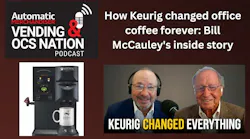 Vending & OCS Nation Bill McCauley of Keurig talks K Cups
About the Author
 Bob Tullio
Bob Tullio
Bob Tullio is a content specialist, speaker, sales trainer, consultant and contributing editor of Automatic Merchandiser and VendingMarketWatch.com. He advises entrepreneurs on how to build a successful business from the ground up. He specializes in helping suppliers connect with operators in the convenience services industry — coffee service, vending, micro markets and pantry service specifically. He can be reached at 818-261-1758 and [email protected]. Tullio welcomes your feedback.
Subscribe to Automatic Merchandiser’s new podcast, Vending & OCS Nation, which Tullio hosts. Each episode is designed to make your business more profitable.