How Keurig changed office coffee forever: Bill McCauley’s inside story
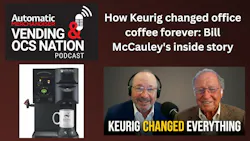




The 1990s were one of the most disruptive decades in the history of office coffee service. Starbucks was reshaping consumer expectations. Filterfresh was introducing single-cup brewing. Flavia was creating an entirely new beverage platform. And Keurig was preparing to launch a product that would transform the industry.
In this episode of Automatic Merchandiser and VendingMarketWatch’s Vending & OCS Nation, host Bob Tullio welcomes Bill McCauley, one of Keurig’s earliest sales leaders and employee number 12. Bill takes listeners behind the scenes of Keurig’s 1998 rollout, sharing stories about the company’s startup culture, early product challenges, customer skepticism and the sales strategies that helped turn a revolutionary idea into an industry-changing success.
Bill discusses:
- Why distributors initially resisted the K-Cup concept
- The famous “puppy dog close” that helped drive sales
- Technical challenges that nearly derailed the company
- The role major distributors played in Keurig’s growth
- Why listening to customers remains the most important business lesson
- The parallels between Keurig’s launch and today's AI-powered smart markets
- How Keurig helped raise quality expectations throughout the coffee industry
- The environmental criticism surrounding K-Cups and how the conversation evolved
Whether you’re an office coffee service operator, vending professional, micro market operator or simply interested in how disruptive innovations gain traction, this episode offers valuable lessons from one of the industry’s most important product launches.
Miss an episode?
Listen to all past episodes of Vending & OCS Nation.
No time to listen? Prefer to read? Here is an edited podcast transcript:
Bob Tullio: Welcome to Automatic Merchandiser’s Vending & OCS Nation, the podcast for the convenience services industry, produced by Endeavor Business Media, a division of Endeavor B2B.
As many of you may know, I became an OCS operator in 1995. I can tell you one thing for sure: The ’90s really were the Wild West era of office coffee service because the industry was suddenly hit by multiple disruptive innovations at the same time. For decades, OCS was a pretty straightforward business. Operators delivered pre-measured frac packs. Customers brewed glass pots of coffee. And the biggest challenge was route efficiency. Then everything changed.
Four things happened.
- Starbucks changed consumer expectations. Suddenly, office coffee was being compared to what people could buy at Starbucks on the way to work.
- Filter Fresh introduced single-cup brewing. Each employee could brew an individual cup. Now today, that sounds obvious, but in the early ’90s, it was revolutionary.
- Flavia created a new category. Flavia wasn’t just selling coffee; it was selling a beverage platform.
- Keurig changed the game entirely. The arrival of Keurig may have been the biggest disruption of all. It appealed to everyone.
On this episode of Automatic Merchandiser’s Vending & OCS Nation, you’ll hear from Bill McCauley, who had a front-row seat for the rollout of Keurig in 1998.
Bill started his career working for over two decades at Aramark Cory, from the warehouse to the executive suite. I asked him how he ended up with Keurig during this disruptive time in the coffee service industry.
Bill McCauley: I was working for Wechsler Coffee at the time, out of New Jersey, and I wasn’t happy there, really. And I was looking for a job. I started reaching out to a few of the people I know in the industry, and Judson Kleinman of Corporate Essentials, who I’ve been a friend with for over 40 years, 50 years — I don’t know how long now — but great, great guy, runs a great business up there too.
He said, “Bill, you ought to look into this,” because I always like gourmet coffee and upscale coffee.
Keurig had just demonstrated to him: Chris Stevens had come down, the vice president of sales of Keurig, and showed him the unit and everything. He was really excited about it. So, he got me in touch with Chris Stevens.
Chris drove down — he was driving down to Washington, D.C., to see Ollie Thomas of Thomas House Coffee — and he stopped in Jersey (that’s where I lived at the time), and we met at a Bob Evans. He went through the whole thing with me, and a week later, I said I’d call him back within a week. And then he got me up to their corporate offices, and I met with the president, Nick Lazaris. They gave me the job, and I was running the Mid-Atlantic states for them as a regional sales manager.
Bob Tullio: But that was really early on in the game.
Bill McCauley: That was 1998. Yeah, that was very early on in the game, because they launched in ’98. In fact, I had commercial brewer number 400, brand new, and they had been demonstrating the units and leaving them on loan in the Boston area. Many of the distributors in the Mid-Atlantic had not even seen the unit.
Bob Tullio: When you first saw the machine — I know you needed a job, or you wanted a new job — but when you first saw the machine, did you think, “This is going to change everything?” Or did you think it was just another coffee gadget?
Bill McCauley: I don’t think I thought it immediately when I was up at Keurig. Of course, that’s where I saw the machine at the corporate offices and ran the machine. I was excited about what it did, and the different flavor varieties. At that time, you had eight different types of coffee (at the very beginning). That was basically it: a light, a medium, a dark, a decaf, a couple of flavors, and that was what was in the rack. But I was pretty excited.
And it was funny. Nicholas Lazaris came over to me and asked me — he was the president — asked me: what changes would I make to the machine?
Now, I’m not a mechanical guy by any stretch of the matter, and he was. So the only thing I could recommend at that time…. I don’t know if you remember the B2000 machine. There was a front coverplate you had to pull. I thought it would be easier for the consumer to put it on a spring with a handle and just open it, and let it close that way.
Now, I got a machine they sent to me, and I put it on my countertop at home, and my wife went ecstatic over it. So that was a good sign.
But when I really felt that this thing was going to take off completely [was] once I went into several of the coffee service distributors. I think the coffee service distributors liked the concept, but they didn’t want to pay the 25 cents a cup — and us telling them to sell it at 40 cents — because at the time, most people were paying 6 cents a cup for a beverage at that point in time.
And Chris Stevens, I give him all the credit for this. He made this about, and I always called it, “romancing the coffee.” We went out with the rack and the brewer, condiments, whipped cream, chocolate syrup, butterscotch — everything you could think of. And when we showed the distributors — because we asked them to set up appointments for us with their field sales reps, and we trained them at the same time — when we went out, and we did all this romancing the coffee in the field… Well, once I saw the first one or two people get ecstatic about it and very excited. I don’t care who it was: the president of companies, the treasurers of companies, people who handled the money…. We’d leave it there for three days, what we used to call the “puppy dog close,” leave it there three days and you own it. Well, we’re closing 70 to 90% of those.
Bob Tullio: Sure.
Bill McCauley: So that was the light that went on in my head that said, “Man, this thing’s gonna take over.”
Bob Tullio: Yeah, and those machines in the early days, they were not exactly reliable. There were definitely some issues with them. Isn’t that correct?
Bill McCauley: There were definitely issues. Throughout the iterations of machines, there were different issues. The first machine had a cup inside the machine — a dispensing cup — and it had a silicone ball in there. And when you press the button, the water would come out of that cup to give you an eight-ounce perfect cup of coffee, because we had the right amount of coffee-to-water ratio.
After three to six months, an operator would have to delime that machine. The machine would start short-cupping. So that was one of the challenges that we had in the early days. Yeah, but there were other problems.
I’ll jump ahead a little bit to some of the issues that we’ve had. A couple of times, we had things that might have — if we didn’t correct them quickly — might have put us out of business. One of them was the lid itself. Lo and behold, instead of puncturing the top of the K-cup, it would just stretch it, never puncturing and backing out, [indicating] something’s wrong with the machine. And this would happen — it happened to me seven out of 10 times when I was on a customer location.
Bob Tullio: Wow.
Bill McCauley: But it was happening all over. That was a critical point. I give credit again to Nick Lazaris, the president. He really jumped into action and found out what he needed to do, which was to make a sharper, longer, entrance needle. That was critical at the time.
And thereafter, you know, we incorporated into the machine the larger, sharper needles. So that was a tough time.
We had one packaging line originally that made the K-Cups. Why I’m telling you this, is that this was another point where they could have gone out of business. If I’ve got the numbers right, it was about half a million dollars for this machine. That was good, and then we grew. So, we needed another K-Cup machine. So we go back to the same supplier, and he wants to double the price for them. We could have gone two ways at that point — more than double now that I think about it.
Bob Tullio: The manufacturer basically was in a position where they felt they could squeeze you.
Bill McCauley: Absolutely, absolutely. And as mad as Nick was about it, fuming, fuming that.
Bob Tullio: He had no choice.
Bill McCauley: He had to suck it up and get the... But he vowed that we’d never buy another machine from them again.
Bob Tullio: Yeah, there’s another lesson. Sometimes you have to suck it up. You have no choice.
Bill McCauley: Absolutely. Yes, we’ve all done that, haven’t we?
Bob Tullio: Yes, we have. Yes, we have.
Where did the name come from?
Bill McCauley: Dick Sweeney, who was there almost from the beginning, the vice president of engineering. His wife was of Dutch descent. And they were thinking of names at the time, and I believe she came up with the name Keurig, which is for excellence or exquisite. And they spent no dollars on this, and that’s how the name was born.
Bob Tullio: Well, you know, sometimes you just get lucky. Do you remember a specific customer account or a moment where you said, “This thing is gonna be big?”
Bill McCauley: I think when W.B. Mason came on board. W.B. Mason was pretty big in the New England [area] and all around the East Coast. And they were buying machines like crazy.
And then you’d start getting calls — and not that we didn’t get calls from these other big players — but all of a sudden you started getting calls from the Aramarks of the world and the Compass Canteens because WB was taking their accounts with the Keurig machines.
So now, even though we had presented to those people several years before, and they kind of fluffed us off… Now, they were interested because now, they were losing customers, and they were hearing from their field management that they had to have this unit.
Bill McCauley: Eventually, Aramark [and] Compass Canteen came on board. And that really, once you have those people…just took off totally.
Bob Tullio: Yeah, that’s a game-changer. But what do you think was their biggest objection? Was it the price objection?
Bill McCauley: I think they thought they were doing it the right way. And they — you know, people get stuck in their ways, and then sometimes they don’t see the new things and the new trends.
Bob Tullio: You know, I remember going out to brew coffee, sometimes working with your daughter, Kailin [Genton].
Bill McCauley: Yes.
Bob Tullio: You know, and she was a superstar, I hope you realize that. She still is, but when she worked for us, she was a superstar. And we’d go on sales calls in workplaces with the B150. I think that was the machine, B150 machine. And people lined up to see this novelty, and it was just amazing. You had to walk them through the steps on how to use the machine: “Here’s how to open it, here’s how you put in the K-Cup…” and they were mesmerized. And of course, the office manager wanted to believe that Keurig was a value. They really wanted to believe that because of all the wasted coffee by the pot, and being poured down the drain. And they believed it until the first invoice arrived. Don’t you agree with that?
Bill McCauley: I would, I would, yes. Yeah, it’s kind of funny. Some of the people, especially in the smaller companies — end-user companies — got that sticker shock.
Bob Tullio: There was a lot of sticker shock, but you know what? It was one of those things…. and we’ll talk about the environmental side too. It was one of those things that — Literally, the love affair with Keurig in the early days was so strong, the appeal was so strong, they found a way.
Of course, when I sold against Keurig, I would always say, “You can’t waste enough coffee to make up for what you’re going to spend on Keurig.” So it just depends on which side of the fence you’re on.
What lesson from Keurig’s success would you say is still relevant today?
Bill McCauley: I always say, “Listen to what the customer really wants.” And if you’re coming up with new equipment and new things, and you’re going to the distributors, make sure you listen to them. They may want things changed because they probably understand their end-user customer better than you do.
So, the coffee service operators, I think, are key to the introduction of any new product. I think that’s one of the things.
I think the other thing is the end-user customers. You’ve got to get out there and show them the machine, work them through the machine. I believe in the three-day hook. Go from there. That’s the only advice I can give them, Bob.
Bob Tullio: Well, you know, you look at the parallels of Keurig and today, particularly in convenience services, is the micro market to AI smart market.
You know, these operators are struggling out there because the cost is so high of that AI smart market compared to a traditional micro market. And of course, just like all those brewers they had on the shelf — that they hate to just put those assets on the shelf — you hate to put those markets on the shelf, and then go out and spend big money for an AI [cooler]. But the reality is, the numbers are there. I mean, isn’t that one of the most important things? You’ve got to listen to the numbers.
Bill McCauley: The operators were basically making a nickel or six cents, if that, on a cup of coffee that you’re selling. I could show them a way to make 15 cents. There’s a big, big difference when you put out a lot of machines like that.
The return on investment, even the investment in the equipment, was six months. In a bottled glass brewer, it was usually a year.
Bob Tullio: Are you surprised that Keurig continues to roll along successfully some 30 years later?
Bill McCauley: I don’t think Keurig would have been a success in the home market without us doing the office market. Because, again, we got a lot of people familiar with the Keurig machine. As you said, we had to show them how to work it, how to put it in. I don’t think people would have figured that out at home without us doing that.
Bob Tullio: When you look back at the Keurig years, what accomplishment are you most proud of?
Bill McCauley: Oh, geez. I think the accomplishment of the company and what it has done, Bob. It’s amazing going back a little off.... I was the 12th employee hired by Keurig. I don’t know how many thousands they have now.
Bob Tullio: Sure.
Bill McCauley: I mean, it was a family. It was really a family. Well, you ran coffee service, and you had a family. But it really, and everybody was dedicated to making it happen.
Nick Lazaris let Chris Stevens do what Chris Stevens does. He left them alone. Chris knew how the sales operation, Nick knew the inside and everything else. He let his management team function — and pretty much independently. They’re smart people, and they were always supportive of the sales force.
That is the accomplishment, I think, just watching that whole thing grow. Just amazing, amazing. I’m so glad I was there, so glad.
Bob Tullio: I can tell just by your attitude. It was an exciting time.
Bill McCauley: It really was — and it was all about the people in that company. Everybody was driven. I mean, we weren’t working 40 hours a week, I can tell you. None of those people. We were 60-hour, 70-hour type people. We were invested in it. There were stock options offered to us, and that’s part of the reason, too, but that wasn’t it. We were just excited about it, no matter who it was.
Bob Tullio: One of the criticisms, of course, that emerged as K-Cups became so successful was their environmental impact. Now, looking back, what do you think about that issue today? I mean, was that something that you guys just didn’t think about?
Bill McCauley: Yeah, back then it wasn’t as big. It grew as time went on. We got the question more.
Bob Tullio: It’s just such an image. You can picture of all those K-cups in the landfill. You know, they talk about it.
Bill McCauley: Yeah, they do.
Bob Tullio: Let’s face it, that’s a powerful, powerful image.
Bill McCauley: It’s not a good image.
Bob Tullio: Did Keurig make the coffee service business better? Or do you think in some way it damaged some parts of it?
Bill McCauley: I’ll tell you why it made it better. One of the big things, and you remember this, but I was hired in 1971 with Cory. We had a three-ounce pack for a 60-ounce glass top. It was three ounces, and two and a half ounces. And that, as far as I know, some places in the different parts of the country used a four-ounce.
All of a sudden, I think it was 1976, I think there was a freeze — I think it was Brazil. I was paying like 69 cents a pound. And then all of a sudden, three months later, it’s over $3 a pound.
Instead of passing on the price increases to the customers, people started cutting the weight of the bag of coffee.
So, I went from two and a half to three, down to two, down to one and three quarter — bastardized the product. They were getting the same 60 ounce, but … and you don’t think the customer knew?
Well, coffee sales were going down year after year after year. They understood. It wasn’t a good product any longer.
So, then Keurig comes along with the right amount of coffee-to-water ratio. People realize that. And they’re willing to pay for quality products. And I think that was good because then even the coffee operators that still had — and still today have — glass-pot brewers increased the weight of the bags in most cases, and made a better cup of coffee for their end users.
So, I think it had a huge impact. Just like Starbucks had a huge impact on everyone. I don’t care where you go or what coffee business you’re in. They made people realize you could get a better cup of coffee. And I think Keurig did the same.
Bob Tullio: What business lesson did you learn by having a front-row seat for the rollout of such a revolutionary product?
Bill McCauley: Hmmm, business lesson.
I’ve always believed this: You’ve got to listen to your customers.
I don’t care what it is, Keurig or anything else. I think listening to the customers and, in most cases, working hard and just doing the right things for people, and you’ll be a success. Listening to them — and not just listening [but] incorporating what they’re saying and doing it.
So that’s the lessons I learned, Bob, a long time ago.
About the Author
 Bob Tullio
Bob Tullio
Bob Tullio is a content specialist, speaker, sales trainer, consultant and contributing editor of Automatic Merchandiser and VendingMarketWatch.com. He advises entrepreneurs on how to build a successful business from the ground up. He specializes in helping suppliers connect with operators in the convenience services industry — coffee service, vending, micro markets and pantry service specifically. He can be reached at 818-261-1758 and [email protected]. Tullio welcomes your feedback.
Subscribe to Automatic Merchandiser’s new podcast, Vending & OCS Nation, which Tullio hosts. Each episode is designed to make your business more profitable.