Third-generation operator shares growth lessons from Sheehan Brothers Vending
Key podcast takeaways for refreshment services operators
- Tough decisions protect the business long-term. Exiting legacy foodservice that wasn’t profitable helped reposition the company for sustainable growth.
- Outside experience can be valuable before joining a family business. Corporate roles gave Patrick Sheehan structure and discipline, which he later applied to Sheehan Brothers.
- Micro markets drive revenue and pricing power. Micro markets, which make up ~55% of the company’s revenue, support higher price points and more creative menus.
- Fresh food as a true differentiator. Sheehan Brothers’ in-house commissary operations help the company stand out from competitors that sell similar packaged products.
- Smart tech should fit the use case. Smart coolers are useful replacements for glass fronts or theft control. Patrick sees walk-in, walk-out smart stores as an emerging technology for high volume sites.
- Inflation exposed the need for better pricing processes. Rapidly rising costs pushed the company to improve margin discipline.
- Growth is strong but purposeful. The company has 5Xed revenue since 2016 and opened its first branch, with future expansion focused on geography, culture and employees.
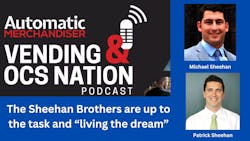




On the surface, taking over a family business would seem to be a dream scenario. But, each time a new generation takes the reins, especially in a well-established operation, inherent stresses come with the job. So far, Patrick and Michael Sheehan of Sheehan Brothers Vending have been up to the task.
What kind of stress does the third generation of a family-owned business typically deal with? Patrick Sheehan sits down with host Bob Tullio in this episode of Automatic Merchandiser’s Vending & OCS Nation. During his many interviews with operators, Tullio has picked up some common examples.
- Will customers be happy to work with the next generation?
- How do we make it a smooth transition?
- As the new leadership, how do I establish authority with my employees (especially those who have been here for many years)?
- How do I ensure continued success? After all these years, I don’t want to be the one who screws things up!
Many successors feel the weight of preserving the family’s legacy. This aspiration can create pressure and lead to decisions rooted in tradition rather than what is best for the business’s future.
It is certainly a great opportunity — stepping into a family business — but it also comes with challenges. After nine years of leadership, Patrick and Michael Sheehan are taking a well-established company to a new level and are having some fun along the way.
No time to listen? Prefer to read? Here is an edited podcast transcript:
Bob Tullio: In today’s episode, I’m talking to Patrick Sheehan from Sheehan Brothers Vending. Patrick took the helm of the company in 2016. Well, he and his brother Michael have weathered a few storms along the way, like COVID. Patrick and Michael are taking a well-established company to a new level. And from all indications, they’re living the dream.
Shehan Brothers Vending, Dennis and Jim. They started out as gumball operators in 1956. I love that story. Give me a rundown on that, Patrick.
Patrick Sheehan: Yeah, so Springfield, Ohio, 1956, is where we got our start with my grandpa and his brother, Dennis. They had really good jobs at the time — a trucking company at Navistar in town. That was really kind of a sought-after job. Grandpa had his third child on the way. So, I know it was a really big risk with all that going on, and they decided to buy a gumball route as a side hustle. They just wanted to keep their jobs and then get a new revenue stream with this third kid on the way.
Three [kids] turned into six, and then eventually they started doing vending machines and kind of the American dream story: Doing it in their garage — their parents’ garage — for a year or two before they just outgrew that and moved to the building we’re at now in 1974.
I’m a third-generation Sheehan. My dad, Dan, who was part of the second generation, has been retired for the past 4-1/2 years.
Bob Tullio: Did Dan really take it to another level?
Patrick Sheehan: I think he took over a little bit of a mess — that happens with family business. So, both sides of the family weren’t working, I think, very well together at the time when he took over. So, I know there were a lot of hard decisions, and business wasn’t always great. I remember one of the stories he tells all the time is that we were doing hot food and speed lines, kind of like hybrid cafeteria service. And he saw we weren’t making any money on it. We were bad at it. And we had to give up a ton of revenue to cut that service off. But it’s probably the reason I’m here talking to you today.
He made hard decisions like that. And he just... he was really a good operator fundamentally. He [put] the bottom line and the profit at the forefront and just really was a great mentor for me. And just a great dad to teach me the fundamentals of this business because he was amazing at it.
Bob Tullio: Definitely a good lesson for you, that’s for sure, right?
Patrick Sheehan: Yeah, there are a lot of stories like that that have helped me guide the ship today and get it where it is today. Yeah, my dad’s probably... he’s 66 now, so he retired. I remember when he was 62.
He [his dad] came right out of college. That’s not how it worked for me and Michael with the third generation. We did not go straight into the business. [We] both moved to Chicago. He worked in the staffing industry, and I worked in the 3PL logistics industry, which was actually one of the best things I could have done because a lot of stuff I learned through that corporate experience. It was very different than a family-owned business in Springfield, Ohio. I was able to learn some things and apply them to Sheehan Brothers kind of right away when I came back in 2016.
Bob Tullio: Yeah, it’s good to get something from the outside. Lay out the geographical coverage and the scope of services that Sheehan provides right now.
Patrick Sheehan: Everything runs out of our headquarters and a branch in northern Kentucky in Florence. We like to not send the trucks out further than 1:45 [hours] from either of those locations. So, we cover a tri-state area with our major markets being Columbus, Dayton, Cincinnati, Richmond, Indiana, Louisville, and [now] Lexington with the branch we opened last year. So that’s kind of our territory. We just opened our first branch and expanded our geographic territory for the first time in 69 years. And a year into that, we’re feeling pretty good about it and could be a strategy for us moving forward.
Bob Tullio: You have two offices, then. Is that correct?
Patrick Sheehan: Correct, yeah. Our headquarters in Springfield, where we have our own commissary. We have a mini campus there. We have a 12,000-ft2 warehouse [and] our own repair department. And then Florence is just a branch. So, we’re picking drinks out of there only. We’re sending a shuttle from Springfield with our fresh food and our snacks down every single day. We have probably close to eight routes running out of Kentucky now. So that team down there is just a warehouse, a small warehouse operation and then routes.
Bob Tullio: How many employees in total?
Patrick Sheehan: We have 170 now.
Bob Tullio: Good-sized company.
Patrick Sheehan: Yeah, quite a bit of employees. Probably 30 of those make up our commissary staff, which is definitely something different with Sheehan Brothers than you see with other operators.
We’ve always had the belief that to set ourselves apart from the competition... we all sell similar drinks and snacks, but not everyone has Sheehan Brothers’ fresh food. So, we really pride ourselves on the quality and the price point of it, and the freshness of it. I would say that’s just one of our biggest competitive advantages — in addition to just our level of services — that fresh food program.
Bob Tullio: Is that something that’s really evolved over time, too, in terms of the quality, the menu size, the whole bit?
Patrick Sheehan: For sure, yeah. It’s definitely … it’s evolved a lot, but it’s stayed the same a lot. People like what they like. Uncrustables are on a tear. We don’t even make that right now. But every single operator you’ve talked to in our industry, that’s probably their number one selling food item out of their break room, whether they make their own food or not. So, you’ll have new things like that pop up.
But a cheap hot dog, a cheap cheeseburger, that’s a lot of our bread-and-butter clientele. Our customer base is blue collar manufacturing, distribution centers, hourly employees with a 20- or 30-minute break at a time. They want a cheap, fresh option in our market, but we still sell a lot of wraps that are $6 or $6.50, too. So, markets have definitely allowed you to sell at a higher price point than you were with vending. We’ve had to adapt to that.
Bob Tullio: Well, and it’s caused you to be a lot more creative, I would think, in terms of your menu selections.
Patrick Sheehan: Yes, for sure. Sure, I mean, you’re just not restricted to that little space in a vending machine. So, what you can do with packaging — and everything — changes. You rethink everything. Being able to control that really helped us since we’re the ones producing it.
We really have a great story behind it, too. You know, it’s so fresh, the food is safe dated. So, when we take those expired items out of these coolers or a vending machine, they’re safe dated. So, we bring them back on the truck cold, and then the Second Harvest Food Bank comes and picks up meals from us five days a week. And it goes to people in need in our local community. We donated 270,000 meals in 2024, and we are probably on pace to exceed 300,000 this year with our growth. I sit on the board of that organization, and I can tell you that ever since COVID, our numbers aren’t meeting anywhere near their needs. So, it’s really cool to see firsthand our spoiled stuff — that could just be thrown in the trash, or a lot of it — we can give it away, and it goes to a good cause right in our local community.
We don’t do any hot food. We use partners for that, like a food [company] or a couple of great local cafeteria companies — our regional cafeteria companies that we partner with. So, we’re not going out and preparing hot food, so we don’t have like a ton of chefs on staff or anything.
Bob Tullio: Sure.
Patrick Sheehan: We bake our own breads, and we have a catering division: a nice, really slick catalog that customers can order off of for box lunches, veggie trays, employee events. We still like to do [that], just not staffed hot ones. We like to use partners for that. So, you can see I’m still learning from my dad’s wisdom — 20 years ago, getting us out of it. But at the same time, I will never leave anything off the table. Like, maybe it wasn’t the right time to do it then. Maybe it makes sense for us down to road.
Bob Tullio: Maybe down the line. Sure.
Talk about your role. You’re president and CEO. What does that job really entail at Sheehan Brothers?
Patrick Sheehan: Yeah, so it’s “The buck stops with me.” You know, we still run Sheehan Brothers — even though we have 170 employees — very much like we did when we had 50 employees a few years ago, as a family-owned business [that] keeps changing and evolving.
My dad started giving me access to the financials pretty quickly. So, I would see the P&L and the income statement. I do not have a background in finance or business from Ohio State. I was on a pre-med track. I was not going to come into this industry. I ended up liking what I saw with the markets in 2012, and then I switched courses to the easiest major at Ohio State to still graduate within four years. And then I was like, “All right, I’m going to Chicago. I’m going to come back to the business in 2016."
My dad started giving me some P&L responsibility. I immediately saw that coffee should be more of our revenue. And so I went all into the OCS side of the business and completely left market operations. Redid the entire operation of the OCS division, started changing how we sell it. And then I naturally moved into sales and started driving our sales team. Soon after that, I started running our finance team — really in the last four years. So, my main day-to-day is sales and finance, but I have a background. I manage an executive team of eight individuals, and we have a mid-level management team of probably close to 25 people right now that I work with daily.
Bob Tullio: So, you’re really involved on the sales side still?
Patrick Sheehan: Yeah, I’m still involved heavily on the sales side. We’re going to be hiring actually a VP of sales. I’ll still stay heavily involved in it, at least for the next year — and probably forever. That’s just like where my passion is.
And my brother, he’s on the operations and the market side. That’s kind of how we split it up: I’m sales and finance. He’s operations. We’re best friends. We get together quite often outside of work and have a lot of the same friends. And really, the dream of getting to run a cool company like this and grow it like we have, with your best friend and your brother.
Bob Tullio: He’s involved in the operations side. So, you get to go out and party with the clients and build relationships and cultivate deals, and he’s grinding on the day-to-day. Do you think that’s fair?
Patrick Sheehan: Yes, I do. I mean, I will switch places with him in a second. I mean, me and you, we were just at CTW. The schmoozing and the networking is not as easy as people make it seem. You know, people see I’m in Miami, but you know, when I’m at these events, I’m waking up at 7 a.m. and I’m working remotely the entire event while attending the event — and then networking until, you know, sometimes midnight at some of these industry events. I would much prefer to have an eight-hour fixed day in the office, a lot of times.
But no, it’s just how our personalities are naturally. So, it’s just, I think we got lucky in that state. I’m still very involved operationally.
Bob Tullio: Of course.
Patrick Sheehan: But it’s just like not day-to-day — not in the weeds anymore. And that’s by design because we can’t keep growing if we don’t delegate and scale in that way.
Bob Tullio: Correct. Especially now that you’re in multiple markets, multiple cities. I tried to convince my brother that the sales side was really tough too, but he was okay. He was getting entertained by these suppliers, so he was doing okay on that end. So there’s that, there’s that as well.
Patrick Sheehan: Yeah, that helps.
Bob Tullio: So, first micro market in 2012, now close to 300. Obviously, you like the micro market business.
Patrick Sheehan: Yeah, that’s our bread and butter. It probably makes up 55% of our revenue. Then another 20% to vending, and then another 15% OCS, is kind of how we’re split. It’s our fastest-growing segment. Our goal every year is to keep vending flat, but we’ve actually exceeded that and still grown the segment, while still we want to grow the market and OCS divisions just as much as we possibly should.
Bob Tullio: Speaking of micro markets, how many smart coolers/smart markets do you have on the street? Or is that not something you’ve delved into yet?
Patrick Sheehan: Yeah, so I’m very opinionated on the smart cooler thing…
Bob Tullio: Okay.
Patrick Sheehan: …Maybe on LinkedIn and stuff. I’ve been like battling the Mike Hoffmans and the people that are trending out there about smart coolers.
I think they serve a purpose, but for Sheehan Brothers, they, you know — it addresses small accounts that I don’t want anything to do with. I think they’re good to replace glass fronts. I think glass front doors, no one wants to set those out anymore because of the repairs, you can’t even get them.
They are good to upgrade any customer that has a glass front that doesn’t want to have repair issues to a smart cooler next to a snack machine, or next to — that’s how they kind of fit in for us.
Where I’m most excited about the smart store technology is replacing micro markets that are doing $200,000 annually in revenue that have double-digit theft. I’m looking for a smart store like, you know, we talk with Amazon, and we’re trying to start implementing some walk-in and walk-out technology. You know, we’ve implemented Cantaloupe Smart Stores in some of those scenarios. But it’s all new technology, and it doesn’t integrate, and the pricing is a barrier.
So, it’s still young, but we are getting our hands on it and creating these relationships because we want to be the first person to have that as soon as it has matured, and it’s at a price point and integrated with the industry where we can scale it. And we need to be a part of that. That’s kind of my point of view on the smart cooler thing. I don’t like them really anywhere other than replacing glass fronts or solving theft issues at large accounts.
Bob Tullio: Interesting. Because you got one on the spectrum that’s like, “This is it. This is the future.” You’ve got new operators coming in, [saying], “That’s all I’m going to operate is smart markets.” And you’re on the other end of it. But you know what? You’ve got something established that’s working for you, too. There’s something to be said for that, obviously.
Patrick Sheehan: I want full-blown markets. I don’t want just a door here or there. Most of the players at our scale, I bet they have the same viewpoint as I do.
Bob Tullio: Yeah, it’s really just a vending machine with a lot of technology on it, isn’t it?
Patrick Sheehan: Yeah, but then it’s like how much you — if you put it in a good location, how much it costs to service it compared to like a vending machine or just a regular market.
Bob Tullio: What do you think is the biggest challenge facing operators today?
Patrick Sheehan: I think just rising costs, number one.
I would have said labor market two years ago. 2021, the first six months of 2022 were probably the most stressful and — hopefully the most stressful — times I’ll ever have running Sheehan Brothers. My brother had just joined and he — it really scared him. He was like, “I do not like this. I don’t think I’m going to last.”
We got through it. And now I would say it’s rising costs. [unintelligible] It’s everywhere. And it’s, you go from 3 to 4% increases —and now you’re getting 10, 25% year-over-year increases, going into three years straight from pretty much everywhere. It’s tough. You've got to stay ahead of your pricing in the field.
I think it’s actually been a good thing for us because we were asleep at the wheel on some of our pricing. Like we just didn’t have good processes in place to increase pricing, to get the proper margin, until we went through this rapid — you were forced to in the last few years, you’re changing prices over time. Yeah, it’s just something, it’s been tough to adapt to, but I think it’s made us better, just like anything else when something’s tough.
Bob Tullio: What does the future look like for Sheehan Brothers?
Patrick Sheehan: We have had strong growth goals. October is our first month, we crossed a $50 million run rate. So, I think when I came back to the company in 2016, we were like $11 million. So I’ve almost 5X the company since I’ve been back. I think we had 50 employees at the time, too. So more than tripled employees — opened a branch. I’ve done a lot of stuff over these last nine years that, if you would've told me I was going to do in 2016, I would have said, “Oh my gosh, that’s the best-case scenario.”
And yeah, now, I think just, I think next is looking at opening another branch. We have to continue to grow our geographic footprint. There is an acquisition game that is being played by the rest of my competition that we now have to play that we didn’t play for 68 years, until last year. So that is really where my focus on is just smart, good, slow, organic growth above all else. Continuing to support our local community, do as much good as we can along the way, and shove as much money into my employees’ pockets as I possibly can.
Bob Tullio: Keeps people happy. You know, and you did all that in the nine years with a little pandemic in the way, too. That’s pretty good.
Patrick Sheehan: Yeah. No, I love that wartime. I am a wartime CEO. When things are bad, and my back’s against the wall.
Bob Tullio: OK.
Patrick Sheehan: That’s when I do my best work. So yeah, no, I don’t back away from a challenge and trying to get better every day. We’ve really focused on culture, and it’s awesome to come to work and grow while still maintaining the family values and feel we’ve always had at Sheehan Brothers for 70 years. We’re lucky we have so many employees who have worked for us for decades, some second-generation employees for us. Yeah, it’s been cool to be a part of.
About the Author
 Bob Tullio
Bob Tullio
Bob Tullio is a content specialist, speaker, sales trainer, consultant and contributing editor of Automatic Merchandiser and VendingMarketWatch.com. He advises entrepreneurs on how to build a successful business from the ground up. He specializes in helping suppliers connect with operators in the convenience services industry — coffee service, vending, micro markets and pantry service specifically. He can be reached at 818-261-1758 and [email protected]. Tullio welcomes your feedback.
Subscribe to Automatic Merchandiser’s new podcast, Vending & OCS Nation, which Tullio hosts. Each episode is designed to make your business more profitable.