Three generations, one mission: The Treasure Valley Coffee story
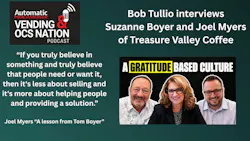




When a competitor won one of Treasure Valley Coffee's original accounts by offering vending, founder Tom Boyer decided to start a vending company. Protecting that customer relationship mattered more than staying comfortable.
That competitive spirit helped turn a business launched in a Boise garage into an operation with 325 employees, four locations and customers across parts of Idaho, Oregon and Washington.
On this episode of Automatic Merchandiser's Vending & OCS Nation podcast, host Bob Tullio talks with Suzanne Boyer and her son, Joel Myers, about the family values, service philosophy and growth opportunities driving Treasure Valley Coffee forward.
Suzanne shares how she joined her father’s business and stepped into leadership after his unexpected passing in 2018. Her experience offers a powerful reminder that the relationships a business builds, with employees, customers and trusted partners, can become its greatest source of strength when circumstances change overnight.
Joel talks about the company’s goal of doubling its size by 2030 and explains why much of that opportunity lies within its existing customer base. From coffee and hydration to concessions, breakroom supplies and micro markets, the focus is on solving more customer problems and increasing revenue at every stop.
It’s a conversation about building an ambitious business while preserving the relationships that made success possible.
Miss an episode?
Listen to all past episodes of Vending & OCS Nation.
No time to listen? Prefer to read? Here is an edited podcast transcript:
Bob Tullio: On this episode of Automatic Merchandiser’s Vending & OCS Nation, Three generations, one mission: The Treasure Valley Coffee Story.
When a competitor took one of his original coffee accounts because it also offered vending, Tom Boyer had a decision to make. He had never wanted to be in the vending business, but he wasn’t about to let someone walk away with the customer he had worked so hard to earn. His answer? Start a vending company.
That competitive spirit helps explain how Treasure Valley Coffee grew from a garage in Boise, Idaho, into a company with 325 employees, four operating locations, and a wide range of services across parts of Idaho, Oregon, and Washington.
But the size of the business tells only part of the story. I sat down with Suzanne Boyer and her son Joel Myers — the second and third generations, helping carry Tom’s vision forward. It’s a conversation about family, leadership and building a business where people want to stay. Here’s my interview with Suzanne Boyer and Joel Myers.
Joel Myers: We are operating in parts of Idaho, Oregon and Washington. We have 29 coffee routes serving roughly 4,500 accounts. We have 35 vending and market routes. We operate out of Boise as our headquarters. We have a Twin Falls location in eastern Idaho, a Blackfoot location, and a Richland, Wash., location. So total of [muffled].
Bob Tullio: That’s great. That’s great.
Suzanne Boyer: Joel has put some hefty goals out there for us with percentage of growing at what rate per year, Joel?
Joel Myers: The goal is to double in size by 2030 based on our 2025 numbers. So, in order to do that, we do need to maintain about a 13.5% growth annually.
Bob Tullio: Do you think that that’s going to come by acquisition? To what extent is that going to be organic?
Joel Myers: I think the biggest bite we could have taken was what we did last year with our acquisition of TVC Northwest. That led to this year having roughly 21 to 22% growth. Now it’s up to us to maximize the opportunities in the territory we have. Other acquisitions aren’t off the table, but I think they might come in less traditional ways.
Bob Tullio: In your market area, are there a lot of available targets for acquisition?
Joel Myers: No, we are the dominant force here in Idaho. We have some competition. We believe that having competition is actually a good thing. We appreciate operators in our market. Outside of Idaho, there might be opportunities, but at this current state, the acquisitions are, I guess we’re done doing some acquisitions for a minute.
Bob Tullio: Obviously, there’s a strong organic effort, though, to grow.
Joel Myers: The opportunities we have within our own accounts are really what we need to be focusing on. Ultimately, we really have a vast catalog of products and offerings and services that we do that are really not typical of an OCS operator.
Bob Tullio: Joel, let’s talk about your scope of services. List it out for me.
Joel Myers: We have our traditional OCS, in where we’re taking care of office settings. Within that, our product catalog is pretty extensive.
When Tom started Treasure Valley Coffee, he obviously saw the need of coffee in the break room. But as we expanded, the opportunities that he created were things like first aid, bathroom and breakroom supply. We’ve expanded in the last couple of years into beverage supply when it comes to bars. So, we now do fountains and bar guns with our own private-label juices, mixes and sodas. Hydration, we are pushing further into hydration and getting creative into what customers we can sell it to. In Idaho, we have plenty of food manufacturing, farms, construction. Those businesses — that is a huge opportunity.
We’ve expanded into concession supply, so we’re a Gold Medal dealer — popcorn, nachos, pretzels. So, our goal on that is: How do we push into snack bars, smaller stadiums, golf courses? Those opportunities are what we’re exploring, in addition to the other opportunities we have within coffee.
Food service? Restaurants that have breakfast service are really the target for us.
Another non-traditional customer base is convenience stores. Our acquisition in Washington — they’re predominantly convenience store. Over half of the customer base was convenience stores, which is not typical for us. We are much less into convenience stores, but through that acquisition, I think we’ve seen the complete value of the differentiation of coffee customer types.
We roast coffee and distribute to operators in 14 states. These operators can be large food suppliers; they could be convenience store suppliers; or other vending and OCS operators.
Bob Tullio: So, you have a big private-label program that you do for other operators?
Joel Myers: A lot of it though, when it comes to private label, are customers that are outside of the OCS space. Most people that we have in the OCS space have taken on our brand just with the reputation that it has within our region.
Bob Tullio: You are operating obviously in a lot of different buckets, from coffee service, roasting, food distribution, beverage, snack, vending is a part of the package. Pantry service, I assume?
Joel Myers: Very little. We had a lot pre-COVID. We are starting to get back into it over the last year. It’s definitely a huge opportunity for us for the future.
Bob Tullio: But not quite the same as the way it is in New York and Boston and Los Angeles, obviously. It’s a different demographic, let’s face it.
Joel Myers: It is — it is. But when I jump on a route and just go out and see people, I’m seeing it in the offices. These guys are going to Costco. They’re getting on Amazon. Just no one in my area is providing the service yet. And we’re going to get there.
Bob Tullio: Micro markets?
Joel Myers: Yeah.
Bob Tullio: Smart coolers?
Joel Myers: Yes.
Bob Tullio: Now I know you've got to be in point-of-use water because you’re not in the bottled water business anymore. Nothing like point-of-use water. First aid, ice machines. You said fountain equipment. You guys are essentially a one-stop shop.
Joel Myers: I agree. I think our goal is to maximize revenue per stop. How do we create a solution for a customer that’s frictionless, with full service, regardless of the business line, that takes all the worry away from the customer? They don’t want to deal with multiple suppliers. The one supplier that they know they can pick up the phone, and they’ll show up and be responsive, is who they want.
Bob Tullio: Makes sense. Suzanne, you mentioned to me earlier that the vending business, you’ve got a story about that. Tell me about that vending story.
Suzanne Boyer: Well, in 2002, Tom walked in my office and said, “I cannot believe that one of my original customers from 1984 has taken their business and gone with Canteen because they offer vending as well.” And I said, “Well, Dad, what are you going to do?” And he says, “Well, I just don’t have any choice. I just have to start a vending company.” I’m like, “You said you never wanted to get into vending. You didn’t want cash sales.” And he said, “It doesn’t matter. They’re not going to take my accounts!”
So, in 2002, at the end of that year, we went over to Washington, met with Jim Brinton, and Dad and one other of the managers went on vending routes with Evergreen Vending, and Treasure Valley Vending was born.
Bob Tullio: Tom Boyer knew what he wanted along the way. Now, when he started the company in 1984 — and for listeners who don’t know the story — how did this business begin in a garage and become the company it is today?
Suzanne Boyer: Well, it actually started in a plan in about 1981 when he was working for one of the national coffee companies, Boyd Coffee. He started seeing that there were opportunities back in his hometown. He was traveling extensively — like gone for three weeks, home for a week — and just started to realize that there was an opportunity to do something more that he loved in me back in the state of Idaho.
So, he told me in 1983, that he was moving back to Idaho and starting Fisher Valley Coffee. He never wanted to roast coffee. He had found a coffee company down in Texas called Continental Coffee, thought that they had a great product, and found some coffee brewers that he loved. And, so he moved from Eugene, Oregon, back to Boise, Idaho, bought a three-bedroom ranch-style house with a coal furnace and no air-conditioning, and started the business in his garage.
Joel’s dad actually took the coffee that came from Continental Coffee Company and repackaged it into Treasure Valley coffee boxes while he was a college student at Boise State University.
It took him one year to bring on his first route salesman. So in 1985, that first route salesman was hired, and we got to business, started growing.
Bob Tullio: Wow. And you joined the company in 1999. Now, was that part of the plan or did your career eventually just lead you there?
Suzanne Boyer: Joel’s dad was in the military, so I did a lot with volunteering with our military spouses. And I had not really thought about working at that point in my life, but Tom had a situation where he had some key people leaving the company, and he and I went camping in his airplane at Chamberlain Basin, where we flew in and put up a little pop tent and went on a big hike in the Frank Church Wilderness area. And we were sitting by a stream and watching a wild moose — you can’t make this up — talking about things. And he told me that he was concerned about the stability of his company when he’d had some key people leave. And I said, “Well, you know, I always thought I’d come to work with you someday.” And so we started talking that weekend about it. And as we flew back to Boise, we put a plan together that I would start in a month, and work part-time until the kids were old enough for me to work full-time.
Bob Tullio: And how has that worked out for you?
Suzanne Boyer: I think it’s been a really good choice.
Bob Tullio: It’s a good thing. It’s a good thing. What did Tom teach each of you about business that still influences the way Treasure Valley Coffee operates today?
Joel Myers: For me, the thing that he taught me was that selling what you love and believe in is the most important thing. For me, that lesson — it’s super important to how we operate and how he operated. His perspective was that if you truly believe in something, and truly believe that people need or want it, then it’s less about selling, and it’s more about helping people and providing a solution. More than anything, Tom loved taking care of customers and taking care of his people.
Bob Tullio: How about you, Suzanne?
Suzanne Boyer: Like Joel said, Tom loved people, and he loved coffee, and it was a great combination. He always would say that his first customers were his employees, and he was very careful on the people that he offered jobs to and opportunities to.
After I had been here for a couple of years, we had our first employee retire, and he had tears in his eyes talking about what a joy it was to see someone through their career and giving them the stability and watching them raise their family and buy their houses and cars, and knowing that we gave that opportunity to those employees. But, those employees gave us the business that we had, and they represented the freshest quality and service that we’ve built our business on for the last 42 years.
Bob Tullio: He certainly helped pave the way for a corporate culture that’s based in mutual gratitude. And I think that’s a beautiful thing. Would you agree with that, Suzanne?
Suzanne Boyer: Absolutely, he had such a passion for people. He was a tough competitor, there’s no doubt about that. And he had three rules to live by — that you better always tell the truth, and you better not steal from him. And he had no tolerance for any kind of harassment. That’s how people lost their jobs with us.
Bob Tullio: So less than 20 years after you joined the company, but right around 20 years, you guys had just made a major acquisition, Suzanne, when your father unexpectedly passed away in 2018. What did the experience teach you about leadership, succession and the importance of having good people around you?
Suzanne Boyer: So, the day that Tom passed away, it was apparent to me that relationships were key to everything. And he had always talked about how treating your employees was the right thing to do, treating them well, and how important your relationship was with your banker and such.
And that day, when we started to make sure that our employees knew and our key people knew about Tom passing away. We didn’t want them to hear it on the radio. People came around and supported us, and supported me especially, in ways that I didn’t even expect.
So I really believe that when you treat people right, they’re there for you in the hard times. And then you can celebrate the good times together.
Bob Tullio: For you personally. Was it a challenging transition, or did you feel like you were ready to make that move at that point? Not planning on it, but ready to make that move.
Suzanne Boyer: There’s no planning for a time like that when the founder of the company is the pillar of the company, and so much of the information and the technical part of the business was in between his ears, not written down anywhere. He really did believe in the old-fashioned handshake. We have never had contracts, for instance, so there was a lot to learn, but fortunately, there were a lot of people that he’d given small amounts of information to that all came together.
For instance, the day after the accident, his second cousin, who had purchased Treasure Valley — or had started Treasure Valley Coffee of Utah in…1994. Tom had said, “If anything ever happens to me, please come up here and be with Suzanne.”
So, Tom passed away on a Sunday. On Monday morning, the second cousin of ours had come up here to be by my side, help the employees and help the company. So, it was about two days later that I realized, “Okay, thank you for coming up. Thank you for notifying people. Thank you for being here. Now you’re in my desk. I need you to go back to Utah, and let me take that desk that’s going to be mine.”
Bob Tullio: Coffee, micro markets, vending, or pantry, which has the most upside over the coming years?
Suzanne Boyer: Well, micro markets are definitely the largest growing part of our business, but we embrace that. We love all of the technology coming with the new micro markets and the coolers, the self-serve kiosks. But we still believe that coffee has the biggest opportunities for Treasure Valley Coffee in the next 5 to 10 years.
Joel Myers: I agree. Coffee, we’ve got our sights set on it. We’re going to grow coffee. We have a production facility. We’re doing one and a half million pounds a year. We’re only running it at about 30% capacity. With the investments we’ve put into it in the last couple of years, it’s time to grow that business. So, we’re exploring opportunities and how we can grow that.
But me personally, I feel like in the next five years, especially for us, markets will be the largest revenue growth, I would think. Coffee could be right around there too, but the markets—. We have a good amount of vending machines, but there’s probably 10 vending machines for every one market. And when we convert a good vending machine into a market, we’re seeing two to three times revenue growth. So, I have an opportunity to grow through just asset replacement.
Bob Tullio: What’s the secret sauce at Treasure Valley Coffee. Suzanne?
Suzanne Boyer: I think passion and quality and the love of people. Passion for great coffee, opportunities to take care of our customers’ needs. We’ve been very blessed in Idaho to have a business that’s been growing with our growing population, with the industries that are coming into Idaho. In 1984, nobody knew where Idaho was. Now, we are kind of the forefront of a lot of best 10 places to live, which is great for business. We really enjoy that. But I just think that our passion for people and our passion for serving people is what’s going to keep us as a leader in this industry.
Bob Tullio: Well, I knew one thing about Idaho that you had a really cool football field at Boise State. I mean, I really like that. I love that blue field. They still have that, right?
Suzanne Boyer: We sure do. We just went to a game on Saturday and it was beautiful.
Bob Tullio: There you go. Joel, what’s the secret sauce?
Joel Myers: It’s the people. We’ve been lucky. We’ve had decades of great people who’ve come in, bought into the idea of what we do, had passion, been able to take ownership in the solutions for our customers. It’s the people. We’ve been lucky to have amazing people.
Bob Tullio: I appreciate you both coming in. Nice interview. Thank you.
About the Author
 Bob Tullio
Bob Tullio is a content specialist, speaker, sales trainer, consultant and contributing editor of Automatic Merchandiser and VendingMarketWatch.com. He advises entrepreneurs on how to build a successful business from the ground up. He specializes in helping suppliers connect with operators in the convenience services industry — coffee service, vending, micro markets and pantry service specifically. He can be reached at 818-261-1758 and [email protected]. Tullio welcomes your feedback.
Subscribe to Automatic Merchandiser’s new podcast, Vending & OCS Nation, which Tullio hosts. Each episode is designed to make your business more profitable.