A different path for operators considering a sale
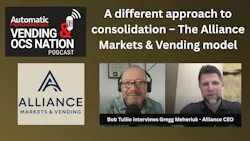




On this episode of Automatic Merchandiser’s Vending & OCS Nation, Bob Tullio talks with Gregg Meheriuk, CEO of Alliance Markets & Vending, about a founder-focused approach to consolidation that offers independent operators something different from a traditional exit.
Backed by Shore Capital Partners, Alliance acquires strong independent convenience services companies while allowing many founders to remain active in the business and invest a portion of their proceeds into the larger Alliance platform. The local company name and customer relationships can remain intact while operators gain access to resources that are often difficult for an independent company to build on its own.
Gregg explains how scale can create advantages in purchasing, technology, HR, finance, sales support and operational expertise. Alliance operators also have the opportunity to exchange ideas and best practices with other operators inside the organization.
The conversation also addresses one of the biggest questions facing longtime operators: What happens if I want liquidity, but I’m not ready to retire? Gregg describes how founders who want to remain involved can reinvest part of the sale proceeds into Alliance, giving them the opportunity to participate in the platform’s future growth and value.
Alliance is showing early momentum. Gregg says the company is performing well ahead of its aggressive budget and exceeding his expectations.
For operators considering succession, an eventual sale or simply a way to accelerate growth, this episode offers a look at an emerging alternative — selling the business without necessarily saying goodbye to it.
Miss an episode?
Listen to all past episodes of Vending & OCS Nation.
No time to listen? Prefer to read? Here is an edited podcast transcript:
Bob Tullio: On today’s episode of Automatic Merchandiser’s Vending & OCS Nation, the podcast for the convenience services industry, we’ll talk about what happens when an independent convenience services operator wants to take some money off the table but isn’t ready to walk away from the business he or she spent decades building.
There is a relatively new option in our industry, and it’s one that I think a lot of operators haven’t heard much about yet. Well, you’re going to hear about it today.
Alliance Markets & Vending, backed by Shore Capital [Partners], is building a network of independent convenience services operators using a model that is a little different from the traditional acquisition. The founder can remain involved. The local company name can remain in place. The operator can invest a meaningful portion of the proceeds into a larger Alliance platform and potentially participate in the future value that’s being created. At the same time, Alliance brings resources that can be difficult for an independent operator to develop on their own: Purchasing power, capital, technology, HR, finance, sales support and the opportunity to share best practices with other successful operators.
My guest is Gregg Meheriuk, CEO of Alliance Markets & Vending. I asked Greg to explain exactly how this model works, what Alliance is looking for in an operator, and why he believes founder ownership can be such a powerful component of consolidation in the convenience services industry.
Here’s my interview with Gregg Meheriuk.
Gregg Meheriuk: What’s interesting is there’s a lot of dollars that go into these platforms — dental, vet, anesthesiologists, you know, HVAC, whatever the platform is. And some of those platforms work well, and some of them don’t work so well. And the one I worked on actually is called Heartland Dental. I spent a lot of time with that group and still kind of— that’s how I got referred to Shore, and I ended up at Alliance. And the thing that’s interesting is in that model, all the doctors own equity in the business.
Bob Tullio: Yeah.
Gregg Meheriuk: The thing that I looked for when I said, like, what’s Alliance all about? Stepping back, I came into this industry, and Alliance didn’t even have a name. Like, I kind of created the Alliance name because I looked at, well, you had Canteen, Sodexo, InReach — which were big corporate entities. And then, you had a long list of independents, but you didn’t have any kind of platform structure. And so, where I thought we had a great opportunity is where if I’m a founder — this is kind of our ideal founder, someone typically in their 40s, maybe 50s, that have kind of built the business, have been in the family business for 10, 20, 30 years. They want to stay in the business, but they want to kind of take some money off the table but also get the leverage of scale and professional operations that we can help kind of— that scale creates. And that’s kind of the perfect Alliance fit.
And so, our brand name is actually not a consumer-based brand. You’ll never see Alliance in the marketplace for the customer or the consumer. We’re strictly there as a holding entity, and we’ll let all those independent operators in those local businesses continue to operate in their name.
Bob Tullio: So that’s why— I reached out to Jason Postl, [CEO of Fresh & Easy Markets]. I said, ‘Hey, I want to do a podcast on you. You’re a good, strong local operator.’ I’ve interviewed him a few times about micro market design and that sort of thing. I know Phoenix is a booming market, that whole area.
And he says— I forgot the term he used. ‘Well, you got to talk to the company that I’m affiliated with now.’ And I’m like, ‘What?’ I had no clue. I said, ‘Were you purchased?’
So, let’s take an example then. [Suppose] I’m an operator, and I’m operating in the Phoenix market. Where are you based out of, first of all?
Gregg Meheriuk: We’re based out of Phoenix.
Bob Tullio: Oh, okay.
Gregg Meheriuk: Yeah, so we just have our head office here. We partnered with a few local operators here.
So in that example, we have a few local operators here in Phoenix where they’re part of Alliance. They still operate their business, and they’re still going to market as their business. The thing that’s interesting in a couple of cases, where some of the smaller operators are, I can use that example for Jason, we’re now servicing his business out of one of our other larger warehouses because it just makes sense, right? When you have — think of [it]: if you’re a small operator, and you have five drivers, and someone gets sick or doesn’t show up for work. 20% of your capacity is gone for that day.
But if you’re part of a bigger business that’s actually servicing, and there’s 20 routes at one facility and one driver doesn’t show up. A, you probably already have a backup driver on staff, which we do. And so we’re able to actually help service those businesses better as you have some scale in there. But that founder and that owner in that instance is still out there selling their business, servicing their business and has that kind of local relationship with that customer.
And so, we have kind of both of those models running, where in some instances, not much has changed in terms of the warehouse is still their warehouse, and they’re still servicing their customers. In other cases, where it makes sense, we have kind of one facility that is actually servicing all the different customers, and that’s where scale’s kind of been an advantage.
Bob Tullio: So in some cases, then you’ll consolidate offices, consolidate operations. Would you keep the two banners still up and running, and existing?
Gregg Meheriuk: Yeah, because those banners are usually unique. And so, in that example — the one that you just talked about with Jason — the type of fixtures they use, the type of products they use, kind of who their customer segment is, different than the other operators we partner with. So, in that case, we’ve kept them separate.
In other cases where the founder — you know, some founders retire, so these are really smaller ones that, ‘Hey, I want out and I want to stuff like exit my business.’ In that case, we haven’t really kept that business growing. [For] that, we’re still servicing it, and the name stays, but we haven’t— we’re not expanding it or continuing to grow.
In other areas where the operator still stays with us, absolutely, we’re continuing to service because it is a different product offering and different brand that they represent.
Bob Tullio: Based on your financial services background with companies like Bain, you saw the opportunity for platforms within an industry where a variety of people, with a variety of companies, all have an ownership interest, allowing them to achieve the benefits of scale. And you started this from ground zero, then? with Alliance in the convenience services industry? Is that accurate?
Gregg Meheriuk: The private equity firm that’s kind of behind Alliance is Shore Capital. And this is Shore’s bread and butter. This is what they do. They’ve had an amazing track record of doing and have very, very successful outcomes. And the thing that I really like about Shore — and this is one of the things that I think Alliance offers that not other PE firms honestly could. Because Shore does micro-cap— in most private equity firms, most of what you have are deal guys that like to do deals and then a few operating partners. Shore’s almost 50-50. And the other 50% are the people that actually help businesses grow and build.
And so, the thing that I really like about it, and my team just got back from a training. Shore puts [on] training. So, anyone that reports to me like, ‘What does private equity work? How do you build up your capabilities?’ And they have cohorts within Shore’s portfolio company, so sales, HR, finance, that leaders of a business at Alliance, or our founders, can go and learn and continue to grow and develop.
So, it’s like having access to almost what a big business would, but we’re a small business. And that’s what I think is really unique about Shore’s model and what I think A helps platforms like Alliance be successful, but also helps us scale — to your point — where we have a lot of different operators that come from small family-run businesses. It helps create and train and develop those leaders also to make those successful businesses and be part of the strong platform.
Bob Tullio: So, did you bring this to Shore or are you part of Shore?
Gregg Meheriuk: No, Shore had this thesis of, ‘Hey, here’s the vending industry, and you got a couple of big players in a long list of independents. We think there’s an opportunity to create a platform.’
And so with my experience at Bain [& Company], Teachers’ [Private Capital] and having worked with several different platforms in different industries, I looked at this, and I’m like, ‘Wow, there’s a great opportunity here.’
But I looked at who we could potentially partner with, some of the founders that Shore had already met with, and we’ve quickly scaled. So, a year and a half ago, we had three businesses. We were talking to a couple that were under LOI. We’ve so far, in a year and a half, closed 11 businesses.
Bob Tullio: Wow.
Gregg Meheriuk: And have locations in kind of the Phoenix area, Utah, Washington State, Seattle, Chicago, and now Texas.
Bob Tullio: And I would imagine it increases your purchasing power as well.
Gregg Meheriuk: It does, it does. I think, the way to think about where Alliance can help, if I’m an independent operator, what I call is like gross margin expansion. How do we think about pricing, and are we effectively at managing price? How are we managing costs, negotiating costs? And you’re right, purchasing power, whether it’s dealing with the suppliers that provide us our beverages or our food, or the equipment manufacturers, or the fees that you pay to have like a micro market. That scale has definitely helped us negotiate some better rates.
And the other piece too, which I think you don’t really know until you kind of get into this — now a year and a half and you start to see it — sharing best practices and learnings from operation. The thing that’s tough when you’re a small business owner is you’re responsible for all the decisions, and you have to make decisions with not— kind of by yourself. And you may call an operator here or there, but it’s different if you’re not part of their business.
Weekly calls with all of our operators, we not only talk about the business, but we share best practices. What worked well, what didn’t work well, and how do we kind of optimize our businesses going forward? And it’s been tremendous. A lot of times, the operators, like I’m not involved at all — our alliances, our operators are just talking to each other, sharing ideas. sharing resources — and it’s really transformational, some of the things that they can do together.
Bob Tullio: Is this unprecedented in the convenience services industry? Are you aware of this type of a platform ever being put together in the past?
Gregg Meheriuk: There’s been, I think, a few different platforms that have been put together. I don’t think they’re the same in terms of the founders rolling in equity into the business and kind of continuing on it. I think there’s been others where they’ve rolled up under a brand name, but nothing where we’re really trying to keep the local brand and the local operator, and they’re continuing to invest in it, that I’m aware of.
Bob Tullio: What does the typical ownership structure look like, or does it vary from operator to operator?
Gregg Meheriuk: There’s a lot of variation from operator to operator. What I would say is the ones that want to stay and grow, typically they would invest not a majority, but somewhere between 30 to 50% of that purchase price into equity.
Bob Tullio: So, if I’m an operator, and I decide to become part of the Alliance network, essentially, I decide how much equity I want to keep in my company.
Gregg Meheriuk: We purchase the business.
Bob Tullio: Yes.
Gregg Meheriuk: And then they’re rolling over money into the broader Alliance platform.
Bob Tullio: Got it. Okay. So if I’m an operator, and I decide I want to become part of the Alliance network, you purchase the business from me, and I decide what percentage of that purchase price is going to go toward my investment in the Alliance network. With the hope that down the line, there’s going to be a big payday, and the company itself is going to continue to operate even more profitably.
Gregg Meheriuk: That’s exactly right.
Bob Tullio: Well, I think your timing is pretty good. I mean, according to Mike Kelner, who’s one of the industry’s leading business brokers, he says it’s a tsunami right now of Baby Boomers who are definitely looking for the exit. And traditionally, they look to Canteen, they look to InReach, they look to Aramark — the big players that continue to grow.
What would you say to an operator about choosing to become part of Alliance as opposed to simply folding into one of the big players in the game right now?
Gregg Meheriuk: Sure, it’s a great question. I think, look, every founder is gonna have the criteria that they need to make their decision on. And so in some cases, some of those other competitors you mentioned are the right choice for them. In other cases, I think Alliance can offer something different.
A lot of our operators love to go sell, love that customer relationship piece.
The other thing that’s unique too is because we want to back and help grow that business, we continue to keep those employees and we help. Sometimes, if you end up in some of those other bigger businesses, you kind of get folded or your business gets folded in. And some of those employees that have been with you for a long time don’t have the opportunity to continue within their business.
And so I think it’s a slightly different proposition, some of the other ones out there, but I think it’s an individual owner’s choice of kind of what they’re looking to do. That’s what our value proposition is.
Bob Tullio: Are you actively marketing the fact that this is an opportunity available to operators? Because honestly, I hadn’t heard of it, and I’m fairly attached to the industry.
Gregg Meheriuk: We’re a year and a half into this. And so, I think we’ve been calling a lot of operators, explaining who we are. We really came into our own this past year. We doubled — more than doubled — our size of our business this year from last year.
Bob Tullio: Greg, how is the business performing with your founders on board? What kind of a year are you guys having?
Gregg Meheriuk: We’re having a great year.
Bob Tullio: Would you say that the performance has exceeded your expectations?
Gregg Meheriuk: Yeah, far exceeded my expectations. We had a pretty high aggressive budget this year. You know, the kind that you’re like, ‘It’s going to require some work,’ and we’re way ahead of where we thought we’d be.
Bob Tullio: In fact, in their short ecosystem, Muhariek says Alliance is one of Shore Capital’s stronger-performing portfolio companies.
About the Author
 Bob Tullio
Bob Tullio
Bob Tullio is a content specialist, speaker, sales trainer, consultant and contributing editor of Automatic Merchandiser and VendingMarketWatch.com. He advises entrepreneurs on how to build a successful business from the ground up. He specializes in helping suppliers connect with operators in the convenience services industry — coffee service, vending, micro markets and pantry service specifically. He can be reached at 818-261-1758 and [email protected]. Tullio welcomes your feedback.
Subscribe to Automatic Merchandiser’s new podcast, Vending & OCS Nation, which Tullio hosts. Each episode is designed to make your business more profitable.