Josh Rosenberg on AI, growth strategy and the future of convenience services
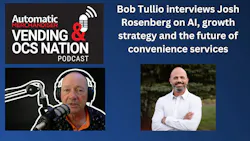



In this episode of Automatic Merchandiser & VendingMarketWatch’s Vending & OCS Nation, it’s the first installment of Bob Tullio’s two-part conversation with Josh Rosenberg, the founder of Forward Thinkers, who delivers an unfiltered look at the forces reshaping the convenience services industry.
Drawing on decades of leadership experience from his years at The Coca-Cola Company to building and scaling Accent Food Services, Rosenberg shares candid reflections on leadership, resilience, operational execution, AI adoption, automation and the evolving M&A landscape.
Rosenberg discusses the defining moments that shaped his leadership philosophy, including the challenges of scaling a multi-state operation, navigating business setbacks and overcoming deeply personal adversity.
His perspective on learning through failure and leading through uncertainty offers valuable insight for operators facing rapid change in today’s market. The conversation dives deep into why operational execution, not just vision, is the true differentiator for growth.
Rosenberg explains how clarity, cultural alignment and human capital optimization often matter more than simply adding more people or equipment. He outlines why operators must think beyond vending machines and begin acting as strategic retail operators.
Bob and Josh also tackle some of the industry’s biggest questions:
- How AI is moving beyond “advanced Google search” into true operational automation
- Where smart markets and smart coolers create real opportunity and where they’re overhyped
- Why operators must rethink supplier dependency and embrace more diversified product strategies
- How data-driven merchandising is redefining consumer engagement
- Why local and regional operators remain uniquely positioned to compete against large strategic consolidators
Finally, Rosenberg offers his perspective on the current M&A environment, the rise of private equity, and the emergence of entrepreneurial newcomers entering the market through smart retail technology. His “barbell effect” analysis paints a compelling picture of an industry simultaneously consolidating and innovating.
Miss an episode?
Listen to all past episodes of Vending & OCS Nation.
No time to listen? Prefer to read? Here is an edited podcast transcript:
Bob Tullio: On this episode of Automatic Merchandiser’s Vending & OCS Nation, I sat down with Forward Thinkers founder Josh Rosenberg for a powerful two-part conversation. In part one, Josh shares hard-hitting insights on AI, automation, growth strategy, the current operator landscape and where the convenience services industry is headed.
When you look back, Josh, what were the defining moments that shaped the leader you became?
Josh Rosenberg: That’s interesting. You know, I think there’s a lot — there’s a lot I could go through in a timeline of 30 years in this industry. But one, I think being attached to the right operators. When I was at Coca-Cola — and strategic leaders from not only the brands that have scaled now to become our global leaders, but also a lot of the independents that have since left — they taught me. They gave me vision. Coke and operators — innovative operators — had a vision for where the market and consumer is going to shift to, and we’re now living in that.
AI is another one of those transitional moments, but I think the greatest leadership challenge and learning I ever had was taking Accent [Food Services] through our challenges. We were on fire. Everybody in the industry couldn’t believe what we were doing, challenged whether or not it could succeed. I’ll let everybody else decide that measure. But we built an entity of multi-state, nearly 700 employees, and we were killing it, and a bad transaction that we paid for dearly. And then, economic downturn with COVID, changed that way of life.
And when you go through that kind of, you could call it failure or challenge, similar to the one I’m going through personally, which is another major milestone in how I lead, how I think and how I operate. You have no choice to either take it on the chin, accept the outcome, and learn from it to make you better and stronger, or you lean into it and fall. And I believe in fail fast, fail forward. And I got to take that approach in life now more than ever with the tragedy our family faced.
And that’s the key learnings is, I had a lot of people counting on me. I still suffer. from that loss because I had so much passion, love for the brand of Accent Food Services. But you don’t get to where you are today if you don’t look at it and say, “Things happen for a reason,” and learn from it. And that’s one of the biggest attributes and key learnings to how I lead and how I think about business and life.
Bob Tullio: You know, and it’s easy to say, but they all say, well, “You’ve got to move on, you know, if you’re a great entrepreneur,” and then that’s the reality of it. There’s no choice.
Josh Rosenberg: No, there’s not.
Bob Tullio: There isn’t. Now you’ve worked in large corporate environments, now you’re building something entrepreneurial with Forward Thinkers. What lessons from both worlds do operators need to understand right now?
Josh Rosenberg: Whether it’s your own business or your client’s business, if you don’t understand what everybody actually does, how they contribute, what they believe, their perception of why you do things, call it change management, but it’s their perception of why are we doing this? Why are you making my job harder or easier or better? To how we execute. What does it take to actually execute?
Because the thing I learned at Coke, and I love that brand, I just saw someone in an elevator at the hotel who had a Diet Coke shirt on. I still get just as excited as I did 13 years ago when I left. Coke was a great company. But, it was slowed by the fact that you never could get out the door with an idea because the idea was bigger than what the team could execute.
When we launched Coke Zero, they said they wanted it on every vending machine in the number-one slot within 90 days. I had 2 million vending machines at Coke alone. Forget what we had in the industry. Nobody looked at the time, the operational challenge of how much time does it take to touch every machine? What’s your labor challenge? We were CDL at the time, so we had only so many hours. We had budgets. And there was no way you can make a change in those machines. We did the math. It was like a 4.5 year process. And I want to say it took us longer than that to get every machine done.
So big corporation: You get big ideas from the think tank. They don’t always translate into execution. And that can disrupt people at all levels of the organization because it puts downward pressure on them, and it reduces buy-in, it creates friction, and it impacts outcome. And I don’t care if you’re a small business or big business, that is number one to me. It’s cultural, it’s human capital optimization, and it’s grounded philosophy that a great idea is only as good as the people that can execute it
And that’s how we live, and that’s how we try to operate our business, and that’s how we try to support clients, because that’s typically their barrier for growth. “Why am I not growing? “People. They aren’t performing.” I get in, and I do these evaluations. I find out that it’s not people. It might be people in the way of outcome, but it’s typically process enablement, clarity of the role, measure and execution, and then outcome — being willing to adapt if your strategy has to change because a thought doesn’t always translate into results.
Bob Tullio: What inspired you to launch Forward Thinkers and what was the gap in the industry you were trying to fill?
Josh Rosenberg: Well, let’s be honest. First of all, it was, I didn’t want to work for anybody else.
Bob Tullio: There you go.
Josh Rosenberg: I had a choice and I did — I went in as a fractional leader. People often like, “Man, Josh is all over the place.” No, I wasn’t. It was all through Forward Thinkers, but it was hired gun. I’ll admit that. And I thought there was a need for that. But as it evolved, the thought behind Forward Thinkers and the reason I felt the industry needed it, and you’re seeing operators actually embrace it more than ever, is that we’re now at the forefront of retail and consumer. And it is hard to service the marketplace that we have already because of the demand, the micro or competitive nature of what we do to fight against each other for the dollar, and the supply chain deficiencies that we have, on time delivery in full, and operators are starting to think differently about their businesses.
It’s about process. Technology has given us data and insights that we can now translate into action and profit. And I saw a wedge there that was a gap, and still I think is a gap. Whether you’re selling your business or your exit strategy, I should say, is to ultimately sell your business because you don’t have a succession plan or that’s your retirement plan, or to grow your business and compete in a marketplace that we’re now competing with all retail for a consumer dollar.
And that takes a lot of thought leadership — much different than just putting it on the truck, selling those core brands that we’ve always sold because they paid us for the space or they commanded the capital and force consumer consumption because consumers don’t have to be forced to what you sell anymore. They’re going to dictate what they buy because they have so many vehicles to do it conveniently. And that’s the opportunity. That’s the wedge we try to support and helping companies grow their business.
Bob Tullio: It seems like your company, Forward Thinkers, certainly is built around leadership, culture, technology, certainly growth strategy, not just vending equipment or products. Do you think the industry is finally evolving from machine operators into strategic business owners?
Josh Rosenberg: Absolutely. And I want to be fair to our operators. We look at industry. And I remember back when I was at Coca-Cola and talking about where we are today with technology, and brand, and consumer, and closeness and relationship with our consumer.
In 09, we talked about the fact that we weren’t relevant brands. Operators didn’t need brands. They had no identity, and that was okay. But there was a group of operators, again, — both strategics and independents — who were saying “That’s not true.” It just takes that long to evolve the technology had to mature, the transformation had to happen, the change management had to be adopted. And it even took a merge or consolidation of industry to thought leaders that were in a position to execute it. I’d like to think we were one of them at Accent at the time, to actually bring us forward to where we’re now true retail-focused, consumer-experience driven. And it better be about right product, right place, and the right people to do the work backed by the right technology and processes.
So I don’t think it just happened. Like it wasn’t just a light switch. The industry has been driving here for a long time. I just think we finally have the collection of tools, technology, and ability to, with margin improvement, to reinvest in the business to get where we needed to get to.
And the cool thing is, we did it while fighting off the 7-Elevens of the world, etc., the Amazons, the Ubers that are trying to get into our space. And we still control the golden real estate. And it’s such a capital-intensive business, it’s still too much for them to enter.
Bob Tullio: Well, I’m going to ask you what you would advise a mid-sized independent operator today. But first, let’s talk about AI, smart markets, automation. What trends are real and transformative, and which ones are getting overhyped?
Josh Rosenberg: Well, AI is not going away. It’s evolving. It is a macro enabler that can improve speed-to-market, execution and outcome.
And that’s something we’re leaning into heavily at Forward Thinkers. We have a whole division and team that that’s all they focus on — building automation for companies, connecting a customer journey, connecting systems and controls and data so you can see everything through one lens. And then training teams because 60% of users on AI, still use it as advanced Google search, not as an efficiency or productivity tool. Again, validating that answer.
Smart equipment, I’ve been challenged by this one. I think it’s always been important for, I’ve seen it more — because of capacity of the cooler, and the cost and ROI — as an expansion opportunity, horizontal or vertical expansion, into new segments. I’m here in Chicago staring at a number of high-rise urban living facilities. Every one of them has an opportunity for a very diverse portfolio to place a smart cooler in the right place and to create public retail access.
When we put them in workplace, I think there’s a fit. If you’ve got a micro market that’s got high theft, there could be a fit there, but if you put it in high velocity, you also lose efficiency. So there’s a balancing there that we’re still learning.
One of the biggest challenges too, that we’re still up against, is we’re still dependent on 7 to 10 core suppliers. They control our space by controlling purchase. If you don’t purchase 14 SKUs, whether you need 14 or 6, then you don’t get this best value. And we still think that way. And you know what?
Somebody, we have to start breaking that. And there are operators doing it.
Pantry is a great example that you don’t need core brands anymore. What you need is local, regional, and some core, in order to reach every daypart and share of stomach. That’s the message to operators.
Utilize equipment and technology wisely.
Recapitalize your business to move away from the Coke and Pepsi machine or the dictated Frito-Lay position, in our snack equipment that we buy the capital for, and go out and look at brands that can replace them.
Because if you look at Amazon data and Walmart.com data, it’s not core brands anymore driving consumer transactions. It’s so blended and so diverse. Again, it goes back to you got to know your data, to know your consumer, to know your day part, to know your audience. But the operators who are doing that are going to be the ones that really turn into the future of retail.
Bob Tullio: We’re going to talk a lot more about M&A in part two of this podcast, but I want to get your take on the current landscape. You’ve got the big boys who are out there buying, not all aggressively right now, but for the most part, the old big companies are buying, and you’ve got large regionals that are buying, and you’ve got private equity, you’re telling me, that’s getting into the game.
And yet at the same time, you go to the NAMA Show, and you have the fireman, and the plumber, and the entrepreneur, who’ve decided they need to be in the smart market business. These folks are passionate about this business. They love the business. They’re trying to find their way into it. Certain companies are trying to facilitate a way into it — some successfully, some not so successfully. Does this excite you, this type of landscape that the market has right now?
Josh Rosenberg: Absolutely. I think you and I have talked before about the barbell effect of M&A. We’ve got — the middle’s been, it’s kind of been bent the barbell because you got the strategics that have invested heavily in M&A and consolidated the market along with private equity. There’s more private equity in the space than I think anyone realizes, both in Canteen franchisees and independents.
Then on the other hand, because of the mergers and acquisitions that have been done. Whether you got the firefighter that started out of their garage, by the way, they have a strategic advantage because they’re not tied to supplier. They’re not tied to historical equipment. They’re nimble. And financing is out there for them to get. And they’re also willing to go to new channels — multifamily and other urban retail placements because smart equipment allows them to go there. Gyms are a great example. I just talked to an operator who’s seen tremendous growth where we just used to have a beverage machine and all the LA Fitnesses, we’ve moved that to smart equipment, and without, I can’t share their data, but I will just say it’s a worthy ROI.
So you’ve got that speed to market, you got innovators kind of challenging saying, “You know what, multifamily doesn’t work well, it can work this way,” because multifamily isn’t what it used to be.
And if you step back, history is just repeating itself. I mean, the cycle of life always does. In this industry in the late 80s, probably more than 90s, when 20-ounce beverage machines were coming out and the bottlers were pushing to put one every 20 feet, operators were going in and seeing that multifamily and other segments were very healthy, but they deteriorated. Well, now they’ve come back.
The market has reinvented itself, and it’s created opportunity. And that’s what those small operators are doing.
And then we can’t forget the fact that it’s I think all three of our strategics do an incredible job, but there’s too big to do it right all the time. And people still desire local regional relationships because they’re more intimate. And that’s why you’re seeing these small operators now turning into middle market. And so M&A is not going to stop because the million or $2 million operator in COVID is now at seven, eight, $15 million operator.
I mean, I could name 10 of them that have scaled their business and are now prime. I know they’re a target list for everybody to acquire, but they filled the gap. Whether it’s through innovation, or whether it’s through consolidation, they’ve benefited. And that’s always going to occur. It’s just the cycle is probably shorter and more repeatable than it had been. It took us, you know, we were 20-, 25-year cycles. Now they’re probably five-year cycles.
Bob Tullio: That’s it for now. On the next episode of Automatic Merchandiser’s Vending and OCS Nation podcast, it’s part two of the Josh Rosenberg interview.
About the Author
 Bob Tullio
Bob Tullio
Bob Tullio is a content specialist, speaker, sales trainer, consultant and contributing editor of Automatic Merchandiser and VendingMarketWatch.com. He advises entrepreneurs on how to build a successful business from the ground up. He specializes in helping suppliers connect with operators in the convenience services industry — coffee service, vending, micro markets and pantry service specifically. He can be reached at 818-261-1758 and [email protected]. Tullio welcomes your feedback.
Subscribe to Automatic Merchandiser’s new podcast, Vending & OCS Nation, which Tullio hosts. Each episode is designed to make your business more profitable.