Gary Arwin on AI coolers, cashless payments and staying competitive as an independent operator
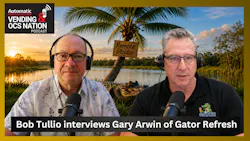




On this episode of Automatic Merchandiser’s Vending & OCS Nation, host Bob Tullio sat down with Gary Arwin, president of Gator Refresh, to discuss his eventful journey from the hospitality industry into convenience services, and how he transformed a tiny vending operation into a modern refreshment services company driven by innovation and customer service.
Arwin shared how he purchased a struggling 20-machine vending business in 2007, complete with old combo machines and operations run from a storage locker. He steadily evolved it into a full-service operation offering vending, micro markets, AI coolers, office coffee service, pantry, water and ice solutions.
The conversation dives deep into:
- How technology transformed Gator Refresh
- Early adoption of mobile payment systems and PayRange
- How he uses smart cooers from Haha Vending and Micromart
- Why AI coolers are reshaping the industry
- The growing demand for pantry service and workplace amenities
- The importance of diversification and data verification for new operators
- Driven by Gen Z and Millennials, trending products in his market such as Alani Nu, Celsius energy drinks and Premier Protein shakes
- Why independent operators still hold a major competitive advantage over national companies
Arwin also explains why he believes traditional vending machines are gradually giving way to AI-powered retail solutions and how operators can position themselves for long-term success.
If you’re interested in the future of vending, smart markets, technology adoption, and independent operator strategy, this is an episode you won’t want to miss. It’s a classic operator story.
Miss an episode?
Listen to all past episodes of Vending & OCS Nation.
No time to listen? Prefer to read? Here is an edited podcast transcript:
Bob Tullio: On this episode of Automatic Merchandiser’s Vending & OCS Nation, a leading Florida operator: Gary Arwin of Gator Refresh, who has over 35 years of experience in hospitality, vending, and refreshment services.
He says he’s built his career and his company around one simple principle: deliver exceptional service every time. As president of Gator Refresh, he leads a team focused on transforming the modern breakroom experience through technology, innovation and unmatched customer care. It’s a great operator story.
Gary, you spent years in the hospitality industry before entering vending. What first attracted you to the convenience services business, and what made you confident enough to take the leap into ownership?
Gary Arwin: Well, that’s a great question. So, after I worked in the hospitality industry for years, and then took a leap into being a partner in a supplier to the hospitality industry, I had figured out very quickly that I had made a lot of other people a lot of money, and I wanted to do something on my own.
The prior business I was in, the partners and I dissolved the business, and I went to a business broker and said, “Hey, I’m interested in purchasing a business, what do you have available?” I looked at the list that they had, and I saw a bunch of different businesses. Vending was one of them. And I kind of had dabbled in vending to the degree that when I was in the hospitality business, I installed some of those — I don’t know if you remember —those big gigantic gumball machines. I had a few of those in some hotel game rooms since I was in the hotel industry.
I was intrigued by the vending. I kept looking at the list and going back and forth. I decided, “You know what? Vending seems like it’s calling my name. Let’s see what’s available.” After looking at the list and the different companies, I found a small vending company. When I say small, I mean it was owned by a retired engineer who was doing it because his wife [wanted him] out of the house, to be honest, and so it wasn’t a big route. It maybe had 20 machines, but it was a good way— I thought — to get started.
I had already been in business and knew how to make money — and knew business pretty well. And, I thought, “You know what? Let’s start with this. Let’s see what happens.” So, that’s kind of what I did: I bought a small vending company to start with. That was 2007.
Bob Tullio: Right in the middle of a financial crisis — very interesting time, that’s for sure.
Gary Arwin: It was, but I was confident in my abilities, honestly, to run any that time, and so I wasn’t really that concerned.
Bob Tullio: When you first acquired the company, what did the business look like compared to what it is now today? I know it was small, obviously.
Gary Arwin: Yes, yes, it was very small. In fact, we had — and you probably remember this — we had all those, a lot of old combo machines called Antares machines, which were like the refrigerator door that opens up, and then you have a little slot where you plug a couple of quarters and nickels. Just old, old machines that we can laugh about now, but at the time, most of the machines that I bought and the locations — that’s what was there. Those were the type of machines that, back in the day, you would receive a postcard in the mail with a picture of you lying on a raft in your pool, and money was falling out of the sky, literally. I think they sold these machines in the ballrooms.
Bob Tullio: Yeah, this was your classic business opportunity equipment, right?
Gary Arwin: Exactly. That’s all they had were just those kinds of machines.
They had a few other older vending machines — and there are a few I wish I had kept today because they’re antiques, the old Pepsi machines from the 50s — but most of them were those Antares machines. They were working out of a storage locker, about an hour away from where I lived at the time. So, it was kind of not the greatest setup to purchase that, but it gave me the opportunity to see the vending industry. That’s kind of where we started.
Prior to me buying that company, I wanted a cool logo. And I’ll be honest with you, I probably went through 200 different iterations of our logo and had a company. We came up with a logo, and that’s kind of how we started.
And today, we’re a full-service refreshment services company, basically handling everything from vending, micro markets, AI coolers, coffee service, water coolers and pantry. We kind of came from the old Antares machines to where we’re at now.
Bob Tullio: Any of the existing locations still with you?
Gary Arwin: That’s an excellent question. There probably are some, but yeah… I believe there are, because if I looked at the list, I’m sure there are definitely some that we still have. Yeah, a lot of them were [not] at great locations, so we moved away from them once we knew what we were doing.
Bob Tullio: Yeah, that’s great that there are still a few original locations as part of it. That’s cool.
Gary Arwin: Absolutely. Got four routes now — I say four-and-a-half to five.
Prior to that, it was just me. I was the only employee for the first six months because I wanted to learn pretty much the entire business from top to bottom.
Bob Tullio: How many employees now?
Gary Arwin: 10.
Bob Tullio: You’ve been known as an operator who embraces technology. So, what were some of the early technology investments? And it sounds like you had to make a lot of investments to move the needle for your business?
Gary Arwin: We were actually one of the first in the country — if not the first — to deploy a device called a VUI. A VUI was what PayRange is today. It was a device that you attach to a vending machine that allowed you to use your cell phone to make a purchase. I believe that was probably sometime around 2012. We had this device, [and] we were testing it. It wasn’t exactly working 100%, but we saw that, and we knew we loved technology already, and shortly after that time, that company kind of went bankrupt.
At the same time, Paresh Patel, who started PayRange, came to us. I don’t know — he must have heard that we had this device. In fact, I think we were on one of the vetting publications on the cover, and he contacted us. and said, “Hey, I want to see if you guys are interested in participating in a secret exploration,” as he called it. He had a code name for it, which was the PayRange device. [He wanted us] to test it for [PayRange].
We said, “Absolutely!” Specifically, we tested it at Apple stores in the breakroom. At least [there], you were dealing with employees who were dealing with customer service on technology all the time. We started using them in those locations, and I think that was our first piece of technology that we started using.
Bob Tullio: What’s the advice you have for up-and-coming operators, especially people who have started recently?
Gary Arwin: One thing I would say is don’t put all your eggs in one basket, meaning don’t just go after car dealers or go after a particular industry, because if something happens with that industry, kind of like when COVID happened, you had all your eggs in one basket, you kind of were in a bad spot. That’s one thing I would tell them.
The second thing I would tell them is don’t believe everything that people tell you. People will tell you, “Oh, I have 150 employees, and I have seven days a week,” or they’ll just tell you different things. You have to vet that data more closely.
Bob Tullio: Yeah, we’ve almost gotten to the point now in many situations, the operators are being sold by the location to take on the business. I mean, do you see that kind of thing happening?
Gary Arwin: I see a lot of different things. You have to check the source. You have to check what they’re telling you because there are, unfortunately, a lot of unscrupulous people. You just have to vet everything.
Bob Tullio: What about from a technology standpoint? What advice do you give there?
Gary Arwin: Interesting that you asked that question.
So, I have another company that’s interested in being bought out. They’ve asked me to take a look at it, and see if I’m interested, and they don’t have any technology. I mean, they have credit card readers, but that’s pretty much it. They don’t know if the machine’s DEX. They don’t know really anything about it.
I would say that in today’s environment, in order to be competitive — in order to be quick and efficient — you have to have technology. You have to have a vending management software program. In addition, credit cards nowadays are not like they used to be, when some people started adopting them. Now, you have to have a credit card reader, and then you have to have the further technology of vending management software, to be able to track everything and keep track of it to be competitive.
Bob Tullio: In the early days, everybody said cash had to be available. Now, this doesn’t happen.
Gary Arwin: It doesn’t happen. When I look at reports currently from our VMS system, and look at the amount of cash versus credit cards, we’re somewhere around 94% credit cards now, and 6% cash.
And probably four or five years ago at NAMA, they came out with machines that didn’t accept cash. Everybody thought, “Oh my God, this is crazy. How could you do this?” And I thought the same thing to a degree. But as you go on in time, more and more people don’t carry cash, and everything is pretty much a credit card or debit card.
Bob Tullio: I remember talking to Kim Miros. Kim, of course, sold her business. And she said, she found sometimes that Florida — there were a lot of folks that were kind of conservative about technology in terms of clients. And it’s a little bit of a challenge to move them from vending to a micro market. Really a challenge to get them to embrace sometimes single-cup coffee brewers that have a lot of bells and whistles.
Do you find the same experience down there, or is that something that’s changing?
Gary Arwin: So, from Kim’s perspective, Kim was located in an area that I would call more rural, so to speak — kind of backwoods. There are still a lot of people today —from those kinds of areas — who are more skeptical of using a card and somebody tracking you. Because we do have some locations in her area. In fact, I referred multiple locations to her when she was operating over there. So, we do see it, but it’s honestly very rare.
Now, again, there are some locations — like for example, we’ve got some locations that are halfway houses. When those guys are on the work release, they’re paid in cash. So, they’re not allowed to have credit cards in some of those [locations,] so those, you’re going to see cash. But overall, there’s rarely any cash these days.
Bob Tullio: Let’s talk a little bit about the scope of your services. Obviously, you probably still have some vending, correct?
Gary Arwin: Oh yeah, absolutely.
Bob Tullio: And micro markets, you’re into micro markets.
Gary Arwin: We are, yes.
Bob Tullio: And smart markets?
Gary Arwin: Absolutely.
Bob Tullio: So you’ve embraced smart markets in the right locations. How about OCS?
Gary Arwin: Yes.
Bob Tullio: Point-of-use water.
Gary Arwin: Yep.
Bob Tullio: Ice machines.
Gary Arwin: Yes.
Bob Tullio: Wow, you got it all. And are you finding particular growth in one area? What area is really exploding? Is it micro markets?
Gary Arwin: It’s a combination of micro markets, but more so the AI coolers. In fact, we’ve put in probably 30 AI coolers in the last six months. I see the growth there. I see vending machines dwindling. I don’t think they’ll ever go away, but I see the vending kind of machine — the old vending-style machines — dwindling, and the AI coolers picking up, the micro markets, and then all those other services that you mentioned
I think, you know, companies… COVID is long over, but you still have some people working from home. They’re still fighting, trying to do the “You got to be at the office three days a week, but the other two” — which is usually Monday and Friday — “you can work from home.”
They’re still trying their hardest to get people back into the office. And so, those kinds of companies are demanding something — anything, coffee service, the water coolers, ice machines, even pantry service — to get them 100% back in the office. So, I think the growth is in those areas, but the vending…. Again, I think it’s always going to be there, but it’s definitely on the downside.
Bob Tullio: So you’re really seeing some pantry service as well.
Gary Arwin: We’re starting to see it. California obviously has embraced it a lot more, has the big companies that are trying to recruit talent, and they’re able to spend more money on the pantry. [In Florida,] we’re just now starting to see pantry come more and more in our market. So, I think it’s a great opportunity because you’re basically delivering cases of product. The companies are loving it, the ones that are doing it.
Bob Tullio: That’s great. Pantry is wonderful. It sounds like you’ve definitely made a significant investment in smart coolers.
Gary Arwin: Yes.
Bob Tullio: And I hear from a lot of operators, “Oh man, they’re so expensive. They’re so expensive!” So is this move being driven by competition? Is it being driven by locations asking for it? Or is this just something — and if this is the answer, I tend to agree with you —is this just something that gives you a competitive advantage?
Gary Arwin: Well, it’s a combination of things.
One, it is a competitive advantage because not every one of my competitors is embracing that.
Two, it’s new, it’s different, it’s exciting for a location.
Three, it allows you to offer a combination of things in one unit: cold food, regular snacks, drinks. So, you can sell more out of that — I’ll call it a device — than a traditional vending machine. And in a location, sometimes when you have a snack machine and a drink machine, you might not really need the snack machine, but they want four or five items. So, this allows you the opportunity to do all the drinks that they want, plus some of the snacks that they are eating, and add a few pieces of food in there, all in one unit.
But when they say it’s too expensive: If an operator looks at the actual cost of a vending machine these days versus an AI cooler, to be honest, the actual AI cooler is less than the vending machine.
Bob Tullio: Makes sense. Does it give you more leverage with the customer when you come in with this expensive piece of technology? You’ve mitigated the theft issue completely. It puts you in a position, I would think, where you’d say, “Hey, if you want this, here’s what we need to see.”
Gary Arwin: Oh, absolutely. Everyone that we’ve even approached about it is excited about it, sees the potential, sees the fact that they can have all these different products in one piece of equipment, and have things that they’ve never had before. Most of my potential customers are very excited about it. Even customers who have vending machines now are like, “Well, what happens to the vending machines?” And in some cases, we remove them completely. And in other cases, we’ll leave maybe the drink machine or the snack machine and put the other one in, or we leave both machines and again, give them more options. So, it just depends on the location. But so far, everybody we’ve spoken with is actually in love with these things, to be honest.
Bob Tullio: Who is your technology partner that you work with when it comes to smart markets and smart coolers?
Gary Arwin: Another great question. So, right now, we have two. We’re working with Micromart, which, I believe, if you ask me, I’d say that’s the Cadillac in terms of the look of the equipment, the quality of the equipment, the features of the equipment, with the screen on top, the digital price tags. And it’s a -40°F cooler, so it’s more or less top of the line.
And then you’ve got the Haha coolers, which we have probably half-and-half of both of those.
The Haha coolers look nice. They don’t have all the bells and whistles, but they integrate with Seed or Cantaloupe, which at the moment, the Micromart version does not. So, you know, it depends on where you’re putting it. If you’re putting it in, for example, a high-end car dealer, then the Micromart might be a better fit. But for most locations, either one would work.
Bob Tullio: What are you seeing in terms of trends right now, product trends? You’ve got multiple generations in the same office now, which is kind of an interesting situation. There are a few Baby Boomers left, but you’ve got a lot of different generations kind of getting dominated now by Gen Z and Millennials. Is there a product trend that you have identified associated with the changing demographic?
Gary Arwin: There is. So, you know, social media kind of dictates where everything is going. And a lot of the kids are seeing things like energy drinks that are clean or healthy, like Alani New or Celsius. They’re looking for, you know, ready-to-drink protein shakes like the Premier Protein shakes, or hard-boiled eggs, fresh items like carrots with hummus and guacamole, and a whole range of different things they’re looking for. And I think they’re seeing these different products and they’re saying, “Oh, we want those items now!”
You know, sometimes they sell, sometimes they don’t. But those are kind of things that we’re seeing right now that are hot and trendy, so to speak.
Bob Tullio: They certainly want protein. There’s no end to the demand for protein.
Gary Arwin: That is true. Yes.
Bob Tullio: When you look at an independent operator like yourself, you've got to be facing a lot of large regional and national companies. What advantages do independents still have today over those folks?
Gary Arwin: Oh, the list is endless, to be honest. I get asked that question all the time. Many advantages.
If somebody has a question or a decision on doing something, and you’re with a national: You’re talking to a national company, they’ve got a [process]. [Maybe] they can’t answer your question right away. Whereas we can make decisions on the spot. So, we’ve got quicker decision-making, better, faster customer service and more product choices.
We have the ability that if someone says, “Hey, I got to have this product,” we can just go out and get that product, whereas someone else has to stick to a defined planogram.
If somebody isn’t happy with an agreement that we put together, we can easily modify that agreement on the fly. Whereas someone else has to go to some corporate office and ask questions.
There are times we don’t even do an agreement. We just do a handshake agreement, where I look someone in the eye, and say, “This is what we’re going to do for you. If there’s a problem, you let us know. If we can’t fix it, we’ll take our equipment out and move on.” But larger companies can’t do all those kind of things.
We’ve got faster turnaround times. If someone says, “I’ve got to have vending machines in two days,” well, the big national’s not going to be able to do that. But we adjust our schedule on the fly, and no problem, we can take care of that. So there’s just a whole host of things that we can do that the big nationals can’t do.
Bob Tullio: And plus, they know they’re dealing with Gary Arwin, and he’s the ultimate decision-maker, and that can’t hurt.
Gary Arwin: That can’t hurt, you’re right.
About the Author
 Bob Tullio
Bob Tullio
Bob Tullio is a content specialist, speaker, sales trainer, consultant and contributing editor of Automatic Merchandiser and VendingMarketWatch.com. He advises entrepreneurs on how to build a successful business from the ground up. He specializes in helping suppliers connect with operators in the convenience services industry — coffee service, vending, micro markets and pantry service specifically. He can be reached at 818-261-1758 and [email protected]. Tullio welcomes your feedback.
Subscribe to Automatic Merchandiser’s new podcast, Vending & OCS Nation, which Tullio hosts. Each episode is designed to make your business more profitable.