Aaron Lawton’s intentional approach to breakrooms is driving his success




Early in his career, convenience services operator Aaron Lawton used books on tape to enter the world of real estate investing. While doing that, he worked as a vending route driver, starting early and tending to his rental property in the afternoon. Ultimately, he decided that he hated real estate but loved the vending business.
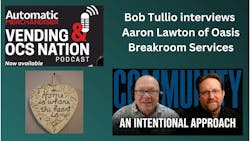
In this episode of Automatic Merchandiser and VendingMarketWatch’s Vending & OCS Nation podcast, Aaron Lawton, president of Oasis Breakroom Services, sits down with podcast host Bob Tullio. Lawton shares his perspective on how deliberate design and thoughtful amenities can turn break spaces into vibrant community hubs that attract and retain top talent. He strives to create a “heart of the workplace” atmosphere.
Lawton is focused on turning traditional breakroom spaces into intentional venues that become a culture hub and a tool for HR directors, promoting onboarding, employee happiness and ultimately, retention.
He loves the convenience services business, especially interacting with clients and end users across the spectrum. As a listener, you will find his enthusiasm for what his company does and his commitment to an intentional approach to be contagious.
It’s a big reason why Oasis Breakroom Services is a success.
No time to listen? Prefer to read? Here is an edited podcast transcript:
Bob Tullio: Our guest is Aaron Lawton of Oasis Breakroom Services in Boise, Idaho. Aaron calls himself the facility director’s go-to guy, the HR people leader’s secret weapon. It’s all about creating intentional breakrooms that engage, reward, energize and recognize their team members.
Aaron really gets it. He understands that what he does as an operator, in terms of putting a breakroom experience together, has a significant impact on a company’s culture. And that approach is helping drive the success of his business.
Just after 2008, while working as a route driver, he made an important career decision.
Aaron Lawton: I decided I should get into real estate — as a lot of people did back then. There were a lot of —I’m going to age myself here, but — books on tape about how you could buy some money down. And I know I’m that many years old, so… but I did. I went out, and I bought just a whole bunch of doors, as they call them — a bunch of rental houses — and took a job as a vending driver because I could start that very early in the morning. And by the time I was done, I could go clean a yard, or whatever I had to do for the real-estate thing.
Well, as it turned out, I hated real estate. I hated being a landlord. I hated just so many things about it. Just was not the business for me.
But, fortunately, I absolutely fell in love with vending. That time in the breakroom was just the coolest thing. I love the movement of it, of the physical but not backbreaking work of being a route driver. I absolutely just loved [it]. I love being in a breakroom where, you know, in the same 10-minute span, I could speak to a CEO, and then, a minute later, I’d be talking to custodial staff or an intern or a manager — whatever levels people were in the company. And I just absolutely loved that.
And so, I went to my boss at the time. It was a division of a food service company, and he was managing two different departments. I told him, “Hey, why don’t you go manage that other one, and I’ll take this one from here?”
And it worked out well. We grew the business a lot over the next 10 years. And then they started expanding nationally and started turning down more and more of the clients that I was bringing to them, including the largest employer in the state of Idaho — which in 2010, was a multi-million dollar vending and coffee account.
And so, I saw the writing on the wall: That we were kind of at our ceiling. So, I quit that job and started Oasis. This was also right as [micro] markets were emerging, and I saw the potential for that, and that’s the path that I wanted to go down.
So, we parted on very good terms. We still do business together between the two companies, but that’s how Oasis came to be. I did not want to get out of this business, and I also didn’t want to be captain. What I was going to do or have it as a secondary business, I just wanted to do this all the time.
Bob Tullio: Sure. So that was around 2010 when you launched Oasis?
Aaron Lawton: Yeah, just a little afterward. Yes, correct.
Bob Tullio: Yeah. Right at the birth of micro markets. So that was pretty good timing.
Aaron Lawton: It really was. And I’m sure that’s one of the reasons that the previous company didn’t want to keep on going because they knew that in order to survive, they were going to have to have a major reinvestment.
And again, it was a secondary line of business for them. And they’re a very, very large, very successful company in what they do in those manual food-service operations. So, can’t say that I blame them, but I get to keep on doing what I love.
Bob Tullio: So, you’re in OCS, correct?
Aaron Lawton: Yep.
Bob Tullio: Micro markets?
Aaron Lawton: Yep.
Bob Tullio: Vending? You still have vending?
Aaron Lawton: A little bit, not much, but a few, yep.
Bob Tullio: Pantry service?
Aaron Lawton: Yep.
Bob Tullio: Water systems?
Aaron Lawton: The flavored hydration, you know, water systems we do. We do a little bit with water. You know, we just partner with a local water bottler for the traditional five-gallon jug service, but we still do that.
Bob Tullio: Not a lot of point-of-use though.
Aaron Lawton: A little bit. If we do go in, that’s what we want to do. We’re not bottling water. So, we will encourage our clients — for a lot of reasons — to go to point-of-use water systems. Mostly, what we try to avoid is the five-gallon jug delivery.
Bob Tullio: Oh, God, yeah. That’s awful.
Aaron Lawton: That’s a lot of work, and a lot of space taken up, and for, yeah.
Bob Tullio: Back-breaking too, yeah.
You position yourself now as the facilities director’s go-to guy, and you also say you’re the HR and people leader’s secret weapon. So do me a favor and expand on that for me, please.
Aaron Lawton: You bet. So, I guess there are two parts to that.
“The facility director’s go-to guy” — most places, that’s still our primary point of contact, whether they’re the ones signing the contract. They’re the ones who we have that daily relationship with. And so, our core value is, “Be their guy.” Whatever it takes, that’s who we are — and we’ll “Be their girl” for some of our female associates — but that’s probably the most valuable thing to a facilities director is that. It goes back to the old NAMA idea of “clean, filled and working,” and that’s what the facility directors tend to want.
“HR’s secret weapon” is more about they want happy, engaged employees. You know, “clean, filled and working” is sort of the entry level to that. Go beyond that with products, services and programs that they can use — that’s how you become their secret weapon.
Bob Tullio: So, you find that you can really help these people achieve their goals, and that’s one of your objectives.
Aaron Lawton: Absolutely. Again, it goes down to creating that oasis for their employees. And that’s where those HR people really step in, or that’s where they really find the value.
We’ve created a training kit for HR and onboarding staff, so they know how to show employees how to get set up with their [breakroom] accounts and how to use it. We start every employee who’s new with a fixed-dollar amount. So, you know, their first sandwich or energy drink is basically on us.
And it also introduces — the breakroom feels different than every other room in the building. And so, during that onboarding process, if the HR team is using that, they can create that same feeling. You know, onboarding can be a little stiff. You have to learn to sit here, learn this policy, sign this form. But, “Let’s go to the breakroom for 10 minutes.” And again, “See this beautiful, bright market we have here. Look at these fresh sandwiches that are brought in multiple times per week. And by the way, here’s a gift certificate for you so you can have your first one free” while we move on to the next bit of drudgery.
Bob Tullio: That’s great. How big is your company now, people-wise?
Aaron Lawton: There are seven of us right now.
Bob Tullio: Okay. Well, so you’ve got a pretty lean organization. That’s good. And of course, one of the things you talk about, and you certainly got my attention with a post you did on LinkedIn recently. I thought it was very good. You talk a lot about intentional breakrooms. What does that really mean? How is it different from the traditional office breakroom?
Aaron Lawton: You bet. So, I’m going to age myself again here. I guess that’s what you do when you get over 50. But, I remember there were a couple of concepts when I was a kid that I would hear a lot. You know, the first one was that the way to a man’s stomach or heart was through his stomach, right?
Bob Tullio: Sure.
Aaron Lawton: The second one is — I don’t know if it’s still a thing, but when I was growing up, it was a fixture in so many households of my parents, my grandparents, my friends — that they would have hanging in their kitchen a sign that would say, “The kitchen is the heart of the home.” And, you know, it was that gathering place, with laughter, and everyone from the kids to the grandparents was there; friends would gather.
And, at some point, something clicked in my head: The breakroom had that same potential. And the companies that I saw with what I thought was pretty good, pretty strong cultures, of employees who liked going there, had that “heart of the workplace” feeling in their breakroom.
But, I also noticed that [it] was intentional. So, where companies were putting effort into that space, in a lot of different ways, that's what that looked like. But, that’s where I saw that vibe, if you will, feeling — in those workplaces.
You know, talking about traditional breakrooms, they didn’t change much for [years]. My grandparents’ breakrooms probably didn’t look that different from the ones I grew up in, right? You had a couple of very square vending machines, and for the consumer, not much changed, up until micro markets came along.
But then again, markets did come along. And suddenly, breakrooms were brighter; they were more cheerful.
When I founded Oasis, fortunately, was that idea of turning those breakrooms into that “heart of the workplace.” And again, the intentional part is just that I think companies that don’t treat it as an afterthought, don’t just maximize for how many chairs they can fit in there — that’s where I see some real deep culture, positive culture happening.
Bob Tullio: Give me some real-world examples then. I know you love to be a storyteller, so give me some real-world examples of how you took that concept of creating an intentional breakroom, and what was the before, what was the after? What are the kind of things that you put in place?
Aaron Lawton: You bet. I think the first place — for us, anyway — that it started with was design. Again, the transfer from vending to micro markets was brighter LED lights, open-door coolers, less spirals — less sticky notes up on the [glass] saying, “I need a dollar back,” or whatever.
Putting elegant surrounds and fixtures around them, and then taking that to an additional level.
You know, we work with pretty big companies — I mean, they’ve got marketing departments and brand standards. So, what can we do to turn it into a co-branded space that matches what they want their employees to sit in, and take pride in their work? So, how can we help you design that, so that it’s your culture, not just Oasis everywhere? It’s their breakroom, and we want to be part of that.
It’s programs, again, that the HR departments can use to welcome their employees, to reward their employees and — most of all, I would say — retain their employees.
Bob Tullio: And what’s the kind of reaction that you get when you step in there and really take an intentional approach?
Aaron Lawton: Positive. And again, it goes from the executives to the entry-level employees.
When we go into a new account, or even when we upgrade one of our original markets recently, we’re having big events. We want it to, again, have that feeling of “the kitchen is the heart of the home.” The breakroom is the heart of the workplace. We want people to gather there. We want to talk about — we’re breaking bread together. We want them to have a positive experience every time they go in there. So, we do a lot of things around rewards, incentives, working with HR teams for onboarding.
So, it becomes part of their culture from the day somebody starts working — heck, sometimes before the day that person starts working — for their new employer.
Bob Tullio: So, all those elements really matter, of course. Layout, furniture, food options, technology, ambiance. But the reality is, when it really comes right down to it, you can have a spectacular breakroom, but if the food isn’t good, that’s a problem. So how do you accomplish that? How do you take the food to the next level? At least, what is Oasis' approach in that regard?
Aaron Lawton: Absolutely. You know, coming from that background of being the vending division of a food-service company that made food from scratch, that was part of my Day One philosophy. I want to get as many high-quality food options in there.
So, we do have local manufacturers, I guess, making food for us that we’re putting there to go along with the traditional, you know, from-frozen stuff. And people still want those hot burritos and sandwiches and whatever else.
You know, the food is a critical element. And it’s, if you really want to create that experience for your clients — and really, their employees — I think food is, you know, what you build that around.
Bob Tullio: What’s the biggest mistake companies make when they’re designing an employee space?
Aaron Lawton: I would say that the most common one is they treat it as an afterthought. They’re optimizing every space in the building, whether it’s the conference rooms: what kind do we want? Sit-stand desks? How many people do we have in a common area? Who needs doors closed?
The breakroom and those common areas are often like, “What’s left?” And, they might make it pretty. They might optimize for the number of bodies they can get in there, like a conference room, for example.
But yeah, I think the main mistake that they make, when they’re designing those spaces, is just that they don’t start with a grand purpose in what they’re designing it for. And that doesn’t have to mean “We want it to be a great conversational space,” or “We want the food to be the highlight,” or whatever it is. Every company’s culture is a little different. But they aren’t designing those spaces often to fulfill that purpose.
You know, the old cliché, “They might put a ping pong table in there,” right? And there might be a place for that. But it’s just really, again, to borrow a phrase here, but — starting with why: What’s the purpose of that space? What do we want that to feel like when employees walk in there? I think that’s the most common one we see.
Bob Tullio: So, too often, you see the unintentional breakroom.
Aaron Lawton: Yes, we see a lot of those. And the banter that happens in those breakrooms is a lot different than the conversations being had in the intentional ones, for sure.
Bob Tullio: Has your intentional approach, do you think, impacted the way others do business? I mean, do you have a reputation in the market as having a different approach to micro markets?
Aaron Lawton: I believe we do. You know, we all have to raise our game to match what the others do. There’s just no way, again, there’s just… Running a business is hard, and so you have to match what your competitors are doing.
So, in this market, there’s a couple of us that, probably have the, I would say, have the majority of the share of business. And we definitely have to keep each other sharp, no question.
I mean, our strength is our relationships. We have relationships that do go back 25 years. And so, I would hope that they, our competitors, feel like they need to up their game.
Bob Tullio: I ask everybody this question. What’s the secret sauce at Oasis Breakroom Services?
Aaron Lawton: The secret sauce... I would say, “Be their guy.”
It’s that core value that I want them to be doing business with Oasis when I’m done. That may be 20, 25 years in the future, but I want those relationships.
To me, again, business is hard in this industry. Anybody who’s been in it for a while knows the ups and downs, where you land that huge, big account, and everything feels great. Then another location closes down, and you’re worried about, “My gosh, I really hope I don’t have to lay somebody off.” It’s a tough business.
So, to have those relationships that you go through with it, and you’re talking about each other’s kids. And I’m not in the breakrooms as much anymore, obviously, but when I do again, and when somebody’s coming up and giving me a massive hug because they haven’t seen me in six months or something, that is really what it’s all about.
And so, when our delivery team goes out there, I want them to be making relationships in the breakroom, and going through the same thing I did 25 years ago, of having that conversation with the CEO and then talking to the receptionist or the janitor, and really make the most of enjoying what we do.
Miss an episode?
Listen to all past episodes of Vending & OCS Nation.
About the Author
 Bob Tullio
Bob Tullio
Bob Tullio is a content specialist, speaker, sales trainer, consultant and contributing editor of Automatic Merchandiser and VendingMarketWatch.com. He advises entrepreneurs on how to build a successful business from the ground up. He specializes in helping suppliers connect with operators in the convenience services industry — coffee service, vending, micro markets and pantry service specifically. He can be reached at 818-261-1758 and [email protected]. Tullio welcomes your feedback.
Subscribe to Automatic Merchandiser’s new podcast, Vending & OCS Nation, which Tullio hosts. Each episode is designed to make your business more profitable.