Mastering customer service: How great service drives revenue growth
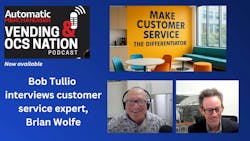
We talk a lot about sales on Vending & OCS Nation. This time, we shift gears and tackle something that may be even more important: customer service.
In this episode, host Bob Tullio sat down with Brian Wolfe, vice president of global customer service at Harman International and the leader behind JBL’s global customer experience operation, to talk about what really separates average service from a true competitive advantage. Together, they dig into three fundamentals every operator should be thinking about right now:
- Empowering your frontline team
- Being proactive instead of reactive
- Responding with speed
Along the way, Bob shares a personal story about a closet remodel gone sideways — because everyday frustrations are often the best business lessons. When sales oversell, when service says “there’s nothing I can do,” when response times drag on — that’s when loyalty is won or lost.
If you’re building a dedicated customer service team, trying to free your salespeople from client maintenance work, or simply looking to reduce churn and protect long-term revenue, this episode delivers practical takeaways you can apply immediately.
Because in our business, customer service isn’t a department. It’s your reputation.
No time to listen? Prefer to read? Here is an edited podcast transcript:
Bob Tullio: On this episode of Automatic Merchandiser’s Vending & OCS Nation podcast, it’s a change of pace — and certainly a change of topic. With my background in business development, we talk a lot about sales on this podcast. But today, we’re talking about customer service. And instead of interviewing someone who’s in the convenience services industry, I decided to look beyond.
Brian Wolfe was nice enough to sit down and talk about best practices in customer service. He is a respected speaker and customer service expert with over two decades of high level experience. He is currently vice president of global customer service at Harman International. But along the way, he’s served Deloitte, Accenture, Oracle and Salesforce.com.
Now, for over 10 years, Brian Wolfe has been using his background to lead customer experience operations for one of the world’s most reputable audio companies. I asked Brian to tell us about his professional world and how he became a renowned customer service expert.
Brian Wolfe: Most of the time, we refer to ourselves — because it’s our best-known brand — as JBL. So JBL speakers, headphones. They found me, and they were creating a new role as a leader for their customer experience part of the business. It was a great fit.
And now, here we are 11 years later, and I’m running customer experience operations for JBL globally, and our division is a $5 billion division.
Bob Tullio: It certainly sounds like you’ve got a vast customer service background. Our industry is all about customer service: It’s about serving both end-users and decision-makers, and it can be challenging at times.
And I see situations — I’m going to tell you a story. I always seem to find that there’s situations that occur in my life that just remind me of things I had to deal with personally in business. And maybe you’ll be able to relate to this — and I certainly know you’ll be able to give me some insights.
I did this remodel at my home in Palm Desert. And to cut to the chase, I put in a 180-square-foot walk-in closet. I mean, it’s really impressive. It’s the mother of all closets.
I needed obviously to appoint this closet with all kinds of cabinetry, and I got a $45,000 bid to do it. And I said, “No, that’s not going to happen.” But Home Depot came in and gave me a bid for $12,500, so they sold me on price. One small problem was that it would be eight weeks. It really turned out to be 10 weeks because you got the extra two weeks to schedule it.
They show up, and the closet has 5,000 little holes in it — you know, for the shelving in it. And I look at all the artist’s renditions, and the website and everything else, and there are no little holes. So, I call up and say, “Geez, what’s with all these little holes in my closet?” And they go, “That does come up as a problem. We have heard that before. And maybe we could do something for you and help rectify that problem….” Maybe throw a little gift card at it or something. But I’m not happy — I’m not real happy at that moment.
So, I’ll ask you this. From a customer service standpoint, when the sales department has oversold, or maybe the product description is a little bit of an oversell, or they misrepresent the final product a little, and customer service is holding the bag, what do you suggest to the customer service rep at that point? What do you do to try to turn a problem like that around?
Brian Wolfe: Interesting story. I mean, the first thing that comes to mind in the story — and you’re kind of alluding to it — this is kind of a more upfront, bigger picture. One thing [that can help resolve this], and not done overnight, is just having the different functional areas talk to each other from the beginning.
So in my experience — and we’ve come a long way here at JBL — customer service historically was looked at as more of a back-office type of function in terms of customer experience.
And, having those folks have a seat at the table from the beginning — when you’re designing products, understanding about [the] products, selling products. That’s kind of a more strategic [approach to] how to mitigate this type of situation from the beginning.
But then if it does come to that, we really pride ourselves on timeliness: So being fast in response to the customer, and then just going above and beyond to try to make it right.
Empowering the agent, and if it’s something that can’t be dealt with straight away, even if it’s a matter of coming back with more information, that’s all fine. But I think in the end, in order to kind of turn that around from a bad experience to a loyal customer, it’s really clearly suggesting to the customer that we’re going to get this sorted out, we’re going to take care of this, we’re going to go above and beyond to make sure things are right.
Bob Tullio: So there really has to be a lot of coordination from top to bottom.
I want to talk about the empowerment piece that you mentioned. When I was this really small company, my employees would say, “God, I really appreciate the fact that you empower me so much to get so much done on my own.” And what they didn’t realize is that I really had no choice. You’ve got to rely on people, and hopefully you’ve hired people you can rely on.
But one of the issues that I dealt with, again, on this closet situation, is that I go to the customer service level and say, “I’ve got a problem. Now you’re missing seven pieces. You’re telling me it’s gonna be another 10 weeks before this thing is done. Now we’re into a six-month closet,” and this person just says, “There’s nothing I can do.” How important is it to empower, to some extent, your frontline customer service people?
Brian Wolfe: I think it’s huge, and it makes me think, just this whole topic of empowerment, it makes me think actually of some personal experiences.
So, as I was thinking about our chat, I’ve moved recently, and even in the last couple of months, a couple of things, and I won’t name any specific names. But I’ve had two examples where if the customer service agent had been empowered to take care of things more themselves, it would have reduced friction, it would have reduced the time it took for me to take care of the situation.
There needs to be checks and balances in place. There needs to be procedure in place because there’s a lot of things going on in the world, and you need to have some form of control. But we really preach within reason, “Please go out of our way when we’re on with the customer to see what we can do to make this right. Take care of this situation in real time.”
If we heard through some sort of a survey or some sort of an escalation that our agent, for example, similar to your scenario, had said something along the lines of “There’s just nothing that we can do,” that’s not how we roll. That’s not acceptable.
And we say this a lot, and we’re proud of it, right? We are the first voice. We are the first interaction a lot of times between our brand, JBL, and the end user. And as the old saying goes, you only have one chance to make a first impression. Empowering them to hopefully result in a better outcome — it absolutely can be a game-changer.
To your point, if you have it, it could turn a poor experience into a good experience and a more loyal customer. If you don’t, it’s just going to create more frustration, more friction.
And the reality is, and this speaks to some of the topic of long-term value and things like that. If you don’t have it, you’re most likely going to lose a customer.
Bob Tullio: Yeah. And, the other thing is, all along the way, people are trying to do the best they can. But as the situation escalates, everything they do is completely reactive. How important is it to be proactive from a customer service standpoint, trying to get it under control?
Brian Wolfe: We try as much as possible to be proactive, to make information available, to explain things upfront relative to our products, so that ideally, we mitigate the customer service inquiry before it even needs to happen.
So, I think being proactive, that’s — to me — a shift in our industry in the last 10 to 15 years. Used to be always reactive: try to fix issues. Whereas now, I think the mindset has changed quite a bit to “Let’s avoid this difficulty — this challenge to begin with — if at all possible.”
Bob Tullio: Absolutely. You know, I still don’t have a closet. That’s the bottom line, Brian, but I’m sure in about 6 to 8 weeks, I’ll have one. And, hopefully, they’ll do something to try to turn it around.
But, it does say a lot about a company’s culture. If you are able to react quickly, especially a small company, I think. That’s got to be the big benefit of being a smaller company, something that can really level the playing field when you’re competing with larger companies. Customer service, empathy, speed, quick response — it can really make a difference out there as a competitive advantage.
Brian Wolfe: Absolutely. So, it’s interesting, I love this topic because again, personal experiences, even to this day, a lot of times when I try to contact customer service, there’s a long wait, it’s not super timely. And so, we really pride ourselves.
We have two main sets of metrics that we look at. One we call our speed metrics, and the other is our experience metrics. We use an industry standard called Net Promoter Score to measure the experience. And then on the speed side, for me personally, when I have to wait, I immediately get frustrated. And all that makes me think about the company is, trying to save costs or trying to move away from actual human interaction and push you to another channel that’s more automated.
So, myself and my leadership — I always say to my team, “We’re quite fortunate because our overall leadership believes in this as well” — we put a real strong emphasis on timeliness. So whatever channel you’re using to interact with us, we’re going to do that hopefully in a very timely manner. So, I think the speed piece for me is — it’s kind of a fundamental piece.
Bob Tullio: For a smaller or medium-sized company, how important is it for them to establish some metrics of their own, even if those metrics are simply derived from quality control surveys on-site, face-to-face with the client? I mean, that can become a revenue opportunity, can’t it?
Brian Wolfe: Yeah, so when you’re smaller, you have the opportunity to be a little more nimble and empower people even more. So, I think it’s a critical success factor when you’re at the client’s site to listen to what they have to say and feed that back to your company on an ongoing basis. If you’re just selling and you’re not listening to what they have to say —either about the product or about your service — I think that’s a real big mistake if you’re not constantly listening to your respective end user and customer.
Bob Tullio: Let’s talk about LinkedIn. You’re out there, you’re reachable. If somebody has a JBL clip that they’re not happy with, it’s conceivable they might reach out to you directly. Now, I reached out directly to the head of customer experience at Home Depot. He never responded to me, and he’s a Harvard graduate, so I’m a little disappointed.
So, Brian, what happens when somebody reaches out to you on a product? What do you do? At least you have a place to send it, right?
Brian Wolfe: Great question. Well, number one, Bob, if they reach out to me, I will get back to them for sure. [I’ve had] a couple of recent personal experiences where frustration with front-line customer service, many handoffs, a lot of instances of being told no, taking up a lot of my time, a lot of frustration, as I said. And so what I did is, I took matters into my own hands — and this is a newer thing for me.
Given my role, and to your point, my title, for example, out on LinkedIn, I’ve gotten very adept at searching on LinkedIn in a matter of minutes. An internet service provider and a major airline. I’m searching vice president, customer service, XYZ company, and I’m finding the people straight away.
Both times that I’ve done this recently, within 12 hours — I mean, within half a day — the respective people got back to me and let me know, based on an e-mail or my name or a ticket number or whatever the case may be, that they were going to get this taken care of straight away. So, that ended up being a good experience. And I’m glad that the person got back to me in a timely manner. And the unfortunate part that we’ve also touched on is that it’s just unfortunate that it got to that point.
Bob Tullio: Right.
Brian Wolfe: In one instance, I’m emailing the vice president of customer service at an airline, trying to get a baggage claim receipt. He doesn’t want to be dealing with that.
When I call customer service —or chat with customer service, or SMS, or WhatsApp with customer service — in my mind, I should have that receipt in a matter of minutes, almost in real time. So, the fact that there were multiple handoffs, the fact that — to take it full circle back to your Home Depot example, Home Depot is getting a lot of love on this podcast — you were told, “There’s nothing I can do about it,” that’s what just starts to make your blood boil.
Bob Tullio: Right.
Brian Wolfe: It’s such an easy transaction. And so, I’ll take that immediately back to my own team and say, “Hey, guys, this is what happened to me. How can we learn from this?”
Bob Tullio: Let’s say I’m a medium-sized business. I’m finally getting to the point where I’ve got a core of salespeople. And what’s typical in a small- to medium-sized business is your salespeople tend to be involved — a lot — in customer maintenance. And that’s a challenge. It’s a real challenge. It’s a great excuse not to sell, number one: I’m too involved with existing customers. There are so many downsides to it. So, there’s a point in the evolution of a company where you say, “I’m now putting together a dedicated customer service team to go out there and just make sure that my clients are happy.”
When you’re putting together a customer service department, what should the focus be on? Should it be on, to some extent, customer satisfaction, to some extent, information, learning what the customer is thinking about, and to some extent, business development? Where should the priority fall?
Brian Wolfe: Yeah, great question. So, now, let me be clear. Within our team, we always say, still the number one, two, and three priority is giving them a great customer experience. So, the sales from service is great, but that’s not the number one priority, but that is a way to generate some revenue.
I think bigger picture. And, it does seem to be a theme of our conversation today, is if we take care of these customers, that’s going to lead to loyal customers, repeat purchases, mitigate customer churn.
As I mentioned, in today’s world, so many options. There’s a lot of products out there where things are more of a commodity. People have choices. In order to keep that customer, in order to generate long-term revenue — consistent repeat revenue — I think it’s imperative to have great customer service, and give these folks a great customer experience.
About the Author
 Bob Tullio
Bob Tullio
Bob Tullio is a content specialist, speaker, sales trainer, consultant and contributing editor of Automatic Merchandiser and VendingMarketWatch.com. He advises entrepreneurs on how to build a successful business from the ground up. He specializes in helping suppliers connect with operators in the convenience services industry — coffee service, vending, micro markets and pantry service specifically. He can be reached at 818-261-1758 and [email protected]. Tullio welcomes your feedback.
Subscribe to Automatic Merchandiser’s new podcast, Vending & OCS Nation, which Tullio hosts. Each episode is designed to make your business more profitable.