Is your insurance keeping pace with your business?
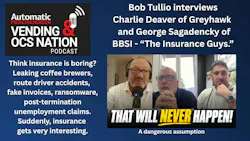



On this episode of Automatic Merchandiser’s Vending & OCS Nation, host Bob Tullio welcomes Charlie Deaver of Greyhawk Premier Insurance Solutions and George Sagadencky of BBSI for a practical conversation about protecting the business you’ve worked hard to build.
From startups placing their first machines to established operators managing employees and delivery routes, the discussion explores why buying a policy is only part of managing risk. Charlie and George explain the questions operators should be asking about workers’ compensation, employment practices, liability, business auto and cyber coverage.
Along the way, Bob brings the conversation directly into the convenience services world: What happens when a coffee installation leaks in a high-rise office? What exposure comes with asking an employee to drop off supplies in a personal car? What if accounting sends $50,000 to a criminal posing as a vendor?
The insurance guys also connect workplace culture, employee training and documentation to risk prevention and explain why “it will never happen to me” can be an expensive assumption.
Miss an episode?
Listen to all past episodes of Vending & OCS Nation.
No time to listen? Prefer to read? Here is an edited podcast transcript:
Bob Tullio: Hi, everybody, it's Bob Tullio. Welcome to Automatic Merchandiser’s Vending & OCS Nation, the podcast for the convenience services industry produced by Endeavor Business Media, a division of EndeavorB2B.
I'm a business development guy. Start talking about business insurance and I'm usually looking for the nearest exit. But I have to admit, Charlie Deaver of Greyhawk Premier Insurance Solutions and George Sagadencky of BBSI got my attention... leaking coffee brewers, delivery accidents, fake invoices, ransomware post termination, unemployment claims. Suddenly insurance gets interesting.
On this episode of Automatic Merchandiser’s Vending & OCS Nation, we're talking about protecting the business you work so hard to build. We explore the many risks that vending micro-market and office coffee operators can overlook, and why your insurance deserves attention as your business changes. Here's my interview with Charlie and George, who I like to call the insurance guys. What is a costly assumption owners make? Insurance wise, give us a real life example if you can.
George Sagadencky: Yeah, I deal with real life every day and Charlie knows this. It's buying cheap comp. It's going to the lowest common denominator. I pick up probably three to seven, eight accounts that I met a year ago or two years ago, where we were twenty thousand dollars higher, and they went down the cheap comp route and didn't have claims management, didn't have HR support, didn't have proper payroll training. So the biggest assumption is they're trying to get to the lowest common denominator. And I understand that. But you need to understand who is the team behind the premium that you're paying and what is your motivation?
Bob Tullio: Can you give me a real life example? I mean, a live scenario that you've actually dealt with.
George Sagadencky: We have met a client last year and when we meet clients, we go on job sites and we'll walk the job sites before we write anyone. And sometimes we'll do that unannounced. We're not trying to be the gotcha police. We're not trying to catch you. We just want to know that when the owner's on site, people are behaving properly, what are they doing when they're off site? And I went into a powder coat company, and this was during daylight savings time. And I was waiting for my meeting, and I saw this beautiful Porsche roll in and take up six parking spots. And I met with the owner and I liked him. So his rates had tripled in three years. And he had been in business thirty years and basically did not have increases for those thirty years. And that's highly unusual in any business. And I asked him, you know, what he thought was going on? And he said, I don't know. I brought in this new manager and I said, oh, can I meet him. And I bring in the manager. And it's the kid who took his Porsche and took up six parking spots. And I said, how many employees work here? He said, thirty three. And I said, how many parking spots you have? He said, I don't know. I don't care. I said, okay. I let him go. I walked the owner out and I said, look, he's your problem. I promise you, he's your problem. You are paying three times the amount in comp because you have a management problem. And that's something that I can't really work with. Now, if you let him go and want to talk again, please let me know. And sure enough, he called me two years later and said you were right. And once I got him out, things have kind of settled down. And I'd like to have you take a look at this again. So oftentimes it's not the owner, it's the people they have in place. You know, people rarely leave companies because of the company. They leave because of bad management. And bad management leads to claims. Claims leads to cost.
Bob Tullio: How about you, Charlie? Can you give us an example of a a costly insurance assumption that owners make?
Charlie Deaver: I think in general, what I always tell people I hear a lot is this will never happen to me. It's not something I'm worried about. That doesn't happen. And we see this all over the place. You know, umbrella people don't love buying umbrella insurance, but you rear end the wrong person. And this is the most common example. You rear end an elderly person, you end a car with a bunch of kids in it. Your equipment tips on the wrong person. These are things that really can cost you your business if you're not insuring it. So we've seen a ton of claims where the umbrella has bailed out a company and we're not having it has sunk it employment practices. People for some reason, don't think they're going to get sued in California or these other states for employment issues. They happen all the time. And people go without the coverage thinking, I've never had it happen in twenty years. It's not going to happen to me and it finds a way to do that. So I think the negative assumption of it's not going to happen to me just because it's never happened is really a costly mistake to a lot of people.
Bob Tullio: I'm launching my first vending or coffee service business. What should I discuss with a broker before my first delivery?
Charlie Deaver: Yeah, I mean, these are good questions. I always point first when I'm talking to clients is, do you have transportation risk? Are you doing that with third party vendors that are transporting your equipment? What kind of foods? You'd be surprised what you can put in those vending machines. That can be a liability to you. And then really, we're just trying to say, hey, do you have employees or are you looking to scale? What's the what's the venture look like long term? We're just trying to understand a picture to go, how much do you want to grow here? And is this something where you have a lot of exposure in.
Bob Tullio: George? What changes when you hire your first employee?
George Sagadencky: Everything. So for every dollar you're going to pay your employee, you're going to pay approximately thirty five cents on each dollar. That is going to cover Social Security taxes, Medicare, soda, and food taxes. In addition to insurance, you're going to need to carry for that employee. From a worker's comp standpoint, is that first employee an admin? Is it a driver? Is it a warehouse? That percentage of payroll that you're going to pay is going to vary based on the on what they're doing and the job description. So it's important to get a job description in place right away and have a policy manual in place right away.
Bob Tullio: Charlie, I'm a one man show planning to just put out fifteen machines in the in a year. I've got a day job. So and there's a million people doing that right now because of advances in technology, of AI, smart coolers and all that stuff. Do I need insurance?
Charlie Deaver: Yeah. I mean, what's funny in our industry, the first twelve months of any business is actually where you see a majority of the catastrophic claims, because that's when you're learning and you're trying to figure it out and you make mistakes that someone who's been in the business for twenty years just wouldn't make. Yeah, absolutely. If you have one of those machines tip on somebody, whether it's your first day in business or your tenth, it is a catastrophic loss. And typically the new businesses, they don't have as much capital, right? They don't have all those reserves. They don't have all that experience. So early on, you actually have the most risk of the business folding and losing what you started. So and you still have fifteen machines that can impact people. If you don't like court and you don't have any money for it. You want to have insurance.
Bob Tullio: So yeah, I guess you have to treat it like a business because it is a business.
Charlie Deaver: It is one. Absolutely.
Bob Tullio: George, a good employee is hurt moving a heavy machine at a customer location. What happens next?
George Sagadencky: So it's different for every carrier. I can talk about what we do and and the mechanisms we put in place. So we have an eight hundred hotline and that person immediately calls the eight hundred hotline. On the end is a registered occupational nurse that's going to talk about the injury. They're going to ask them what happened, how they're feeling, and also where they're located. That's an important phone call because one, that call is recorded. And if that employee hurt his back and says, oh, it's not a big deal, I'm just going to put some aspirin on an ice and I'll call you in the morning and the next week or the next month goes by and he's claiming his ankle hurts and his head hurts and his wrist hurts. Now we go back to those calls and deposition to make sure that the injury is the injury that we're paying for and that we're treating. Once he calls and we make a determination, is he going to go to a clinic or is he going to go home and pack some ice? When they go to that clinic, they're seen by a doctor and an evaluation is done. Yeah, my back hurts. I do lifting in the warehouse. We're going to put him on modified restrictions. Meaning, hey, if his job's lifting more than thirty pounds, you can't do that anymore. We're going to have to find something else for him to do. Now, if it's so bad that he says, look, I can't go into work, my I can't get in the car and drive. We want to put him on something called modified work duty. And that's very important that we give that employee, if possible, something else to do, as opposed to sitting home and looking at all the eight hundred eighty eight legal commercials that are going to make everybody rich. That's what we're trying to avoid. Now, often owners have two or three employees and they said, look, I don't have anything for him to do. We have volunteer programs we can put them in, but we want to keep them doing something if it's possible.
Bob Tullio: So, it sounds like one of the most important things that has to happen right off the bat, whether it happens through your eight hundred system, which sounds great. Forms that need to be filled out is very definite. Documentation has to happen pertaining to the event, correct?
George Sagadencky: Anything that's above a paper cut or a little hurt shoulder, we're going to do an accident investigation. We're going to go on the job site. We're going to talk to the employee. We're going to talk to the employees around him. Hey, what happened here? What went wrong? Generally, I'd say 85% to 90% of our claims are people not following procedure or to Charlie's point, new employees that are learning a job where they don't have a great training program in place. There's always a reason. And what our goal is, is to learn from that and not have it happen again.
Bob Tullio: So, Charlie, if somebody else is injured or property is damaged, what additional coverage questions arise?
Charlie Deaver: Before I answer, I don't think people realize how difficult the system is in workers comp. You talked about what happens. You learn fast that it is not a pleasant place to be, and that you should try and take care of your people. And training programs are important. Okay? This also leads to your question of like, what else happens? There can be so many things where they weren't following procedures, they weren't trained properly. Driving claims are my favorite one to give. As an example, you have a worker's comp claim because your driver got hurt and they caused it. You have an auto claim and you can have all your property in the back of that truck that is also damaged, right? We've seen claims where all three policies respond at once. They're miserable. Right? So it just makes you think, hey, I need to protect my company and I need to do training. Well, I need to be vigilant that like, it's not just send people out in a truck and hope for the best. There is a right way to do this to make sure that long term, you don't have big issues pop up.
Bob Tullio: George, why isn't buying worker's comp the same as managing workplace risk?
George Sagadencky: Worker's comp is a no fault insurance policy that protects the employer from being sued by an employee. Managing workplace risk is a arduous process that happens from the very first time you hire somebody. If they're required to lift fifty pounds on a truck, are you testing them? Do you have cameras in your trucks? Do you have GPS in your truck? If you have a driver going eighty miles an hour and you see it on GPS, are you going to pull that driver in and remind them of your safety protocols that you talked about when you onboarded him? And then are you going to do something about it? That's the number one thing I see is employers are like, I can't find people and I can't lose people. But once that driver speeding around at eighty miles an hour and gets in an accident, it's going to cost them five times as much as it is to replace or discipline the employee when things arise like that. That's why the cameras are very, very important to have sound and have video on there. I can't tell you how many claims we've had where guys are texting. Oh no, I wasn't doing that. It's on the camera. like, come on. And those are things we need to defend arduous and fraudulent claims for the business owner. But it's setting the tone from the very beginning. Here's your job description. Here's the expectations. Please sign off on the safety training.
Bob Tullio: Charlie, I want to talk about employment practices coverage. Distinguish for me the difference between an injury claim as opposed to allegations of harassment, discrimination, wrongful termination. There's a big difference, isn't there?
Charlie Deaver: There's a big difference. And a lot of times, if you have one claim, you probably are going to get followed up with the other, which is unfortunate. Listen, an injury right? You say, hey, this guy hurt his back. Like George has mentioned common one that's going to be comp. That's a physical injury. But what we see a lot of times is if someone is not performing well and they get let go, they will find a way to say, hey, you've discriminated against me, you've wrongfully terminated me. And we see these a lot. George will know they come up with Post-termination worker's comp claims on top of that that says, hey, while I was working after you let me go, I'm going to sue you for my injuries that happened there. So they do go hand in hand. A lot of times together, employment practices is its own separate thing, and it carries a lot of risk just from a culture standpoint, which George also mentioned. There's a lot of culture built into that issue. So that's the big difference between them, their separate policies. One does not cover the other.
George Sagadencky: Post term claims are super important, Bob, especially from a business owner standpoint, because what that says is if I leave employment, whether it's my choosing or the employer's choosing, they have twelve months to file that claim. And generally what happens is they go on unemployment. It runs out after nine months, they haven't found a job, and they're going to say, well, I had a claim and the business owner is going to say, you never reported it. You never told me. Doesn't matter. They can still file that claim. And I will tell you, as somebody who deals with business owners all day long, eighty percent of the time those claims are because that company had bad culture.
Bob Tullio: Yeah. Corporate culture can save you money.
George Sagadencky: Yes.
Bob Tullio: I think that's why you need to keep the break room well stocked.
Charlie Deaver: It's a fair point. Yeah. I mean, we always talk about culture. It is hard to define it, and everyone uses that word. But you will know a good culture from a bad one when you're around it, right? Everybody's been like, no, I love my boss. I love my company. You can feel it. Yeah. They typically perform better and to no fail the guys that are tyrants and really hard to deal with and are really unfair to their people, they just see mountains of comp claims and employment claims to no fail.
Bob Tullio: I'm going to talk to you about a real life nightmare in our industry. And I was in the coffee service business for many, many years. And, and they do have ways to prevent leaks in high rise buildings. They have water blocks, they have leak detection equipment. And this stuff is absolutely critical to have. But a coffee installation leaks overnight, damages a customer's office. I have general liability. What still needs checking?
Charlie Deaver: Yeah. I mean, from my end this is the umbrella conversation, right? If you're in a high rise building on the tenth floor, and that water finds its way down to the next unit below it and the next unit below it, you have a huge liability issue. This is the part where people think it'll never happen to me and I don't need umbrella coverage. At a certain point, your general liability coverage runs out and the only way to get excess coverage to go for these big losses is umbrellas. And, you know, we see them as a really cheap way to cover catastrophic losses because they are. So this is the conversation of like one, did you have the right processes in place like those water detections? And you should have those all the time. But if not, and something weird happens. And by the way, it could not be your fault. It could have been an employee of that tenant that kicked something or that like was poking around, was shaking the machine no one would ever know. And it still falls back on, on you as the owner of that piece of equipment with, with the liability. So that's the most important conversation for you guys because there is risk. It's out there and it may not even be your fault, but you're going to pay for it.
Bob Tullio: Sure. Janitor moves the equipment, trying to clean. Next thing you know, the copper line breaks.
Charlie Deaver: Yeah. And what we also found very, very commonly is even before we could get out there to document what happened, mold mitigation people were in there tearing the place apart. I mean, so you're starting to lose evidence of who's liable. I mean, you've got to react pretty quickly.
George Sagadencky: Well, you mentioned leak detection. That's a great it's like GPS in advance. That's a great one. And my recommendation is everybody who installs does a video after of a coffee running. And look Amazon documents every package with a picture. Here it is on your doorstep. It's an additional five minutes. It's an easy step. Is it a magic bullet? Of course not. Is it a bullet in Charlie's tool case when he's battling the carrier? Yeah, that would be the big one.
Bob Tullio: You know, classic scenario. Hey, Joe, would you mind dropping off this box of sugar to the client on your way home. Just with your personal car. What kind of a risk is happening when that occurs?
Charlie Deaver: Yeah. So your big liability in that regard, if someone's in their personal vehicle work time is hired Non-owned auto. You as the company don't own that person's vehicle. You can't insure things that you don't own typically. So the way around that is hired non-owned auto. And so if that guy gets into an accident on the way there with a big case of sugar or equipment or whatever it is you, the attorney is going to go after, what were you doing? Why do you have all that equipment there? Oh, I'm on work time. I'm delivering for X, Y, and Z company. They are suing you guys now. Yeah, because that's work time. So if you didn't have hired Non-owned Auto, you would be covering that yourself. It would not be covered. The personal insurance for that driver is also their insurance, whether it's Geico or State Farm. They look at it and go, we don't do commercial. We are a personal insurance company. We are covering the driver and that's it. And they were on work time. We're going to exclude it so you can get yourself into a weird position. If you don't have hired unknowns.
George Sagadencky: And the exposure to the business owner is worker's comp, and how are they paying you? You know, he's on the clock. If he's dropping that off, is it at the end of an eight hour day and are they paying him overtime? And so it's wage an hour and it's definitely a worker's comp claim. And I'm sure that vehicle is not insured with three hundred thousand plus in liability, which is a big deal. If they get an accident, I'm sure Charlie will attest to that. I know it sounds so easy and so simple, like, hey, just drop this off. But there's so much exposure when you start to behave like that.
Bob Tullio: John Hickey, from Tech to Success tells us that on an average basis, he is seeing a weekly report of ransomware in our industry alone, a weekly report. So if ransomware shuts us down on Monday morning, what costs should we ask a cyber insurer about, and what kind of coverage do I need? What kind of cyber insurance coverage do I need?
Charlie Deaver: Yeah, that's a good question. So cyber is everywhere. And so obviously you guys and your industry are seeing it because you have more tech and more ability to run things electronically. But the world of cyber is so vast and a carrier can get it really wrong or get it really right. There's definitely interruption coverage, which you're talking about. And what happens if a hacker gets a hold of all one thousand five hundred of your units all over the country, or just in these dedicated areas, you need to pay a ransom to get it unlocked. Right. And that's a huge exposure. There's the just, hey, I'm losing income. My clients are pissed off that they can't use any of these machines for two, three, four, five days. There's so many things that you can look at and go. There's a ton of different, different disruptions in that cyber claim. There are a lot of good carriers right now that are handling what I would say, most of it soup to nuts coverage, but it's a little bit more expensive than you'd think it'd be because it's getting used all the time.
Bob Tullio: Now, what percentage of your clients would you say have cyber coverage?
Charlie Deaver: It's abysmal. It's ten percent to fifteen percent right now and it doesn't make any sense. And on top of it, we're just talking about the equipment. There are so many other parts of cyber that can impact your business, like, you know, cutting a false check or getting, you know, fish. So there's so many aspects to cyber that can hurt your business now and nobody wants to talk about it.
Bob Tullio: That's the strange part about why is that, Charlie, do people feel like they're embarrassed that they get hacked? I mean, they feel violated. They don't want to talk about it one hundred percent.
Charlie Deaver: Yeah. They just don't want to talk about, hey, this did happen to me and I had to cough up twenty, thirty, forty grand for a policy that probably would have been, you know, depending on the size of the company, they start at two thousand five hundred bucks. Yeah, yeah. And it makes you feel like an idiot. Also, it legitimately the, the thing I started with, it will never happen to me is so prevalent in cyber. I'm never gonna get hacked. No one's going to care about my little rinky dink company. That's what they have in their head. But really, they target the small companies more than anybody because they don't have as much defense systems and they don't have as much wherewithal. So yeah, it's just something that's a that's a weird, embarrassing story that they don't want to tell.
Bob Tullio: So if a fake vendor email tricks an employee into sending fifty thousand dollars to a criminal, is that the same insurance problem as ransomware?
Charlie Deaver: It's technically not. That's a but it's still a cyber policy that can pick it up. It's called social engineering. It's a it's a phishing email. And so social engineering is the coverage that you have to have to pick a claim like that up. We see these so often, we actually probably see these more than a ransomware attack, because it's easy to send out emails and masks that look like legitimate invoices. And your accounting department will just look at something that looks legitimate, cut a check and it's out. And that's a tough place to be because it's God knows how many others that that have happened. And if you don't have the right coverage, it's not covered.
Bob Tullio: George, you're the prevention man. What payment, approval and employee training procedures can help prevent this type of situation.
George Sagadencky: It's all about educating the culture of the company about what are their current processes. So this is the number one thing that keeps us up at night is we cannot afford to get hacked. We cannot afford to send out money. We get what are called internal ransomware emails that we do trainings on. They're two hours of trainings a year. And if I click on the wrong thing and it was generated by our company internally three times, I'm not going to have a job. So part of that is training and getting people to understand. If you look at a typical hack, there's a lot of similarities. You clicked on something that wasn't normal. Well, my CEO never sends me an email that says, hey George, I need you to approve this right away. That never happens. And that's generally the type of thing that comes on these attacks is it's getting you to click on something that you normally wouldn't do. And a big tell is the email. Like look at the email. Often Fedex is misspelled. Amazon is misspelled, approved this right away when there's a sense of urgency that's not normal to the day to day operation. That's a big red flag.
Charlie Deaver: And if I can bring up a topic that I know is overplayed, but AI is changing the way, you know, hacking is done as well. The payment processing, the the ability to cover a, a voice and make it sound exactly the same as your accounting person or your boss is real. So there are services that will do like, you know, the fake phishing that way. It's like, hey, you're training your people and making sure that they see what's out there. It is so important. It is changing significantly and they're getting so good at making it look like a legitimate invoice or a person within the organization.
Bob Tullio: That's it for now. On the next episode of Automatic Merchandiser’s Vending & OCS Nation Podcast presented in cooperation with VendVue. I sat down with Patrick McGinty, founder of VendVue, to talk about the company's evolution from an ambitious idea into an end to end sales solution with nationwide operator coverage. VendVue once had more opportunities than operators available to serve them. McGinty notes that the challenge has changed as the company has secured coverage across more than three hundred markets. Automatic merchandisers Vending and Ox Nation is produced by Endeavor Business Media, a division of endeavor B2B, and it is available on your favorite podcast platform. Subscribe and you will never miss an episode. Give us a like, leave a comment or give us a review.
Thanks for listening. Until next time, I'm Bob Tullio.
About the Author
 Bob Tullio
Bob Tullio is a content specialist, speaker, sales trainer, consultant and contributing editor of Automatic Merchandiser and VendingMarketWatch.com. He advises entrepreneurs on how to build a successful business from the ground up. He specializes in helping suppliers connect with operators in the convenience services industry — coffee service, vending, micro markets and pantry service specifically. He can be reached at 818-261-1758 and [email protected]. Tullio welcomes your feedback.
Subscribe to Automatic Merchandiser’s new podcast, Vending & OCS Nation, which Tullio hosts. Each episode is designed to make your business more profitable.
Related
 Mike Ferguson, VMAC: Don’t run your convenience services business without a backup plan
