Five innovation mindsets that can help operators grow faster

For convenience services operators managing vending, micro markets, office coffee and unattended retail programs, innovation often comes down to something practical: improving routes, refreshing product mix, testing new service models or strengthening customer experience.
Kaiser Yang, CEO and co-founder of Platypus Labs, says innovation is less about sudden breakthroughs and more about mindset, curiosity and disciplined experimentation. During a recent podcast, Yang shared a framework operators can apply to their businesses.
To unlock innovation, what skills should an entrepreneur try to develop?
Yang said when he speaks to audiences, as he did at the 2025 CTW event, his primary objective is to encourage people to rethink the challenges and opportunities in front of them. “I want everyone to believe passionately that they can unlock their creativity and tackle challenges in new and unique ways,” Yang explained.
For convenience services operators, that mindset might apply to:
- Improving underperforming locations
- Adjusting service schedules or replenishment models
- Expanding fresh food or premium beverage programs
- Using data differently to guide decisions
Innovation starts when routine assumptions are questioned.
“Roughly 80% of creative capacity is learned — it’s built through daily habits, not natural talent.”
What is the number one thing that holds people back from unlocking innovation?
Yang believes the single biggest inhibitor of innovation is fear:
- Fear of failure
- Fear of uncertainty
- Fear of judgment
- Fear of accountability
“You can ask all the questions you want,” Yang noted, “but if you can’t get past that fear-based approach, it’s hard to drive progress.”
In his presentations and book, Yang discusses the five core mindsets of innovators and offers practical takeaways.
Mindset 1: Believe every challenge has a solution
Yang said innovation must begin with a core belief: even difficult problems can be solved with enough creativity, energy and imagination. Without that belief, teams unconsciously limit their own outcomes before they start testing.
Innovation is a learnable skill
Yang cited a six-year Harvard study that interviewed more than 3,500 successful innovators, including Jeff Bezos and Michael Dell. The research found that roughly 80% of creative capacity is learned, not innate, and identified five daily behaviors that cultivate an “innovator’s DNA.”
Associating: Combining unrelated ideas to create new value. An example operators could try is to borrow loyalty program ideas from retail and apply them to micro market offerings.
Questioning: Constantly ask open-ended questions such as why, what if and why not.
“Heads up” time, or staying observant: Rather than staying buried in daily tasks, innovators deliberately watch how customers behave and how systems actually function. Operators can put this into practice by visiting both well-performing and poorly performing markets and observing how employees shop or use the vending equipment.
Experimenting: Run many small tests instead of betting everything on one big initiative. Yang emphasized innovation is usually built on “singles and doubles,” not home runs.
Networking for fresh perspectives: Look beyond the convenience services industry for viewpoints that can spark innovation. Operators can learn from foodservice operators or retail chains that may approach similar challenges differently.
One practical exercise Yang recommends is the judo flip — listing assumptions about a product, process or experience, then reversing them to unlock new possibilities.
He pointed to Porsche’s subscription program as an example. Instead of assuming customers must own or lease one vehicle, the company flipped the assumption and created a model where one monthly fee provides access to multiple vehicles delivered on demand.
Operators can use the judo flip using the same technique. First, list your assumptions, such as that routes must run on fixed schedules, that all markets need similar assortments, or that pricing should be uniform across locations.
Then, flip each assumption:
- What if routes were demand-driven?
- What if assortments varied dramatically by workforce type?
- What if pricing reflected site performance or premium placement?
Oppositional thinking often reveals opportunities hidden by habit.
Mindset 2: Burn the blueprints
Yang’s next mindset challenges companies to abandon the belief that current processes will automatically produce future success.
He illustrated this with the founder of Simply Gum, Caron Proschan, who questioned the industry’s reliance on synthetic ingredients hidden under the term “gum base.” Instead of competing directly with established brands, she rebuilt the product from scratch using natural ingredients, transparent labeling and premium positioning, effectively rewriting the rules of the category.
Mindset 3: Seek the unexpected
Yang said people naturally limit their choices too quickly, often settling on the first few ideas that seem workable. True innovation comes from pushing beyond those initial options and searching for unconventional solutions.
Mindset 4: Start before you’re ready
Yang emphasized that many organizations delay innovation while waiting for perfect conditions or complete data. Instead, the most successful innovators launch early, gather feedback and adjust.
Operators could apply this mindset by testing a new market concept at one location or by testing new technology with a single route. Real-world feedback accelerates progress more than extended planning.
Mindset 5: Fall seven, stand eight
Yang’s final principle reframes failure as a normal and necessary part of innovation. Setbacks should trigger learning and adjustment, not abandonment.
“The process of change… there will be setbacks along the way,” Yang said. “The best innovators continue to learn and press forward.”
“The future belongs to those who can use AI in ways that have not yet been imagined.”
Let’s talk about artificial intelligence a bit. Will people be less creative because of it, or will it further unlock our creativity?
Yang sees artificial intelligence as a powerful partner rather than a replacement for human creativity. AI can:
- Analyze data
- Generate research insights
- Improve forecasting and operational visibility
But meaningful innovation still depends on human imagination and decision-making. “The future belongs to those who can use AI in ways that have not yet been imagined,” Yang said.
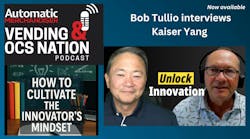
Tune into the podcast
About the Author

Bob Tullio
Bob Tullio is a content specialist, speaker, sales trainer, consultant and contributing editor of Automatic Merchandiser and VendingMarketWatch.com. He advises entrepreneurs on how to build a successful business from the ground up. He specializes in helping suppliers connect with operators in the convenience services industry — coffee service, vending, micro markets and pantry service specifically. He can be reached at 818-261-1758 and [email protected]. Tullio welcomes your feedback.
Subscribe to Automatic Merchandiser’s new podcast, Vending & OCS Nation, which Tullio hosts. Each episode is designed to make your business more profitable.