Inside Royal Cup: National scale, local touch and an old-school approach to office coffee service
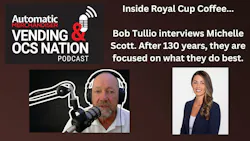




For more than 130 years, Royal Cup Inc. has quietly built one of the country’s most respected coffee businesses. While many convenience services companies have expanded into vending, micro markets and every imaginable workplace amenity, Royal Cup has taken a different path, doubling down on what it believes it does best.
In this episode of Automatic Merchandiser and VendingMarketWatch’s Vending & OCS Nation podcast, Bob Tullio sits down with Michelle Scott, director of national accounts for Royal Cup Coffee & Tea’s office coffee service division.
Michelle shares how the company has evolved from a regional coffee roaster into a national OCS leader without losing the relationship-driven culture that has defined Royal Cup for generations.
The conversation explores:
- Royal Cup’s customer-first philosophy
- Why remaining focused on office coffee service has become a competitive advantage
- How the recent Farmer Brothers acquisition expands the company’s national reach
- Why being a coffee roaster — not just a distributor — continues to matter in today’s premium coffee marketplace
Michelle also discusses workplace beverage trends, the growing importance of cold brew and employee wellness, Royal Cup’s sustainability initiatives, and the company’s commitment to giving back through programs like Neverthirst.
Whether you’re an office coffee operator, convenience services executive or simply interested in how a 130-year-old company continues to thrive, this episode offers valuable insights into building a business around quality, service and long-term relationships.
Miss an episode?
Listen to all past episodes of Vending & OCS Nation.
No time to listen? Prefer to read? Here is an edited podcast transcript:
Bob Tullio: On this episode of Automatic Merchandiser’s Vending & OCS Nation podcast, I sat down with Michelle Scott, director of national accounts for Royal Cup Coffee and Tea’s office coffee service division. Michelle brings 20 years of experience in the OCS industry to her role.
You don’t hear that much about Royal Cup, but there’s quite a story to be told about this 130-year-old roaster, OCS operator and food service supplier. Royal Cup isn’t all over LinkedIn making a big splash. But, with their recent acquisition of Farmer Brothers Coffee, they are a force in the OCS business.
What surprised me was their old-school approach, at a time when convenience services operators are striving to be all things to all customers, and I’ve been an advocate of that myself. Royal Cup is focused on coffee and OCS-related products which, according to Michelle, is what they do best.
Bob Tullio: Definitely, you folks are big in the OCS business. Do you agree that OCS is the best conduit in terms of getting into a location because of the emotional nature of the product, and the fact that people are a little more excited about coffee than they are maybe about vending, or maybe they are about some of the other aspects of convenience services? So, to what extent is it a conduit for you folks? And to what extent do you have an additional scope of services beyond coffee?
Michelle Scott: Yeah, I think that coffee — people are so passionate about it, and it’s so personal. And it’s a fun conversation. Even when people don’t drink coffee— There are so many times I’m talking to someone, and they’re like, “Well, I don’t drink coffee but….” They’ll tell me about a latte, or their child that drinks it, or their husband or wife that drinks coffee, and what they like. So, people have opinions about it, so I definitely think it’s a great way to open the conversation and open the door.
And now, it’s really become, not just that black cup of coffee, but there’s so much more in the experience in an office space. So, you’re looking at coffee, tea, cold brew, sparkling water, RTDs, snacks, fresh food and packaged snacks. And so, it opens the door to “Let’s talk about coffee, and then what else do you want to offer your employees? What other amenities are you looking to provide for them?” And then letting us really talk about that whole experience, not just the cup of coffee.
Bob Tullio: And Royal Cup offers a full refreshment program in terms of— Do you provide vending? Do you do micro markets? Do you do that sort of thing?
Michelle Scott: We don’t do vending and micro markets, no. We provide everything that could be in a break room that you would be giving an employee for free. So, snacks, paper products, sodas, canned drinks — anything that you’re giving away — but we don’t do the vending [or] micro market piece. We try to partner with different local vendors in different areas to do that.
Bob Tullio: That’s really surprising to me because I, you know, your company has really evolved. I remember Royal Cup, at least in my region, I saw Royal Cup as very much a food service company. And, you know, in terms of providing food service products, for the most part. We didn’t really compete with you folks on an office environment standpoint. Do you see the possibility that down the line, your company is going to move into being a full refreshment provider?
Michelle Scott: You know, I don’t know. There have been conversations in the past. Does it make sense? It really does change how we go to market. And as you referenced, we do have a huge food service side of our business. And so vending is just different, and micro markets are different. And so, I think that would have to be different discussions on how we want to manage the business. And right now, it just doesn’t make sense for us. And I think there’s so much opportunity out there for just solid OCS business without the vending piece. That’s really where our focus is.
Bob Tullio: So, you do full-on pantry service?
Michelle Scott: The word pantry, I guess, depends on how you define it. I would say no if we’re talking fresh food. You know, we don’t have refrigerated trucks, so we don’t do hummus, cheese sticks. We can do a full plethora of snacks, create the snack racks, but it’s not — depending on how you call pantry — it’s not the fresh food.
A big piece of it is we operate through routes, and a lot of our routes are both food service and office coffee: They will deliver to both sides. And so, adding those extra pieces—. That just [doesn’t] make sense in our business structure right now, [and they] just aren’t something that we’re going to add on.
But, you know, we really do find success in our tier of pantry: the snacks. And it’s funny because people always ask for the healthy snacks, but the big movers are the chocolate and the Doritos. And those are, you know, what we’re seeing move much quicker.
Bob Tullio: Well, if you can do that model, I mean, that’s fantastic. There’s no question that the OCS business is the best part of the business as far as I’m concerned.
How do you compete with the big guys that are out there that could offer a full suite of services when it comes to a national deal?
Michelle Scott: We go against them every day, right? Like, that’s who we’re going against are people who can do everything, and we are not doing everything. And, we’re leaning on partners to help if it’s something where they want to bundle everything.
But what I would say is, we want to do one thing really well. Sometimes, it’s hard when you put several different buckets into a program and try to do everything together. I’m not going to try to sell you a pen and a cup of coffee. I’m going to sell you the cup of coffee, and it’s going to be a good cup of coffee.
And so, that would be how I would compete against maybe a competitor who can do everything. And I’m working with different partners to do it, and really, focus on what we can do well, and make that be the selling point. You know, not focusing [on] what we can’t do or what we don’t do, but what we can do and how we’ll support them in service.
And, we can support nationally, but we really want to focus on that local touch too because I think that’s a differentiator for us, and then focus on being a roaster too, not just a distributor. We are a roaster, and that’s a big piece of our business. And that’s what we can talk through and be that competitive advantage.
Bob Tullio: You’re not just an operator. You have maybe a little more caring view toward the quality of the coffee, and the type of coffee that the client selects, and what their needs are. Is that how that piece works for you as a roaster in terms of the selling standpoint?
Michelle Scott: It can, yes. And, more and more — you spoke earlier on, you know, Gen Z and cold brew — the story behind the cup is important. You know, it’s no longer just, okay, is this a sustainable cup of coffee? But, you know, understanding kind of where it came from and being that we’re a roaster, we have access to really great quality products. It’s different than all operators in the OCS world. Not everybody can do that. You know, obviously we’re also a distributor, and we partner with other companies, and we sell other brands, not just our own. But being a roaster, that’s something that we can talk to when we’re selling.
Bob Tullio: It’s an interesting challenge you have as the national account manager, because I’m sure that’s the thing that comes up a lot. Everybody wants to put the whole package together, and you obviously have to have a great product, and a very dedicated approach to be able to compete that way. So, I give you a lot of credit in that regard. I’m sure it creates some challenges though, because when you bring the partner in, then you’re responsible for the partner doing a great job. And it’s one more thing you have to deal with that you don’t have control over.
Michelle Scott: When we’re looking at what’s the ideal customer, it’s not always the customer with vending for us. So, looking for someone who — are we giving out free packaged snacks? Are we giving out free sodas, or free canned LaCroix? That — for us — is what the ideal customer looks like. And so, we really try to focus on that when we’re prospecting and filling that funnel on who we want to go after.
Bob Tullio: Talk to me about Royal Cup’s legacy. You know, they’ve been around for more than a century. What’s the secret to staying relevant for that long?
Michelle Scott: You know, it’s very, very cool to be with a company that has been around for 130 years, and I think it’s really our values. And yes, they’ve changed over the years — and maybe modernized a little bit — but it’s really quality, quality products. That’s what we stand for. And integrity, doing what we say we’re going to do.
The people at Royal Cup are really the center of everything. So, people are so important. And then our service — [we] really focus on that gold level of service. And that hasn’t really changed. And that’s why we continue to be where we are and continue to grow because we really stay focused on the values.
Bob Tullio: So, fundamentals, all the way.
Michelle Scott: Absolutely.
Bob Tullio: And when somebody hears Royal Cup, what do you hope they immediately think about?
Michelle Scott: I hope they think, “They’re reliable, and they’re good people to work with.”
Bob Tullio: And when you talk about the original DNA of the company, to what extent is that DNA still alive today, even though the company has obviously evolved and changed?
Michelle Scott: Yeah, you know, I always say people do business with people, and the story behind Royal Cup is really, you know — that handshake, look someone in the eye, thank them for their business, ask how they can grow with each other.
And that’s still the DNA that we have today. So really working with people, having those strong relationships — I think that helps. Business changes and grows, and even our own customers will change and grow. But, if you have a relationship with them that they come to you and say, “Hey, Michelle, we used to do this, but we don’t really… It’s not hitting the mark anymore. What can you bring us that can move?” Having that relationship that they’ll open up to you versus, “Hey, we’re just going to go out to RFP, or we’re going to go look around because we don’t like our program anymore.” So, I think that’s really, that was our DNA, and it still is just having those relationships with our customers.
Bob Tullio: Coffee’s changed dramatically over the last certainly 25, even 30 years now. How has Royal Cup changed with it from a product standpoint, from a quality standpoint, and in terms of meeting the changing needs of customers out there?
Michelle Scott: Yeah, I mean, coffee is so different. Even just in my journey in office coffee, and seeing from Royal Cup where we were and where we are now, I think the biggest thing and how we’ve changed is we’re always making sure that we’re staying on top of trends and we’re following market research.
And then, how does that work?
So most recently, we came out with a line of cold-brew RTDs, you know, a Royal Cup line. And I think cold brew is a huge factor that has changed. You know, that’s something that’s not even just drunk when it’s hot anymore or just in the afternoon. Some people choose the cold coffee over hot coffee even in the morning, first thing.
And so, making sure that we’re staying on top of how the market and the industry changes, that’s a big piece. And I would say, seeing what we’ve done with the cold brew RTDs, is really cool and just kind of showcases: yes, we’re evolving as the beverage category evolves.
Bob Tullio: You talk about trends, and obviously cold brew is one of those trends, and cold drinks. You see what’s happening. I mean, you talk to certain people in this industry, and they say, when you’re talking about particularly Gen Z and younger Millennials, it’s all about cold drinks. But at the same time, there would have to be other trends that you’re seeing out there. Talk to me about the trends in the workplace, in office environments, that you’re seeing that are really prevalent today.
Michelle Scott: The beverage or break room experience is an amenity for employees. So, it’s not just, “There’s where the coffee pot is,” or “There’s where the water cooler is,” but it is a full amenity. So, it’s part of a wellness program.
So, we’re seeing the trends that [address]: what do employees want to stay in the office? And that’s not just the coffee or the cold brew, but it’s a full health and wellness amenity, and they’re weaving that into the beverage experience too. So, having lattes, having an afternoon pick-me-up, healthy snacks — you know, we’re speaking with HR managers, where in the past they weren’t really involved in the office coffee offerings, but it’s, “Hey, this is important. We want our employees to have actual breaks where they’re stepping away from a computer, letting their mind reset, having a beverage, having a healthy snack. It’s part of what we’re offering to the employees.”
So, for me, that trend is newer. That wasn’t always an important piece in the office. And it’s adding, for us, different products that we’re bringing on and that we’re offering, but different conversations that we’re having with customers and prospective customers as well.
Bob Tullio: One of the biggest growth stories over the last several years has been your continued growth, including the acquisition of Farmer Brothers. Why was that such a good fit for you folks?
Michelle Scott: Farmer Brothers does what Royal Cup does. It’s quality products and reliability and served through the same value propositions of route, equipment and service. So, the combination brings together almost 250 years of coffee roasting excellence, which is really cool.
So now we’ll have two roasting facilities, one in Birmingham, Ala., and the one in Portland, Ore., in the West. With our unmatched route network, we’ll now have roughly 340 routes and 200 service technicians. So, it really just leverages and complements what Royal Cup’s already doing with that national scale, local touch.
Bob Tullio: One thing that impressed me when preparing for the interview is how involved Royal Cup is in terms of giving back. Tell us about that culture and some of the programs associated with that.
Michelle Scott: Yeah, absolutely. You know, there are several that are close to Royal Cup’s heart.
One thing: Veterans Day parade. For example, we had a big group of Royal Cup employees kind of support that. Birmingham has one of the largest parades standing in the country. And so, supporting that with coffee and beverages is something that, you know, we’re not just saying that we are out there volunteering and giving back, but we’re doing it.
One, for me personally, [is] our Neverthirst program and partnership. It’s a Birmingham-based nonprofit that’s bringing clean water to communities around the world that can’t get clean water. And I think a lot of times we take for granted our easy access to clean water. And it’s a great story too, connecting to the coffee. You know, you can’t have coffee without water. And so, our whole entire Roar line of coffee — so it’s whole bean, single serve, tea, all of that — there’s a give-back to Neverthirst. So just by drinking the Roar line, you’re giving back to the Neverthirst Foundation. So, that’s really a huge kind of both philanthropic story but also give-back partnership that Royal Cup has. And I personally think [it] is a very cool, important piece of our business.
Bob Tullio: That’s it for now. As I mentioned earlier, Michelle Scott brings 20 years of OCS experience to the conversation. Accordingly, we’re going to dedicate another episode of the Vending & OCS Nation podcast to Michelle and her playbook for selling OCS. If you are in the OCS business or thinking about adding OCS to your scope of services, this is a conversation you won’t want to miss.
About the Author
 Bob Tullio
Bob Tullio
Bob Tullio is a content specialist, speaker, sales trainer, consultant and contributing editor of Automatic Merchandiser and VendingMarketWatch.com. He advises entrepreneurs on how to build a successful business from the ground up. He specializes in helping suppliers connect with operators in the convenience services industry — coffee service, vending, micro markets and pantry service specifically. He can be reached at 818-261-1758 and [email protected]. Tullio welcomes your feedback.
Subscribe to Automatic Merchandiser’s new podcast, Vending & OCS Nation, which Tullio hosts. Each episode is designed to make your business more profitable.