Joe Simonovich is relentless about elevating corporate culture



Is the breakroom becoming the most important room in the office? Increasingly, the answer is yes.
Fortunately for the convenience services industry, that’s creating a major opportunity. Operators are delivering more than coffee, snacks and refreshments. In the best locations, they are tasked with delivering an experience that will influence corporate culture.
Companies aren’t just asking how to stock a breakroom. They’re asking how to create a workplace environment that employees want to come back to.
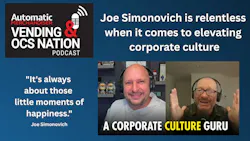
On this episode of Automatic Merchandiser & VendingMarketWatch’s Vending & OCS Nation podcast, Bob Tullio talks to Joe Simonovich of Daycast about his relentless efforts to elevate corporate culture.
Joe’s perspective is especially valuable because he came up through office coffee service, where he learned that every cup of coffee, every service call and every customer interaction contribute to something much bigger than a transaction. Joe talks about:
- How his days at Corporate Essentials with Judson Kleinman had a significant impact on his current approach to serving clients
- How he helped navigate Newsstand from the retail streets to the workplace
- How his new company, Daycast, is positioned against competitors like Canteen North America, Aramark, Sodexo and Crafty as a workplace experience agency.
Think of a workplace experience agency as a management company on steroids. They have the coveted opportunity to guide companies that are committed to a premium workplace experience for their employees. And, most importantly, they are prepared to spend handsomely to make that happen.
Tell the industry about your experience
If you work in the convenience services industry and have great stories, we want to hear them! If you’d like to join us on an upcoming podcast to talk about singular events such as your greatest achievement or your biggest failure, or an “ah-ha” moment that changed the course of your business, fill out the form and let us know.
No time to listen? Prefer to read? Here is an edited podcast transcript:
Bob Tullio: On this episode of Automatic Merchandiser’s Vending & OCS Nation podcast, I sat down with Joe Simonovich, an industry veteran who for years has been relentlessly focused on how convenience services can impact corporate culture in such a way that employees are happier, want to be in the office, and ultimately are more productive.
His newest venture, Daycast, is what he calls a workplace experience agency. I like to think of it as a management company on steroids that has the coveted opportunity to help guide companies committed to a premium workplace experience for their employees and prepared to spend handsomely to make that happen.
Simonovich and his partners at Daycast, formerly known as Newsstand, are not alone in this space. All of the big national operators — Canteen, Aramark, InReach — are offering programs designed to provide high-end account management. Crafty is a big name in the business. They went from being a happy-hour service, working out of the backseat of a Cadillac in Chicago, to a national presence in the food and beverage industry.
Joe, the reason why you’re such a good guest is that, unlike some of your competitors, your view of enhancing corporate culture comes from spending time on the front lines. It’s not an ivory tower perspective. While others in your space were filling vending machines and serving drinks at happy hours, you cut your teeth in the business working with the folks at Corporate Essentials with Judson Kleinman, a pioneer in the concept of using refreshment as a way to elevate corporate culture. Tell us about that part of your journey.
Joe Simonovich: The Corporate Essentials days in particular — I’ve learned so much from just so many great people that I had the chance to work with. We were rebranding Corporate Essentials back in 2014, and having a lot of different conversations about, “What do the products that we deliver represent?”
It was always kind of looked at as you’re delivering coffee, you’re delivering caffeine. So it’s productivity, it’s getting those extra hours out of people, and things like that. And we were working with a marketing agency, and we were tossing around a lot of different ideas — some more deep than others — but we’ve landed on this tagline of “Feel culture, work happy.”
No one had ever really talked about culture in the workplace, and the products that we deliver affecting those things. And we really honed in on that. But the secret to that was, as everyone and industry, the wider workplace segment, really focused on that word culture, it was always about the word happy. That was always the key word. And it’s that happiness —the little bit that the products that we deliver and the services that we provide — how they affect people in each one of those offices and what that little smile means. And as things kind of became more clear, the idea that that is workplace experience, that is something around workplace experience. And it’s a much broader topic, and it’s become a much broader area of focus. But it’s always about those little interactions and those little moments of happiness that you’re able to create.
Bob Tullio: What lessons from OCS still influence your thinking today?
Joe Simonovich: Oh, I think if I were to focus on one, I think the biggest thing that comes up probably, at least on a weekly basis, is that idea that nothing that you ever do is going to go completely to plan. [For instance, when there are problems, it’s that] the water source wasn’t turned on. The power is not correct for the coffee machine.
And knowing that those things are going to happen, also knowing that those things don’t necessarily matter to the customer. It’s how you deal with those things. It’s the next step. It’s what comes after that they remember.
Nobody remembers that the coffee machine went down for 10 minutes this morning. They remember that, “Hey, my operator was there to fix it before 9 o’clock. Everyone had their coffee. Everyone was happy. Everything went on.”
So, that idea that we’re doing things that are important, but things can go wrong and we know how to deal with those things. It’s something that always sticks with me, and I’ll deal with it, be upfront about it, be honest about what happened and deal with the situation because that’s what sticks with people.
Bob Tullio: Joe, what do operators understand and do very well? And what kind of opportunities do you think they are missing out on out there?
Joe Simonovich: Operators understand service.
I remember being in Chicago, probably going back 15 years, maybe longer, at a NAMA event. And there was someone from Harley-Davidson that was speaking at an early-morning Friday event. And he said, “Who in this room tells their clients that they have the best service?” And it was a Friday morning, so it was a little light on operators, but everybody in that room raised their hand.
There were a lot of things that stuck with me from that presentation, but the one thing that stuck with me was: Everyone in that room, everyone that’s a OCS business owner, everyone that’s an operator, does understand that their service matters.
And when it comes to missed opportunities, I think there’s a couple different buckets here because I think there’s the idea looking back on something as, yes, I missed it. Maybe I focused too much on OCS and didn’t pivot into pantry at the right time. Or, maybe I didn’t get on micro markets fast enough.
But every business is not meant to be a pantry service. So sitting there and saying, “Hey, we missed the pantry wave when it came through New York.” It may not be the case because you may be the best OCS provider, and you may be so good at what you do, that pantry just wasn’t the thing. And you may not have thrived in that space anyway.
Where opportunities can be missed, is by not realizing what’s going on around you, and not adapting the parts of what you do to fit the broader market of things.
Bob Tullio: Let’s talk about Newsstand, now Daycast. For anybody who doesn’t know, give me a simple explanation of what Newsstand is all about and how it’s evolved.
Joe Simonovich: Newsstand was, or in some cases still is, a retailer popping up really cool, really interesting retail locations in places like subway stations and in abandoned newsstands, which is where the name originally came from, airport kiosks, where we do still have some locations today.
It was a very interesting concept that did very well. When the pandemic hit, being that it was very New York City-centric, integrated with the subway system of New York, it went from about 85 locations to zero, almost overnight.
And being that it was a company that was backed by some investors and places that had workplaces. They said, “You know what, we’ve seen the success that Newsstand has had in brick and mortar. We want you to bring this up to the office.”
And that’s when I joined the team, when it was time to bring it up to the office and figure out what does Newsstand look like in the workplace. But Newsstand at its core has always just been about making whoever interacts with it, their day, a little better.
Bob Tullio: You transitioned the company into the office environment, into the workplace. And did that basically entail everything that an operator would normally provide? Or how did you do it differently?
Joe Simonovich: When I came on board, I’m a firm believer in that industry already does so many things great, and there’s great independent partners out there that are doing all these things. So, we started partnering with some independent operators to actually execute on the service.
So, Bob, Newstand, now known as Daycast, is a workplace experience agency.
And what that means is we’re a partner to the client from the idea of someone saying, “Hey, we need to improve our workplace culture. We need to make this place more fun. We need a change. Yes, we want more people in the office, but we want the hours in the office to matter. We want, when people are there, we want them to be happy. We want them to be engaged. We just don’t want them showing up to check a box.”
And it’s important to separate it from just a management company, because what a management company will do is come in, give you a great price on great service, and give you one person to talk with about the services that they offer.
I think where we really excel is in the two-way communication with our clients, and with our operators. We will tell you what our point of view is on what will work in your office. We will give you a playbook of, “Hey, you should be doing two events a month. One is food-based, one is totally geared around office interaction to help someone find their new work best friend.”
We will tell you these are the best snacks that should be in every location, but we will make sure that it happens. We want to have more conversations. We want to be more of a part of your business in seeing this all the way through.
You know, from the operator standpoint, we know our partners can execute all of those things on the ground and execute them better than anybody. We know that they’re already working to make sure that offices have the newest, latest, greatest snacks in the office. There’s not necessarily a why attached to it.
We’re going to give that why.
Bob Tullio: So, it kind of sounds like you’re a management company on steroids in the sense that you find clients, meaning locations, and I understand you have a little over 30 right now. You find locations all over the country. Is that correct?
Joe Simonovich: That is correct. And a lot of times they come to us through partnerships that we have, but we’ve done a fair job in bringing some on our own. And that’s something that we really haven’t tried to do to this point. We’ve been kind of building this thing.
Warner Music Group is a great example. [It was] a proposal that Newsstand had out forever. And as we were reforming, we said, “Well, what didn’t work? What didn’t work? Why didn’t this deal happen?” And we went back to them with a new proposal based more on this thesis of, “We are your workplace experience partner.”
We closed the national deal with Warner Music over a couple weeks. It’s been challenging at times, but definitely fun.
I feel like when you have the chance to step back and build the business while you’re in the business, it gives you a much clearer sense of where you’re going.
Bob Tullio: So you’re finding locations that are very focused on an enhanced workplace culture. You’re bringing operators into this mix that are willing to provide what needs to be provided to really enhance that workplace corporate culture. And it sounds like you guys are very hands-on through the whole process to make sure it happens. But it does go beyond the workday, doesn’t it? Because it sounds like you’re also involved in — because these folks are into events, they’re into really, really doing things that are special for their employees. Tell me about the secondary piece of it, where you guys are helping them out with after-hours events and such.
Joe Simonovich: Absolutely. And you know, that’s where a lot of the fun really starts —putting together these different experiences in the office, and working with gelato and affogato bars, and pickle-making classes, and another sip-and-shop event.
And these are really fun because while the snack-and-beverage programs are always on, every day, always there, these are those moments of surprise and delight. These are the things that not necessarily get people out of their comfort zone, but allow new connections to be made. These are the things that start creating those moments of happiness, and then attaching them to everything else that’s going on in the office. And that’s where it all rolls downhill.
Because when someone has a great experience at an event that’s put on, and that was brought to you by Daycast, the snack out of the cooler that has Daycast on the front of it, tastes a little better because now you have a great perception of this company that’s doing it for you and knowing that they’re there for different things.
Bob Tullio: So let’s say I’m an operator. I'm in a booming market like Phoenix, just an absolutely exploding market. And I’m in a competitive situation, and I’ve got a client who is very, very into workplace culture, having a great experience for their employees. Would it behoove me as an operator to say, “Here’s the extra piece that I can bring to the table. Let me bring in the folks at Daycast because they specialize in putting together programs for companies that are a step above. They maximize value, but they’re really focused on performance. They can help you with their special events.” I mean, is that something that Daycast can bring to the table for an operator?
Joe Simonovich: Absolutely. And for the partners that we’ve been working with, when you’re working with Daycast, when you’re part of what my friend Andrew called the Daycast co-op as opposed to the Daycast network a couple days ago, it really stuck with me because that idea of co-op really connects with people and it says that, “Yeah, we could do all these things, but we can’t do them without each other.”
Bob Tullio: Daycast appears to be building a model around the idea that amenities are no longer transactional. They’re part of culture and employee experience.
Joe Simonovich: The idea that they are not transactional is 100% at the core of things. These are things that are in an office — people interact with them every day — but they have come to expect them.
We’re really looking at that idea of you need these things. They are part of your culture. They are things that influence the employee experience every single day.
That term of “always on,” it always sticks with me because it kind of goes to the core of the convenience services business as a whole. That idea of always on, these are the parts that are always there, always available, always able to improve the employee experience and the culture as a whole.
Miss an episode?
Listen to all past episodes of Vending & OCS Nation.
About the Author
 Bob Tullio
Bob Tullio
Bob Tullio is a content specialist, speaker, sales trainer, consultant and contributing editor of Automatic Merchandiser and VendingMarketWatch.com. He advises entrepreneurs on how to build a successful business from the ground up. He specializes in helping suppliers connect with operators in the convenience services industry — coffee service, vending, micro markets and pantry service specifically. He can be reached at 818-261-1758 and [email protected]. Tullio welcomes your feedback.
Subscribe to Automatic Merchandiser’s new podcast, Vending & OCS Nation, which Tullio hosts. Each episode is designed to make your business more profitable.