From prospecting to follow-up: Putting AI to work in OCS sales

Just seven months ago, AI took center stage for the convenience services industry at NAMA’s Coffee, Tea and Water Show in Miami. Ethan King’s keynote had attendees buzzing, and as the event’s emcee, I had a front-row view of the reaction. One operator after another said the same thing: “After seeing this presentation, I know I have to lean into AI.”
Here we are today: Things have moved quickly. Artificial intelligence has become one of the most talked-about technologies in business, viewed by some as the future of everything. Others are more skeptical, and some are genuinely fearful.
For office coffee service (OCS), vending, and micro market operators, the reality is somewhere in between. From my conversations with operators, most are using AI much like the rest of America: as a more powerful search engine.
A tool to use
AI is not going to replace great salespeople. It is not going to build relationships, shake hands or close deals over lunch. What it can do, however, is dramatically improve the way operators identify prospects, prioritize opportunities, craft outreach and follow up with precision. In other words, AI is quickly becoming one of the most valuable prospecting and sales support tools our industry has ever seen.
To test this, I recently used AI to evaluate a target market many operators would consider appealing: automotive dealerships. On the surface, dealerships look like strong prospects. They often employ large teams of technicians, service advisors, parts personnel, administrative staff and salespeople, while also serving customers who may spend significant time waiting for vehicle service. Many also operate extended hours, bringing a substantial number of employees together in one location.
But, not all dealerships represent equal opportunity. This is where AI begins to shine.
The prospecting advantage
I started by telling ChatGPT that I was a convenience services operator, interested in selling car dealerships in the 818 area code, and I needed a list of their addresses, contact names and contact information. As the conversation progressed, I ended up with a detailed contact sheet, a map and a step-by-step prospecting and sales plan.
I learned that rather than simply pulling together a list of dealerships in a local market, AI can help operators qualify prospects based on highly specific criteria. For example, an AI-assisted analysis can score a dealership according to employee density, service throughput, customer dwell time, existing refreshment offerings, ease of decision-maker access and multi-location expansion potential. The prospecting results were impressive.
Try it out yourself. I used ChatGPT, but you can take your pick of AI services.
The level of qualification turns prospecting from a broad shotgun approach into a much more precise targeting strategy. Instead of saying, “Let’s call every dealership in the San Fernando Valley,” an operator can identify which rooftops offer the highest probability for success and prioritize accordingly.
The messaging advantage
The benefits do not stop there. One of AI’s most practical applications is its ability to tailor messaging to specific verticals. Selling to an automotive dealership requires a vastly different conversation than selling to a manufacturing facility, hospital or distribution center.
A dealership-focused, AI-generated outreach sequence might emphasize business outcomes that resonate with operations directors and general managers. For example, AI can instantly generate outreach messaging built around a dealership’s pain points:
- Reducing technician downtime by minimizing off-property breaks.
- Enhancing customer satisfaction with upgraded premium coffee and fresh, unattended food options.
- Modernizing employee amenities to support recruitment and retention.
That kind of vertical-specific messaging gives salespeople a much stronger starting point than generic “we provide vending and coffee service” outreach. Even more valuable is AI’s ability to structure follow-up.
The follow-up advantage
Most sales opportunities in convenience services are not won with a single email or phone call. Success often comes through disciplined, relevant follow-up over time. AI can create a multi-touch follow-up cadence that strategically evolves the conversation.
- The first contact might introduce the concept.
- The second could focus on technician productivity.
- The third could highlight customer experience benefits.
- Later touches might reference industry trends or provide practical examples of refreshment modernization.
This creates a professional, thoughtful sales sequence that keeps operators top of mind without sounding repetitive or overly aggressive.
The selling advantage
Another important use case is objection preparation. Common objections often sound like this:
- “We already have vending.”
- “We’re not interested right now.”
- “We don’t have room.”
AI can help operators prepare tailored responses that reframe these objections as opportunities to discuss modernization, space-efficient solutions or service quality improvements. This level of preparation helps salespeople approach conversations with greater confidence and professionalism.
The competitive advantage
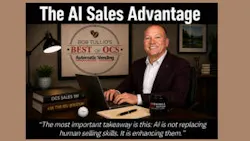
The most important takeaway is this: AI is not replacing human selling skills. It is enhancing them. The operator who understands their market, builds relationships and follows through consistently will always outperform someone relying solely on technology. But when that same operator uses AI to research accounts, prioritize opportunities, personalize outreach and maintain structured follow-up, the efficiency gains can be substantial.
That is not hype. It is a genuine competitive advantage.
In a business where the right account can create years of recurring revenue, that is an advantage worth paying attention to.
About the Author

Bob Tullio
Bob Tullio is a content specialist, speaker, sales trainer, consultant and contributing editor of Automatic Merchandiser and VendingMarketWatch.com. He advises entrepreneurs on how to build a successful business from the ground up. He specializes in helping suppliers connect with operators in the convenience services industry — coffee service, vending, micro markets and pantry service specifically. He can be reached at 818-261-1758 and [email protected]. Tullio welcomes your feedback.
Subscribe to Automatic Merchandiser’s new podcast, Vending & OCS Nation, which Tullio hosts. Each episode is designed to make your business more profitable.