What Nayax's Q3 2026 financial report tells vending operators and equipment owners
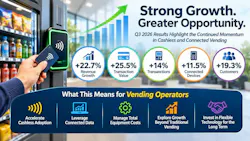
On November 11, Nayax Ltd. announced its Q3 results. In it, Yair Nechmad, Co-Founder, CEO and Chairman of the Board commented,
"Our third-quarter results demonstrated continued growth alongside improved margins, operating leverage and a return to positive free cash flow. Revenue grew 23%, gross margin hit a record 49.6%, and Adjusted EBITDA increased by more than 70% sequentially, all while we converted a 41% positive free cash flow. We completed the acquisition of IPS Group on October 1, 2026, expanding our platform into parking. Meanwhile, our new distribution partners are putting Nayax readers on more machines across more markets. With a strong Q4 order pipeline and IPS now contributing, we are well positioned for a strong finish to the year. As we move into 2027 and beyond, our focus shifts from investing to delivering, turning the partnerships and platforms we have built into recurring revenue and returns. We are still early in a long-term global shift, and Nayax is built to lead it."
Nayax's Q3 results offer a useful snapshot of where the unattended retail technology market is heading. For vending operators, equipment owners and prospective buyers, there are several important signals—not just about Nayax's financial health, but about the economics and capabilities shaping the industry.
Cashless conversion remains a major growth opportunity
Nayax reported:
- Payment processing revenue increased 23.5%, from $47.7 million to $58.9 million.
- Total transaction value increased 25.5%, reaching $2.213 billion.
- Processed transactions increased 14%, reaching 839 million.
- Connected and managed devices increased 11.5%, reaching approximately 1.6 million.
- Its customer base grew 19.3%, to approximately 130,800 customers.
What this means for operators:
Cashless payment adoption is not simply a convenience upgrade. It represents an opportunity to increase the number of transactions, capture more customer spending and generate revenue from machines that may otherwise be limited by cash-only purchasing.
Nayax also reported that average revenue per unit (ARPU) increased 10.9%, to $255. The company attributes this partly to converting existing machines from cash payments to cashless payments and expanding into higher-transaction-value markets.
If you still have cash-only equipment in your fleet, evaluate the economics of upgrading it. Consider transaction volume, average ticket, processing fees, equipment compatibility and the potential for incremental sales before deciding which machines to convert.
Recurring technology revenue is becoming increasingly important
Nayax is not relying exclusively on selling payment terminals. It is building a business around ongoing payment processing and software services.
What this means for operators:
- Vending equipment increasingly functions as part of a connected technology ecosystem.
- Payment systems and VMS platforms can provide continuing operational value.
- Operators should consider the long-term costs and benefits of software subscriptions, payment processing and integrations.
- Connected equipment can provide information that helps with inventory, sales analysis, route planning and machine performance.
The larger point is that equipment decisions should account for the entire technology ecosystem—not simply the purchase price of the machine or payment terminal.
Operators should be able to answer questions such as:
- Which machines generate the most revenue?
- Which locations have declining transaction activity?
- Which products generate the strongest sales?
- Where are customers experiencing failed transactions?
- Which machines are frequently out of service?
- Which accounts justify additional equipment investment?