Key questions to ask before you sell your business
Key takeaways for convenience services operators
- Know why you’re selling before entering the market. Personal, health and lifestyle motivations often matter more than timing or valuation.
- Understand what the sale must deliver financially. For most operators, the business is the retirement plan, making net-after-tax proceeds critical.
- Plan emotionally for life after ownership. Sellers who aren’t prepared for the transition risk regret, deal fatigue or second thoughts.
- Address employee and family considerations early. Stakeholder expectations can influence deal structure and buyer confidence.
- Resolve ownership issues before they become problems. Minority shareholders and other hidden interests should be aligned well before a sale process begins.

It’s that time of year: a time for contemplation. For many, the thought of selling their convenience services business in 2026 is top of mind.
Before diving into the deep waters of M&A — which can be an exhilarating experience — some important questions need to be asked — and answered honestly — by a prospective seller. This step is an important part of the selling process.
In this season of contemplation, as options are being considered, I thought it might be helpful to share the key questions about selling and the most common answers I hear.
5 questions every prospective seller needs to answer
- Why are you selling now?
- What are your financial goals and needs?
- Are you emotionally and psychologically ready to sell?
- How will the sale affect stakeholders, including employees, customers and suppliers?
- Who else has a stake in the sale, and how do you keep them happy?
The real reason owners decide it’s time to sell
Here is the first question to be prepared to answer honestly: Why are you selling now?
Often, I'll see a scenario where the operator is an older person, anywhere from 60 years old and up, and they'll say, “It’s just time. I want to spend more time with my grandkids.”
I have a situation right now in the upper Midwest where a gentleman has a serious health problem, and he knows that he needs to sell the business so he can focus on his health.
Sometimes, I work with a multi-generational operation, and the younger generation has no interest. The operator says, “I’ve talked to my kids, it’s just not their thing. They all went off to college, and now they are pursuing their own dreams.”
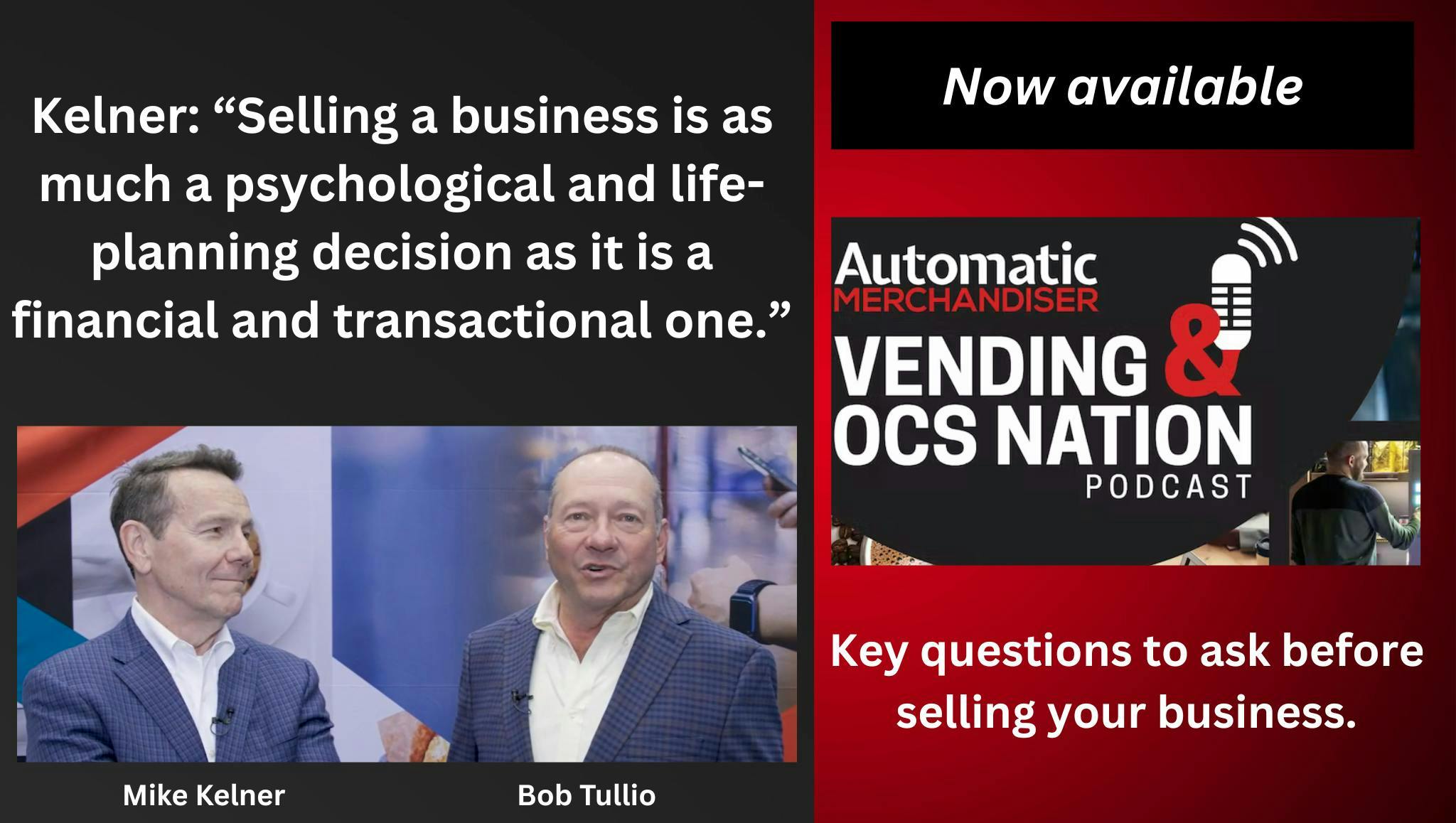
Sometimes a sale is driven by spousal pressure. The owner is ready to work forever, but his spouse wants to travel and live life more slowly.
Let’s face it, if you are a mid-size vending operation, it’s all-consuming. You are the CEO, the human resources manager, the operations manager and the buyer. It is a hard job, so sometimes, the operator is just tired. They want to enjoy life without work stress.
Understanding post-sale cash, taxes and retirement reality
The second question is: What are your financial goals and needs?
For 99% of my clients, the money they derive from the sale of their business will fund their retirement entirely. In many cases, that is their only retirement. There is no 401(k), pension or anything else. It is all tied up in their business and has been for their entire lives.
For those folks, it's critically important for them to know what they will get from the sale after the taxman takes his cut. A lot of thought and consideration is required on that issue, with the support of a tax advisor and a wealth manager.
Beyond the sale: Preparing for life after ownership
The third question is: Are you emotionally and psychologically ready to sell?
In many cases, the business is central to their identity and their daily routine. Their name is often on the building. In their neighborhood, among their friends, they have always been known as the “vending guy” or the “coffee guy.”
I am not a therapist; I am a sell-side business broker. But I always ask sellers to sit down and think about life after the sale. What are they going to do with their time? Are they finally going to get some good use out of that fishing boat? Are they planning to travel the world? Will they try to lower their golf handicap to under 15? This is something they need to talk over with their spouse and close friends — people they trust.
Sometimes, sellers love their job so much that they want to stay on board with the buyer in a special capacity for 15 to 20 hours a week. That can typically be arranged as part of the deal, and it can help ease the transition for both parties.
Each seller’s experience is personal. For some, it is a challenge to go 100 miles an hour every day and then suddenly be sitting still, trying to figure out what to do with their day after breakfast. For others, it is a welcome change and no problem at all.
Balancing loyalty with buyer realities
The fourth question is: How will the sale affect stakeholders, including employees, customers and suppliers?
It comes up in just about every deal. The prospective seller says, “I want my employees protected,” or “I want to make sure that my employees are taken care of.” Sometimes, the seller will kick in a nice bonus to key employees, especially those who helped prepare the company for sale and knew it was coming. Or they’ll say, “I want my people to have guaranteed retention.” That’s a lot to ask of the buyer, who might be wary of being saddled with an employee who was loyal to the company for years but not necessarily a high performer.
I like to provide the buyer with a list of key employees: what they do, their seniority level and a description of their value to the company. “Tom is a top mechanic. Bill knows every customer very well, and they love him.” This helps position employees for the opportunity to succeed with the buyer.
Identifying ownership landmines before they explode
The fifth question: Who else has a stake in the sale, and how do you keep them happy?
In some cases, people outside the business need to be satisfied. For example, while the seller might run the business, their parents might own the building and rely on the rental income. It is just another issue to address.
Sometimes, a minority shareholder needs to be considered. Is the minority shareholder being sufficiently taken care of? Unexpectedly, the minority shareholder may be unhappy with the sale and create issues. In my role as a sell-side broker, it's important to identify potential landmines and work to defuse them early.
Every deal is exciting, but what I love about owning VBB Advisors is the opportunity to find solutions that lead to successful outcomes. At the same time, it is a pleasure to successfully guide sellers through what is typically the most important deal of their lives.
Catch up on Mike's full M&A series
 Selling a convenience services business: valuation is key
 What will a buyer pay for your convenience services business? Here is the answer for operators
 two business people negotiating a deal
 negotiating a sale
About the Author
 Mike Kelner
Mike Kelner
Senior Business Intermediary, Vending Biz Broker
Mike Kelner is the founder and president of VBB Advisors, a full-service merger and acquisition firm serving the vending, office coffee and bottled water industries. Mike has been a senior business intermediary in the refreshment services industry for over 30 years, representing sellers exclusively. He is a Certified Business Intermediary and Value Builder Advisor.
Mike can be reached at [email protected] or 704-942-4621.