How Surpass Refreshments went from vending routes to smart markets
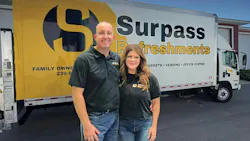
Matthew Rainey is not afraid to admit when he was wrong.
The owner of Surpass Refreshments was once skeptical of micro markets. Then he went to his first NAMA Show in Dallas in 2024 and saw almost no traditional vending machines on the show floor.
“I was anti-micro markets at the time,” Rainey said. “But when I went to NAMA, I’m like, ‘OK, that’s all that’s here.’ So, you’re going to do it and figure it out as you go — because the industry is evolving.”
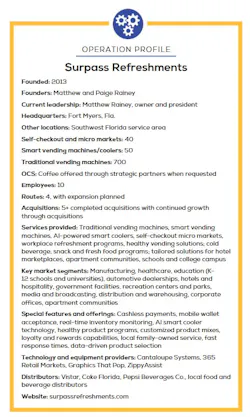
That willingness to change course has helped shape Surpass Refreshments, a Southwest Florida convenience services operation that Rainey built, from one used vending machine in 2012 into a company with about 700 vending machines, 40 markets, 10 employees and four routes.
A mechanic discovers vending
Before vending, there were cars.
After graduating from vocational school, Rainey built a career as an auto mechanic, working in dealerships and eventually developing a power window repair business. He still owns Surpass Power Window and occasionally takes on a repair job for long-time customers.
For years, automotive work was all he knew. Then a vending machine caught his attention.
Why vending? “I have no idea why,” Rainey said with a laugh. “It just caught my eye. It wasn’t ever my intention to be a full-time job.”
Rainey initially viewed vending as a side business that could generate some extra income. He bought a used machine and convinced a dealership to let him place it in a corner of the building.
The location wasn’t particularly strong. The machine certainly wasn’t generating life-changing revenue. But something about the business clicked.
“It gave me motivation to keep going,” he said.
He bought used machines, leaned on Facebook and personal connections to find early locations, and built from there. In the beginning, he and his wife Paige bought products at night and stored them in their apartment.
“Our living room was like a warehouse,” he said.
Within a year, as machine counts increased along with revenue, the side business had grown from a hobby into Rainey’s full-time work.
“There was a lot of cash back then,” Rainey said. “It became overwhelming…so, it became like, ‘it has to be legit.’”
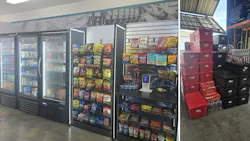
Rainey calls himself a workaholic, and it’s that work ethic, along with plain old hard work, that helped him grow in the early days, in a part of Florida without a major metropolitan base to serve up large accounts. One of his earliest accounts, a John Deere farm equipment location, was won thanks to a high school friend who worked at the dealership at the time. The account, which consists of a single beverage machine, is still with Surpass today.
“Yeah, it’s just a drink machine,” Rainey said. “I love it.”
Rainey bought out very small vendors — sometimes with only about 10 machines — and used each acquisition as another step forward.
While the business grew steadily, Rainey said he never felt like he had everything figured out. In fact, he still doesn’t. While experience and trial and error have taught Rainey a lot, he also relies on advice from a handful of industry veterans who served as mentors.
Growing from vending to markets to smart coolers
A meeting at Cantaloupe University a few years ago served as a tipping point.
“I met a guy there who was just teaching me the ropes. And I think the main thing is like — I didn't have a warehouse to even do picking. We were working out of a couple of storage units where our orders were getting delivered to it, and whatnot. So, we didn’t even have a warehouse.” Rainey said.
Rainey realized that if he wanted to grow, he needed the room to grow into, and the tools to make it happen. He moved into his first warehouse and invested in technology solutions, including Cantaloupe Seed.
“First, you need the warehouse, which is expensive. Then you need all the racking, which are expensive. And then you have to have an employee to pick everything. So, it was a lot involved. And not only that, to get everything inside of Seed was a lot of data. It took hours and hours and hours and hours to input all those coil counts, all those machines, make sure all the machines DEX, make sure that they keep DEXing. It was a lot.”
Rainey and his wife traveled to Dallas in 2024 to attend their first NAMA Show. For an operator who was largely a traditional vending machine operator, the absence of vending machines on the show floor — and the emphasis on micro markets and how unattended retail was evolving — was surprising.
“When I went to NAMA in Dallas, I didn't know what to expect, but what I did see was that there were no vending machines there,” Rainey said. “It was very, very, very eye-opening.”
Rainey went home and looked at his strongest vending locations, then took the best and converted those into micro markets immediately. The move helped Surpass stand out in a region where many customers had never seen a workplace micro market before.
“All these locations had no idea what a micro market is. You’re trying to sell something that in my area nobody has even seen, Rainey said. “When you describe it, they’re like, ‘Oh yeah, those are what’s at the airport.’ And I’m like, ‘Well, they are at the airport, but that’s the only place where they’re at.’”
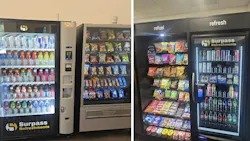
In the area Surpass serves, he said, a successful micro market location does not always require 200 or more employees. Rainey has launched profitable micro markets in locations with 60 to 80 employees because vending performance had already demonstrated demand.
“If they had already high vending sales, we knew that there was very, very high potential for micro market,” Rainey said.
The company still has a large base of traditional vending equipment, but Rainey is clear about where he wants to grow next: micro markets, smart stores and smart coolers.
“We’re trying to make ourselves different,” he said. “If we come in with smart stores or markets, it kind of gets their attention.”
“The real rapid growth has been in the past three years,” he said.
From micro markets to smart coolers
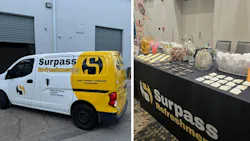
Rainey said he is still learning as he goes. “I didn’t go to college for business. I have no background in business,” he said. “I’m just pretty much learning as I go.”
When Surpass began moving into smart coolers, that willingness to learn as he went helped Rainey again. At first, he did not believe the format made sense, even as he couldn’t help but notice that they were everywhere at 2025 NAMA Show in Las Vegas.
“At NAMA in 2025, I said the same thing: I will never ever, ever get involved in the smart stores.” While he understood that they could sell more, they didn’t have the capacity of a BevMax, one of the bread-and-butter machines in so many of his locations. How could the added sales potential offset the lower capacity compared with a traditional beverage machine?
Then he tested one location: an auto dealership. “I took the two machines out of there, and I put that in there,” Rainey said. “It was very, very eye-opening.”
The sales, he said, were about three times higher.
Smart stores have become especially attractive, and in some environments, the customers expect something that looks more modern than a traditional vending machine. That is particularly true in dealerships — locations Surpass serves well.
“We just installed a brand new dealership where one of the things that was required was they had to be smart coolers — not vending machines. Where they got this information from, I have no idea, but I was on board and I was like 100%. You know, this dealership is beautiful” Rainey said.
“Some dealerships don’t allow vending machines on their showroom floor, and I believe it’s because they don’t like — they don’t want —the look of a vending machine on their brand new or their showroom floor with their brand new cars. But if they knew what these smart stores look like and could look like, I believe they would change their mind.”
“My smart stores are sometimes [worth] more money than the cars on the showroom floor,” Rainey added.
Embracing technology to power growth
Today, when Surpass evaluates a new location, Rainey often thinks first about whether it could support a market, smart store or smart cooler rather than a traditional vending machine. He said experience has taught him when to walk away.
“Every time I take a location, and I’m like, ‘I know this is not going to be a good location,’ it has never been a good one,” he said.
The company is now targeting larger accounts, including opportunities about an hour north of its original territory, as well as auto dealerships and universities. Rainey said he has had less success with residential properties, especially when operators are asked to place markets in low visibility spaces that residents are unlikely to use.
For Surpass, visibility matters. So does the look of the installation.
Rainey said his highest-end smart markets are placed where customers and guests will see them, not hidden away in a back breakroom. That approach makes the installation part of the customer experience and harder for competitors to replace.
Surpass moved into VMS-driven operations only recently, after years of running without a full picking system. Rainey said the shift required a warehouse, racking, labor and extensive data setup, including machine information and coil counts.
“It took hours and hours and hours,” he said.
Now, the company is moving into a larger warehouse and plans to add Lightspeed. It also uses tools, including Panoptyc and ProWatch to monitor markets for theft, and ZippyAssist for service communication.
Even with his investments in warehousing and technology over the last three years — all of which have improved his efficiency — customer service remains the biggest advantage of being independent and family-owned, Rainey said.
“I am so on with customer service — answering my phone, answering emails. If there’s an issue, fix it immediately. It doesn’t have to go through 50 channels of people to get that done,” Rainey said. “A lot of people we deal with love it that it’s family-owned. It’s more of a relationship for us versus just another customer.”
I take it very seriously in everything that we do,” Rainey added about his customer service expectations. “Even our smallest clients, I’m still as hands-on as with the bigger people.”
Customer service also extends into market merchandising. Rainey expects markets to look reset after service, with products facing forward and photos taken through Seed Driver once the work is complete.
“Everything has to be on point like they were just there,” Rainey said. “I’m very OCD about how things are placed and look.”
As he grows, Rainey looks for opportunities to improve the operation. For example, after recently acquiring another business, he asked his drivers for their input on the best way to revamp the routes.
“My feeling is that if I were a route driver, and I had to do vending machines all day, and then I had to go fill this ginormous market, that would probably wear my nerves out all day long. And I would probably hate going to there,” Rainey said. “That’s just my feeling. I’ve asked my employees that. They told me no, but I don’t think they’re telling me the truth. I feel like the markets are very, very mentally hard.”
With four trucks now running, he is considering dedicating one route primarily to micro markets and smart stores, with nearby vending stops added to fill out the route.
Fresh food remains a challenge. Rainey said Surpass has tried it multiple times, but shelf life, low margins and limited account size have made it difficult. Refrigerated Uncrustables, however, have been a standout in smart stores.
“That’s one product that stands out from everything,” he said.
Rainey is already thinking beyond workplace refreshment. One idea on his list is an unattended convenience store in his downtown area, where he sees demand for snacks and drinks but few convenient options outside restaurants.
“It has to be unattended,” he said, pointing to labor costs.
For an operator who once said he would never move into micro markets, then said the same about smart stores, Rainey seems poised to make it happen.
Rainey’s story is not only about building a business from one machine. It is about knowing when to let go of old assumptions.
“There are a lot of operators that are stuck in old times,” he said. “My advice is, stay in old times, and we’ll take over.”
About the Author
 Linda Becker
Linda Becker
Head of Content
Linda Becker is head of content for Automatic Merchandiser and VendingMarketWatch.com, responsible for the brands’ overall content strategy, planning and performance. She oversees the creation and performance of editorial and multimedia content across platforms such as magazines, websites, webinars, podcasts, newsletters, videos, social media, events and eBooks.
Since joining Automatic Merchandiser and VendingMarketWatch.com, Linda has developed a new appreciation for the convenience services industry and its essential role. She is dedicated to serving readers by covering the latest news in the vending, office coffee service and micro market industry. She can be reached at 262-203-9924 or [email protected].