7 Themes Emerge at Automated Retail & Kiosk Innovation Show 2026
With the end of the year full of vending operator events to attend and stay on top of industry trends, VendingMarketWatch took a look at the upcoming Automated Retail and Kiosk Innovation Show taking place December 14-16 in Miami Beach, FL, to see what themes emerged.
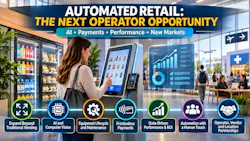
1. Automated retail is expanding beyond traditional vending
The opening keynote, “Retail Without Walls: The Rise of Autonomous Commerce,” frames automation as an increasingly important part of the omnichannel retail experience. Tuesday's keynote, “How Brands and Locations Win with Automated Retail,” specifically addresses airports, hospitals, casinos, campuses, stadiums, hotels and shopping centers. It also explores specialty retail, branded experiences, fresh and hot food, robotics and automated stores.
What operators should pay attention to:
- New opportunities in nontraditional vending locations.
- Converting underused space into revenue-generating retail.
- Expanding from packaged snacks and beverages into specialty products, fresh food and hot food.
- Partnerships with brands seeking new distribution channels.
- Understanding the different operational requirements of each venue.
The business implication: Operators may have opportunities to compete for business beyond conventional vending accounts, but each new venue brings its own requirements for product mix, replenishment, security, infrastructure and customer support.
2. AI and computer vision are becoming practical deployment considerations
AI is a recurring subject throughout the agenda. The Intel breakfast briefing addresses AI, computer vision, digital experiences, reliability, security and lifecycle efficiency. The future-of-kiosks session adds biometrics, voice interfaces and mobile connectivity. Wednesday's AI and mobile session explores how these technologies can work together to create more personalized and frictionless shopping experiences.
This is not simply a discussion about new technology. The agenda repeatedly connects innovation to deployment economics, scalability and customer experience.
What operators should pay attention to:
- Computer vision and automated checkout.
- AI-assisted product recognition and personalization.
- Mobile integration and customer identification.
- Biometric authentication and voice interfaces.
- The cost, reliability and maintenance requirements of advanced systems.
- Whether technology reduces labor or simply shifts labor to other tasks.
The business implication: Operators should evaluate technology based on measurable improvements in transactions, labor efficiency, shrink, customer experience and profitability—not novelty alone.
3. Installation, maintenance and lifecycle management are critical to profitability
One of the most directly relevant sessions is “Install It Right or Pay for It Later: The Hidden Risk of Poor Kiosk Lifecycle Management.”
The agenda explicitly identifies downtime, lost revenue, brand damage and security exposure as consequences of poor installation and maintenance practices. It emphasizes preventative maintenance, field service and protecting uptime and return on investment.
What operators should pay attention to:
- Total cost of ownership, not just equipment purchase price.
- Preventative maintenance schedules.
- Installation quality and site readiness.
- Service response times and technician availability.
- Equipment uptime and lost-sales measurement.
- Security updates and ongoing software support.
- Replacement cycles and long-term equipment planning.
The business implication: The economics of automated retail depend on what happens after installation. A machine that is inexpensive to purchase but expensive to maintain—or frequently unavailable—can quickly become a poor investment.
4. Payment flexibility and frictionless checkout are competitive necessities
Wednesday's “Frictionless by Design” session is dedicated to payment experiences in unattended retail. It covers cash, card, contactless payments, mobile wallets, cardless ecosystems, biometric authentication and app-based payments. The session explicitly connects payment choice to convenience, security, transaction speed and customer expectations.
What operators should pay attention to:
- Whether payment options match the behavior of customers at each location.
- Contactless and mobile-wallet adoption.
- The cost of payment processing across different technologies.
- How payment friction affects abandoned transactions.
- Security, fraud prevention and customer data protection.
- Integration between payment systems, vending management software and reporting.
The business implication: Payment technology is not just a back-office function. It directly affects whether a customer completes a purchase, how much the operator pays to process it and how much useful transaction data the operator can capture.
5. Operators need to measure performance beyond equipment uptime
“Decoding the Data Behind Successful Self-Service Ecosystems” is one of the most commercially important sessions in the entire agenda. It introduces a Kiosk Success Matrix that goes beyond uptime, examining customer behavior, automated upselling ROI and operational KPIs.
This is an important distinction: a machine can be technically operational and still be underperforming.
What operators should measure:
- Sales per machine and per location.
- Transactions per day and average transaction value.
- Product mix and category performance.
- Out-of-stock frequency and lost-sales opportunities.
- Shrink, refunds and failed transactions.
- Equipment uptime and service costs.
- Sales lift from automated merchandising and upselling.
- Return on equipment and technology investment.
The business implication: Operators need to understand which locations, machines and product assortments are generating profitable results—not simply which machines are online.
This also reinforces the value of a strong VMS and integrated reporting environment. Better data can help operators make smarter decisions about pricing, assortment, service frequency, equipment placement and account profitability.
6. Automation should improve the customer experience—not remove the human connection
The opening keynote and Tuesday's hospitality keynote both emphasize the balance between technology and human engagement. The Shin Starr session explores autonomous foodservice, 24/7 operations, labor redistribution and margin protection while retaining the human element of hospitality.
What operators should pay attention to:
- Where automation can remove repetitive tasks.
- How staff can be redeployed toward customer service and higher-value activities.
- Whether automated experiences are intuitive and accessible.
- How to maintain customer trust when transactions become increasingly self-service.
- Whether technology improves the experience enough to encourage repeat purchases.
The business implication: Automation should not be treated as an objective in itself. Its value comes from improving convenience, service consistency, labor efficiency and customer satisfaction.
7. Venue partnerships and operating models will shape expansion opportunities
The “Making Automated Retail & Kiosks Fit” and “Operator vs. Vendor” panels provide another important signal: successful automated retail requires alignment among operators, equipment providers, technology companies, property owners and brands.
This is particularly important as operators move into airports, healthcare, education, corporate campuses and mixed-use properties.
What operators should pay attention to:
- Who owns the equipment and who maintains it?
- Who is responsible for inventory, replenishment and customer support?
- How are revenue shares, commissions and service fees structured?
- Who handles connectivity, payment processing and software support?
- What service-level expectations are required?
- How are responsibilities handled when equipment fails?
The business implication: A promising location or technology partnership can become unprofitable if responsibilities, economics and service expectations are not clearly established before deployment.
We hope this agenda analysis helps you make the most of your time at the Automated Retail and Kiosk Innovation Show!
Editorial opportunity: Vending Operator Partnerships: The Questions to Ask Before Signing a Technology or Location Agreement.