Business Expert Presents 'Result Driven Strategy,' Along With Case Study, During National Automatic Merchandising Association OneShow In Chicago
Did you ever wonder what separates companies that are successful over a long period form those that aren't? The question has long confounded business observers. The answers aren't simple, but they are available to those willing to learn.
Attendees at the National Automatic Merchandising Association OneShow filled a room to capacity at McCormick Place North to learn about a business author's method for long-term success and to also hear from one of his clients on how the tenets were successfully used.
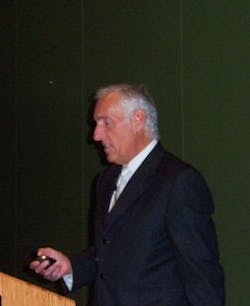
In a standing room only presentation titled "Building Your Business With Growth Opportunities," Mark Frigo, Ph.D., CPA, CMA, presented an overview of his "Return Driven Strategy" while E. Terry Groff, chairman and president of Reading Bakery Systems, Robesonia, Pa., described how Frigo's tenets worked for his company.
Attendees received a free copy of Frigo's book, "Driven – Business Strategy, Human Actions And The Creation of Wealth."
Frigo is director of the Center for Strategy, Execution and Valuation at the Strategic Risk Management Lab at Kellstadt Graduate School of Business at DePaul University in Chicago.
Frigo's method is based on five tenets: 1) target changing customer needs, 2) target the right customers, 3) change and innovate your offerings, 4) brand your offerings, and 5) use the right incentives and measure.
The book is designed as a guide to develop and evaluate strategy and strategic initiatives and develop strategic objectives and performance measures.
Frigo studied how 15,000 companies performed for a 20- to 30-year period.
He noted that high performing companies show an extraordinary ability to continually re-strategize and execute.
Groff of Reading Bakery Systems noted that Frigo's Return Driven Strategy helped his company create an effective strategic plan and the tools to examine every facet of its business. This resulted in higher sales and higher profits.
Groff said his company had set goals in various areas, such as service sales, pet treats, crackers and biscuits, and equipment sales. But performance in most areas fell short of goals. From 1994 to 2006, the company's revenues fluctuated rather than improved.
In 2006, the company implemented Frigo's Return Driven Strategy.
For Groff's company, a lot of time was spent identifying key customers. "Who really were our customers?" he noted.
The company decided to group customers based on how they think and act instead of grouping them according to size or geographic location. "That was an eye opener for us," Groff said. The company paid close attention to customers that valued its products and services.
It divided its customers into two key groups: corporate thinkers and entrepreneurs.
Corporate thinkers are customers who are motivated by the need to protect their own jobs. In presenting a business proposition to such a customer, Groff said he could predict what the outcome would be.
"But the entrepreneurs in the group didn't think that way," he said. Rather than protecting their jobs, they were interested in protecting their assets.
How did this help Reading Bakery Systems? By understanding the customer's needs, they knew how to sell to them better.
"This got me job after job after job," Groff said.
This exercise forced the company to recognize some customers should not be kept. This proved very helpful.
"Now the competitors are not making any money on them," Groff noted.
Frigo's system also forced Groff's company to examine its offerings. "I wanted to create offerings that were appreciated and valued," Groff said.
Reading Bakery Systems focused attention on deliveries, on partnerships, on branding, and its internal processes.
As a result of the focus on internal processes, the company is now producing double the amount of material with the same number of people. "The productivity gains have been enormous," Groff said. "I've imbedded this in my culture."
The exercise also involved identifying the company's "genuine assets." These include relationships, attention, technology, brand equity, processes, intellectual capital, physical assets, financing, human resources, and the work force.
After making a list of these genuine assets, the company established relationships with universities. This includes funding a graduate study program.
The company also examined the forces of change affecting them, such as energy costs, rising food sales, transportation costs and currency fluctuations.
From the time Reading Bakery Systems implemented the Return Driven Strategy in 2006 through 2008, revenues rose by 150 percentage points.
Frigo said that Groff took a close look at customer needs and aligned his company's offerings to those needs.
Frigo said a company's business strategy needs to consider everything the company does. "Your strategy is what you do," he said.
Frigo encouraged his listeners to identify their goals in terms of increasing value.
Business strategies are oftentimes too general, Frigo said. If this is the case, the company will have a hard time putting the strategy into action.
He said companies also have to have the right metrics to measure return on investment (ROI).
"ROI is not just return on financial investment, it's return on time investment" Frigo said.
He noted it's important for a business to know if and how its customers' needs are changing. Once the company determines this, it can change its offerings to better meet those needs. To do this, the company needs the capabilities and assets to deliver those offerings.
Frigo said partnering is an important activity, but not an easy one. He said there are risks involved.
He noted that genuine assets include a company's knowledge of its customers. "Knowledge of customers is an asset many companies don't leverage enough," he said.
Frigo also quoted business author Peter Drucker: "If you can't measure it, you can't manage it."