Rising Fuel Costs Add New Pressure on the Bottom Line; Vendors Seek Solutions
Days after Hurricane
Katrina dealt a devastating blow to the nation’s largest
energy hub, the worst-case possibility was quickly becoming a
reality: gasoline prices surging above $3 a gallon,
with some consumers complaining of price gouging; reports of violence at the pumps; underground storage tanks running dry; and gas runs by drivers worried about supplies.
Vending operators who participated in the 2005 NAMA Operating Ratio Report spent an average 3.8 percent of their sales on vehicle expenses in 2004, as indicated in the chart on page 44. Given the fact that participants posted an operating profit of 1.5 percent of total sales in 2004, higher fuel costs pose a definite threat to profitability.
Vendors face difficult choices
Vending operators were particularly concerned about the gasoline hikes, given the fact that many had already raised prices within a 12-month period to cover higher operating costs.
“I don’t know how many times we can go to the well,” said Tom Bergstrom, owner of Bergstrom-Daywood Co., an
11-route vending operation based in
Austin, Texas. Bergstrom observed in early September that his fuel bill had doubled over the previous month. The company raised its prices one year ago
to cover higher product costs.
Another reason Bergstrom was hesitating is he doesn’t know how much to raise prices. He doesn’t want to raise prices in the short term only to have to raise them again.
Fuel surcharges not seen as an answer
Most vending operators don’t think fuel surcharges — which vend product suppliers charge operators — are an option. The only options most felt they had in the short term was to raise prices, ask customers to reduce commissions, review routing, and cull unprofitable accounts.
Don McDaniel, owner of McDaniel Snack & Vending, a 10-route vending operation based in Huntsville, Ala., noted in early September that he told his drivers to fill up their gas tanks every morning. He said he wasn’t sure if and when supplies in his area would run low, and he doesn’t want his trucks to be low on fuel.
As part of his preventive measures, McDaniel said he plans to fill up his on-site fuel tanks in case of a shortage.
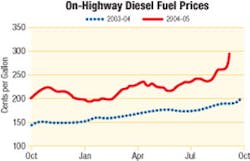
McDaniel has converted most of his vehicles to diesel fuel. Many operators have switched to diesel fuel over the years; however, as indicated in the chart above, diesel fuel costs haven’t differed significantly from gasoline. Both types of fuel depend primarily on crude oil.
McDaniel is one of many operators who has a fleet fuel card that allows him to review how often his drivers are fueling, where they are fueling and how much they buy. The card provider sends him a weekly report which he can review over the Internet.
In the meantime, he continues to review different fuel card programs. Trade associations and buying groups offer discount fuel card programs. The National Automatic Merchandising Association, the Better Vendors Association and the Vendors Purchasing Council all offer their members programs.
Price hikes seen as the only option
McDaniel, like many operators interviewed, felt that his only option in the short term was to consider raising prices or asking customers to reduce commissions.
He has also instructed his drivers to shut off the engines as soon as they pull up to a loading dock.
First Choice Food & Beverage Solutions Inc., based in St. Cloud, Minn., was fortunate to have prebooked unleaded fuel at $1.97 per gallon through September, noted Russ Ergen, controller. This benefit came to an end with the new prices, however. The discount did not include his diesel vehicles, which currently comprise more than half of his fleet.
“We’re going to have to find some way to recoup that; there’s no doubt,” Ergen said. “It’s going to have a major impact.” He is considering raising his prices and looking for places to cut costs.
New strategies sought for raising prices
Some operators are not questioning the need to raise prices.
Cromer Food Service, a 75-route operation based in Anderson, S.C., realized it needed a new strategy for raising prices earlier this year. Given the recent fuel costs, company president Brent Cromer is glad that he assigned one of his managers the task of seeking price increases on a full-time basis. The company has learned it is easier to raise prices in smaller increments on a more frequent basis than the more common method of taking a big jump less frequently.
“You can’t just raise prices without asking permission,” Cromer said. “Most of the time, people are understanding. It (the new system) has been a big plus for us. We should have done it a long time ago.”
New depot, lower commissions
Cromer is also asking for lower commissions in some accounts.
In addition, the company has decided to build a new depot in one of its distant markets — Jefferson, Ga. — where some stops require extra long trips.
Cromer doesn’t think he’s seen the end of price increases this year. So far, the price increases in the machines have not hurt turns significantly, but at some point, he suspects they will.
Vendor negotiates a discount
A.H. Management Group Inc., based in Rolling Meadows, Ill., negotiated a reduced rate with a gasoline station, noted Bob Oplaski, an account rep who oversees the fuel program for the company’s 118 vehicles.
After receiving a promotional mailer from this gas station in Cook County, which has the highest local gasoline taxes in his service area, Oplaski approached the owner and negotiated an arrangement. The station owner agreed to charge the company a per-gallon rate of 5 cents above the station’s cost. “He tells me a nickel over cost is as low as he can operate,” Oplaski said.
This arrangement only applies to those vehicles that don’t leave Cook County, Oplaski said; fuel is usually cheaper in surrounding areas. Under this arrangement, the company normally pays 10 to 15 cents less per gallon than the station’s advertised price.
Oplaski noted that even with this arrangement, his company is incurring much higher fuel costs than a few months ago. He said they are continuously seeking higher prices to offset rising costs, but that the options are limited due to competitive pressure.
Long-term technology offers solutions
Many operators are aware that technology offers new ways to save on fuel, but these are long-term and not short-term solutions. Technology requires an upfront investment.
One technology that many operators have recently added is satellite-based fleet monitoring, known as Global Positioning Systems (GPS), which was examined in the August Automatic Merchandiser. The article noted that more and more vending and OCS operators are using these systems to improve operating efficiencies and employee accountability.
GPS systems save fuel in three distinct ways: 1) They allow the operator to know if unauthorized vehicle use is occurring; 2) They make it easier to determine more efficient routing; and 3) They allow managers to monitor how fast drivers are driving; excessive speed wastes fuel.
McDaniel at McDaniel Snack & Vending has considered GPS, but right now, his company is on “information overload” with its vending management software, and he feels GPS would be difficult to manage.
GPS offers more control over fuel
“The information we’re getting is very valuable about how fast guys are going,” said Jeff Parks, president of CL Swanson Corp., the Madison, Wis.-based vending/foodservice operation serving 10 states. The company has implemented GPS on its routes. Parks said the move definitely reduced fuel costs.
Nor-Cal Beverage Co. Inc., based in Sacramento, Calif., has been looking at new vending software, noted Tim Willbanks, vending director. Rising fuel costs have piqued the company’s interest in a telemetry-based remote machine monitoring solution, he noted.
Remote machine monitoring
Telemetry-based remote machine solutions offer various benefits to a vending operation, including more efficient service schedules. These systems allow management to track machine activity from a distant location. By allowing an operator to poll a machine from a remote computer, the operator can schedule the machine for service when the machine needs it, as opposed to servicing it on a regular basis. This reduces unnecessary service trips.
“We’ve been taking a look at technology to look at how many times we go to a machine,” Willbanks said.
Technology does add an upfront cost. But technology costs usually decline with time, and when they do, there is a faster return on investment. Costs for telemetry-based solutions have fallen in recent years.
Rising operating costs also impact return on investment. As costs increase, the faster the payback on technology that reduces costs.
“It is still quite expensive to make that transition,” Willbanks at Nor-Cal Beverage Co. observed. “It’s not an overnight move.”
Nor-Cal Beverage Co. is not anxious to seek another price increase, Willbanks said, given the fact that most customers have already incurred at least a nickel price increase on most products in the last year. But a price increase will be easier to ask for than a fuel surcharge. “You have to pass it on,” Willbanks said of the higher fuel costs. “You can’t just absorb it.”
As for location commissions, Willbanks said his company isn’t paying much to begin with; hence, there isn’t a lot of relief he can seek in this area.
Fuel charges work for OCS deliveries
Operators have been able to tag surcharges onto OCS deliveries.
Stansfield Vending Inc., based in LaCrosse, Wis., began adding fuel surcharges this past spring, noted Kevin Witt, vending operations manager. Smaller customers have also been given the option of increasing their orders or to reduce their service deliveries.
“I really was amazed more people didn’t say something (bad) about it,” Witt said.
Unfortunately, fuel surcharges are not an option in vending, Witt said.
Operators find few short-term options
Bertsch Food Service Inc., based in Warsaw, Ind., has been charging OCS customers a fuel surcharge for a year and a half, noted Larry Richardson, purchasing manager. Out of close to 800 OCS customers, there was only a handful of objections. Like Witt at Stansfield Vending, Richardson doesn’t think this is an option in vending.
Richardson said he thinks the most sensible way to recover the cost for higher fuel in vending is by reducing location commissions. “That seems to be the most painless way of doing it,” he said.
Alternative fuels and more efficient vehicles are another option for operators, but these are also long-term solutions.
More efficient vans offer a solution
CL Swanson Corp. recently began testing Sprinter vans from Freightliner. At 20 to 23 miles per gallon, these vehicles get double the fuel mileage of other commercial vans, noted Parks.
The company is also considering raising prices.
Higher fuel costs aren’t all bad for vending, according to Mike Maddock, owner of Superior Office Snacks Inc., a vending and honor box operation based in Olathe, Kan. Maddock said employees at his locations will be more inclined to eat their meals on-site instead of driving to restaurants.
As for conserving fuel costs, Maddock is considering reducing his service frequency, at least for the honor box routes. He would rather reduce service frequency than raise prices.
Alternative fuels reduce costs
Conversion to alternative fuels is another long-term solution.
When oil prices spiked in the late 1970s, McDaniel Snack & Vending in Huntsville, Ala. converted its trucks from regular gasoline to liquid propane gas. Five years later, the company switched to diesel. Today, propane is less expensive than either diesel or gasoline, but McDaniel said it is not as easy to convert from diesel to propane as it was from gasoline to propane.
Schwan’s Sales Enterprises of Marshall, Minn., a supplier of food and ice cream to vending and foodservice, has relied on propane to fuel its fleet of delivery trucks since 1978, according to Alan Macht, director of fleet purchasing. The company switched to propane fuel in response to gasoline shortages and unstable prices in the late 1970s.
Schwan’s Sales Enterprises delivers frozen foods and ice cream with alternative fuels in 48 states, and its fleet of delivery trucks is more than 88 percent alternative fueled, Macht said. Out of the 6,400 vehicles currently in the company’s fleet, 88 percent are dedicated propane medium-duty trucks. These vehicles are refueled at the company’s 500 depots located across the country.
Macht said a gallon of propane gas currently costs $1.25.
Alternative fuels require education
Converting gasoline engines to propane fuel required an education, Macht said, but it certainly paid for itself quickly. He said the company replaced gasoline injectors with propane fuel injectors, installed propane fuel lines and propane tanks on the trucks.
Operators need to consider performance differences when looking at alternative fuels.
For example, the Energy Information Administration advises consumers that because propane is a less dense fuel than gasoline, power might decrease slightly.
In the shortterm, vending operators have no choice but to consider raising prices and reducing commissions. The government is not forecasting any significant relief at the gas pump.
Vehicle expenses as a percent of sales
Typical | High profit
Vending 3.8% | 3.4%
OCS 3.5% | 2.1%
Source: 2005 NAMA Operating Ratio Report.
Fuel saving tips for route drivers
The American Petroleum Institute offers the following fuel saving tips:
• Perform maintenance checks according to schedule. An engine tune-up can improve car fuel economy by an average of 1 mile per gallon.
• Keep tires properly inflated. Under-
inflated tires can decrease fuel economy by up to 1 mile per gallon.
• Slow down. The higher the speed, the more gasoline your vehicle uses. Driving at 65 miles per hour rather than 55 miles per hour reduces fuel economy by about 2 miles per gallon.
• Avoid jackrabbit starts. Abrupt starts require about twice as much gasoline as gradual starts.
• Drive at a steady pace. Unnecessary speed-ups, slowdowns and stops can decrease fuel economy by up to 2 miles per gallon. Stay alert and drive steadily, not erratically.
• Use the air conditioner sparingly. The use of air conditioning can reduce fuel economy by as much as 2 miles per gallon under certain speeds and operating conditions.
• Avoid lengthy engine idling. Turn the engine off when you are delayed for more than a couple of minutes.
Website indicates cheapest fuel
The following website monitors the least expensive fuel in many locales:
www.fueleconomy.gov