Duo Makes it Big in the Big Apple, Where Quality Rules
In his famous song, “New York, New York,” Frank Sinatra sings: “If I can make it there, I’ll make it anywhere.” Sinatra might not have been singing about the OCS business, but if he were, he would have been right.
Metro New York has always been a bellwether market for the OCS industry. Having the largest concentration of offices in the U.S., the Big Apple has spawned some of the nation’s largest regional OCS operations, some of which have been market leaders in pioneering new concepts, notably single-cup, and in OCS marketing and operations professionalism generally.
To succeed in this highly competitive environment, partners Charles Chiarello and John Malizio had to be at the top of their game from the beginning. The founders of Classic Coffee Systems Ltd., based in Valley Stream on Long Island, recognized at the outset that they needed to be professional in every way to succeed.
This wasn’t as obvious when the partners founded their company in 1980. The OCS industry was still young, and scores of one-person operations were thriving throughout the New York metropolitan area. Startup costs were low by today’s standards, and many worked out of their homes.
STARTING OUT ON THE OCS ROUTE
Chiarello and Malizio each had the benefit of having worked for one of the larger and more professional OCS operations at the time: Professional Coffee Plan in Lynbrook, N.Y. Working as route drivers and mechanics, the pair, both college educated and in their early 20s, recognized that customer service held the key to success in OCS.
With OCS just gaining its identity as an industry at the time, Chiarello and Malizio saw an opportunity to provide reliable service in the huge New York metropolitan market. Offices in Manhattan didn’t (and still don’t) have the luxury of sending an employee to a warehouse club for things.
“We saw what was going on; both of us saw there was an opportunity,” Malizio said. With about $20,000 in combined savings, they struck out on their own in May of 1980.
PROFESSIONALISM FROM DAY ONE
Chiarello and Malizio rented a 1,500-square-foot warehouse and hired a part-time office worker before they made their first sales call. “We thought if you started small you’d always be small,” Chiarello said. “At that time, a lot of guys worked out of the house and never got out of the house.”
They held a party the night before they opened for business, inviting friends and acquaintances. They knew the importance of networking, and that opening night party drew prospective customers.
They needed the warehouse because they knew from their experience that many accounts wanted vending in addition to OCS, so they needed to have vending machines ready to be deployed. They also needed space for allied products, which they knew was a big part of the business.
NETWORKING: AN ONGOING ACTIVITY
Chiarello and Malizio called on friends, family and acquaintances in addition to knocking on doors. They signed up about 10 customers per month. Their morning sales calls began wherever their deliveries took them. “Wherever we delivered, that’s where we would sell,” Malizio recalled.
After six months, they had about 60 customers, and they hired their first delivery man.
A friend who worked for a bank in Manhattan got them an interview with the bank, which resulted in their first 400-plus account. “That lit a fire under us,” Malizio said.
Beneath all of the excitement of a growing business, the pair never forgot their founding principle: customer service. “Customer service became who we were,” Malizio said. If a customer wanted a specific item that they didn’t warehouse, they would (and will still) get it for them.
A customer might want a specific cough drop, juice or popcorn. The customers know they can call on Classic Coffee Systems and get it at no extra charge. “That goes a long way; the fact that they can call the owner of the company and get that kind of response,” Malizio said.
EARLY SUCCESS: COCA-COLA BREAKMATE
Classic Coffee Systems rode the popularity of the Coca-Cola Breakmate, the 3-select, countertop cold beverage dispenser, placing about 75 units in the 1980s. The Breakmate eventually lost popularity due to its service cost and limited product variety.
While OCS was still a growing business in the 1980s, pricing pressures were much fiercer. The consumer had not been exposed to high quality coffee, and many purchase decisions were based on price instead of quality.
Many OCS operators couldn’t handle the pricing pressure. Hence, acquisition became an option for growth-minded companies like Classic Coffee Systems. Their largest acquisition gave them 500 new accounts.
Chiarello and Malizio introduced a private label coffee to allow them to compete with the national brands that were dominant at the time. Many operators saw private label as their most profitable option, due to the pricing pressures. It accounted for 80 percent of Classic Coffee Systems’ coffee sales in the 1980s.
LEARNING FROM THEIR PEERS THROUGH ASSOCIATIONS
Chiarello and Malizio were active in OCS associations, which they credit for much of their success. They have been active in local and national trade organizations, where they have learned from other operators. “We’ve made great contacts over the years,” said Chiarello, who has taken the National Automatic Merchandising Association’s quality coffee certification course.
The biggest challenge they faced early on was single-cup systems, which were just coming on the scene. The metro New York market was among the first to have single-cup systems.
Filterfresh, the leading single-cup player, was grabbing big accounts in New York City, and OCS operators were scrambling to find competitive systems to fight Filterfresh. Filterfresh offered a reliable system with high quality coffee, and customers were willing to pay for it.
Chiarello and Malizio tried using the hopper single-cup systems that were introduced in the late 1980s and early 1990s, but they were not fully satisfied with them due to their service costs.
PORTION-CONTROL SINGLE-CUP SYSTEMS EMERGE
Portion-control single cup eventually provided the tool to compete against Filterfresh. But for most OCS operators, things got harder before they got easier. In the mid 1990s, one of Classic Coffee Systems’ biggest competitors was offering one of the two dominant portion-control, single-cup systems on an exclusive basis.
Classic Coffee Systems secured an agreement with the other dominant portion-control, single-cup system in 1998, which was a turning point for them. Portion-control systems became available just as the big specialty coffee retailers were educating consumers about better quality coffee.
With portion-control systems, OCS operators found they could offer coffee house quality in the office. The roasters supporting these systems provided enough variety to meet growing customer preferences. “That variety sells those machines more than anything,” Malizio said. “No one complains about the price of coffee.”
For a company like Classic Coffee Systems, with the support system in place to deliver this variety, growth was imminent.
SINGLE-CUP REVITALIZES OCS
“We rode the wave just like everybody else, and there’s a much better feel to it,” Malizio said. “The last 10 years are very different than the first 10 years.”
Chiarello and Malizio have found portion-control so popular that most accounts are willing to pay a rental fee for the brewer. They estimate that between 85 to 90 percent of their portion-control brewer customers pay a rental fee.
For the past three years, Classic Coffee Systems has carried both of the leading portion-control systems, Keurig and Flavia, and these products now account for 40 percent of their total sales and 90 percent of their new placements.
Portion-control systems have allowed OCS operators to provide more national name brand quality products, Malizio noted. It has also made them aware of the importance of product variety.
Chiarello and Malizio have been more aggressive than most OCS operators in offering organic and “fair trade” coffees. While the demand for these products remains small, the pair believe that it allows them to send a message to their customers.
Chiarello said he personally believes in being socially responsible. He does this by marketing fair trade coffee. “I think we have to do little things,” he said.
ENVIRONMENTAL CONSCIOUSNESS GROWS
The duo also believe that environmental issues are becoming more important to many customers, hence, the organic coffees. They are also introducing a “green” catalog. One of their customers recently moved to a new facility that meets “green” building standards. They also noted that their private label roaster, Empire Coffee Co., is providing non-bleached boxes.
Classic Coffee Systems has also found a demand for espresso-based drinks in some offices. For this, they use the Lavazza Espresso Point machines.
While single cup has given the business new vitality, allied products are keeping pace with the growth, thanks to a barrage of cold beverage innovations in recent years. While the company has always been cognizant of the demand for cold beverages, customer tastes have become more diverse.
Coca-Cola Breakmates have been retired, but point-of-use water systems are more popular than ever. Classic Coffee Systems offers both purified and spring water. The 5-gallon bottles also remain popular, but the delivery for these has been outsourced.
Chiarello and Malizio have paid close attention to the rising demand for alternative beverages, such as energy drinks, mineral enhanced waters, green teas and vitamin enhanced juices.
They have also paid attention to kitchen and bathroom supplies, and have increased these offerings as well.
There are six warehouse workers who load trucks at night.
The company relocated twice in the last 10 years to its present 17,000-square-foot facility.
EXPERIENCED EMPLOYEES SUPPORT GROWTH
Chiarello and Malizio believe the strength of their staff has allowed them to maintain consistently strong customer service as the company has grown.
“We’ve had longevity with our employees, Chiarello said. “We promoted long-term employees to management positions and they responded beautifully.” Six of the company’s managers have more than 100 years collective experience.
Chiarello and Malizio have made it a policy to always hire from within.
They do background checks on all drivers, and have used Internet screening. They do not use newspaper classifieds.
Joan Crader, the longest standing employee with 23 years of service, has become the controller. The operations manager, Ken Ostipwko was a shipping clerk, and the service manger, Phil Monroe, was a route driver. Terri Jurasits, who started as a part time clerical worker, now manages the customer service department.
Joan Crader, the controller, wrote the employee handbook. The company provides health care, paid vacations and paid holidays. There are annual performance reviews.
Chiarello and Malizio have continued to remain active in civic organizations. Both have coached little league, and they are involved with a high school mentoring program and with a charity that raises money for autistic children. “We try to give back to the community,” Chiarello said. Both men’s offices are adorned with plaques from civic activities.
If that doesn’t keep them busy enough, they are also active in networking groups. These are organized groups of business people who meet on a regular basis and exchange leads.
MEDIA ADVERTISING PLAYS AN IMPORTANT ROLE IN NEW YORK
Media advertising has always been a cornerstone in the New York metro market. Unlike operators in most other markets, the New York players use radio and TV aggressively. The company has also been creative in working out barter arrangements with some of the radio and TV stations. The TV ad on the local public TV station is a trade.
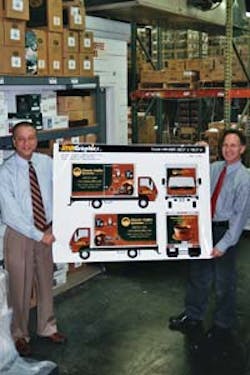
The most recent initiative has been to coat the delivery trucks with vinyl wraps carrying the company’s logo and some of its key coffee brands. “This is better than the Yellow Pages because tens of thousands of people see our trucks daily,” Malizio said.
Advertising has become increasingly important in recent years as many offices no longer allow solicitors on the premises.
The Internet has become a bigger marketing tool as well. Classic Coffee Systems launched a Website in 1992. The Website has evolved as a customer education tool, allowing sales people to review the company’s products online with people. The Website allows customers to peruse the company’s entire catalog for ordering. They can also view virtual demonstrations of brewing equipment.
While Chiarello and Malizio have noticed that many of their larger customers prefer to place their orders online, they don’t want to encourage this. They prefer to have their customer service reps call customers regularly to maintain personal rapport.
FOCUS STAYS ON CUSTOMER SERVICE
While the company has grown, Chiarello and Malizio still pride themselves on personal service, which they believe gives them a leg up over the national OCS players. “They (the nationals) can’t offer the service that we do,” Malizio said. “They are not going to get a box of popcorn to somebody. They (the customer) aren’t going to be able to talk to the owner.”
Chiarello and Malizio do recognize that the nationals have some aces of their own. Many national accounts are looking for national service contracts. To compete for these contracts, Classic Coffee Systems has partnered with independents in other markets to bid on national requests for proposals. This remains a work in progress. “We have a nice little network of independents that are of the same philosophy,” Chiarello said.
Chiarello and Malizio feel fortunate to have established a presence in a big market at a time when OCS is enjoying a new growth period. By maintaining a dedicated staff and keeping an eye on new products, they expect to ride this growth for many more years.
PROFILE: Classic Coffee Systems Ltd.
Headquarters Location: Valley Stream, N.Y.
Founded: 1980
Owners: John Malizio and Charles Chiarello
Number of Routes: 10 OCS, 2 vending
Number of Customers: 1,500
Business Mix: 45% coffee, 50% allied products, 5% vending
Main Brewer Manufacturers: Bunn, Cafection Enterprises, Mars Drinks (Flavia), Keurig
Private Label Roaster: Empire Coffee Co.
Software Supplier: Metroplex Data Systems.
Annual Sales: $6 million to $7 million