Electronic Payment Technology Evolves Fast for Consumers
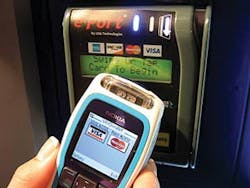
While operators continue to struggle with the implementation of cashless payments to vending machines, many other industries have transitioned past the threshold of non-cash settlement and begun accepting contactless cashless payment media. Contactless technology allows the consumer to simply wave, or tap, a payment device in front of a contactless reader to complete a transaction.
Trials of proximity payment technology revealed that contactless payment technology produces higher transaction throughput, increased spend per transaction, and enhanced customer convenience. While the preferred contactless technology has been radio frequency identification (RFID), the newest trend favors near field communication (NFC) technology.
Unlike RFID, which requires a unique infrastructure to work, NFC is a more intuitive application that provides an open basis for connectivity and networking.
In addition, NFC can be housed in a mobile phone and offers built-in security, enabling it to be used for transaction settlement as well as data exchange. As attention shifts away from RFID to NFC convenience, the potential impact on the vending industry could be significant.
M-COMMERCE EVOLVES
Are consumers interested in using an NFC-enabled mobile phone for making purchases? A recent online survey conducted by Visa found that 61 percent of respondents between the ages of 25 and 34 responded favorably to making purchases using a mobile phone. Similarly, the survey found 64 percent of the respondents are interested in receiving coupons via a mobile device. In addition, more than half of the consumers surveyed admitted carrying a mobile phone at least 75 percent of the time.
The demand for NFC technology is being heavily driven by the emergence of contactless payment formats being packaged into mobile devices (m-commerce). The development and deployment of innovative chipsets for cellular phones is projected by ABI Research to lead to widespread adoption of NFC contactless payments over the next five years.
CONTACTLESS TECHNOLOGIES EXPANDUp until recently, contactless payments were limited to card-based payment interface involving a sophisticated card reader. Rather than inserting a payment card into a point-of-sale (POS) device, or swiping the card through a magnetic stripe reader, the contactless device merely required the card to be in proximity of the reader to capture data stored on an embedded RFID chip.
Waving a card within a few inches of a contactless reader was sufficient to complete the data exchange. Once the RFID data was captured, the reader had to be interfaced to a payment mechanism for the transaction to progress toward settlement.
With NFC technology, the housing device (mobile phone) acts as an electronic wallet (e-wallet) and is responsible for completing the settlement function.
RETAILERS EMBRACE CONTACTLESS PAYMENTContactless payment adoption at retailer stores is gaining momentum as reported by research firm Aberdeen. The company claims that nearly one-third of all retailers have either implemented or are planning to implement some form of contactless payment technology in 2008.
Initially, the movement toward contactless technologies experienced resistance from business operators based on the high cost of implementing new equipment and the corresponding infrastructure necessary to complete the exchange of financial data.
With the evolution of strategic partnerships between NFC providers, payment processors, and POS vendors, retailers now have the opportunity to implement cost-effective hardware, software, and netware without necessitating structural changes. In addition, there is also a solid base for ancillary and future applications.
Typically, contactless payments significantly reduce waiting times for customers by removing the hassle associated with cash payments or the processing of swiped electronic payment cards. Such benefits may well apply to consumers using vending equipment.
Basically, NFC evolved from a combination of existing contactless identification and networking technologies, but was designed to offer simplicity in connectivity while establishing high levels of reliability. Unlike RFID applications, NFC has a higher level of standardization, interoperability, and security.
Additionally, NFC is capable of both sending and receiving data. Compared to the Bluetooth process in which one device needs to contact (ping) a nearby device and formulate a compatible protocol to achieve connectivity, NFC is more intuitive.
In other words, NFC does not require a device to seek permission before making a connection with a nearby device; the two NFC-enabled devices can communicate so long as they are within close proximity.
NFC has superior networking functionality and dependable security features that qualify it for use with transaction payment processors. In fact, in Japan the popular NFC-enabled phone of mobile operator DoCoMo is referred to as “osaifu keitai” – meaning “wallet phone.” Estimates indicate that more than 10 million wallet phones are currently in use throughout Japan, with a significant expansion projected for this year.
NFC can be configured to work with all electronic payment formats (debit or credit transactions). An NFC tag is the component that allows devices to communicate with each other simply by being put close together.
NFC APPLICATIONS EXPANDAlthough mobile devices are the most common host for an NFC chipset, the technology is not limited to mobile devices as some suppliers have begun placing chips in plastic cards, smart cards, wristwatches, and key rings.
NFC is distinguished from other wireless interfaces by its ability to connect, even to proprietary configurations, using a set of standard interoperative, seamless networking technologies. The primary uses of NFC are:
- Connectivity of electronic devices (wireless components);
- Digital content access (ability to download content from a smart tag);
- Ability to conduct contactless transactions (payments, access, and ticketing).
When an NFC device, such as a mobile phone or smartcard, is within close proximity of a reader, data exchange will take place. Most often, data transfer takes place as soon as the NFC chipset is passed or swiped over a reader.
NFC OFFERS ELECTRONIC WALLETWith NFC payment technology, the amount of the purchase can be immediately deducted from the consumer’s bank account or charged against a deferred form of payment. NFC devices can be linked to a bank account so money can be debited directly from a user to the retailer.
Alternatively, NFC cards or phones can be stocked up in advance with credit to be used as payment. Similarly, NFC devices can be used for proof of purchase as in the case of admission ticketing. The certificate of purchase is stored on an NFC chip and redeemed by simply pointing the NFC device at the entry gateway.
Unlike other technologies, NFC provides global interoperability of contactless identification and interconnectivity. NFC operates in the 13.56-MHz frequency range, over a typical distance of a few centimeters. The underlying layers of NFC technology are based on ISO, ECMA, and ETSI standards.
NFC technology is supported by major communication device manufacturers, semiconductor producers, network operators, information services firms, and financial services organizations. An important feature of NFC is its automatic compatibility with all forms of contactless cards and readers, even legacy media, deployed worldwide. Given that the NFC transmission range is so short, NFC-enabled transactions are inherently secure; additionally, physical proximity of the devices also reassures the consumer of maintaining control of the process.
Products with built-in NFC dramatically simplify the way consumer devices interact with one another, helping speed connectivity to receive and share information, including fast and secure financial transactions.
NFC provides intuitive, simple, and safe communication between electronic devices. NFC is both a “read” and “write” technology.
AUTOMATIC NETWORK COMMUNICATIONBringing two NFC-enabled devices in close proximity of one another will initiate an automatic network communication configuration. NFC-enabled devices are then able to exchange and store data – including personal and financial data, text and voice messages, photo and video images, and MP3 files – without user intervention.
By delivering intuitive connectivity, auto-configuration, and smart key access, NFC accelerates data transfer while enhancing levels of security. It is important to note that in a pilot program in Chicago, Motorola is testing NFC payments for an upgrade in the MasterCard PayPass contactless processing system.
From a technical perspective, an over-the-air (OTA) infrastructure is necessary to support NFC applications, including transaction settlement, coupon downloading, and smart poster content downloading (tag on poster links with mobile device for communication). The OTA protocol involves strong security measures designed to ensure proprietary data is not exposed or vulnerable to interference or interception. Motorola is among several vendors claiming that the benefit of NFC applications outweigh its cost (infrastructure and device chipsets).
In November 2007, Infineon Technologies of Germany announced a highly secure microcontroller to secure mobile commerce applications initiated with NFC chips. The microcontroller, like the NFC chipset, resides inside the cell phone casing. The microcontroller acts as a firewall to protect financial data exchange interference and allows account and transaction data to be safely stored on the NFC chip.
NFC APPLICATIONS BECOME MORE VERSATILESoon, users may be able to open electronic files and door locks as well as replace remote control devices with an NFC-enabled cell phone. From a unique application perspective, an NFC-embedded photo frame that automatically recognizes a compatible NFC device and enables the transference of pictures to or from the frame or device, is expected in the near future. In addition, NFC phones will likely be capable of storing receipts for all purchases, thereby creating an electronic transaction history.
According to ABI Research, American consumers favor using a mobile handset for transacting in-store payments, but a significant majority prefer having only one credit or debit account stored in the device. Much of the work on developing standard application platforms across NFC handsets has been directed at providing an application capable of supporting and managing multiple payment accounts (from credit and debit card issuers).
CONSUMERS PREFER A SINGLE ACCOUNTThe consumer’s belief that a single account is easier to manage with mobile payments is contrary to the wide menu of settlement options designed into the specifications of most NFC-enabled devices. Other findings from this research study include consumer attitudes toward handset security risks and potential hidden account fees (consumer and retailer). The solution to these issues requires a cooperative partnership between mobile operators and NFC payment processors.
A driving force to the expected surge in mobile phone manufacturer production in 2008 is based on the projected activities in the marketplace. In the coming year, leading payment processor ViVOtech has announced plans to strongly support NFC payment programs across the U.S. and throughout Europe.
Along with payment capabilities, this rollout will also feature two important NFC features: smart tapping and electronic couponing. A smart-tag tapping application allows consumers to touch an NFC device to a sensitized sign or poster and download its contents (e.g. movie trailer). Downloading electronic coupons to NFC phones provides a long-awaited direct distribution of item promotions.
In general, the use of contactless payments grew 15 percent in 2007, and at year end the market was valued in excess of $200 million with an expectation of $820 million by 2013 (ABI Research). ABI expects 6.52 million NFC chipsets to be shipped in 2008.
CONTACTLESS VENDING EXPECTED TO GROWDigital Transactions Magazine in January 2008 claimed that the number of U.S. merchant locations, vending machines, and taxi cabs capable of accepting contactless transactions, and therefore payments initiated with NFC-enabled cell phones, will rise from the current base of about 70,000 to more than 150,000 at the end of 2008.
The primary motivators for deploying contactless solutions in vending are speed and convenience. Speed of service is especially attractive in a busy location, as is payment simplicity. Similarly, customer convenience and accelerated transactions are the main focus of NFC payment interfacing.
Efficiencies associated with NFC may provide the economic proposition many vending operators felt was impossible with credit and debit card acceptance. Technology developers, recognizing that operators struggle to justify the acceptance of electronic payments, believe NFC may present a feasible platform for low-value transactions.
VENDING TECHNOLOGY PROVIDERS STEP FORWARD
The recent introduction of a contactless vending application from USA Technologies Inc. involves its e-Port reader configured with NFC technology that enables cellular phone purchasing. This application represents the potential in the next wave of contactless payment technology in the industry.
USA Technologies (USAT) reported that placement of its e-Port device has resulted in a 32 percent increase in average revenues in select markets. Along with increased revenue streams, USAT also noted improved efficiency, productivity and security for operators through online auditing and monitoring capabilities.
The firm claims e-Port improved customer satisfaction by overcoming the need to carry coins as well as its ability to accept multiple forms of cashless payments, including NFC-enabled devices.
While MasterCard, Visa, and American Express have actively pursued contactless payments via stand-alone RFID technology, Discover Financial Services (Discover Card) opted to take a different approach. Discover invested in NFC technology.
In January 2008, USA Technologies announced compatibility of its e-Port device with NFC capabilities of the Discover network. With faster transactions, shorter queues, fewer customer dropouts, reduced cash handling, and lower maintenance costs, NFC-enabled applications should have a positive cash flow.
Currently, financial institutions and card processors have not announced a specific interchange category for contactless transactions, especially NFC-based payments. Some retailers perceive NFC transactions as displacing cash, which for some is a lower cost transaction.
COUPONS AND LOYALTY PROGRAMS COULD HELP IMPLEMENTATIONCreating an interchange category that provides an incentive for supporting NFC transactions may be needed to spur adoption across the vending channel. Some industry observers claim that the real incentive for unattended point-of-sale support for NFC may lie in the technology’s ability to deliver coupons and loyalty programs through the cell phone.
One possibility is for vending operators to place posters and promotional materials beside the machine to enable real-time product discounts from downloaded coupons or the presentation of nutritional and expiration date information for an informed consumer purchase decision.
In essence, the concept is to convert the cell phone into an electronic wallet that can be used for a variety of functions (as well as settlement) at the point of sale.
Contactless/wireless technologies
Available contactless/wireless technologies include:
• Bluetooth – A short-range radio technology designed to simplifying data exchange and synchronization between Internet devices as well as between those devices and the Internet.
• Near Field Communication (NFC) – A standards-based, short-range, wireless connectivity technology that enables data exchange between multiple electronic devices. Similar to RFID, NFC involves radio frequency technology.
• Radio Frequency Identification (RFID) – Use of a transceiver for the receipt of radio signals scanned from a nearby transponder.
• Short Message Service (SMS) – Service required for exchanging text messages between mobile devices.
• Text Message – Exchange of short text messages (normally less than 200 characters) between two mobile devices (e.g., cellular phones, PDAs or pagers).