Broker of the Year: David Gellman, Gellman Associates, Norristown, Pa.
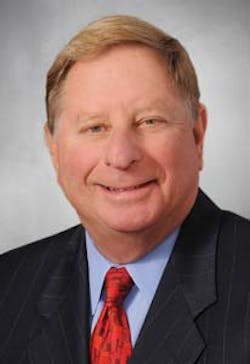
"Innovative” and “resourceful” are characteristics of successful product brokers, and no one embodies them more than Dave Gellman, owner of Norristown, Pa.-based Gellman Associates, the 2008 Automatic Merchandiser Broker of the Year.
Now in his fourth decade as a product broker, Gellman remains as active and as innovative as ever. He oversaw the development of the National Automatic Merchandising Association’s Coffee Summit in Cherry Hill, N.J. last February, which most attendees heralded as a great success. He also did the ground work for hooking NAMA up with St. Joseph’s University in Philadelphia, Pa., which will become the second college after Michigan State University to host a NAMA endowed vending/OCS education program.
Gellman was also instrumental in merging the New Jersey, Delaware and Pennsylvania state vending associations into the Tri State Automatic Merchandising Council last year, a move that he believes provides better services to operators in all three states.
AT FIRST, HE FOLLOWED HIS FATHER
Gellman got into the brokerage business on a part-time basis following his U.S. Coast Guard service in the early 1960s. He took classes at Temple University in Philadelphia at night and worked for his father, the late Harry Gellman, a retail food broker.
In 1964, interested in learning more about food marketing, he switched from Temple University to St. Joseph’s University, which offered a dedicated food marketing degree. His studies were cut short when his father bought a pretzel manufacturer and offered him a job as a production foreman.
Gellman quickly tired of the factory position and moved into sales, calling mainly on candy and tobacco wholesalers. When his father decided to close the pretzel factory after a year and a half, Gellman became a full-time salesman for the food brokerage. While his father managed the national accounts, Gellman worked on developing smaller retail accounts.
THROWN INTO A CHALLENGING SITUATIONBefore he could get himself well established in the Philadelphia market, his father passed away, leaving no one to handle the big national accounts.
Gellman did not like selling to big retail accounts. The buying decisions were all based on numbers, and it took a long process to get an order signed.
His customer list included some vending operators, and he liked dealing with them.
In 1968, Gellman made two key decisions. He got out of the retail food business and attended his first NAMA convention. At that convention, he made a key contact: Everpure. It became his first major vending/OCS line. He still represents Everpure.
LAUNCHING A NATIONWIDE BROKER NETWORKThe biggest change came eight years later, in 1976, when Gellman and a cadre of dedicated vend brokers in other parts of the country formed the National Vend Brokerage Association (NVBA). The purpose of this group, of which Gellman was the first president, was to offer a national broker network to product manufacturers.
Growth came quickly with NVBA’s establishment, and before the first year was finished, Gellman hired his first full-time sales rep besides himself.
No sooner was the brokerage off to a strong start than an economic recession hit in 1977. At the time, the vending industry’s customer base was more dominated by heavy industrial accounts, which were laying workers off by the hundreds. “It was a major recession,” Gellman recalled.
The industry recovered when the nation’s economy rebounded in the mid 1980s. Another recession came in the late 1980s and early 1990s, but this was minor by comparison to 1977.
OPERATORS CONSOLIDATERising costs and the continuing downsizing of industrial accounts led to more consolidation of the operator universe in the last decade. This has reduced the customer base for brokers, who, as a result, have also been forced to consolidate.
One of the biggest changes that Gellman has observed in recent years is the increase in the use of machine planograms. This has brought both positive and negative results, for both operators and brokers.
While planograms have helped operators manage their inventories better, Gellman isn’t sure that customer needs are being met as best as possible.
Fortunately, the evolution of higher capacity glassfront merchandisers (for both snacks and beverages) has allowed vending operators to offer more variety in the machines. This has improved the overall level of customer service and allowed operators to provide a wider variety of price points.
This is especially important, said Gellman, because vending machines are now going into more diverse types of locations. “The population today isn’t in the work environment as it was,” he said.
Gellman thinks that operator consolidation will continue as profits become more squeezed. “The market has matured to a point that is more competitive,” he said. “More people are knocking on doors for the same business.”
Technology is contributing to the cost of operating, he noted. Operators are realizing they need new software to be competitive.
STATE COUNCIL ACTIVITY REMAINS IMPORTANTAnother cost that operators have to consider is lobbying at all levels of government. Gellman has long been involved in local, state and national trade organizations, and he has always encouraged his associates to be involved.
In 2005 and 2006, as president of the Pennsylvania Automatic Merchandising Council, he led a successful campaign against efforts in the state legislature to repeal sales tax exemptions benefiting operators. If these exemptions had been repealed, the industry’s sales tax liability would have risen from 3 percent to 6 percent.
The state associations provide important education and lobbying functions, according to Gellman.
Gellman is also on the advisory board for the Edison Fareira vending repair program in Philadelphia, Pa.
Brokers, like operators, must continue to invest in their staffs. Gellman has made liberal use of manufacturer training programs for his staff, as well as NAMA education.
There will always be a place for small vending operators since the medium size and larger operators cannot afford to service small accounts, he noted.
Profile: Gellman Associates
Founded: 1960
Owner: Dave Gellman
Headquarters Location: Norristown, Pa.
Number of Full-time Employees: 7
Product Lines: Bridgford Foods, Cadbury Adams, Cathead Foods, Daisy’s Bakery, Del Monte Foods, Diversified Foods, Everpure, Farley & Sathers, Domino, Florida’s Natural, General Mills, Holiday House, International Paper, Kool Tek, Monogram Meat Snacks, Mr. Nature, Novamex, Sara Lee, SlimFast/Unilever, Snak King, White Castle
Annual Sales: Not revealed