Brad Bachtelle Explores Routing Efficiencies During Southeastern Vending Association Convention In Destin, Fla.
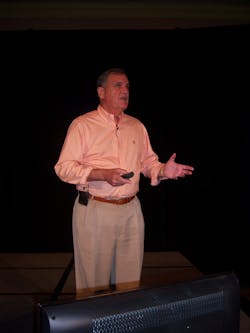
Technology has given vending operators new tools to improve route efficiency. Brad Bachtelle, a longtime vending industry consultant, has measured the impact that these tools bring and as a result, he wants operators to realize the improvements are real and the traditional way of operating routes is inefficient and highly unprofitable.
That was the message Bachtelle delivered during a presentation titled "Profiting from improved route efficiency" at the Southeastern Vending Association Convention in Destin, Fla.
Bachtelle began by defining route efficiency. He defined it as doing the same job with fewer "inputs," which he defined as all labor, activities and assets utilized in a route operation. Improved route efficiency is achieved by doing more with the same inputs. The best scenario, he said, is doing more work with fewer inputs.
"Being efficient simply means reducing the amount of waste or finding a better way to do it without reducing service quality," Bachtelle said.
He then compared financial averages from the 1999 and 2008 National Automatic Merchandising Association profit reports, noting that 1999 was the first year before major economic fallout began in the U.S. He noted the average route had sales of $341,591 per year in 1999 and $346,048 per year in 2008.
This, he said, translates into a 1.3 percent gain in efficiency over a 9-year period, during which prices increased by 10 percent.
"That's not efficiency," Bachtelle said.
In addition, route expenses rose about 18.6 percent in this period. Given the 1.3 percent sales gain and the 18.6 percent cost increase, routes actually declined in expense-to-revenue efficiency by 15.7 percent, he said. In other words, it cost about 16 cents more per dollar to run a route in 2008 than nine years earlier.
"We should have gone the other way by 16 percent," Bachtelle said.
He said this is doable with today's vending technology.
He noted that route costs represent about 30 percent of the costs in a vending operation.
He said it is necessary for operators to look at their pre-route activity and their at-location activities to get a better handle on route costs.
Key route performance metrics in his view are:
- Revenue per route
- Stops per collections
- Machine out of stock frequencies
Monitoring these metrics will allow an operator to measure performance and establish activity expectations.
With today's technology, Bachtelle said he has seen collections as high as $125 to $140 per stop compared to industry averages of $65 to $75.
Besides increasing collections, he said it is also possible to increase the number of stops serviced per day.
He said some operators have improved their route revenue by 70 percent. He also noted that most operators are not using the tools that are now available to enable them to do this.
"Metrics defines the playing field," He said.
A key change is to move from the traditional system of arranging service by week day to work day. "Why do we route by weeks?" he asked. He said this system is based on operator convenience, not location need.
To be efficient, Bachtelle said operators should schedule service using the longest work day gap possible to deliver the most effective service. This will reduce the number of visits but maintain the same level of quality.
Using historical sales data, an operator can know if the location needs service every second day or every third day.
In scheduling service on the appropriate work day, many operators find they have uneven account loads. Bachtelle said the solution is to divide same-frequency accounts into a number of groups matching the work day gap and slide each group one work day. One third of all ever-3-day accounts will be serviced each day.
Bachtelle said efficiencies can also be improved by focusing on what tasks require specialized attention. He said Henry Ford improved efficiencies in auto manufacturing by identifying specific assembly line tasks.
Bachtelle said operators should minimize the amount of time trucks are not moving; all stoppage time is wasted time.
In addition, he said operators should minimize the amount of time drivers spend in the warehouse and at the location.
"I want them out of the warehouse," Bachtelle said of the drivers.
"Can we focus the tasks of all aspects of our operations to free up the routes to let them be routes?" he asked.
Other opportunities include reducing out of stocks in machines by doubling up on faster selling items.
Another opportunity is to maximize the vending machine's capacity to carry more product.
Still another opportunity is to set par levels in the machine and on the truck to what is needed.
Bachtelle then focused on the capabilities that new technology allows: pre-kitting, dynamic routing and dynamic scheduling.
"There are some amazing new technology capabilities," he said.
To use these technologies, an operator must have SKU (stock keeping unit) sales information, Bachtelle said. He said the sales data can be historically based or real time.
He said real time data is significantly more expensive for the operator, but "the benefits are substantial."
These systems will reduce the time needed to load the machine and the inventory carried on the truck to the machine, he said. In addition, they will deliver better gas mileage since there is less inventory on the truck.
Pre-kitting, dynamic routing and dynamic scheduling typically require additional warehouse staff, Bachtelle said.
He noted that inventory picking software has been introduced that further improves warehouse efficiency.
Bachtelle said comparing the new route management systems to the traditional system is like comparing a rotary phone to a smart phone.
He said operators who have used the new systems have on average witnessed route sales increases of 32 percent to 76 percent. This has also resulted in route expense reductions of 35 percent to 45 percent.
Operator investment payback has been from 15 to 18 months, he said.
Bachtelle acknowledged that out of stocks increase due to less frequent service, but this is manageable.
He also said the systems will reduce the company's carbon footprint and improve employee morale.
During the question and answer period, Bachtelle said driver commissions usually have to be adjusted after these systems are implemented.
To begin the process of making routes more efficient, he said operators need to understand their metrics. "If you don't know what your routes are doing, you can't make those adjustments," he said.