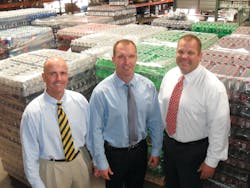
Ace Vending in Tempe, Ariz., an 18-route operation servicing 3,000 machines from five operating facilities, offers a case study of a company that has become a market leader and continues to grow at a healthy clip. As the only big independent in the market it services, Ace Vending offers more services than the numerous small competitors and also provides a more personal touch than the national service provider active in the market.
One key to the company’s success has been its pioneering use of technology, including cashless readers, DEX handhelds, pre-kitting, automated warehouse management and micro markets.
Ace Vending, to be sure, is not a typical company. Partners Wade Stooks, Kevin Van Hazel and Chuck Walton Jr., friends from junior high school, are all college educated and highly motivated Gen Xers who grew up cognizant of the way technology has changed business in general. When they launched Ace Vending in 1998, they came with no preconceptions about how the vending business should be run, and they organized their deliveries in a way that made it easy to incorporate DEX handhelds and eventually gain DEX-based efficiencies.
Beginning with Coca-Cola
After graduating from college, Stooks and Van Hazel landed jobs at the Phoenix, Ariz. Coke bottler, Stooks in sales and Van Hazel in finance. Walton became a Phoenix firefighter, a job he has continued to hold in addition to working for Ace Vending.
While working at Coke, Stooks and Van Hazel quickly learned that there was no established independent vending operator serving greater Phoenix. Believing they would be able to develop a vending business quickly using bottler-loaned machines, they, along with Walton, struck out on their own in 1998. Stooks and Van Hazel had saved enough money to cover their living expenses for six months.
Armed with a used delivery truck and working out of a garage, they began knocking on doors in Casa Grande, which is about one hour equidistant from Phoenix to the north and Tucson to the South.
And while they didn’t have vending experience, they knew the importance of having a professional appearance. They invested in uniforms and literature, and they approached prospective accounts as if they were already an established company.
“We acted like a big company from the get go,” Van Hazel said. “We looked like a professional vending company.”
Stooks already had a successful track record in sales at Coke, and getting accounts did not prove too difficult. Many vending accounts were dissatisfied with the service they were getting from the existing providers.
Arizona: a unique vending market
Arizona has always been a unique vending market since there are not a lot of large industrial accounts that typically form the customer base of large vending operations. The market has long been dominated by small operators, many of which are retirees.
Once Stooks, Van Hazel and Walton got an account, they bought the equipment, installed it and began providing service.
Beverage machines were a “no brainer” since the bottlers provide them for free. But snack machines were a different story. Focusing on cost, they first tried used snack machines, which proved a mistake. “It was a nightmare,” Van Hazel said, in reference to the servicing of used equipment. “We were naïve. We jumped in without looking.”
They immediately began buying new equipment from the local Automatic Products, ltd. distributor. The new equipment cost more money but saved a lot of service calls.
After six months, sales were sufficient enough to justify a 1,500 square-foot warehouse for the young and growing company.
After one year, with 50 accounts, they hired a full-time driver.
Only one account, an auto parts dealer, wanted cold food and hot beverages. After installing and servicing the cold food and hot beverage machines, the partners decided it was not the business they wanted to be in. However, larger accounts still wanted food and hot beverages, so they looked for alternative ways to meet this demand.
Instead of cold food machines, they offered frozen food machines. Van Hazel said most customers who want food can be convinced to accept a frozen machine, which also offers ice cream.
Instead of hot beverage machines, they offered countertop coffee brewers, an offering that eventually grew into a separate OCS division.
Machine planograms early on
Being newcomers to vending, the partners did not follow established industry practices, such as paying drivers based on commissions or having drivers pick products in the warehouse. Instead, they reasoned it made more sense to have a planogram for the driver to follow, and to have the truck loaded in the warehouse by the lower paid personnel.
“Why would I have a salaried guy spend part of his day loading his truck when I could have an hourly guy do it?” Van Hazel asked. “I want him out collecting money as much as possible every day.”
This system proved to be fortuitous when the partners sought vending management software.
Van Hazel, a college math major, initially designed his own software system to manage the product inventory.
Starting the business in 1998 had a key advantage; DEX was just coming on the scene with vending machines. In learning about DEX, Ace Vending was able to attack the market with state-of-the-art management software. By using DEX data, they were able to gather item-level sales data from the machines, which made product inventory easier to manage. It also enabled them to develop planograms that more accurately matched deliveries to machine needs. “We were very lucky getting in (the business) when we did,” Van Hazel said.
Focus on route management
By 2002, the company had four routes and moved to a larger warehouse. The partners recognized that route management was key to profitability. They began to research DEX handhelds. They saw DEX handhelds as a key to improving route accountability.
Where many vending operators become interested in DEX handhelds as a way to improve cash accountability, Van Hazel saw it as a way to make the route planning system more efficient. The company was already using a planogram for its routes and was pre-kitting the loads for the drivers in the warehouse.
DEX handhelds, in providing item-level tracking, gave Van Hazel a tool to make the planogram more accurate.
After researching industry specific software, Van Hazel felt Streamware offered the best system. Streamware was one of the first software suppliers to offer DEX-based management. In addition, it was the only company that responded to a request for an onsite visit.
“I think we made the right decision,” Van Hazel said of Streamware, which is now part of Crane Merchandising Systems. “Their product pretty much does what it always says it can do.”
In 2004, they began pre-kitting routes using DEX data.
In 2007, right before the recession hit, Ace Vending expanded into OCS. That was a fortuitous move, since the OCS business has weathered the recession better than vending. Recognizing the unique needs of OCS, they established a dedicated OCS truck.
“The office coffee business is really what has kept us profitable over the past five years,” Van Hazel said.
Technology pioneers
The company was also ahead of the curve in its market with cashless vending, which it introduced three years ago. The company began testing the USA Technologies Inc. system. “We thought it was finally ‘plug and play,” Van Hazel said.
Customers weren’t asking for cashless at the time, and most were not aware that it was available. But Van Hazel wanted to be ahead of the demand before it hit, and in retrospect, he made a wise decision.
Ace Vending started with 10 cashless readers on a test basis in existing locations, mainly locations with a lot of public traffic and a lot of younger consumers. These included hotels and telemarket call centers. The results were immediately positive. Those first 10 machines experienced sales increases of 10 to 15 percent.
The USAT readers and telemetry system worked reliably. The system also interfaced seamlessly with the Streamware server.
They also tried some cashless readers in blue collar accounts, and the response was not as good. That has changed, however, in the last year.
In three years, Ace Vending has installed card readers on half of its 3,000 machines. In addition to USAT, Ace Vending has used some Streamware readers.
The company has also been able to take advantage of the timely cash sales data provided on the USAT Website in addition to cashless data. This data, which is more timely than the DEX handheld data, has improved the accuracy of the sales information needed for pre-kitting. “Our kits automatically became a lot more accurate,” Van Hazel said. “With credit card readers, you’re getting a feed every night of what’s happening.”
Van Hazel estimates the machines on average are 45 percent empty when serviced. The trucks return with only a few cases of product on them at the end of the day.
The company’s routes generate $650,000 per year on average, which is more than double the industry average, based on National Automatic Merchandising Association data.
Once all machines are reporting data to the Website, the company will be able to expand from pre-kitting to dynamic scheduling. Van Hazel thinks he will be able to ensure that the driver will pull at least $100 (or any amount of his choosing) every time they go to the machine.
“The inclination (among operators in general) is to over service to prevent a service call,” Van Hazel said. While this is a consideration, managing labor costs is a major concern in a labor intensive industry like vending.
When the company expanded into micro markets this past year, inventory management became even more important due to the higher number of stock keeping units in the warehouse.
After installing four micro markets, the company invested in LightSpeed, a pick-to-light warehouse management system that accelerates the pre-kitting process by issuing light signals to direct the activities of pre-kit personnel. The LightSpeed system has been especially beneficial for the company’s micro market routes.
“That one purchase is the one best purchase we ever made,” Van Hazel said of LightSpeed. He claims he recouped the investment in LightSpeed in less than a year.
At the present time, the micro markets are serviced by some of the vending routes. Van Hazel wants to have a dedicated micro market route.
Micro markets fuel growth
Van Hazel learned about micro markets at a Unified Services Group buying group meeting a year and a half ago. No one in Arizona was offering micro markets at the time to the best of his knowledge. Jim Brinton, president of Avanti Markets, gave a presentation on his system. Van Hazel went to Seattle, Wash. to visit Avanti Markets and learn more about the system.
Brinton provided a list of products for Van Hazel to carry in the micro market. One type of product he was not used to carrying was fresh sandwiches. Van Hazel was able to work out an arrangement with a commercial commissary.
Van Hazel placed his first micro market in an established vending location, replacing the vending bank with the micro market, on a test basis. The micro market doubled the sales in a short period of time, and the sales have remained at the same level ever since.
Once he had one micro market set up, Van Hazel had a location he could take other customers to see. In the past year and a half, he has installed 50 micro markets. “This is where it (the business in general) is at, in my opinion,” he said. He seeks locations with 150 to 200 employees minimum for a micro market.
When introducing a new micro market to an account, Ace Vending provides “value cards” to each employee with $2 loaded on the card. The “value card” contains a personal bar code by which the customer establishes a personal account with Avanti Markets which they can access over the Internet. The employee is also awarded extra value for loading $20 on the value card, either with cash or a credit or debit card. “They save some money by keeping value on the card,” Van Hazel said.
To date, half the micro market purchases are made with the value card and the rest with debit or credit cards. Avanti Market does not accept cash payments, although a customer can load the value card with cash at the kiosk.
The purchase history for every location is analyzed by Avanti Markets. Operators can access reports on top selling items to offer.
One top selling item for Ace Vending has been cheese sticks. Van Hazel said he never sold this product in vending.
The fresh food has also been an excellent seller.
The micro market also works well for employee wellness programs, Van Hazel said, since it allows more variety than vending.
Energy shots, which never did well in vending, have been very successful in the micro markets, Van Hazel said.
Van Hazel thinks giving the customer the ability to touch a product before they buy it makes a big difference.
From the operator’s perspective, not being constrained to nickel increments (as in vending machines) has been a big help. “It improves the customer’s experience,” Van Hazel said.
Avanti Markets has offered some very successful promotions at the point of sale. A recent promotion allowed customers to win an iPad with five chip purchases. In another instance, customers got 25 cents off a soda when buying a sandwich and chips between 3 p.m. and 5 p.m.
For hot beverages, the micro market has a Keurig brewer where the customer can insert K Cups they buy from a MultiMax machine.
Ace Vending manages the Avanti Markets data over the Internet. The Avanti Markets data interfaces with the Streamware VendMax data, allowing Ace Vending to manage inventory for both the vending machines and the micro markets without a lot of extra steps.
Employee theft has not been an issue with micro markets, Van Hazel said. The only problem is when a cleaning crews don't realize the products there aren’t free. This is usually solved through simple communication.
Multi-faceted marketing
One way Ace Vending has distinguished itself in the market has been a multi-faceted marketing program that includes the Internet, the media and business trade shows.
The partners realized they were technology pioneers with pre-kitting, cashless acceptance and micro markets. To communicate their uniqueness, they hired a professional Internet designer to upgrade their Website, http://acevending.net. The Website has a professionally produced YouTube video about pre-kitting that emphasizes product freshness, how handhelds ensure accurate deliveries, and how clean the warehouse is.
Another professionally produced YouTube video demonstrates Avanti Markets.
Ace Vending has found that vending technology offers a great way to win media exposure. In late 2008, the company was featured on national television when the History Channel’s “Modern Marvels” ran a special segment on vending technology. When the TV crew visited Crane Merchandising Systems to demonstrate how DEX handhelds work, Crane suggested the camera crew visit Ace Vending to see how a vending operator uses the handhelds.
The company has also advertised in a business newspaper, the Phoenix Business Journal. The newspaper did a feature article on the company when it introduced Avanti Markets in 2011.
Shortly after the Phoenix Business Journal ran its article, The Trivalley Dispatch, a daily newspaper in Casa Grande, Ariz., also ran a feature about the company.
Van Hazel said the media coverage has given the company more credibility in the community.
Ace Vending has also found it worth the time and trouble to exhibit at business trade shows. They have experienced success exhibiting at a show for human relations managers as well as a more general business trade show.
In addition, the company has promoted itself on social media Websites, but has not determined how successful this has been.
Future direction: video touchscreens
While vending is currently suffering compared to micro markets and OCS, Van Hazel is optimistic about vending, thanks to the new technology on the horizon.
He thinks interactive touchscreens that display a variety of digital content at the point of sale and allow text messaging will bring new life to vending. He plans to introduce VendScreen, an Android-based, touchscreen that displays a variety of content and collects real-time point-of-sale data for analytics, plus connects wirelessly to the Internet to allow cashless payments and refunds, inventory management data and more.
VendScreen will also be helpful in meeting calorie disclosure rules, which Van Hazel thinks will be mandated in the near future.
“We want VendScreen,” Van Hazel said. “It’s going to make the machine smart and will handle this regulatory thing that’s coming up with nutritional communication.”
Long-term, Van Hazel hopes technology will help remove commissions from the picture. Location commissions have been a sore point with him from the very beginning. “With us bringing the technology in, the commission has to go,” he said. “(And) the more technology comes into play, people who don’t know what they’re doing will be out of the picture.”
As excited as he is about the future, Van Hazel thinks there are some big challenges for the vending industry to address. In addition to calorie disclosure, he is concerned about the new Americans With Disabilities Act law mandating new machines have controls at certain heights. “How is it going to affect what I have to do in the future?” he asks.
While the core business is struggling because of the recession, Van Hazel points to an upside: the availability potential employees. “The economy being down has helped us find good people,” he said.
The Ace Vending story demonstrates the growth that forward thinking operators can achieve with new technology, even during a recession.
Operation Profile
Name: Ace Vending
Founded: 1998
Owners: Wade Stooks, Kevin Van Hazel and Chuck Walton Jr.
Headquarters: Tempe, Ariz.
Branch operations: Prescott, Ariz.; Yuma, Ariz., Kingman, Ariz.; Denver, Colo.
Number of routes: 18
Number of employees: 60
Hardware and software suppliers: Streamware, USA Technologies, LightSpeed, Avanti Markets
Main equipment suppliers: Crane Merchandising Systems, Keurig, Multi-Max
Annual Sales: $12 million
About the Author

Elliot Maras
Elliot Maras served as the editor of Automatic Merchandiser magazine from 1993 to 2012. To reach the current editor of Automatic Merchandiser and VendingMarketWatch.com, email [email protected].