Better user experience grows Texas operator business
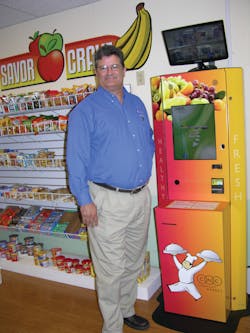
Before 2011, Chuck Olson of CNC Vending, serving Houston, Texas, would have said his company was just like every other vending company. He sold the same products, with the same equipment, as his competitors. He was only able to promise better service. However, at the Chicago 2011National Automatic Merchandising Association (NAMA) OneShow, Olson came across three ideas that changed the future of his company: cashless payment options, self-checkout micro markets, and the NAMA industry growth strategy (IGS).
At the show, operators with years of service were presenting the need for a more positive and exciting consumer experience. That really spoke to Olson, who had been in business for only three years. And technology could make it happen.
First was credit and debit card acceptance, which offers users more payment options, allowing them the convenience they want, but also the ability to buy more product than they could afford using only the cash in their pocket.
Micro markets present a completely unique experience for vending customers with convenience store product variety, and value that can increase sales at a single location.
The IGS, the association's strategy to target new vending consumer markets and grow existing ones, especially Gen Y, led Olson into the realm of social media. He embraced it, and started his own social media campaigns, which won him the first and only NAMA operator innovation award, the 2012 Gold iSpot award.
Olson's success in vending did not happen without previous business experience.
Drawn to vending's cash-flow potential
After a career as a successful accountant, investor, restaurateur, real estate owner and landlord, Olson found vending. He thought it would provide the positive cash flow he was looking for, and was somewhat recession proof. He bought a 4-route operation in 2008 with his silent, financial partner. He spent the next year learning the business. "It's not for the faint of heart," said Olson. "But I love it. It's fun."
Olson had ups and downs at first. He immediately condensed the four routes to three, in order to be more efficient. He lost two large accounts in the first month. He then picked up another significant location. "There's a lot more to this business than babysitting machines," Olson said. He was surprised by how much maintenance vending machines require, with all their moving parts. He also decided the investment was too high for back-end telemetry, so he kept a paper-based inventory management system.
In 2011, Olson attended his first industry trade show. "It's the best thing this company has ever done," said Olson. "It was a turning point." It changed how Olson viewed the industry -- no longer a daily grind, but something new and exciting, with opportunities to grow sales at every location.
Cashless -- the first move
Olson chose the USA Technologies’ ePort for his cashless system in 2011. And now 250 machines have readers that take all debit and credit cards, as well as near field communication payments, including Google Wallet. He's seen the benefits in his business with increased sales and how it sets him apart from the competition. "Every machine that goes out now has a credit card reader," said Olson.
This June, Olson will start using two tier pricing, with a surcharge for customers using cashless payment. He has already received some push back from locations, but feels it's a move he has to make to cover the cost of the transaction.
Micro markets drive huge sales increases
"I'm just so excited about the markets," said Olson, who installed his first one five months after the 2011 NAMA show. He quickly added two more in early 2012, with five to be installed in June.
For Olson, the micro markets, which he calls "CNC Company Markets," hold many positives he isn't getting from vending. First, the drivers don't handle cash. Second, it has real-time data, so he can see what's selling and what's not. It also allows him to adjust prices or give refunds immediately. "They're operationally easier to manage," he said.
While technology exists that would allow him to do many of these things in vending, he hasn't wanted to spend the money on these back-of-house systems. Instead, he invests his money where it will impact users most.
Olson uses the 365 Retail Markets kiosk for his markets. He likes that he can use his own brand on the machines, unlike some of the other market retailers, and it offers biometric payment options.
Another great advantage to markets is the high dollar margin on products, although the percentage margin is higher in vending. Olson breaks it down, explaining that he sells chips in a vending machine for $.95, with a cost of $.38, leaving him with a $.57 profit, 60 percent. In the markets, he sells a grab bag sized chip for $3.69 with a cost of $2 and profit of $1.69, 45 percent. In the market, sales tax is added to the customer's final purchase amount, similar to a retail transaction. Olson sees this as a benefit because he doesn't have to build the tax into the price, as he does with vending products.
Most astounding, however, is the increase in sales volume from the markets. He replaced a vending bank averaging $400 per week with a market that offers coffee, frozen foods and deli foods in a cooler. The sales are now $900 to $1,000 per week. Plus, the upfront equipment costs were lower, and maintenance can be done over the phone. Just recently, Olson had an audio malfunction on a kiosk. He called into the service lines and they fixed it remotely, charging him nothing.
Initially, Olson had the route drivers stock the markets, but this did not work well. Olson finds route drivers don't make good marketers. "Vending guys are not c-store guys," he said. Most drivers lack an understanding of the importance of facing products or of maintaining that "strike zone" of high margin products presented at eye level. Therefore, he recently hired a more tenacious individual to focus on merchandising, inventory and customer service exclusively at the markets.
Branded hot beverage machines
While CNC Vending does offer office coffee service to customers who request it, Olson never wanted to enter that side of the business. However, Olson has found success offering branded hot beverage machines. He had a generic machine at a local community college, but swapped it out for a Seattle's Best Coffee machine and saw growth.
"That machine was selling maybe $50 a week," said Olson. "Now it (the Seattle's Best Coffee machine) sells $50 in a day." He's convinced it's the branding that makes a difference. In his markets, he's planning to remove the current machine and place a branded Starbucks coffee machine.
Healthy products really work
Health and wellness items are really a draw in markets. "We're becoming more than a vending company," said Olson. "We're becoming a health and wellness break room expert." He uses health and wellness as a selling tool, offering to assist companies in achieving wellness initiatives all while servicing their employee’s needs. Olson has co-branded the CNC Company Markets with a local company whose expertise in the Health and Wellness Community is unparalleled. “We create excitement around our new market openings complete with education, screenings and the like”, Olson beamed. “At one market opening we had a technician measure how many daily calories an individual burns daily by screening their breathing patterns.
The concept is fairly new. Previously, Olson believed the common thought that customers want healthy products in the break room, but won't actually buy them. But, he proved himself wrong, this year.
CNC Vending was approached by a large location that needed to offer a 1:1 ratio of healthy items to unhealthy items. Olson agreed, deciding the variety required a market. He balanced traditional candy bars with granola-type bars made by Kind. Because the account was prominently blue collar, and the healthier bars were priced significantly higher than other candy bars, Olson didn't expect them to do well. He was wrong.
He sold almost as many Kind bars as candy bars. This inspired Olson to add nutritional bars to all accounts, and even baked chips or similar healthier alternatives.
"And sales didn't go down," said Olson, although he admits they didn’t increase either. "But now we know we're meeting a need."
Food dominates health and wellness market
According to Olson, offering food makes a big difference in sales, but is only effective in micro markets due to the 3-day shelf life and the fact that consumers really want to physically examine the food products and read the labels.
CNC Vending outsources its food production instead of operating a commissary. However, CNC Company Market puts its labeling on the products to build their brand. The products offer variety, including soups, gourmet sandwiches, salads, entrees and even organic foods. Olson admits the margin on food is minimal. He makes his money when the customer also buys a snack and drink to go with it.
The selling cycle on markets is a little longer than for vending banks, because customers are less familiar with them. He finds he has to explain what the market is and how it works to several people at a potential location, including the location manager, the facilities manager, etc. He's hoping it will be easier, and faster, now that he can take potential customers to an existing market.
Theft isn't an issue
Theft is everyone's first concern when they see a micro market, including locations. But Olson said it hasn't been an issue. "No employee wants to lose their job over a Snickers bar," said Olson about why he doesn't think more employees steal from the markets. He experiences about 1 percent in shrinkage, which could be accounted for, at least in part, by mishandled inventory. Even so, when Olson compares the 1 percent in shrinkage to the 250 percent lift in sales he averages from a market, it loses all relevancy.
Another advantage to the markets is cashless payment by stored value account, which helps Olson avoid the transaction fees associated with debit and credit cards. When Olson opens a market at a new location he gives every employee $2 in an account. Customers can pay with their fingerprint using the biometric scanner on the market kiosk.
He also sets the machine to occasionally throw in freebies, like during the grand opening week if the employee puts $20 in their account, he'll add an extra $5. Or, Olson will authorize buy one, get one free promotions, which he can't do with a vending machine.
The user account gives employees an opportunity to add their email address. Olson will use those emails to send specials; say if he's adjusting prices because a product will expire soon.
Because Olson can access the market remotely, he can correct prices or give refunds. Staff at locations, who used to handle refunds, enjoy being able to send Olson an email instead of doing the refunds themselves.
Currently, 5 percent of Olson's business is micro markets, but he's aiming for 50 percent in the coming years.
Growth strategy leads to social media
Last year, when NAMA announced the IGS, it opened Olson's eyes to the need to stay current with his business, and really set himself apart. He wanted to get involved.
He took advantage of NAMA's Facebook contest, Vend.Love.Win., by placing signage and clings on machines at his locations. While he felt it was worthwhile, it was hard to identify how successful the campaign was, because he couldn't see analytics of the NAMA Facebook site. So he decided to come up with his own campaign "Connect for Cash," where Facebook fans and Twitter fans would be placed in a drawing for product tokens or credits.
He enlisted his daughter to launch CNC Vending into social media. Olson made his own signage for the Connect for Cash campaign, started checking Twitter a number of times per day and began posting on Facebook.
Facebook is especially useful to Olson, due to the built-in reporting features. As of this article, he had 250 fans on Facebook. According to the analytics, when those fans comment on his company, there's a potential 115,000 people who would see it.
Olson loved running contests, whether it was the drawing or offering tokens/market credits to people who guessed how many fumbles would happen during the Super Bowl. He got so invested in tweeting during the game, he said it was a little community talking back and forth, and these were his vending customers.
Another example is when Olson received a tweet from a customer explaining how he loved the blue Monster energy drink, but wished there were more in the machine, because it was always running out. Olson asked the route driver to add an additional spiral of blue Monster. The next day's tweet had the customer expressing his amazement and gratitude. "Before he just dealt with a machine," said Olson. "Now, he knows, it's a real person."
Olson admits getting his social media campaign started was costly. He figures it cost $2,300 in Q1 to run the campaign, including the give-aways. He's hoping to partner with suppliers for his next round of social media campaigning. Still, it was worth it. "It (social media) gave me a better understanding of what they want," he said. "I can't quantify it, but I know there's value in the knowledge."
At the 2012 NAMA OneShow, Olson decided to build a new Website to strengthen his online presence and leave behind a “Mom and Pop” impression his old Website conveyed.
A business for the future
Olson loves the vending business, especially with the exciting addition of micro markets. All the changes he's made are real tangible points of difference. "We have a future, a plan, a purpose," he said. "And it's to be the highlight of the break room. And we can do it."
Plus, he gets to work with his wife of 25 years, Cari, every day. "That's been a real joy," he said.
Branded hot beverage drove sales
At college campuses, technology really pays off. When Olson started swapping Dixie Narco 5800 glassfront machines for can vendors, sales tripled. When he put in a Seattle's Best branded hot beverage machine, sales spiked over 70 percent. And every machine offers the option to pay with credit, debit or even Google wallet.
His next upgrade will be to add touchscreens. "I think they'd do really well (at these types of locations)," he said.
iPad compliments micro market reporting
While micro market systems and data are accessible via smart phone, Olson found the screen too small to read reports. That's when he invested in an iPad. He can pull up reports, account information and change prices from any WiFi location, including a McDonalds.
Operation Profile
11 full time employees, started with four
Main equipment lines: VE, H.A. Franz in Houston, 365 Retail Markets
Maine product lines: Frito-lay, Zaps, Mars Chocolate North America, Hershey's
Software provider: USA Technologies, VendSys
Web Designer: VendCentral
Pre-kitting to improve route efficiency
Olson is thinking about the future and how to increase efficiencies. Right now the pen and paper method his route drivers are using allows them to take in about $11,000 per week from 125 to 140 machines. He's contracted with VendSys for some pre-kitting software that will raise the weekly revenue per route to $16,000. After a month, the accuracy should be 94 percent. He's planning to switch over one route first to work out the kinks and then do the rest. He thinks it will take about six weeks.
He's believes pre-kitting will also allow him to replace his older fleet vehicles with more fuel efficient, smaller delivery vehicles. Besides fuel, this will also lower maintenance costs.
Using Vendsys will require adding handhelds, but Olson probably won't DEX machines that don't have it.
Olson is confident the combination of increased accountability, fleet efficiency, and inventory control will mean a quick return on investment for the pre-kitting system.
About the Author

Emily Refermat
Emily Refermat began covering the vending industry in 2006 and served as editor of Automatic Merchandiser from 2012 to 2019. To reach the current editor of Automatic Merchandiser and VendingMarketWatch.com, email [email protected].