More schools embrace self-op vending to promote nutrition
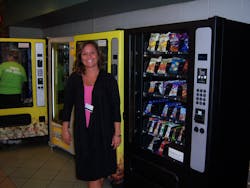
Two years ago, Clell Hoffman, the foodservice director at Albany Unified School District in Albany, Calif., decided it was time to replace the beverage vending machines at the high school. Hoffman wanted to offer more than 16.9-ounce water and juice. The state nutrition rules he had to meet, coupled with the fact that the bottles had to be fairly rugged to prevent possible breakage in the stacker beverage machine, severely limited his product choices.
When Hoffman found out about the variable temperature machine offered by Vend-ucation, a school vending resource based in Dunbarton, N.H., he was intrigued. Not being a stacker machine, it is not as restricted in product choices. And being a combination snack/beverage machine, he could also offer snacks. But that wasn’t all.
The Alpine SZ 5000 machine made by U-Select-It Corp. came with remote machine monitoring hardware, enabling Hoffman to monitor transactions via the Internet. There would be no more manual counting the slots.
Two years later, Hoffman is glad he made the change. He has been able to provide students a variety of snacks and beverages that meet California’s strict nutrition rules. Vending sales have more than quadrupled. The two Alpine machines bring in more than $4,000 per month, compared to the $750 the two previous bottle drop machines did.
And because of the greater variety of products, his average gross margin has increased from 40 percent to 55 percent.
“This machine is really versatile as far as what kind of products we can put in there,” Hoffman said. He is offering protein bars, 8-ounce juice, string cheese, seaweed, half sandwiches, dried fruit, baked chips, and bottled water.
Hoffman is not concerned about the stricter nutrition rules that take effect July 12, 2012. “None of these (products in the machine) are even close to exceeding the limits as far as fat and sugar content,” he said. “It’s all healthy vending as far as what we have in there. It’s there to have access to snacks and to keep them going throughout the day.”
Albany, Calif. is one of many school vending success stories that have emerged in the last several years in the U.S. Since 2007, schools nationwide have discovered vending machines are a good way to improve students’ access to healthy food and beverages.
A handful of vending equipment marketers have figured out ways to interface the machines’ internal reporting with cafeteria point of sale (POS) tracking software. Hence, the machines allow schools to integrate the vending sales with manual food line sales. This allows the schools to document what products are being served to how many students, helping them comply with government funding requirements.
“The vending machine is just another POS line,” noted Sherry Ephraim, Midwest account rep for Horizon International, which provides schools with POS cafeteria software. She said her company now advises schools they can interface vending machines with their cafeteria food lines.
Vending authorizes meal eligibility
Schools have been able to use state-of-the-art vending machines to authorize students who are eligible for government subsidized meals. In situations where students use prepaid payment methods, kids can get their meals by entering identification numbers and birth dates on a pin pad. These systems eliminate the embarrassment that occurs when students have to pay with cash or be exposed to their peers as receiving a government subsidized meal.
Schools find the economics of operating their own machines preferable to hiring vending operators.
Schools already have their own walk-in refrigerators and freezers for storing product. Many schools have staff that can manage vending machines along with their onsite feeding.
What’s the benefit to the vending industry? The next generation of consumers is learning to associate vending machines with healthy products. And based on most accounts to date, the kids like the newer, high tech machines.
“We are feeding more kids and using today’s technology to do it,” explained Bob Gottlieb, director of Star Foods, a division of Fort Lauderdale, Fla.-based VE South Inc., one of the most prominent providers of school vending solutions. Gottlieb said there are about 250 Star Food machines on site nationwide. The Star Food machine is a first-in, first-out, carousel, refrigerated machine made by N&W Global Vending S.p.a., based in Valbrembo, Italy, that can use wireless communication and biometric identification.
Gottlieb said most schools initially become interested in machines as a way to alleviate manual feeding lines. “Cafeterias are bursting at the seams,” he said. He noted that the Star Food machines have generated a lot of positive media coverage.
But the schools are also finding the vending machines support their health education initiatives.
School vending machines are not presently required to comply with federal school food nutrition rules. Some do have to comply with state and local rules. But beyond these requirements, many schools that have recognized the beneficial role vending machines can play in supporting their nutrition initiatives. Hence, many are applying cafeteria food standards to their vending offerings. (See sidebar),
Schools recognize vending’s benefits
Pinellas County Schools, based in Largo, Fla. has placed 180 vending machines at 10 schools since 2006, noted Art Dunham, director of foodservices. Previously, the foodservice operation did not use vending machines. Dunham said it was not hard for the foodservice staff to prepare the meals and place them in the machines.
The 20 Star Food machines at Pinellas County send the number of meals served to the cafeteria POS system, which prepares daily reports that the school uses to demonstrate compliance with government funding requirements. After school, the machines are filled with a la carte items, fetching additional sales.
Dunham particularly appreciates the fact that the machines send a temperature reading to his computer every 10 minutes. If the power goes out, the machine will automatically shut off after 30 minutes.
Vending increases lunch sales
“We got the vending machines because we couldn’t get the kids through the serving lines,” noted Donna Martin, foodservice director for Burke County Public Schools, based in Waynesboro, Ga. Her two Star Foods machines sell 75 to 150 meals per day and increased lunch servings by 10 percent, she noted, “which is significant.” The machines serve entrees in clear, plastic bags, offering salads, chicken fajitas, chicken strip salads, sandwiches, ham and cheese rollups, peanutbutter and jelly rollups, meal bars, juice, fruit and chips.
The Star Food machine’s remote data system interfaces easily with the school cafeteria’s POS tracking software from Heartland Payment Systems.
Since all kids in the district are eligible for fully reimbursable meals, Martin opted not to allow any cash acceptance. Kids simply enter their ID number and birth date on a pin pad.
More recently, Miami Dade County, Fla. schools purchased 70 Star Foods machines, mainly as a way to serve reimbursable meals at its 350 schools, said Susan Rothstein, coordinator for nutritional wellness. Nearly three quarters of the students are eligible for free or reduced price meals. Rothstein said she became interested in the Star Food machine after reading about it in a school foodservice publication. Rothstein said she was able to secure grants to cover the cost of the machines.
Rothstein said the Star Food machine’s remote monitoring system interfaced easily with her cafeteria POS tracking software.
When a student enters his or her ID number and birth date on the pin pad, the system determines one of three reimbursable levels: free, reduced, or paid. The district is then reimbursed $2.79, $0.40 and $0.28, accordingly.
The meals have three to five components, including fruit, yogurt, salads, sandwiches, wraps, fruit and vegetables. The most popular is fruit, yogurt and granola parfait, Rothstein said.
Students who are required to cover some of the cost can replenish their account by bringing cash to school, paying by credit card on the Internet, or by sending a check to the school.
Rothstein has opted not to activate cash acceptance on the machines in order to discourage vandalism.
The school uses posters and staff demonstrations to teach kids how to use the machines.
The POS software, from PCS Software, allows her to see how many kids used the machines, Rothstein said.
Last fall, Richland Bean Blossom High School, Elletsville Ind. used a $5,000 state dairy council grant to buy an Alpine vending machine from Vend-ucation to replace a refrigerated food machine that only accepted cash and did not interface with the cafeteria POS system. Vickie Coffey, food and nutrition director, wanted to promote reimbursable breakfast sales as well as a la carte items in addition to lunch meals. The machines offer whole grain peanut butter and jelly sandwiches, whole grain cereal bars, low-fat string cheese, cereal bowls, fruit, 100 percent fruit juice and reduced fat white milk, Splenda iced tea and bottled water.
With these selections, Coffey would not be concerned about meeting the new federal nutrition rules that take effect later this year, even if she were required by law to meet these guidelines.
“With this machine, we eliminated the a la carte in the lunch line,” she said. The machine was so successful that she ordered another machine for the middle school.
Kids can pay using the pin pad or with cash; about 70 percent use the pin pad.
Monthly sales jumped from $600 to $2,500, Coffey said. She credits much of the gain to the cashless acceptance. “It’s the convenience of it,” she said. “We’re leaders in technology with this vending machine.”
To educate kids, the staff at Richland Bean Blossom High School developed a video for the school Website and internal TV network to show the students how to make purchases from the vending machine using their lunch account balance.
The Heartland Software POS system makes accountability easy for her.
Vend-ucation modifies the Alpine SZ 5000 machines based on the needs of the specific customer. Jim Dillingham, owner of Vend-ucation, adjusts the selection configuration to the wellness restrictions and the type of packages they prepare.
Burlington High School in Burlington, Vt. is another satisfied customer of the Alpine machine, noted Doug Davis, food service director. Davis for years included vending machines as part of the bid criteria. He felt he did not have a lot of control over the selections. This has changed since taking the vending in-house. “This was a thought-out plan to make our vending more controlled,” he said.
The three Alpine machines have enabled him to offer reimbursable breakfast and lunch along with a la carte items. The machines accept cash and pin pad payment.
In the first 90 days, the Alpine machines delivered a 283 percent increase in sales over the previous vending machines, Davis said.
Being able to interface the vending machines with the cafeteria POS has been convenient, he said. To expect outside contractors to do this would be problematic. “Owning the machines ourselves eliminated that extra step,” he said.
Hudson, Ohio schools opted to purchase its own vending machines after Maureen Pisanick, the foodservice director, became dissatisfied with a machine lease arrangement with a vending contractor. The machines required a lot of repairs, and she didn’t think they were energy efficient.
Three years ago, Pisanick purchased two snack machines and four Alpine machines after coming across Vend-ucation at a school nutrition association meeting. She likes the modern look of the machines, and the fact that they have LED lighting, due to the district’s commitment to energy efficiency.
The machines were modified to equip them with bar code readers. The bar coded student ID cards offered access to the student lunch account balance that was already active in the cafeteria through the school’s POS system.
However, Pisanick said the kids learned how to make their own bar code card readers and were able to get free products. She has since switched to biometric identification for the pre-funded lunch POS system and to cash for the vending machines. She is presently exploring biometric payments for the vending.
An Ohio state bill effective last July and previous health and wellness mandates provide nutrition rules for school vending machines. Hudson has removed all noncompliant beverages and high sodium and high fat snacks. The sales initially took a hit, but have since recovered as kids got used to the new products, Pisanick noted.
At Madelia High School in Madelia, Minn., the impetus for getting a healthy vending machine came from a student council president and is not operated by the school foodservice department. Student Crystal Suiter conducted a survey of the student body for her campaign for president of student council. Based on the survey results, she promised a vending machine if she were elected. After being elected, aided by teachers and a fellow student, she researched school vending and came across Vend-ucation.
They also sought donations from local organizations and received a $1,000 grant from a state organization.
The machine was placed in the cafeteria but is operable only during non-meal times. Products meet federal school nutrition guidelines are priced 50 cents to $1.50. At these prices, the products deliver 33 percent profit on average.
The school has not yet enabled he cashless payment options. They enabled up to $10 bill acceptance and dollar coin payout.
The machine does between $85 to $100 per day, which teacher/adviser Chanda Caldwell said is good for a school with 225 students. “We’re very pleased with the way it’s working,” she said.
Caldwell said a recent survey confirmed that most students like the machine. “We want to promote healthy eating,” she said.
School officials nationwide are beginning to recognize that vending machines, despite their rap as purveryors of unhealthy food, are a useful tool in not only making food accessible kids, but the type of food they want kids to have. The movement is still in its early stages.
The end result will be a population of consumers who are comfortable using vending machines and associate vending machines with nutritious foods and beverages.
For more information, contact:
Heartland Payment Systems, 866-941-1477, www.heartlandpaymentsystems.com
Horizon Software International, 800-741-7100, www.horizon-boss.com
PCS Software, 800-247-3061, www.pcrs.com
Star Food, 877-857-3663, www.starfoodhealthyexpress.com
Vend-ucation, 800-633-1200, www.vendingmachinesschools.com
Schools use vending to embrace health iniatives
Healthier meal requirements are a component of the Healthy, Hunger-Free Kids Act, which was championed by the First Lady as part of her Let’s Move! campaign and signed into law by President Obama.
Besides meeting the rules of the school lunch program, schools are also participating in The HealthierUS School Challenge, a voluntary initiative that recognizes schools participating in the National School Lunch Program that have created healthier school environments through promotion of nutrition and physical activity.
| The U.S. Department of Agriculture and the First Lady launched the Recipes for Healthy Kids competition last September, challenging kids, nutrition professionals and community members to develop healthy recipes to be incorporated on lunchtime menus for the National School Lunch program. The contest is a component of the First Lady’s broader Let’s Move! initiative that also includes Chefs Move to Schools, which encourages chefs to work with schools in their communities. |
About the Author

Elliot Maras
Elliot Maras served as the editor of Automatic Merchandiser magazine from 1993 to 2012. To reach the current editor of Automatic Merchandiser and VendingMarketWatch.com, email [email protected].