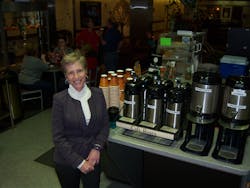
When the recession hit in 2008, small Rust Belt communities took it hard. Areas like Erie, Pa. on the Ohio/Pennsylvania border had never recovered from the manufacturing decline that began in the 1960s.
But for business owners like Anita Rose-Marcoline who know how to leverage their strengths and meet customers’ needs, every challenge brings a new opportunity. Rose-Marcoline, owner of McCormick Coffee and a 30-plus-year coffee industry veteran, continues to prosper in the face of a recession.
For Rose-Marcoline, challenge has been a constant. She got into the OCS business in the midst of the worst coffee price increase in the industry’s history. That challenge prepared her well for those that would face her for decades to come. She learned that a relentless focus on product quality and customer service would enable her to prosper in the face of adversity.
One key to her success has been her ability to recognize customer needs and meet them. As a coffee service provider in a small city that is just beyond the market reach of the very large competitors, she has expanded from traditional OCS to foodservice coffee and retail coffee. Having established relationships with high quality roasters and developing a team of capable equipment technicians, she has made a name for herself as Erie’s pre-eminent coffee service expert. She has expanded beyond coffee service to equipment maintenance for a wide spectrum of coffee retailers.
A midsize market
Erie, Pa. has a population of about 100,000 and is about 100 miles equidistant from Pittsburgh, Pa. to the south, Cleveland, Ohio to the west, and Buffalo, N.Y. to the east. The national OCS players have never established a lasting presence in Erie, creating an opportunity for independent players like McCormick Coffee that are committed to quality service.
This past year was one of her most profitable years ever, despite the fact that she lost one of two hospital coffee shops she operated.
Rose-Marcoline’s career has taken many twists and turns from the time she launched her one-person OCS business in 1978. While she shares the entrepreneurial instincts of many of her OCS colleagues, her story is unique in several ways. She did not come from a business family and does not remember being a particularly motivated student in school.
Humble beginnings
After earning an undergraduate degree Gannon University in Erie, she became an X-ray technician. Once on the job, she realized the 9-to5 routine was not for her. The problem was she didn’t know what was. “I didn’t know what I wanted to do,” she recalled. It was five years before she left the technician job and went into OCS.
The path from X-ray technician to OCS operator wasn’t smooth. Her future husband introduced her to a friend whose parents enjoyed freshly ground coffee for home use. She got interested in opening a coffee shop and started researching the coffee industry.
Rose-Marcoline’s research took her to Jamestown, N.Y. to meet with roaster/retailer/OCS operator John Cayer who operated a company called Coffee Exchange that sold 100 percent Colombian coffee. Cayer told her that OCS was a better business to get into than a coffee shop.
Rose-Marcoline realized the main OCS player in Erie at the time was not selling good quality coffee. Encouraged by Cayer, she struck out on her own in 1978, working from her home under the name Coffee Mill. Cayer loaned her equipment and provided her a supply of his private label Columbian coffee, private label cream and sugar, and some pourover brewers.
“He (Cayer) introduced me to what good OCS coffee tasted like,” Rose-Marcoline said.
Coffee becomes a passion
“Once I went into the coffee business, I fell in love with it,” she said. “It was a grass roots effort. I knew it was my passion. When I reached a certain point, the entrepreneurial spirit just led me away.”
Which is not to say that it was easy. Coffee prices were rising in the late 1970s, and her main OCS competitor was cutting prices on national name brand fraction packs. But encouraged by Cayer, she persisted with her 1,75-, 2 - and 2.5-ounce fraction packs of 100 percent Colombian coffee. Unlike the competition, she offered coffee with the Juan Valdez 100 percent Colombian coffee logo. She told prospects she cleaned the pots with every visit. And she won accounts.
Rose-Marcoline offered national brand coffee to customers who requested it, but the majority of customers purchased the private label.
Following Cayer’s advice, Rose-Marcoline joined the National Coffee Service Association (NCSA). She attended NCSA conventions every two years, which she found informative.
By 1987, Rose-Marcoline had hired her brother and a sales rep to help service her 100 accounts. She moved to a warehouse in the downtown area.
A change in career path
At the time, the local beer distributor decided he wanted to get into the coffee business and offered to buy Rose-Marcoline’s company and two other independent OCS companies. The beer distributor, owned by the McCormick family, acquired Coffee Mill, Coffee Systems of Erie and Cafco Coffee Service to form McCormick Coffee.
Rose-Marcoline had never lost interest in running a coffee shop, so after selling Coffee Mill, she opened a coffee shop in a local hospital. In the meantime, she launched some unrelated businesses. She started a courier service for hospital laboratories and a health care provider directory that included facsimile numbers of health care providers. Both of these businesses met needs she learned about while working as an X-ray technician. “You get inside of a business and you begin to understand the needs,” Rose-Marcoline said.
The hospital coffee shop was successful, and she opened a second coffee shop in another hospital.
McCormick Coffee, meanwhile, under its new owners, expanded into the convenience store coffee business, servicing 75 convenience stores. The convenience store chain became half of the company’s business.
McCormick Coffee sales had increased substantially by 2004, when the owners were planning for retirement and they approached Rose-Marcoline about buying the company.
Opportunity beckons
Rose-Macoline and a partner agreed to purchase McCormick Coffee. The company operated from a 12,000-square-foot building in downtown Erie owned by the McCormick family.
When she assumed control of the business, she found it needed a stronger focus on quality. The company had grown significantly, but it had poor inventory controls, and it had not maintained Rose-Marcoline’s commitment to quality coffee. The McCormicks had largely replaced Rose-Marcoline’s high fraction pack, 100 percent Colombian coffee with lower fraction pack, national name brand coffee and their own private label blend.
“They really eroded what I had worked so hard to achieve,” Rose-Marcoline said. “There was no vision.”
She reviewed the sales records and eliminated about 300 of the nearly 1,000 accounts on the books, based on sales volume.
The former owners had introduced handhelds and a computer program written for the beer industry. Rose-Marcoline is switching to a customized software system that utilizes wi-fi enabled handhelds.
She consolidated three warehouses into one.
She replaced all of the employees with the exception of one.
But things got worse before they got better. Six years after buying the company, it lost the convenience store business, which cut sales in half.
The setback didn’t discourage her. In retrospect, this was a blessing in disguise. Rose-Marcoline opted not to try to recover the convenience store business with other convenience stores. “They (convenience store customers) are very demanding,” she said. “You run your whole company for those sales. I’d rather have manageable customers instead of them managing me.”
She also realized a lot of exciting new products had come on the OCS market.
Single-cup offers new growth
The biggest opportunity of all was single-cup coffee, which was almost non-existent in Erie in 2005. Rose-Marcoline signed on as a Keurig distributor after she began carrying Green Mountain Coffee Roasters fraction packs. “I saw them (Green Mountain Coffee Roasters) as a company that could become a real force in the quality coffee industry,” she said. “We have had a lot of success with the K-Cup business.”
“They moved everybody from the ‘pot’ price to the ‘cup’ price,” Rose-Marcoline said of Green Mountain. “That was their success.”
The Keurigs helped win accounts and are now in 15 percent of the company’s OCS accounts.
She also recognized that many restaurants needed a reliable coffee service provider. She hired a salesperson with restaurant sales experience, John Machuga. “He understands what it takes to get and keep a big account,” she said. “I knew that he could get big business and that’s what we needed.” Many of the foodservice distributors in the market could not match her service capabilities, she noted.
Rose-Marcoline’s two repair technicians are able to fix restaurant brewers. With repair service a big part of the business, foodservice now accounts for 40 percent of the company’s sales.
She combines the foodservice deliveries with the OCS deliveries on the same vehicles. The trucks are wrapped with her company graphics and make a great sales tool.
A recent focus has been nursing homes, which have become the fastest growing customer segment. Rose-Marcoline uses water soluble coffee in these and other foodservice accounts. She noted the quality of water soluble coffee has improved a lot in recent years.
“I saw a really great opportunity here,” she said.
She also launched a Website for the company in 2005, and is in the process of upgrading it.
Ongoing OCS training
In 2007, she took the Quality Coffee Certification Program at the National Automatic Merchandising Association Expo. Two other employees, John Machuga and Max Marcoline, have taken the program as well. Max Marcoline is Rose-Marcoline’s son, who recently moved from warehouse manager to sales, and is the only family member in the business.
The company’s focus on foodservice and health care accounts proved helpful when the recession hit in 2008. The company did lose some accounts, Rose-Marcoline said, but the accounts lost were among the less profitable ones to begin with. Hence, the customer fallout did not significantly hurt her bottom line.
The company grew steadily under Rose-Marcoline’s ownership. Fiscal 2011 proved a challenging year, however. She lost one of her two hospital coffee shops when a hospital opted to manage the coffee shop themselves.
Rising coffee prices, meanwhile, required her to pass the increases on to customers.
The company’s commitment to quality and its focus on acquiring foodservice accounts and health care accounts enabled continuous growth in spite of these challenges.
By consistently focusing on good quality coffee, Rose-Marcoline believes she is better able to raise prices to customers when necessary.
She notes she has had success putting popular icons like peace signs on coffee packages. “The younger generation is really tuned into the cool factor,” she said. “Coffee is supposed to be fun.”
New challenges arise
While K-Cups have been an important area of growth, their pervasiveness at retail has brought new challenges.
Rose-Marcoline said she keeps a close eye on accounts installing an unauthorized Keurig machine. If this happens, it will erode her sales. “Sometimes it takes six months to figure out what’s going on,” she said.
Recently, Green Mountain Coffee Roasters has changed its order requirements for certain K-Cup products which she finds difficult. She sees this as one of the biggest challenges she currently faces.
She is overall optimistic since she has a good group of employees. She offers a competitive benefits package, including health insurance, life insurance, accident and disability insurance, and an IRA retirement plan.
Last year, she acquired her partner’s share of the company and is now the sole owner.
Rose-Marcoline has maintained a high community profile for the company. The company is active in local business organizations. In 2010, she was listed as one of the most admired CEOs by the local business magazine.
In 2011, Rose-Marcoline was honored by the Erie Regional Chamber and Growth Partnership as an Athena Powerlink Program recipient.
She believes the company will continue to grow in the foodservice and health care segments. Much of this growth will be in the equipment service area. She notes her company’s service capabilities are among the best in the region.
The demand for quality coffee will continue to increase, she noted. In recent years, name brand coffee retailers such as Starbucks and Caribou have expanded into the market. Rose-Marcoline offers these gourmet brands, but she offers her private label as a more economical alternative.
Tim Hortons, the Oakville, Ontario-based coffee retailer, has entered the Erie, Pa. market, but Rose-Marcoline said that the brand does not yet have a lot of loyalty in her market.
Rose-Marcoline would like to eventually retire from the business and spend time traveling to coffee growing regions. But for the time being, she remains committed to building the company.
“I see no stop to people loving coffee,” she said.
Company Profile
Name
McCormick Coffee
Location,
Erie, Pa.
Founded
1978 as Coffee Mill
Owner
Anita Rose-Marcoline
Number of accounts
700
Number of employees
9 (Not including owner)
Business Mix
60% OCS, 40% foodservice coffee
Coffee brands: Green Mountain Coffee Roasters Inc., Starbucks, Caribou, Folgers, Hills Brothers, Maxwell House.
Private Label Roasters: O’Neill Coffee Co., Excellent Coffee Co., Xcafe
Equipment Providers: Bunn, Keurig
Annual sales
Not revealed
About the Author

Elliot Maras
Elliot Maras served as the editor of Automatic Merchandiser magazine from 1993 to 2012. To reach the current editor of Automatic Merchandiser and VendingMarketWatch.com, email [email protected].