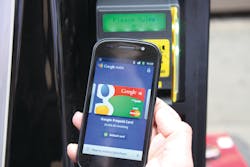
This past holiday shopping season set records, driven largely by the rapid growth of smart phones, consumers’ willingness to use smart phones for buying, and retailers’ efforts to accommodate and reward mobile purchases. Mobile commerce sales will increase 91.4 percent this year to reach a total of $6.7 billion, according to eMarketer, a company that studies digital marketing and media.
The mobile payment revolution has been building momentum for years. Consumers have become more adept at using smart phones to find products they want, compare prices, and determine where to find them.
Retailers have expanded beyond their initial online stores and are developing integrated e-commerce programs that include in-store point of sale, Websites, and social media.
Consumer product manufacturers, for their part, have entered the fray, offering smart phone apps that help customers shop, enticing them with chances to earn and redeem loyalty rewards.
Vending operators mostly watched from the sidelines.
Vending machines, the most pervasive retail venue by number of outlets, are “out of the loop” of today’s increasingly integrated retail marketplace. Less than 5 percent of the nation’s snack, beverage and food machines have the telemetry required to participate in the mobile commerce marketplace.
Vending software suppliers note that the rate of adoption has improved in recent years, but investment continues at a slow pace.
Many arguments have been made for vending technology in recent years. The most persuasive of all, perhaps, is the new reality of mobile commerce that is revolutionizing all of U.S. retail.
Product suppliers aren’t waiting.
Product supplier move forward
Starbucks, since the launch of its mobile payment app in January of 2011, has processed 26 million mobile transactions to date.
Green Mountain Coffee Roasters Inc. in August launched a K-Cup® finder app in response to consumers who had been asking for this type of app to help them with their selection of K-Cup® packs. The app points to the page on the Website where the consumer can purchase the product.
PepsiCo Inc. has partnered with Foursquare, a location-based service, to offer a rewards program that links with loyalty accounts, allowing customers to earn rewards from check-ins at participating retailers.
Coca-Cola Co. sends electronic coupons to customers’ mobile phones, where they can participate in Coke’s “My Coke Rewards” program.
These initiatives don’t ignore vending completely. Vend customers could, for instance, participate in Coke's “Twist, TXT, Win” initiative by texting in the alphanumeric code under a 20-ounce bottle cap to get an immediate response via SMS telling them whether or not they have won a prize.
More vending machines need to be brought “online” before the machines can accept mobile payments, but in the meantime, vending can benefit from mobile marketing. It’s as simple as attaching a quick response (QR) code to a vending machine or the products in the machine.
QR codes are inexpensive and easy to create. Operators can use the codes to carry manufacturer promotions along with their own company promotions.
Laura Marriott, CEO of NEOMedia Technologies, a QR code provider, said a QR code on a vending machine could direct the consumer to information on the vending company's promotions, the nutritional information about the products and/or direct consumers to the company's Website for additional information. "A QR code on a vending machine is a great tool for marketing," she said.
Mobile payment, however, will take vending to a new level.
USA Technologies Inc. (USAT) took a pioneering role by adding near field communications (NFC) technology to its devices and now has more than 50,000 NFC-ready ePort devices in the market. Because many of these devices are installed in vending machines, their vending customers are in a position to accept mobile payments and to benefit from its expected growth. The USAT ePort G8 was designed to be open to all mobile payment platforms, including Google Wallet, ISIS, PayPal and others.
USAT is adding more features to its ePort Connect service that will capitalize more broadly on the NFC terminal it provides and add more value to the offering, including an alternative mobile payment system, prepay system, loyalty program and electronic couponing.
Coca-Cola North America’s business unit recently piloted a program with Google Wallet where consumers can use their mobile device to pay for a drink at thousands of its vending machines across the U.S. The goal is to gain experience with mobile wallets and understand how consumers want to interact with Coca Cola with this new technology.
Mobile payment: a new promotion tool
Loyalty rewards are not new to vending. Sanese Services, the vending/foodservice provider based in Columbus, Ohio, continues to offer manufacturer-sponsored forms on products that consumers fill out and place in boxes near the machines.
More recently, Sanese has offered customers prepaid card programs from Sprout and the Company Kitchen self checkout market that allow customers to qualify for reward points from participating product manufacturers.
The prepaid card programs and the manufacturer sponsored sweepstakes for vending that Sanese Services currently uses are "closed loop" promotions.
Mobile payment promotions, by contrast, are “open” offerings that allow any consumer with a compatible smart phone to participate. By appealing to a wider audience, these offerings have stronger customer appeal.
Mike Cascione, president of CC Vending in Bronx, N.Y., sees the Google Wallet as another payment option beyond cash and the prepaid Sprout program he offers, but one with more potential. He recently welcomed the news that Cantaloupe Systems will implement NFC reader technology. This will enable his customers using Google Wallet to make purchases by tapping their phones at vending machines installed with the Cantaloupe Systems’ readers.
“The merchandising value here goes beyond customer convenience to building customer loyalty and frequency of purchase in the mobile age,” said Cascione. “With mobile payment solutions like Google Wallet augmenting the customer information we’re already receiving from Cantaloupe Systems’ wireless Seed technology, we’ll be able to offer custom-tailored promotions keyed to individual product preferences.”
Scott Meskin, president of Black Tie Services Inc. in Baltimore, Md., sees Google Wallet as a great opportunity and already has already ordered 300 Google Wallet Vivo Tech bezels from Cantaloupe Systems. Meskin was has already found e-commerce a great tool for building sales. He said having inventory online makes customers more aware of the variety he offers. He said products with a health association in particularly sell well online.
Coffee Service Can Add Mobile Payments
For coffee service operators, mobile-payment-based loyalty programs are already feasible since most refreshment service operators already have most of the necessary infrastructure in place.
Rob Masri, president and CEO of Cardagin Networks Inc., noted that many refreshment service operators are already active in the e-commerce arena. Cardagin provides an app for consumers to download. The app identifies a promotion for the consumer to see on their smart phone and flag the merchant where the promotion can be used.
Masri said refreshment service operators can provide customers the apps that allow them to participate in loyalty reward programs.
Masri, who spoke at the National Automatic Merchandising Association CoffeeTea&Water event in Las Vegas this year, said companies like his manage loyalty rewards programs of numerous product manufacturers on behalf of merchants. In addition to managing the rewards programs, his company compiles data on customers’ characteristics and buying habits that retailers find useful.
Masri said the vending industry stands to gain a lot when more vending machines are capable of accepting mobile payments. He envisions a day when promotions are sent to people’s smart phones based on their vending machine purchases. “Mobile technology gives you information and access to people in real time,” he noted.
Vending Operators Have Issues
In the meantime, many operators view the manufacturer mobile commerce initiatives as competition more than support.
Don Rubenstein, owner of Dr Soda in Los Angeles, Calif., has been involved in e-commerce since the late 1990s. He has stopped offering Volvic and Fiji waters in some markets he serves due to these companies’ e-commerce initiatives which he saw as competing against him.
Rubenstein hopes product manufacturers will come to appreciate the service capabilities companies like his provide.
Long-term, Rubenstein thinks the evolving tools of ecommerce will help him. “The best is yet to come,” he said.
Other Retail Channels Move Ahead
Competing retail channels, meanwhile, have taken a cue from the product manufacturers and are using social media to promote mobile payments.
According to Cellit, a provider of mobile customer relationship management (CRM) systems, many quick serve restaurants did this by offering low-cost, easy-to-execute tactics such as leveraging existing social media and email databases to convert customers to mobile.
Social media channels quickly drive traffic into a mobile program and an average of 10 percent of these online communities signed up for the mobile program at little or no cost, Cellit found.
Some vend product manufacturers noted that because mobile marketing and social media marketing are still new, it will take some time before they know how to integrate the vending channel in these campaigns. Spokespersons for Coca Cola North America, PepsiCola Inc. and Mars Chocolate North America noted the companies are developing integrated marketing approaches.
Product manufacturers pioneer interactive vending machines
Three vend product manufacturers, Coca Cola North America, PepsiCo Inc. and Kraft Vending & OCS, have pioneered mobile marketing by developing vending machines with interactive touchscreens.
Coca-Cola North America has already introduced the second generation of its interactive venders. A mobile app allows consumers to find its interactive venders.
PepsiCo Inc.’s Social Vending System allows a consumer to digitally “gift” a beverage to a friend.
Peter Wolsky, senior sales executive at DCI Marketing, the company that provided the software and hardware for the front end controls of the Pepsi Social Vending System, said processing the rewards at the point of sale brings a whole new dimension to vending beyond its traditional benefit of convenience.
The Kraft Diji Touch machine with interactive touchsreen will be on the market some time in 2012.
For more information, contact:
Cardagin Networks, www.cardagin.com
Cantaloupe Systems, 866-986-7333, www.cantaloupesys.com
Cardagin Networks, www.cardagin.com
Cellit, 800-790-6597, www.cellit.com
Coca-Cola Co., 800-438-2653, www.cokesolutions.com
DCI Marketing, 800-778-4805, www.dcimarketing.com
Kraft Vending & OCS, 888-879-0267, www.kraftvendingocs.com
NEO Media Technologies, 678-638-0460, www.neo.com
PepsiCo Inc., 914-253-2000, www.pepsico.com
USA Technologies Inc., 800-633-0340, www.usatech.com
Types of mobile payments
Type How it works Examples
Mobile at point of sale Paying with mobile device Google wallet, ISIS, Mobile wallet
Mobile as point of sale Merchant uses mobile device Verifone
to process transaction
Direct carrier billing Buying digital content and Mopay, Zong, PaymentOne
charging it to carrier
Closed loop mobile Paying with a device, billed Sprout, Starbucks card
by merchant or third party
About the Author
 Elliot Maras
Elliot Maras
Elliot Maras served as the editor of Automatic Merchandiser magazine from 1993 to 2012. To reach the current editor of Automatic Merchandiser and VendingMarketWatch.com, email [email protected].