A customer relations plan and why you need one
With change coming so fast on so many fronts – customer needs, products, technologies, and new competitors – can vending operators adapt quickly enough to survive?
Most operators recognize the business environment is changing. But with the day-to-day challenges they face in a difficult economy, operators are unsure where to begin making changes in their operations. Operators are unsure which technologies to invest in and where they will get the best return on investment and improve customer relations.
Automatic Merchandiser this past year profiled operators who use new technology successfully. But many readers wonder if these are not exceptions whose experiences cannot be easily duplicated by the average operator.
In the interest of helping a “typical” operator strategize in a challenging industry, Automatic Merchandiser has developed a customer relations action plan designed to help operators determine what technology tools make the most sense, given that operators’ resources are limited.
The magazine’s staff met with business veterans from varying backgrounds early this summer to assess the industry’s situation and determine how an operator with limited means can take advantage of the new technologies.
Automated systems are replacing manual ones at a time when consumers are more attuned to technology than ever, and are more demanding of the products they buy from service providers. The new tools create new opportunities, but at the same time, new challenges.
One operator who recently upgraded her Website noted the frustration she encountered because of the capabilities that the new Website created. On the positive side, this operator, who asked to remain anonymous, said the upgraded Website has drawn more customer inquiries and has provided a tool to pre-screen customers. At the same time, she said some customers began asking for things like video touchscreens that are too expensive, while others that she would expect would want the most state-of-the-art tools only want the most basic service.
With all of this change occurring, the vending operators’ role continues to be one of meeting the refreshment needs of consumers conveniently while they attend to both at-work and non-work functions.
Technology brings more choices
Automatic Merchandiser has spotlighted a host of technology-based solutions to emerge in recent years that give operators new ways to meet their traditional objectives: cashless payments, remote machine monitoring, touchscreen messaging, self checkout markets, automated warehouse management, etc.
The new tools create new operating efficiencies that enhance customer service. In some cases, such as cashless payments and touchscreen promotions, the new tools create new customer conveniences as well.
In assessing the benefits of these new tools, Automatic Merchandiser concluded that virtually all of the decisions operators face regarding these tools have to do with making their businesses more customer relations focused.
Hence, the very purpose of the service that automatic merchandising provides gives focus to reorganizing an operation with new technologies.
The proliferation of tools makes planning more necessary. Few operators have the resources to take advantage of every conceivable tool now available.
Starting point: who and what are you?
The underlying question that an individual operator must ask is: What is the company mission?
When asked this question, operators have various answers. The fact that operators view their missions differently is reason for asking the question in the first place. The operator who sees his or her mission as providing the largest assortment of products at the lowest possible price will be different than the one who defines the mission as creating a memorable refreshment experience.
By understanding their mission, operators can develop more specific goals in the areas of service delivery and marketing.
The operator who successfully introduces automated warehouse management will be able to serve more customers with fewer route drivers. How to make best use of the labor savings will depend on what the company’s goals are in the area of customer satisfaction.
The company interested in minimizing customer interaction will be more likely to assign the former route drivers to tasks having less direct impact on customer service.
The company interested in maximizing customer interaction will be likely to promote a former driver to customer relations specialist, a move which could require additional training.
Company mission dictates choices
Providers of some of the new technologies introduced in recent years, such as dynamic routing, have emphasized the opportunities for improved customer interaction (due to giving drivers more time to spend with customers). However, in conducting field research, Automatic Merchandiser learned that some of the most technologically progressive operators believe the technology minimizes the need for customer interaction.
This point of view is consistent with those who have long believed that the best vending service is the one that remains unseen and unheard.
Operators who hold this view are those who were less likely to conduct customer surveys in the past and are least inclined to engage in social media in the future.
Again, the purpose of this article is not to advocate one school of thought over another. The goal is to recognize that as new tools arrive on the scene, operators must know their objectives as service providers. This understanding will enable them to determine what tools to invest in and what roles to assign employees.
Two groups of customers
To know their service mission, the operator must recognize what needs are specific to the two constituents they typically identify as customers: 1) the account decision maker, and 2) the end user, the consumer. The two are not listed in any intended order of importance.
An operator could, for instance, want to have a high level of interaction with the account decision maker but keep his actions largely out of view of the end users.
Such an operator would be likely to have a newsletter for the decision maker but not have a Facebook page inviting end users to participate in company sponsored contests.
Another operator might take the opposite view and seek to influence the decision maker through the end users.
Step 1: Mission statement
The first step is to write the company mission in a few succinct sentences. Everything the company does should be covered by this mission statement.
Step 2: List what company provides customers
The next step is to make a list of everything customers want from your service. There should be two lists: decision makers and end users. The decision makers may want the following:
- Sales reports
- Commissions
- Statements documenting user satisfaction
- Updates on new products available
- Reports on machine inspections
The end users will want the following:
- Good value for their money
- Clean and attractive machines
- Convenient payment options
- New products on a regular basis
Step 3: List company activities
The next step is to list every ongoing activity the company conducts: Training, record keeping, phone followup, filling bins in the warehouse, etc.
Step 4: Match activities to customer experience
Then list how each activity relates to the account decision maker and how it relates to the end user.
This will be a long list. It will allow every employee to see how their task affects the customer.
Step 5: List how company roles impact customers
The next step is to list all the positions in the company and how each position impacts customer satisfaction. This step has taken on new importance in companies that have introduced technology tools since new technology has changed some employees’ tasks.
In January/February, Automatic Merchandiser examined how more automated operating systems deliver greater efficiencies and sometimes a higher level of customer service, but also change some employees’ responsibilities and requires better trained employees.
Pre-kitting and dynamic scheduling, for example, allow drivers to service more stops. In some cases, it results in fewer visits to locations.
If the company believes maintaining contact with customers is important, management must determine how this contact will be provided. With today’s communication tools, there are more options for providing this than ever.
Item-level reporting at the machine level allows the operator to provide customers more detailed information about location product preferences. Remote machine monitoring gives operators a tool to make transaction information accessible to account decision makers without leaving their desks.
Management must decide if providing this information is beneficial to its customer relations and if so, develop processes for gathering it and providing it.
In interviewing operators, Automatic Merchandiser found varying opinions about how much information to share with customers. Providing unwanted information can hurt more than help customer relations.
Many operators noted that it is important to decide what information to gather since every task costs valuable employee time.
Some operators believe that the automation they have introduced in their operations has made their companies more interesting to visit for both customers and potential customers.
Step 6: List communication tools
Once the company has decided what types of information to communicate, and to whom, the next step is to decide what communication tools to use. These include the traditional tools such as customer newsletters, in-person visits, direct mail, telemarketing, as well as the newer and more powerful tools like Internet Websites, email, and social media.
The final step is to executive the plan.
Consultants advocate new tools
William Donohue, Ph.D., a professor and director of sales communication at Michigan State University who has participated in the NAMA executive development program, thinks tools that give operators more feedback from end users are more important than many realize. He said account decision makers only hear from a small minority of end users.
“The vending machine people never get information from the people who put money in the machines,” he said. “We have to somehow get more direct linkage between the operator and the people who stick money in the machines.”
Donohue urges operators to seek consumer input via their Websites.
He noted that operators can place quick response (QR) codes on vending machines. Consumers with smart phones can flash the quick response code and download a Website where they can give input. If the QR code takes users to some information about a specific machine, they could list food preferences or comment on machine issues.
“Operators should explore making the vending experience more direct and even more fun,” Donohue said.
Tom Siciliano, who operates Integrity Recruiting & Consulting Inc., a Huntley, Ill.-based NAMA Knowledge Partner, said there are many online tools for businesses to use to support their social media outreach. One such tool is Hootesuite, which allows a user to schedule social media posts automatically.
Siciliano said social media is a very cost effective way to reach targeted audiences. For vending operators, he said it’s a great way to help clients do their jobs better.
He noted there are also tools that allow a business owner to find out who is looking at their online information. He suggests operators find consultants who are knowledgeable about these new tools.
Sheryl Barlow, director of business development at CWS, a Rochester, Minn.-based web design firm, said social media is becoming a more important tool for businesses. She acknowledged that some owners are concerned about soliciting negative feedback, but she said businesses can control the information they make available for employees and customers to see.
Barlow’s company is developing a social media program for D&R Canteen in Rochester, Minn.
Operators experiences vary
Operator experiences using new tools for customer relations report varying experiences.
One operator who recently introduced SPIO redeemable coupon dispensers on machines and self checkout markets said he believes the technologies enhance customer relations significantly. These customer enhancements have increased sales and profits for his company. “We’re having better success at getting no-commission accounts,” said the operator, who did not wish to be identified.
He noted that to successfully use technology, it is important to have good employee training programs. The technology solutions he provides can create big problems if the field execution is not good.
This operator is among those who welcome the National Automatic Merchandising Association (NAMA) Facebook contest and gratitude tour to promote new vending technology.
Vending operators have not been quick to embrace social media. The Automatic Merchandiser State of the Vending Industry Report found only 22 percent are using it.
More operators have, however, recognized the need for more professional Websites.
Operators have learned that customers are using the Internet to find service providers, and a user friendly Website helps win customers.
Vend Central Inc., a Pleasanton, Calif.-based provider of Website design and marketing services for vending, finds vendors more interested in improving their online presence, noted Neil Swindale, company owner. “You can’t get a good online presence for $500,” Swindale said.
Swindale’s services include search engine optimization and online videos.
“Videos are the fastest growing thing online,” Swindale said. “People love to watch product and service videos.”
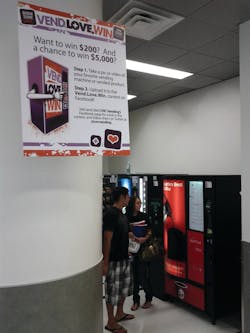
P&Js Vending in Hopkington, Mass. recently launched a blog on its Website, noted Laura Kelly, customer relations manager. The company is promoting the NAMA Vend.Love.Win Facebook contest, inviting people to submit photos and videos to win $200. “It gave us a way to be relevant through social media,” Kelly said.
Prior to the NAMA campaign, Kelly took a course in using social media from the Massachusetts Small Business Development Center. “This (social media) is the way communication is happening,” she said.
CNC Vending LLC in Houston, Texas also recently began promoting the Vend.Love.Win Facebook contest, noted Chuck Olson, company owner. He has used vending machine stickers and banners provided by NAMA’s marketing company, Healy & Schulte in Chicago, to promote the Facebook contest.
Olson plans to attend the NAMA Gratitude Tour when it comes to Austin, Texas. He also plans to offer customers a chance to win a trip to New York next year on his Facebook page.
Paul Tims, owner of Imperial Vending Co. based in Tulsa, Okla., said he relies mainly on sales people to educate customers about new technologies such as automated warehouse management and the Sprout prepaid card. “We educate the public by going and selling them,” he said.
Tims does see benefit in having printed mailers for specific audiences, but not for the general public.
Sid Greenspan, president of Vendrite Vending Corp. in Whitestone, N.Y., agreed that personal interaction remains his main education method. He said Websites are not the main tool for customers seeking new services. As for social media, he said it is useful for reaching younger decision makers.
John Mitchell, president of Treat America Food Services based in Merriam, Kan., said solutions such as the Sprout prepaid card and self checkout markets allow companies to build same location sales, and fortunately, today’s management software allows him to measure sales growth more effectively.
Mitchell thinks new technology is helping change the industry’s image. “There is still a commoditization that needs to be examined and ultimately fixed,” he said.
Aldar Vending, a Hackensack, N.J.-based company that has invested in various technologies, was advised by a consultant that search engine optimization and social media are not the best investments for a vending operation, noted Mike Ehrentreau, owner.
Commercial Coffee Service/Food Systems Inc., Bridgeview, Ill. invested in a more robust Website and has been pleased with the results, noted co-owner Tom O’Malley. The Website, www.cfsvend.com, has an audiovisual presentation about its services.
Refreshment services has always been about customer service. Operators will find that fine tuning their customer relations activities will deliver more satisfied customer and ultimately better business results.