It's no secret locations are money conscious when it comes to vending and office coffee service. However, water service is trending upwards as people become more educated about water contaminants.
According to the Water Quality Association, a non-profit international trade association representing the water treatment industry, more than half of Americans are concerned about the quality of their water and will take action in their homes, revealed by a 2011 independent survey by Applied Research-West, Inc. The study found a majority of consumers are now willing to pay more to eliminate contaminants, especially those respondents who had experienced a "boil water alert," (about 19 percent). More than half typically purchased a filter pitcher or end of tap device, compared to 38 percent in 2008. Additionally, 54 percent are concerned about health contaminants in tap water, and 42 percent believe the water is not as safe as it should be.
This has implications for the vending and coffee service industry because these people are the decision makers when it comes to adding water service. And the good news is that operators have more options than ever to satisfy the concerns of these consumers. There are better sanitation processes that don't waste water. And there's no need to eliminate the office water cooler, because now it can be bottleless.
Multiple filter options available
"It's really just educating the end user what options there are," said Cliff Rosen, president of KoolTek. He recommends operators open with a good, better, best presentation of water filtration. This way, the location can balance cost with their desire for filtered water.
Filters have really come a long way, according to Rosen. For coffee brewers he recommends a 5 micron carbon filter, which eliminates most contaminants that will affect taste and will take out odors. A micron is a unit of measurement. The smaller the micron number, the better the filtration, because it prevents particles and parasites of smaller sizes from going through the filter with the water.
In the case of the coffee brewer, the water is being boiled, so more intense filtration usually isn't necessary.
For drinking water, Rosen said the filters can now go down to a half micron, to filter out extremely tiny impurities. "To give you a comparison, a human hair is 100 microns," said Rosen. "The filtration available today is just mind boggling."
More expensive options include sterilizing the water. Five years ago, everyone wanted reverse osmosis systems remembers Rosen, but even with the units becoming more efficient, they can waste three to four gallons of water to make one gallon because of the pressure required to force water through the membrane. Instead, the trend is towards ultra violet (UV) treatment, where the UV light passes through the water, and breaks down the DNA of hard-shell bacteria. Ozone units also sterilize water, although these are not as popular because the term ozone disturbs end users.
Rosen believes selling water service is about sharing information with the end user. Not to scare them with it, but enough for them to make an informed decision.
Brewer filtration options
Roger Egli, sales executive at HydroLife Inc., hears a lot about how operators want to cut their maintenance costs. He offers a solution to lime scale, which can otherwise build up and damage or clogging of hot beverage equipment. The unique Hydro Life media alters the molecular structure of Calcite (lime scale) by changing the number of oxygen atoms within the molecule. The Calcite becomes a substance called Aragonite, which has no clinging capability, allowing the scale to remain harmlessly suspended in the water as it passes through the equipment holding tanks and water lines without adhering to equipment surfaces. "There are no chemicals of any kind used in our media. It is completely chemical free," he added.
Eliminating lime scale without the use of chemicals is a niche for operators serving the espresso market, according to Sergio Trevino, senior account executive of Omnipure Filter Co. While phosphate can be added to water to prevent scale on drip coffee brewers, there are applications where using special softening filters that include a combination of carbon and resin, is preferred to protect equipment and improve taste. "Espresso is made under pressure where all the water in the tank is turned into steam, so phosphate doesn't work," said Trevino. Instead, he recommends operators soften the water before it goes through the machine to protect the espresso brewer, an expensive piece of equipment.
Trevino has heard customers say even less expensive coffees have more flavor when made with filtered water.
Jim Nelson director of sales for Everpure, LLC tries to get operators to see the value in decarbonization filters (those that eliminate lime/scale). "Most operators want a $10 filter, no scale, that last forever," he said. He teaches operators about the return on investment for filters, such as spending more on a decarbonization filter on the 10 percent of accounts that account for 50 to 60 percent of the service calls. "If it costs you $300 a year, but saves you 12 service calls, it's worth it," said Nelson.
Dynamic filter service
Because to be effective the filter needs to be changed regularly, Everpure offers an interactive filter service program. Operators can enter the water's hardness, the type of coffee equipment, the location size, etc. and the program suggests a filter change schedule.
"A byproduct (of the filter) is taking all the alkalinity out which produces great coffee, and great iced tea," added Nelson.
Filtered drinking water market is growing
A new company on the water scene, Apiqe, is offering water that can be made individually for the end user. "Office employees drink, on average, 10 times more water than coffee," said John Margaritis, president-sales at Apiqe.
The Apiqe unit is described as a countertop water dispenser, which serves room temperature, chilled or hot water in a single-serving. The end user can add sparkling water and/or flavor enhancers as well.
"We will see some new technologies soon in carbonation and water flavoring enhancing," said Margaritis. He added that the carbonation technology has already advanced to a point where the Apiqe unit does not require a compressor tank, pump or electronics, allowing it to be a countertop unit.
Point of use trends big
The most popular water filtration system today is point-of-use because it eliminates bottled water charges and is fairly inexpensive. According to Carl Sutera, president of Pure 1 Systems, it's been a progression that began when big companies started making filters and lending credence to the idea of filtered water together with the fact that all bottled water is filtered. When water companies started doing coffee service, "It made OCS companies take notice," he said. With the advent of quality POU technology the OCS operators were able to retaliate by adding water to their services. "(Companies that) go to the table with everything, get the business," observed Sutera.
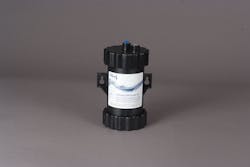
Pure 1 offers a new 4-zone cartridge that goes from 5 micron filtration down to a half micron absolute, which eliminates the need for separate prefiltration. "Without an absolute rating, 1 and 2 micron bacteria could potentially get past the filter," Sutera said. Using this filter would ensure protection even if a boil water alert were announced. Sutera also touts how green the cartridge is, compared to other models on the market. It's a small efficient filter with a lifetime warranty. The inner cartridges, which are the parts that get replaced, are able to be incinerated instead of just thrown away(land filled).The sediment cartridge Is made of spun polypropylene, which makes it less expensive and tougher than brittle ceramic filters. "And we manufacture the products in the U.S.," added Sutera.
Many operators have turned add on water service into a premium water program, according to Everpure's Nelson. Operators are charging for cleaning, sanitizing, changing filters, etc. Nelson suggests operators can also charge to upgrade filters. Everpure offers an ultrafilter technology that has a membrane made of millions of piano wire-looking strings. It's certified by the NSF as a purifier, so it reduces bacteria and viruses. It is hard for reverse osmosis manufacturers to get the virus-elimination certification, although Nelson admits that it does. "So operators can upsell 'virus protection even to customer with reverse osmosis systems" said Nelson.
Most operators lease a water filtration system to the location, and charge them a rental free per month. "It's a good revenue model," added Nelson.
Nelson sees fixed pressure water reducing valves as the next trend in new technology for the water industry. "Insurance claims (after a water leak) are going up and up," said Nelson. Especially in high rise buildings where the water pressure is likely to fluctuate due to use, so the possibility of the pressure breaking a filter or splitting a line is a real possibility. Nelson remembers when those insurance claims were to clean carpets or fix baseboards, but now water can damage expensive servers or high-end copy machines. "We're going to work at NAMA to focus on best practices, and the potential for liability," said Nelson. "I know pressure regulators are going to (soon) be a required part of any installation going into a high rise."
Going bottleless
There's an opportunity for new bottleless water coolers in the industry, which save the end user money, hassle and still provide top quality drinking water, according to Bob Cooper, part owner of ZeeCooper, LLC. "It's much more cost effective, if there's an available water source," he said. It also allows the operator to guarantee certain filtration standards."The location knows exactly what's being filtered out. You don't know that with bottled water," added Cooper.
Most units allow multiple filters, giving operators diverse choices. Cooper noted filters can be chosen based on how long they're rated for, ie. 2,000 gallons; how fine a filter it is, say half micron; and for what it removes, such as chlorine taste, odors, particulates such as lime scale or parasites like giardia cysts and cryptosporidium.
Besides the savings in 5-gallon bottle fees, delivery fees and the storage problems, going bottleless can actually make water free to certain locations. According to Cooper, many office spaces don't pay for a number of utilities, including water usage. This means, a plumbed in water cooler will only cost the location for service and filters. Coupled with the fact that the connection processes for coolers have become much easier to perform, offering a bottleless water cooler makes a perfect add-on service for operators.
Because many operators already look at water as an add-on, Cooper sees the price of the cooler units as important. He's found the price difference between a cheap and expensive model tends to be its bells and whistles. "The big one is a digital read out," said Cooper. The digital read out shows the end user what the temperature of the water in the cooler is. While this is a nice feature, he has heard at least one negative experience because of the digital read out. Cooper had an operator who didn't want the digital read out because his location would call him for service anytime the numbers didn't seem right, regardless of whether the water was still cold or not.
Cooper also notes stand alone units with a filter housing underneath tend to be less expensive than table top units with filters that hang on the back.
Water filter technology has come a long way. Most customers want the peace of mind, and great tasting beverages, that come with a water service program.
Breaking Into Water
The first thing Cliff Rosen, president of KoolTek tells operators about the water service business is to do some homework.
- Call water municipality
- Get report on water
- Determine use, brewer or drinking water
- Determine three price point presentations, including filtration and frequency of filter changes.
"With a little education they will pay for more frequent filter changes," said Rosen. To assist operators in educating customers, Rosen offers information sheets, flyers and data from NSF International, an accredited, third-party certification body that tests and certifies products to verify they meet public health and safety standards.
For more information, contact:
Apiqe
Everpure, LLC, 630-307-3000, www.everpure.com
HydroLife Inc., 800-626-7130, www.hydrolife.com
KoolTek, 877-Kool-Tek, www.kooltekcoolers.com
Omnipure Filter Co., 800-398-0833, www.omnipure.com
Pure 1 Systems, 978-975-1800, www.pure1.com
ZeeCooper, LLC, 443-404-5462, www.zeecooper.com
About the Author
 Emily Refermat
Emily Refermat
Emily Refermat began covering the vending industry in 2006 and served as editor of Automatic Merchandiser from 2012 to 2019. To reach the current editor of Automatic Merchandiser and VendingMarketWatch.com, email [email protected].