Google Wallet further empowers the smart phone
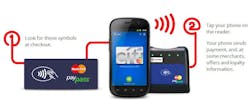
In late May 2011, Google announced its revolutionary mobile payment platform that enables consumers to tap or wave a smartphone at a point-of-sale terminal, including vending machines equipped with a near field communication (NFC) enabled reader to initiate a secure transaction, generate coupon offerings, and activate applicable loyalty programs.
NFC enabled readers for vending machines include MEI’s 4 in 1 Payment Acceptor, USAT’s ePort ‘G’ Series devicer, the Vivotech 4500 Series or Coinco’s upcoming Arrow Smart Reader.
To date, such data exchanges required multiple taps but Google’s innovative scheme claims to accomplish these tasks simultaneously from a single tap or wave action. This transaction application, termed the Google Wallet, is designed to work with Google’s Android mobile phone software in combination with NFC technology.
The Google Wallet simply establishes a reliable a way to pay for goods via a mobile phone (m-commerce). The Google Wallet was recently launched through a partnership with Citibank, MasterCard, Sprint, First Data and three major retailers (Macy’s, Subway, and Walgreens). The Google Wallet is a downloadable application for an Android smartphone equipped with NFC technology. It is important to note that the mobile device supporting the download must contain an NFC chip.
Consumers carrying the device can then use it to complete purchase transactions at compatible POS terminals. It is estimated there are more than 311,000 NFC-compliant retail locations worldwide (i.e., POS locations accepting MasterCard's PayPass settlement service). Part of the application download includes the flash sale, coupon-based Google Offers software, akin to Groupon (groupon.com) or Living Social (livingsocial.com) services.
Google requires users to download its Wallet application from the Android Market and subsequently link the application to an active CitiBank MasterCard or Google Prepaid Card. As an incentive to consumers, Google has bundled the Wallet with Google Offers, thereby enabling consumers to automatically apply discounts, promotions, and affinity programs to relevant sales transactions in real time. The joint introduction of the Google Wallet and Google Offers links electronic coupons and payments to create an unparalleled shopping experience built upon highly successful online and offline shopping concepts.
Mobile Payments
The challenge facing the Google Wallet (and alternate e-wallet formats) is, “Are consumers interested in using an NFC-enabled mobile phone for making purchases? A recent online survey conducted by Visa found that nearly two-thirds of respondents between the ages of 25 and 34 responded favorably to mobile phone purchase payment. The survey also revealed that 64 percent of the respondents were interested in receiving coupons through a mobile device.
In addition, more than half of those surveyed admitted carrying a mobile phone at least 75 percent of the time.
It is widely assumed that the demand for NFC technology is being heavily driven by the emergence of contactless payment formats packaged into mobile devices (advanced m-commerce). The development and deployment of integrated NFC chipsets to cellular phones is projected by ABI Research to lead to widespread adoption of NFC contactless payments during the next few years.
NFC
Near Field Communications (NFC) technology involves short-range wireless data exchange between a POS terminal [reader] and a chipset [transmitter] contained in a mobile device. Up until recently, contactless payments were limited to card-based payment interfaces involving a sophisticated card reader, antenna, and embedded chipset already contained in many existing credit/debit cards. Historically, the consumer needed to swipe a payment card through a magnetic stripe reader so that the radio frequency identification (RFID) technology would initiate the transaction through physical contact. Once the RFID data was captured, the reader had to be interfaced to a payment mechanism for the transaction to progress toward settlement. Newer contactless formats of the payment media (card or fob) merely need to be in close proximity of the reader for the necessary exchange of data to take place. In other words, waving a card within a few inches of an RFID contactless reader was sufficient to complete the data exchange. With NFC technology, the housing device (mobile phone) acts as an electronic wallet (e-wallet) and is responsible for completing the settlement function. By comparison with legacy RFID applications, the Google Wallet offers a higher level of security as the consumer’s mobile device screen must be powered to initiate (send or receive) transactional data and each transaction requires the consumer to enter his/her PIN number for authorization.
The novelty of Google Wallet is that it allows users to “store” multiple credit card numbers securely in a mobile smartphone. The chip inside the phone can emulate multiple credit/debit cards that can be selected using the application in mobile payment device. Currently there is only one phone to support the Google Wallet and it is the Sprint Nexus S 4G, though other Android phones are certain to follow. In addition, Apple and Google may or may not cooperate to enable this technology in Apple iOS devices.
Contactless payment adoption at retailer stores is gaining momentum as reported by research firm Aberdeen. The company claims that nearly one-third of all retailers either implemented or plan to implement some form of contactless payment technology. Initially the movement toward contactless technologies experienced resistance from business operators based on the high cost of implementing new equipment and the corresponding infrastructure necessary to complete the exchange of settlement data. With the evolution of strategic partnerships between NFC providers, payment processors, and POS vendors, retailers now have the opportunity to implement cost-effective hardware, software, and netware without necessitating structural changes. In addition, there is also a solid base for ancillary and future applications. Typically, contactless payments significantly reduce waiting times for customers by removing the hassle associated with cash payments or the processing of swiped electronic payment cards. Such benefits well apply to consumers using vending machine equipment.
Currently, there are at least five contactless/wireless technologies in use, including:
Near Field Communication (NFC) -- a standards-based short-range wireless connectivity technology that enables data exchange between multiple electronic devices. Similar to RFID, NFC involves radio frequency technology.
Short Message Service (SMS) -- service required for exchanging text messages between mobile devices and a POS solution (or vending machine).
Basically, NFC evolved from a combination of existing contactless identification and networking technologies but was designed to offer simplicity in connectivity while establishing high levels of reliability. Unlike RFID applications, NFC has a higher level of standardization, interoperability, and security. Compared to the Bluetooth process in which one device needs to contact (ping) a nearby device and formulate a compatible protocol to achieve connectivity, NFC is more intuitive. In other words, NFC does not require a device to seek permission before making a connection with a nearby device; the two NFC-enabled devices can communicate so long as they are within close proximity (normally four inches). NFC has superior networking functionality and dependable security features that qualify it especially well for use with transaction payment processors.
NFC allows consumers to easily connect to other NFC-enabled devices, perform financial transactions, and access a variety of digital content and media. NFC can be configured to work with all electronic payment formats (debit or credit transactions). An NFC tag is the component that allows devices to communicate with each other simply by being put close together. Although mobile devices are the most common host for an NFC chipset, the technology is not limited to mobile devices as some suppliers have begun placing chips in plastic cards, smart cards, wristwatches, and key rings.
When an NFC device is within close proximity of a reader, secure data exchange can take place. Data transfer takes place as soon as the NFC chipset is detected by the NFC reader. With NFC payment technology the amount of the purchase can be immediately deducted from the consumer’s bank account, settled with stored credits/debits, or charged against a deferred form of payment (e.g. phone bill) .POS payment against a phone bill has gotten traction in Europe, but to date has not been widely deployed in the US. Additionally, NFC devices can be linked to a bank account so money can be debited directly from a user to the merchant. Similarly, NFC devices can be used for proof of purchase as the certificate of purchase is stored on the NFC chip and can thereby be redeemed by simply pointing the NFC device at a controlled gateway.
NFC-enabled
NFC operates in the 13.56 MHz frequency range, over a typical distance of a few centimeters. The underlying layers of NFC technology are based on ISO, ECMA, and ETSI standards. NFC technology is supported by major communication device manufacturers, semiconductor producers, network operators, information services firms, and financial services organizations. An important feature of NFC is its automatic compatibility with all forms of contactless cards and readers, even legacy media. Given that the NFC transmission range is so short, NFC-enabled transactions are inherently secure; additionally, physical proximity of the devices also reassures the consumer of maintaining control of the process (i.e. interference avoidance).
Products with built-in NFC capability dramatically simplify the way consumer devices interact with one another, helping speed connectivity to receive and share information, including fast and secure financial transactions. NFC provides intuitive and safe communication between electronic devices. NFC is both a “read” and “write” technology and by bringing two NFC devices in close proximity automatically initiates a network connection. From a technical perspective, an over-the-air (OTA) infrastructure is necessary to support NFC applications, including transaction settlement and coupon downloading. The OTA protocol involves strong security measures designed to ensure proprietary data is not exposed or vulnerable to interference or interception.
NFC Applications
NFC-enabled devices can link contactless payment systems, connect to smart media, and access downloadable content. NFC applications, being developed and tested by Nokia, Motorola, Philips, Sony, and others are typically divided into four broad application categories.
1. Touch and Go -- Applications that require that a device equipped with access information be brought into proximity of a reader. Examples: transportation and event ticketing, security access coding, and smart label reading.
2. Touch and Confirm-- Applications such as mobile payment where the user has to confirm acceptance of a transaction and/or enter a password to verify and authorize payment.
3. Touch and Connect -- The linking of two NFC-enabled devices for peer-to-peer data transfer. Music downloads, image exchanges, and address book contents, for example.
4. Touch and Explore --NFC devices can offer multiple functionality. The user is able to explore device capabilities to select the most appropriate function or service.
Google Wallet
The impending success of the Google Wallet is somewhat focused, and dependent, on the increasing popularity of mobile and local (MoLo) platform programming. As an m-commerce application, the Google Wallet has the capability to electronically store credit/debit account information, promotional offers, loyalty and reward points, and gift cards. During transaction settlement, discounts, promotional campaigns, and loyalty points can be automatically applied and reflected in final reconciliation. For example, a consumer might tap his/her smartphone on an NFC payment reader, thereby exchanging payment information, applying relevant discounts, and aggregating loyalty information. As mentioned earlier, a serious concern related to the Google Wallet is security. The Google Wallet is highly secure with multiple levels of authentication including a screen lock, PIN code numbers, and encrypted credit/debit information. Google Wallet merchants become "SingleTap" merchants, meaning that users can pay by just waving or tapping a compliant Google Wallet device to settle a purchase while earning loyalty rewards and redeeming e-coupons. Given affiliation with MasterCard, MC Paypass-enabled terminals as well as CitiBank MasterCard and Google Prepaid Cards also accept Google Wallet and Google Offers.
See Figure One for a schematic explanation of Google Wallet functionality. The next phase of the Google Wallet is expected to enable users to store driver’s license, admission tickets, other IDs as well as electronic access (keys) in application file, in other words to resemble a physical wallet. (See Figure One - Schematic Operation of Google Wallet.)
MoLo
The success of the Google Wallet is largely dependent on the increasing popularity of mobile and local (MoLo) platform programming. As a mobile application the Google Wallet has the capability to handle transaction settlement, apply discounts, apply promotional campaigns, and factor loyalty points in the final reconciliation. MoLo Rewards (molorewards.com) technology allows users to earn, find, and use coupons for a variety of purchases. With MoLo e-coupons, which likely can work with any e-wallet application, are located and applied at the point of purchase with affiliated rewards being appropriately managed. Basically, a consumer taps a mobile Google Wallet device on an NFC payment reader, exchanging payment information, applying relevant discounts, and aggregating loyalty rewards.
MoLo is built on both NFC and RFID technologies. An NFC-compliant device is also equipped with an RFID tag that creates a unique identification code to control transactions. The code links to data stored on MoLo Rewards servers. (See Figure Two - Schematic Operation of MoLo Rewards.)
Google Offers
By broadcasting price discounts and product promotions directly to the phone of the consumer, savings can be applied when the products are purchased and settled at the point-of-sale (POS). Sales credits are applied to the transaction at time of settlement, loyalty or reward points are posted, and a receipt is sent back to the phone as support documentation. There are no hard copy documents that accompany product purchases. The Google Wallet is bundled with Google Offers software to produce a comprehensive and efficient shopping device. (See Figure Three - Google Wallet with Google Offers Content Example.)
Projections
Unlike credit/debit card processors that rely on transaction fees for revenue, Google does not plan to profit from transaction processing fees, but instead will aggregate purchase data for transactional and trend analysis. Google views the Google Wallet not as a means for transactional residuals, but rather as a way to expand its mobile advertising strategy. Concentrating on consumer data is expected to generate a competitive advantage for Google over alternate electronic payment schemes since transaction expenses will be lower and NFC readers may be provided to retailers at little or no cost (supplemented by Google).
According to projections by financial analyst group Canaccord Genuity, Google revenues could exceed $14 billion from mobile-advertising sales in 2015. This projection is based on the increased volume of mobile search, display, and applied advertisements on smartphones with Google Wallet operating under the Android operating system. Google's growth is expected to increase significantly between 2011 and 2015 given the abundant growth of mobile, social and local applications on handheld devices. The main factor leading to significantly enhanced mobile revenues is the projected success of Google Wallet and Google Offers.
Note: If currently using a smartphone for Google Maps, then a similar sequence of activities is followed for Google Wallet and the use of advertising and promotions. For example, consider what happens when employing the mapping application in search of a local pizzeria. The application will display nearby pizza restaurants along with available promotions. Following service at the selected pizza place, the smartphone housing the Google Wallet is waved to initiate payment while active discount are redeemed and applied against the amount due.
Summary
The Google Wallet is simply a way to pay for goods via a mobile phone (m-commerce) and was recently launched through a partnership with Citibank, MasterCard, Sprint, First Data and three major retailers (Macy’s, Subway, and Walgreens). The Google Wallet is a downloadable application for a smartphone equipped with Near Field Communication (NFC) technology. This technology enables consumers to complete a purchase transaction by waving or tapping the phone with an NFC-compliant payment terminal. Part of the download includes the flash sale, coupon-based Google Offers. Google Offers is a flash sale service based on local promotions, discounts, and special offers. Google has been described as disinterested in charging transaction fees as it plans to derive revenue from location-based advertising, couponing, and related promotions.
Near Field Communications (NFC) technology enables the Google Wallet to function as a mobile payment device supporting multiple credit/debit card accounts whenever a compliant smartphone is waved or tapped at an NFC-enabled terminal. Operations include: a-flash sales support, b- increased internal storage capacity, and c- enhanced screen display. Unfortunately not all industry observers are in agreement relative to the projected success of the Google Wallet. Experts seem unsure that billfolds and plastic cards will be traded in favor of electronic files on a mobile device. Unfortunately, what remains unclear is a lack of reasonable incentives designed to accelerate consumers and/or merchants to support the Google Wallet.
How Operators Can Be Ready For Google Wallet
All new smartphone payment technologies, including Google Wallet, will require NFC-compliant technology in the vending machine payment mechanism. While this capability has not been widely used in the past, and therefore may add $50 or so to the cost of the bezel device, it is a wise investment.
Hence, NFC technology is recommended for all payment devices going forward. In addition, it is likely card associations (Visa, MasterCard, Amex, and Discover) may offer subsides for installing (NFC) contactless cashless equipment in vending machines. As a point of interest, there currently are payment devices available from vending industry suppliers that are certified NFC-compliant and that will work with some electronic wallets.
At least initially all processing for Google Wallet is performed by First Data and other processors. It is likely that a vending operator currently accepting open cashless payments can rely on their processor to process Google Wallet and related transactions.
As the Google Wallet field trials expand into additional markets, vending industry suppliers may participate (along with related forms of automated retailing). Equipment manufacturers will be an excellent source of information as this technology matures.
About the Author
Glenn Butler operates CTO Services LLC, a technology consultancy. He can be reached at 781-688-1597 or at [email protected].
About the Author
Don Finley is VMS product manager at MEI Group.
About the Author
Michael Kasavana, Ph.D., is the NAMA endowed professor in hospitality management at Michigan State University in East Lansing, Mich. He has been researching venidng technology for several years.
Editor's Note: For an extended version of this article, visit www.vendingmarketwatch.com.
For more information, contact:
Coin Acceptors Inc., 800-325-2646, www.coinco.com
MEI Group, 800-345-8215, www.meigroup.com
USA Technologies Inc., 800-633-0340, www.usatech.com.
VivoTech Inc., 408-248-7001, www.vivotech.com
About the Author
 Michael Kasavana
Michael Kasavana
Ph.D.
Michael L. Kasavana, Ph.D., is the Emeritus NAMA Endowed Professor in Hospitality Business, The School of Hospitality Business at Michigan State University having retired from MSU after nearly four decades of teaching and research. Kasavana holds CHTP (Certified Hospitality Technology Professional) and NCE5 (NAMA Certified Executive) certifications. He remains an active researcher and consultant, focusing on current and near future developments in hospitality-related technologies including: electronic commerce, self-service applications, property management systems, and transaction processing technology. He has also created a series of instructional materials, industry manuals, and software products.
Dr. Kasavana is engaged in innovative and creative solutions for both attended and unattended points of sale for various aspects of the hospitality industry including online and offline, cash and cashless, contact and contactless, physical and virtual data exchange, location-based services, and interchange and merchant fee based digital media. He has conducted extensive research on the impact of technology on hospitality industry productivity, profitability, and competitive advantage and is credited with coining the phrases “V-Commerce”, “V-Engineering”, “Menu Engineering”, and “Auto-Coursing.”
Dr. Kasavana was named the NAMA Industry Person of the Year in 2011 and is a recipient of the MSU Distinguished Faculty Award. In addition, he was inducted into the HFTP International Technology Hall of Fame and was presented the Distinguished Lifetime Achievements Award from FS/TEC for foodservice technology innovation. He has authored, or co-authored, several books, including the industry best-selling texts Managing Front Office Operations (9th edition) and Managing Technology in the Hospitality Industry (7th edition) and has published more than two hundred articles in academic and trade journals.
Dr. Kasavana earned BS (Hotel, Restaurant and Travel Administration), MBA (Finance), and Ph.D. (Management Information Systems) degrees from the University of Massachusetts - Amherst.
 Glenn Butler
Glenn Butler
Glenn Butler was a founder of VendScreen and served as CTO. He also runs a M2M and vending focused consultancy called CTO Services. He can be reached and [email protected] or 781-248-3122.