Self checkout markets ride growing retail trend
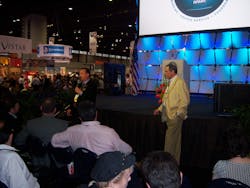
In 1998, I came across the first self-checkout system I had ever seen at a National Automatic Merchandising Association (NAMA) convention at McCormick Place in Chicago. It was a company called Smart Vending Solutions Ltd. based in Israel. The system involved going into an enclosed area using an access card, selecting the products, paying for the products, and then exiting the enclosed area. The system seemed to be designed primarily to prevent theft.
How times have changed!
Self checkout systems operated by vending operators are expanding rapidly from coast to coast. In a self checkout market, a customer picks products from open racks, coolers, freezers and bins, then scans the UPC bar code or RFID tag for each product at a payment kiosk. They pay with a single payment, be it cash, credit card or stored value card.
In showing a prospective customer a self checkout system at an existing location, I witnessed how the consumers at the location were happy to demonstrate how fast and efficient was the selection and payment process. The operator did not have to say a word – the consumers themselves were selling the self checkout system. When did this ever happen to you, as a vending operator, at a vending location?
Self checkout is expanding in a variety of retail environments, and as it does, we can expect the acceptance of self checkout markets to increase. In the meantime, vending operators have plenty of questions about these formats. The purpose of this article is to educate vending operators about the operations and economics of these systems.
Before examining the benefits these systems offer to vending operators, I think it’s important to note that self checkout is not happening in a vacuum. Retail self checkout is evolving quickly, and as it does, the acceptance and demand of the systems that vending operators are using will grow.
The other day, I went grocery shopping at our local Stop & Shop supermarket. Upon entering the supermarket, my wife and I scanned our Stop & Shop card and obtained a “Scan It” gun and started shopping. The Scan It gun quickly scanned all the UPC labels on the product packaging. We placed the scanned products in our “green’ shopping bags we had brought into the store.
Any products that required preparation at the fish or meat counters were wrapped with labels with prices and the UPC for scanning. Fresh fruits and vegetables had numbers affixed to the bunches. We went to the readily available scales, entered the number, weighed the product, generated a price/UPC label, placed the product in a plastic bag, affixed the label to the bag, and then scanned the label. If the fruit or vegetable did not have a number, the scale had icons describing the product from which you could generate the appropriate price/UPC label.
The display on the scanning gun enabled us to track our purchases by unit and price. Periodically, special promotions appeared on the screen. Stop & Shop can store each customer’s sales and then at the next visit, customize promotions to their purchases. The promotions are recorded immediately on the screen.
A pint of strawberries was displayed with the signage, “Buy 1 And Get 1 Free.” We scanned in the two pints and the display confirmed that the second pint was free. (I wondered: Is this a method to move products that are approaching their shelf life?)
The most important aspect of the shopping experience occurred at the self checkout kiosk. Responding to prompts we scanned in the gun, we selected a method of payment – cash, and credit or debit card – paid, and walked out of the store without any store personnel checking the contents of our “green” bags. We saved time and money. It was totally user friendly; a dramatic contrast to the “locked” room concept of the earlier self checkout concept described above.
Down the block at our local drug store, there are no cash registers. Every product is paid for at self-checkout kiosks. There are store personnel available for assistance. Once you interact with any of these systems, it is just like pumping gas.
A recent Wall Street Journal article on these new devices claims that smart phones will eventually incorporate these capabilities.
The vending industry must now take advantage of what I call self-checkout vend markets (SCVMs). I have adopted this term since these applications function without any personnel on-site. In contrast, the kiosk applications at retail sites have staff available to assist the consumer. SCVMs process purchases without any support from onsite personnel. They are truly part of the vending industry.
Self checkout emerges for vending
Automatic Merchandiser Magazine first reported on SCVMs in its March 2006 issue (although the article did not use the term SCVM).
In 2010 at the NAMA OneShow, there were no companies displaying SCVMs. At this year’s OneShow in Chicago, there were three companies showing SCVMs: Avanti Markets, 365 Retail Markets and Microtronic US. In addition, vending operators using the two more established of these SCVMs, Avanti Markets and 365 Retail Markets, made a joint presentation at the 2011 OneShow. More SCVMs have entered the market, such as Company Kitchen, operated by Treat America Food Services Inc. in Mission, Kan., and Breakroom Provisions Co., based in Hickory, N.C.
One of the most interesting things about the evolution of the SCVMs is that vending operators have been the key developers of these systems.
At the present time, the vending industry is using this concept to change and improve its offerings to vending locations.
In anticipation of this development, Kraft Vending & OCS engaged Vending Consultants Co. to conduct a survey of the two established SCVMs. The survey specifically examined what is being sold and what is the return on investment (ROI) for the SCVMs. Vending Consultants obtained sales data for a 2-month period; December 2010 and January 2011, from six SCVMs, three from Avanti and three from 365.
The major and most dramatic difference from vending is the number of stock keeping units (SKUs) available to satisfy the consumer. The six SCVMs had an average of 272 SKUs available for sale, sold 4,304 units each month, and averaged $6,888 in monthly sales, $1.60 per unit sold. Vending Consultants analyzed the monthly sales by the following product categories: cold beverages, candy, food, pastry, snacks and sundries.
Food, for the purpose of this analysis, included all refrigerated and frozen products as well as ambient products such as Kraft’s Mac ‘n Cheese, single-serve cereals and soup, etc.
Cold beverages and food comprised 50 percent of the SKUs (127) generating 60 percent of the monthly units sold (2,541), and 70 percent of the monthly dollars sold ($4,740). The average unit selling price for cold beverages was $1.50; $2.52 for food, $1.31 for candy and $1.19 for snacks.
Any experienced vending operator can see these averages are higher than typical vending prices. But more importantly, the gross dollar profitability is higher as well. In terms of gross profit, cold beverage and food products delivered the best results, in the 70 percent to 75 percent range.
More diverse payment options
How consumers pay is also critical to understand SCVMs. There is a key difference between the two systems; the 365 accepts cash in addition to card payment while the Avanti system only accepts card payment. The Avanti system does allow cash for reloading the stored value card at the payment kiosk, but it does not offer cash purchases.
At the three Avanti SCVMs, credit and debit cards payments averaged 28 percent and the stored value account card was 72 percent.
Stored value account cards are debit cards controlled by the Avanti system. The significant advantages to the stored value cards are: 1) there are no fees associated with the cards, and 2) the operator has access to data about the consumers to create special promotions.
The monthly sales breakout for 365 were: 37 percent for credit and debit cards, 14 percent for the stored value card, and 49 percent for cash.
More importantly, consumers now have a full range of products to select. Traditional vending operations only provide products that can be vended. This restriction now no longer exists. The SCVM operator can provide any product.
If you have a chance, visit a SVCM operation and watch the consumers. They pick up the products, check the nutrition information, and buy multiple items. One consumer stated: “With the wide range of products and sizes, I now have the ability to select; with vending I felt that I was being dictated as to what I had to buy.”
One critical omission from the SCVM sales in the installations tested was coffee. The average monthly sales figure of $6,888 does not include any coffee sales.
Coffee at all six locations was provided in the traditional OCS manner.
Coffee can be sold through SCVMs. The opportunity to include coffee sales through the SCVMs will be critical to profitability.
A closer look at the numbers
Both Avanti and 365 have provided ROI pro formas based on annual sales through the SCVMs in the range of $32,000 to $100,000.
The 365 pro forma offers scenarios for stored value card sales, combined credit card and cash sales, and credit card only sales. The pro forma considers product cost, shrinkage, depreciation, labor, utilities, parts, credit card expense and depreciation.
The Avanti pro forma compares the SCVM to a vending bank, and considers product costs, shrinkage, depreciation, labor, utilities, vehicle costs, parts, credit card costs, sales taxes and overhead.
The pro formas are comprehensive, but in reviewing them, several questions arise. Given the importance of food, neither pro forma addressed the critical issue of spoilage, which most vending operators know severely compromises the profitability of refrigerated food.
Another question concerns the locations where the SCVM failed, and of course, the reasons for such failure.
Vending Consultants will be expanding its analysis of SCVM sales to include refining food sales and quantifying sales per person at each location.
In addition, operators should be aware that management companies will provide a complete range of services, including financing, for vending operators to successfully install SCVMs.
Your vending consumers are being educated about self-checkout cold beverage and food products. Retail locations are no longer purchasing cash registers. Soon, vending operators will be concentrating on purchasing SCVMs.
For information, contact:
365 Retail Markets, 888-365-7382, www.365retailmarkets.com
Avanti Markets, 877-242-5851, www.avantimarkets.com
Breakroom Provisions Co., 828-322-8301, www.breakprovisions.com
Company Kitchen, 913-384-4900, www.companykitchen.com
Microtronic US, 800-879-3586, www.microtronicus.com
About the Author

Allen Weintraub
Allen Weintraub operates Vending Consultants Co. providing research and consulting services for product manufacturers, technology companies, and individual vending operators. He can be reached at: 333 Mamaroneck Avenue #239, White Plains, NY 10605, phone: 914-287-0095; email: [email protected].