Willing to Learn Technology and New Equipment, This Duo Gains a Foothold in Chicago
Accepting new ways of doing things can be difficult in established companies, but for industry newcomers, learning what's new comes more naturally.
In today's changing market, newcomers are learning the latest equipment, and because of this, they are sometimes able to get a jump on their older competitors, even in a highly competitive market like Chicago.
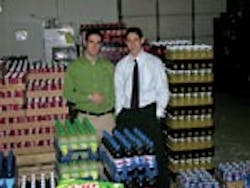
Case in point are Michael Klong, 27, and Randy Nasatir, 28, who have managed to chisel a niche for their company, Classic Vending Inc., by only placing new equipment, by offering multi-temperature food machines to smaller population accounts, and by constantly making themselves available to clients. Their youth and enthusiasm have paved the way for a successful journey in full-line vending.
Youth is on their side
"Our youth is an advantage," said Klong. "Clients have the ability to deal with the president and the CEO directly, at any time." This is reflected in the Classic Vending philosophy: "We are big enough to service large corporate accounts, yet small enough to handle our clients' individual needs. We understand that no two clients are alike, and we are committed to providing for each of our client's unique circumstances."
Vending was in his blood
Klong and Nasatir, friends since kindergarten, worked at Klong's mother's one-route sticker and bulk vending route over summers while in high school. Klong expected to work with his father in the trucking industry after earning a degree in business management. Nasatir earned a degree in communications.
But after a job interview in front of a firing squad of truck union workers, Klong decided to go back to his roots and work in the industry he grew up with -- vending. Fresh out of college, he did not wish to work with potentially hostile employees.
In 2000, the young men borrowed money and bought Klong's mother's sticker and bulk vending route. Nasatir handled operations while Klong handled the sales and bookkeeping. They eventually decided to hire an experienced bulk vending driver so they could both devote all of their time to sales.
Full-line expansion possibilities
In the process of developing the bulk vending business, the pair came across full-line opportunities. "We found that the (full-line) vending business was not as saturated as bulk," said Klong. They decided to explore full-line vending as an area in which to expand.
"In the beginning, we did not obtain any vending accounts from our bulk vending accounts. We started (full-line) vending with a couple of very small businesses, and endured a great deal of failed sales pitches while honing our sales skills," said Klong.
"They were really two separate kinds of business, (bulk and full-line vending); however, it did teach me to be aggressive when it comes to new business," said Klong.
New machines in every account
Classic Vending targets all size accounts and has won contracts from schools, hospitals, financial institutions and insurance agencies. After earning their first few clients through strong sales presentations, they have found it easier to win new accounts by giving potential clients the names of existing clients as references.
"Once we secured the first few accounts, it was a good stepping stone for others," said Klong.
Klong found that some clients were just not happy with the older machines and the lack of product choice offered by their current vending operators.
With financial backing from their parents and a bank, they pitched their first full-line vending account and promised the newest machines and product. They learned that promising new equipment is a key to winning an account. "The machines from three years ago look like the machines from 20 years ago," he said. Most of their competitors use a lot of older equipment.
Used equipment just didn't work
The oldest piece of equipment that they own is three years old. "We made the mistake by buying a used piece of equipment once. It gave us so many headaches in regard to repair and downtime that now we only use new equipment," said Nasatir. They have tried different brands of machines and have found success with National Vendors' Millennia and GPL's Vision Series.
The Vision Series, in fact, fits right in with Classic Vending's sales pitch.
"We come to the customers with not only new equipment, but a new vision of what we can do in the accounts to make it better," said Klong.
Some features that are appealing on the new machines include new sensors, double spirals and expanded product versatility. "The new glassfront machines offer a wide variety of drinks that appeal to accounts like hospitals and schools," said Nasatir.
New machines bring increased flexibility with product lines and reduced breakdowns and repair times. But because of the high investment in buying all new machines, Classic Vending asks clients to sign a contract.
"Our business model is structured to achieve the highest level of customer service; as a result, we feel comfortable providing an 'out clause' for the customer should they encounter problems with our service. To date, we have not had a customer attempt to make use of the out clause," said Klong.
Division of responsibilities
Both men find working with their best friend a good situation. "Our personalities complement each other," said Klong. "Plus, we have complete trust in one another."
Even though they are both in management positions now, Klong and Nasatir both began on the route truck. "It was the best experience to start from the bottom; we have an appreciation of what we have done," said Klong. "It is also a great advantage for employee management." Klong and Nasatir say that because they did the job themselves, they can relate to the problems route drivers may encounter and offer viable solutions based on their experience.
Fast growth brings growing pains
The company has quadrupled its size in the last three years. This hasn't come without headaches. "We are now looking for a computer system to help organize our business and to accommodate the future growth we are expecting," said Nasatir.
They are looking at computer systems to inventory the warehouse. They hope to utilize DEX handhelds, and are investigating systems from Crane Streamware and CompuVend. "It's the next logical step to efficiency," he said.
Spiral-level data will be used in product selection. "The benefits will be huge; to find out what is selling at an account versus relying on the route driver," said Klong.
Nasatir sees this becoming even more important as they expand and hire more route drivers. "It will be beneficial in training and getting a new driver started," he said.
They foresee the implementation going smoothly. "We have already approached our route drivers with the new concept, and have been met with enthusiasm," Nasatir said.
Because Classic Vending only places new equipment that is capable of DEX reporting, it will make the transition easier and less expensive than having to retrofit older machines with new technology.
"There is no question as to the value of DEX handhelds and the importance of incorporating it into our current system. We plan on having a new system, using DEX handhelds, in place by the end of the summer, and increased cash accountability will play an important role," said Klong.
Another goal is to control inventory. "Right now, we have a high shrinkage rate at 10 percent(for perishable foods). With the new software system, we hope to reduce this to 0.5 percent," said Klong. They hope to accomplish this by tracking what is selling at each account and not having to rely on the route driver as much.
Classic Vending has no set planogram by which the route drivers fill machines; they rely heavily on customer feedback.
"We send out questionnaires to the employees at a location and find out what they want in the machines," said Klong. They hope to better refine this approach after implementing a software program that will give them in-depth reporting on machine data.
Healthy food choices
Klong and Nasatir are looking to place some healthy items in the machines. "Regardless of the profits of the company, we feel we have a responsibility to give healthy options," said Klong.
In one school district account, the machines are stocked with 40 to 50 percent "healthy foods," including Powerbars, Luna Bars and Harvest Bars. Gatorade has been successful in beverage machines placed near gyms. "The flexibility to get any product people are looking for is an advantage," said Nasatir.
Multi-temperature food machines
At the request of one of their 24-hour warehouse accounts, Classic Vending moved into food vending a few years ago. They have found that brand names sell well. "People are looking for familiar names," said Klong. Oscar Mayer, Deli Express and Pierre are all good sellers.
Normally, operators don't consider giving mid-sized accounts food machines since these accounts don't have the sales to justify the investment. But Classic Vending has found a compromise. "With the addition of multi-temperature equipment from Wurlitzer and GPL, we are able to offer food to smaller accounts. It has given us a competitive advantage," said Klong.
They are able to win smaller accounts by offering them limited food from these versatile machines. "We hope that when they buy a sandwich that they buy a drink and chips all out of the same machine," he added.
Another advantage Klong and Nasatir found with multi-temperature machines is that if the food at the account proves to be unprofitable, they can reconfigure the machine to vend just snacks. The machines are configured to allow snacks and soda in the same machine instead of requiring two separate machines.
"We offer commissions to all accounts," said Klong. "Prices may be higher for the consumer, but we give every account the option."
OCS: a market yet to be tapped
Classic Vending fell into OCS in the same manner as food -- from a customer request. Gevalia, Brio and Progema single-cup machines serve them well in small accounts, and they use Newco pourover brewers at other locations. "Just like when we got into vending, with the single-cup machines, we have tried them all. Consumers recognize the name brand Gevalia and that makes it a good fit," said Klong.
The company offers Superior Coffee, Metropolitan Fine Coffee and Starbucks Coffee along with Everpure filtration systems to ensure the quality cup of coffee.
With only 5 percent of their business coming from OCS, they see this as an area to grow. Currently, OCS and vending are serviced on the same truck.
The company also has a small bottled water division which they are looking to expand. Everpure and Omnipure filtration systems and Century Springs bottled water have proven to be good products.
And things are still going strong on the sticker and bulk side of the business. One driver is dedicated to sticker and bulk machines. "We are just as aggressive in this area as in (full-line) vending," said Nasatir.
Youth is not always an advantage
The duo hasn't been met with open arms by everyone. Walking into some of their first accounts, potential clients had to do a double take at the baby-faced Klong trying to pitch a huge proposal. "They hear me start to talk about the business, and we seem to get through to them. We have passed those hurdles now and have some big accounts to show people," said Klong.
"Keeping the customer happy has been the hardest part of vending for me," said Nasatir. There are still people who have negative feelings about vending, whether it be the type of product being vended or the reliability factor. It's tough to combat." But what they are doing seems to be working; Classic Vending has never lost an account due to client dissatisfaction.
Demand for quality customer service
"We personally cater to the customer," Klong said. All clients are given home and cell phone numbers. "If there are issues, which there always are, they are dealing with the president and CEO directly; there is no bureaucracy to wade through. We make sure that it gets done."
"We have been called at 4 a.m. many times, but that is the commitment we make," added Nasatir.
Klong and Nasatir hold high expectations for their suppliers as well.
"Accounts believe in our business plan," said Klong, who stands strong on creativity, accessibility and providing exemplary customer service. "We expect the same degree of professionalism from our suppliers and distributors as well."
When Classic Vending was a small start-up company, national product suppliers and machine manufacturers were not interested in working with such a small volume. Klong and Nasatir found loyalty from Concession Services Inc., Chicago, and Five Star Distributors Inc., Vernon Hills, Ill., both product distributors, and from National Vendors.
"When we grew to a larger-sized company, and those original suppliers came back to court us, we stuck with our original suppliers whom we have built relationships with," Klong said. He and Nasatir demand loyalty from their suppliers just like they give that same respect and loyalty to their clients.
Expansion plans
Inventory of product and equipment at the Chicago office is kept low, for security reasons, but also for space issues. The company is currently looking to buy a new warehouse to better accommodate growth. The current rental facility is just over 5,500 square feet. They are looking to buy one triple that size.
"We plan to build our company based on our reputation and experience. We are going to keep doing what we are doing," said Klong on the future of Classic Vending. "We believe in ourselves and what we are doing."
"It's great to see something that started so small grow into this. It's a great feeling at the end of the day. It's rewarding and exciting," he added.
Operation Profile
Name Classic Vending Inc.
Headquarters Location Chicago
Founded 1989
Owners Michael Klong, President and
Randy Nasatir, CEO
Number of Routes6
Number of Employees 15
Number of Accounts 115
Main Equipment lines GPL, National Vendors, Wurlitzer
Annual sales Not revealed