Vendors Respond to Public Concern About Nutrition With More Education Initiatives
Health and nutrition: it's the issue that won't go away. Vending operators read about it every day on VendingMarketWatch.com (Automatic Merchandiser's daily news website), mostly as it relates to schools.
Trade organizations are spending their members' money to make the media and government officials aware that the vending industry didn't create the obesity crisis and are trying to be part of the solution.
Vending operators for the most part support these efforts, which they view as a price they must pay for being in a business that is involved with public health.
The bottom line, however, is that the obesity and nutrition debate has very little to do with daily business reality for the average vending operator. The operator, for his or her part, will be more than happy to provide customers products with higher nutritional content if the customers desire it ?-- through their purchasing habits. Which for the most part, isn't happening.
But is this really the bottom line?
No one can say for sure what the legislative landscape will look like five years from now. While only a small number of states have passed laws pertaining to vending, and these apply only to schools, this could change. There is no reason to believe that vending restrictions won't extend to business and industry. The Department of Agriculture has released new dietary guidelines placing stronger emphasis on reducing calorie consumption and increasing physical activity.
Government and industry drive change
A less visible movement has emerged in the private sector: employee wellness. Medical costs are forcing employers to consider multi-faceted wellness programs to ensure healthier employees and, hopefully, lower health insurance premiums. These efforts oftentimes include an emphasis on healthier meals.
Case in point is the Highsmith Co. Inc., a distributor of supplies, furniture and equipment to libraries, based in Fort Atkinson, Wis. The company has an extensive employee wellness program that includes making nutrition information available in its employee break area.
Laura Hanson, manager of learning and development at Highsmith, said stickers on the food machine identify fat content for certain healthier food selections. These selections are priced at reduced cost, Hanson noted. The nutrition information is provided by the vending company.
Highsmith's multi-faceted wellness program has had a beneficial impact on the company's healthcare premiums, Hanson said.
Obesity interest continues
One thing's for sure: The media isn't going to let up on this issue. Obesity is a problem affecting all parts of society, and issues in the public spotlight tend to take on lives of their own; media attention feeds itself until the public genuinely loses interest.
Most vending operators have been satisfied to let their national trade association carry the weight of the burden. But many are also learning the issue affects them directly. When they do, they begin to realize the full value of the work NAMA has done on their behalf.
Vendors have new education tools
NAMA's Balanced for Life campaign, introduced this year, is an ongoing media relations effort to inform the public that vend products can be part of a healthy lifestyle. The campaign provides tools to help operators address the media at the local level, and help them participate in legislative initiatives at both the local and state levels.
One Balanced for Life tool is the Snackwise Nutrition Rating System. This is a nutrition rating plan at a Columbus, Ohio hospital that rates the nutritional quality of snack foods; products are color coded red, yellow and green.
Another tool is the support of four dietitians who are available to help operators work with legislators and other public officials on the industry's behalf. These dietitians have already been called into action at the state level.
The real bottom line for most operators is that they cannot expect to put the health and nutrition issue on the back burner, lest they get burned.
Vendors feel the heat
Consider California Vending Services, a one-and-a-half route operation in rural Turlock, Calif. Located 80 miles from both San Francisco and Sacramento, Turlock is hardly a hotbed of nutritionist activism. The most attention company owner Gordon Dirvanian paid to nutrition was responding to a few requests for low-carb products.
One day, a few weeks ago, his local newspaper called him and asked him if he was providing any sort of nutrition labeling. The reporter was following national and regional issues, and wanted to "localize" the story and see what a local vending company was doing about nutrition labeling.
After Dirvanian answered that he wasn't rating his products for nutrition, the reporter then asked if he was open to doing so. Dirvanian answered that he is open to doing anything his customers ask him to do.
Dirvanian has noticed that the snack manufacturers are coming out with more products labeled as baked and not fried, and that these products hold their own in many of his accounts. He plans to keep monitoring the situation, and he's glad his national trade association is on top of the issue.
In Chicagoland, where legislative initiatives are more prevalent, Rich Caldarazzo, president of Twin Oaks Vending, based in suburban Aurora, Ill., has made it a point to be on top of what restrictions are being proposed. While Caldarazzo has not decided to go out of his way to educate his customers about nutrition, he isn't going to let his guard down.
Like many operators, Caldarazzo is a bit hesitant to take an aggressive approach, following an earlier attempt to promote low-fat products in the middle 1990s. At that time, consumer researchers heralded the "low-fat" revolution.
Twin Oaks Vending signed on with Heart Smart International, a third-party nutrition labeling program. He instructed his drivers to attach channel markers on his snack and food machines to draw attention to products certified as "heart healthy" by Heart Smart, only to find that it didn't do much for sales. (The Heart Smart certification is based on American Heart Association standards.)
Remember low-fat?
Like many operators who joined the low-fat bandwagon, Caldarazzo thinks the interest was created more by location managers who wanted to position themselves as health advocates and by consumers who weren't completely honest about what they wanted to see in the machines. "They gave you lip service, but when we watched them in the cafeteria, they didn't purchase it," he said.
Caldarazzo still offers Heart Smart to customers who express an interest in the program, but he's not proactively promoting it. "We're not getting the demand (from locations) we were seven years ago," he said.
Caldarazzo realizes that government mandates will continue, but he doesn't see it going beyond the public sector. As for consumer demand, he's noticed an increasing acceptance for baked snacks recently, but nothing dramatic.
Bill Buckholz, chairman of Goodman Vending Services Inc. in Reading, Pa., has been tagging his machines for years to draw attention to healthier items, using a variety of programs. While these efforts have never done a lot for sales, he thinks the industry needs to keep promoting itself as a healthy industry.
"More and more, snack food has gotten the image that it can harm you," he said. Because of this, he continues to participate in Heart Smart, and regularly includes nutrition information in his customer newsletter. Buckholz welcomes the NAMA Balanced for Life initiative, and will take a look at the Snackwise color coding program.
"It's a step in the right direction," Buckholz said. "We've got to let people know our industry is conscious of these things."
As a Pennsylvania operator, Buckholz has seen more than his fair share of regulatory action. The Philadelphia school district has banned soda, and some state bills have advocated eliminating vending completely. He has testified against some of these measures as a member of his state vending association.
One benefit of third-party certification programs is most of them enable the operator to comply with health labeling regulations. Labels and point-of-sale materials that make specific health claims must comply with FDA definitions. Nutrition information must be available for all products for which any health claims are made.
"Low fat," for example, is defined as having 3 grams or less of fat per 100 grams of food.
Certification addresses definitions
Third-party certification programs that use FDA terms make sure the products they certify meet these requirements. Programs that don't follow these definitions don't use these terms.
Bruce Myers, owner of Hampton Roads Vending & Food Service Inc. Hampton, Va., is concerned that the industry not promise more than it can deliver. He thinks operators who place channel markers on their machines will do themselves, their customers and the industry a disservice if the wrong products get into those machine facings. "A lot of the ideas are great, but the implementation is missing," he said.
Myers has provided nutritional information to certain accounts, such as schools and recreation centers, that have requested it. He has hired a nutritionist to assist him with this information. The majority of his accounts, however, have not asked for it.
Vendors seek professional help
"Certainly I'm for trying to communicate with the public on these matters," Myers said.
Meanwhile, legislation will continue to keep the issue in the public spotlight.
The NAMA campaign ties lobbying support in with media relations; the two areas constantly overlap. Some operators have already found the program beneficial.
In Indiana, a slew of medical associations have supported a bill requiring half of all selections to be "healthy," using the same guidelines the state of California adopted last year. The Indiana Vending Council has been grateful for NAMA's initiative, which has provided them the services of a dietitian, giving the industry more credibility.
The dietitian, Michelle Macedonia, is one of four nutritionists under contract with NAMA to support the vending industry.
"She's been a tremendous help to us," said Steve Beebe, executive director and lobbyist for the Indiana council. "She provided a degree of credibility on this issue that I don't think the rest of us would have had. This is one of the best things NAMA has done to help the states work with the issue."
Lobbying assistance proves vital
Beebe said Macedonia has not only given the industry more credibility with legislators, but has also helped its members understand the issue from an outsider's perspective, which has helped them strategize better. While the industry can make legislators aware of the complexity of the issue, Beebe said the industry will have to realize that the vending piece is one of the easier ones to address legislatively.
The New York State Vending Association is also utilizing the services of a NAMA-contracted dietitian, noted Robert Desormeau, association president. He said one area where the association hopes to play a role is in defining what is and isn't healthy. "We want to be proactive," he said. "We want to show these legislators what our industry is doing."
Desormeau, the Albany, N.Y. regional director of Canteen Vending Services, said he believes there are a lot of products available today that could qualify as healthy.
Competition makes some proactive
Competition could also encourage more operators to become more involved with nutrition education, although some will argue that the nationals and the large regionals have been promoting healthy eating programs for many years.
The nationals and the big regionals continue to upgrade their nutrition labeling programs.
Canteen Vending Services Inc. recently replaced its "Nurture Our World" point-of-sale nutrition education campaign with a new one titled, "Balanced Choices." The company is targeting 15 percent of all of its choices in its snack, cold drink and food machines as "Balanced Choices." There is also a dedicated "Balanced Choices" machine that is 100 percent healthier items for select accounts. The program includes a website where consumers can get nutrition information.
ARAMARK Refreshment Services Inc. recently updated its "Balanced Selections" with a new point-of-sale nutrition education program.
On the foodservice side, ARAMARK recently launched "Just4U?" featuring new, healthier menu items with easy-to-understand nutrition information and bold menu identifiers to make it easier for diners to find the foods that are right for them. These menu items have been tested for nutritional value and accuracy by ARAMARK chefs and registered dietitians.
Large operators improve education
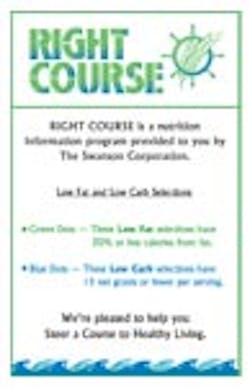
Swanson Corp., a vending/foodservice provider based in Omaha, Neb. serving 10 states, has expanded its "Right Course" healthy eating initiative from low-fat to also include low-carb. Where green dots designate low-fat items, blue dots indicate low-carb. All Swanson Corp. machines have some blue and green dot stickers.
In addition, a dedicated "Right Course" machine has two complete rows designated as low-carb and the rest designated as low-fat. Low-carb items are defined as having 15 net carbohydrates or less per serving. Low-fat items have 30 percent or less calories from fat per serving. All designated items have been approved by a staff nutritionist.
Swanson Corp. also updates customers on nutrition in its regular newsletter, and during the month of March, National Nutrition Month, sends out flyiers provided by the American Dietetic Association.
"There's been plenty of nutrition banter relating to the vending industry," said Deb Prestage, vice president of communications at Swanson Corp. "We're doing our share to make our customers healthier."
Operators who want to be proactive in a similar manner will find no shortage of information resources available. (See the list on this page.)
Service Vend, a one-route operation in New Orleans, La., uses both products and point-of-sale educational information provided by Snack Essentials, a healthy food distributor/nutrition education resource based in Irving, Texas. Tina Paradela, vice president of Service Vend, puts channel markers designating columns as low-sugar, low-carb or organic. There is a variety of products available that fit these definitions, including nutrition bars, soy chips and vitamin supplements.
The Snack Essentials program has been most successful in schools and nursing homes, said Paradela, but they presently account for half the offerings in most of her accounts. The products are priced from 75 cents to $1.25, a little higher than most, but they sell well in the appropriate locations.
Public health resources are also available for nutrition education.
In 2001, the Henry County, Ohio Health Department commissioned Maumee Valley Vending, based in
Defiance, Ohio to develop a heart healthy and a "5 A Day" labeling program. The company has since extended the program to 10 counties in Ohio, Michigan and Indiana.
Operators can be resources
With school districts now required to come up with nutrition education plans, educators are reaching out to private and public health organizations, as well as vending and foodservice professionals. Vending operators could find it worth their time to become involved.
The need for vending operators to take a more proactive stance in their communities will become more obvious this year as legislatures and media continue to focus on obesity. Government and media alike will find more questions than answers, meaning the issue will remain in the spotlight for some time to come.
Vending operators need to familiarize themselves with nutrition information resources.
Manufacturers respond with products that meet stricter dietary needs
Major product manufacturers have responded to the obesity challenge by changing the nutritional content of their products and developing labels that emphasize nutrition. These include:
-
PepsiCo introduced the Smart Spot? symbol designed to help consumers identify
more than 100 of the company's food and beverage choices that contribute to healthier
lifestyles. Products displaying the Smart Spot? meet nutrition standards based
on authoritative statements from the FDA and the National Academy of Sciences.
The symbol designates that products are fortified and contain other wholesome ingredients, or meet limits for fat, saturated fat, trans fat, cholesterol, sodium and added sugar, or are reformulated to reduce ingredients, such as fat, sodium or sugar, or are reformulated to have specific health or wellness benefits.
Frito-Lay has also partnered with Kenneth Cooper, founder of The Cooper Aerobics Center, to further develop better-for-you snacks. - Kraft Foods Inc. has introduced its Sensible Solution labeling program, featuring a prominent on-pack "flag" for food and beverage products that meet specific, "better-for-you" nutrition criteria that Kraft has established for each category of products. The Sensible Solution flag, which will help consumers more easily identify Kraft's "better-for-you" choices, will appear on qualifying products in April.
- Hershey Foods Corp. has introduced Smartzone snacks. This consists of classic
Hershey's flavor mixed with the research that Dr. Barry Sears' Zone Diet is built
on.
Adhering to Dr. Sears' proven ratio of carbs, proteins and fat, a Smartzone bar helps balance the body's blood sugar levels. - General Mills Wholesome Snack Choices include one or more of the following nutritional benefits: an excellent or good source of whole grain, calcium, and vitamin C, or naturally cholesterol free. Also, many snacks meet the school nutrition standards suggested in California SB19 and the school nutrition standards adopted by the Texas Department of Agriculture. General Mills Wholesome Snacking Choices in vending include: Nature Valley? Crunchy Granola Bars, Nature Valley? Chewey Granola Bars with Yogurt Coating; Chex Mix? Snack Mix; Gardetto's? Reduced Fat Original Snack-Ens; Big G Cereals; Sunkist? Fruit and Grain Bars; Milk 'n Cereal Bars; Fruit Shapes; Pop Secret? Light Popcorn; and Yoplait? and Colombo? Yogurts.
Third-party certification programs
Gundersen Lutheran Medical Center (500 Club), 608-782-7300
Heart Smart International Inc., 480-948-7631
Snack Essentials, 866-955-5553
Nutrition resources
Kids First, 401-751-4503
Low Carb Vending, LLC,
www.healthyvending.net
National Automatic Merchandising Association,
www.vending.org
American School Food Service Association,
www.afsa.org
Mecklenburg County, N.C.
Health Dept. (Fit City),
www.fitcitychallenge.org
Nutrition for Kids,
www.nutritionforkids.com
Columbus Childens Hospital (Snackwise),
www.snackwise.org
Team Nutrition,
www.fns.usda.gov/tn
USDA Center for Nutrition
Policy and Promotion,
www.usda.gov/cnpp
American Heart Association,
www.amhrt.org
About the Author

Elliot Maras
Elliot Maras served as the editor of Automatic Merchandiser magazine from 1993 to 2012. To reach the current editor of Automatic Merchandiser and VendingMarketWatch.com, email [email protected].