Global Positioning Systems Becomes More Affordable, Allowing Greater Efficiency
With accounts not growing, vending operators are taking a closer look at ways to operate more efficiently. And while implementing technology to improve efficiency usually adds costs before saving any, some technologies are proving their usefulness. Case in point is satellite-based fleet monitoring, known as Global Positioning Systems, or GPS.
As with any new technology, operators face a task educating themselves about how the technology works and how different systems on the market compare. Because GPS is still fairly new in vending, operators must sift through a lot of information before they can determine how much to invest and what the payoff will be.
Satellites beam down signals
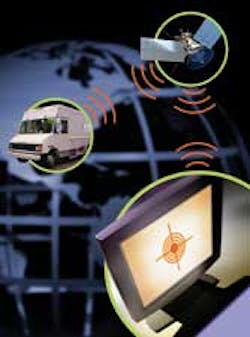
GPS fleet management systems utilize a network of satellites that transmit radio signals to ground-based receivers. GPS technology, combined with analysis and mapping software, can provide an operator with up-to-date information on vehicle activity, including graphic annotation of key events such as service stops, excessive speed, variations from the route and more.
GPS systems have proven particularly useful in facilitating service dispatch operations, thereby enhancing customer service in a more efficient manner.
Technology costs fall
GPS systems have been available for fleet management for several years, but as with many technologies, the costs have fallen in recent years. A random survey of vending and OCS operators revealed that many are using this technology to improve operating efficiencies and employee accountability.
There are two main types of GPS systems: "active" (or "real time") and "passive." In an active system, data is transmitted via cellular telemetry to the main office or to an Internet website where the subscribing company can view its fleet activity in real time. In a passive system, the data is stored for retrieval and uploaded to the principal fleet computer when the vehicle returns. Many GPS providers offer both systems, and combination options.
There is also a two-way tracking system that uses low-orbit satellites that allows communication between drivers and managers. This works in areas where cellular networks are not established. This is the most expensive option.
Rising fuel costs drive interest
Vending and OCS operators have taken more interest in GPS systems in light of skyrocketing fuel costs. Fuel savings are achieved in three distinct ways: 1) By making sure unauthorized use of the vehicle isnt occurring, 2) By allowing more efficient routing, and 3) By allowing managers to know how fast a vehicle is moving; excessive speed wastes fuel.
Vending and OCS operators have found use for these systems for all their main vehicle functions; delivery, service and supervisory. Most use it for service and supervisory vehicles versus delivery trucks. This is because there is less management oversight of service and supervisory vehicles than route delivery trucks.
"We can dispatch our service techs; tell them you are here and I need you to be there, rather than the service tech telling us where he is. We tell him where he is," noted Alan Plaisted, president of Southern Refreshment Services Inc., based in Atlanta, Ga. The company monitors service techs in real time and the supervisors after the fact.
Real-time data useful for service trucks
Plaisted finds it worth the extra cost of knowing in real time where his service vehicles are. There is never any question where a vehicle is at any time.
The biggest benefit has been improved routing efficiencies. The system creates reports that summarize every trucks mileage by any time interval chosen.
Plaisted doesnt plan on installing GPS receivers on his route trucks unless there is a problem with a particular driver.
Plaisted has been using GPS for two years now and said system costs have come down. He said prices and options vary considerably.
Operation finds immediate payoff
Continental Vending Inc. in Anaheim, Calif. realized immediate benefits from GPS in providing faster response to service calls, noted Joe Shake, company CFO. The company was introduced to the services of @road.com by its wireless phone carrier, which also serves as the carrier for the GPS service. Continental Vending has 35 routes.
"It was much faster for us to look at a map of all driver locations to see who was in the closest proximity to the customer to respond to their needs as opposed to calling them on the phone and asking where they are," Shake said. "As a result, GPS has saved us a lot of time and frustrations, thus equating to a cost savings as well."
OCS operation also finds benefits
Brand Coffee Service Inc., based in Houston, Texas, implemented Teletracs real time service a year ago to complement the OCS companys route handhelds. Ken Boerner, general manager, said the real-time feature has improved the accuracy of vehicle tracking. The company is now getting more service calls done per day.
Canteen of Central New Mexico in Albuquerque, N.M. installed Fleetboss GPS on its eight service routes and six school foodservice routes last winter. Kevin Callesen, company president, said he wanted better accountability of the route vehicles since they cover a lot of terrain. The system has been particularly useful in multi-location accounts where the account manager may not be aware which machines have been serviced at a given time.
Callesen particularly likes the mapping feature the system creates to demonstrate visually where a vehicle has been. "A visual representation is a lot easier than verbally telling somebody," he noted.
Upfront cost can be high
The system cost $34,000 for hardware, software and training, Callesen said. The office staff had about 25 hours of training.
As with any technology that improves efficiency, the benefits accrue based on company size. However, small operators are finding benefits from GPS as well.
DAFCO Vending Service, a four-route operation based in San Francisco, Calif., realized efficiencies from the Teletrac system. There are no more early morning naps being taken in the trucks, noted Connie Mack, owner.
Some operators who invested in systems several years ago when they were more expensive did not stay with them.
Early users were more challenged
Eight years ago, Custom Vending Services in Beltsville, Md. spent close to $45,000 to install a real-time system plus a monthly maintenance fee of nearly $20 per vehicle for 24 routes and four technician vehicles. Mike Finelli, general manager, said the cellular signals were not always reliable. There were also issues with the GPS hardware and software.
The receivers also sometimes drained the vehicles batteries if the driver didnt turn the engine off when he left the vehicle, Finelli noted.
Finelli acknowledged that the system did provide certain benefits; it identified route redundancies. And in one instance, it was able to identify the location of a stolen truck.
He further noted that eight years is a long time when it comes to technology. "If we got into it now, it would be a completely different ball game," Finelli said.
Corporate Service Group, based in Tampa, Fla., was satisfied with the system from @road.com which it installed four years ago to track service vehicles in real time, noted Brad Bartholomew, president. Two years later, however, the service provider wanted to change all the hardware. At that point, Bartholomew decided the cost was too much and discontinued using the system.
Bartholomew acknowledged the system did give him more control of vehicles. He said it was particularly helpful to have a system that specifically identified the location of both the drivers and where the service calls were coming from.
Bartholomew has noticed costs have come down in the last two years and he is considering investing in another system.
Handhelds and electronic locks
Some operators see GPS as a way to complement the accountability that handheld computers and electronic locks provide. Route handhelds provide an activity record for route drivers while electronic locks do the same for machines.
Southern Vending Co. in Ardmore, Okla. uses a passive GPS system from Advance Tracking Technologies in conjunction with CompuVend route handhelds and Videx electronic locks. Aldo Waters, Southern Vendings president, said the employees home addresses have been inputted into the system so management can be alerted if an employee takes a vehicle home. The system also allows management to review how much time employees spend at each stop; too much or too little time can cost the company problems.
"Since we put the system in, our repeat calls have drastically dropped," Waters said.
Appreciated Vending Service in Cinnaminson, N.J. is presently testing a system from GPS North America in three of its seven vehicles, noted Tom Sheehan, CFO. He estimated the hardware will cost between $700 and $800 per truck, which he will lease for a four-year period. In addition, monitoring will cost $35 per month per vehicle.
Systems provide options
Todd Elliott, president of Tomdra Inc., a 16-route operation based in Tucson, Ariz., tested a GPS system three years ago and thinks costs have come down enough that hes decided to invest in a passive system. He sees it as a good management tool. If management finds there is a problem with a certain route, they can imbed the truck with a GPS receiver and review its activity.
GPS helps keep employees honest
Elliott also thinks employees become more honest and productive when they know they are being watched.
Several operators recently have taken interest in a GPS product from a company called Xora Inc. based in Mountain View, Calif. that relies on Nextels cellular signal. The service is similar to other GPS products except that the tracking device is not hardwired to the vehicles engine. Instead, the GPS receiver is in the mobile phone which the employee carries with him.
The Xora charge of $11.99 per month appears on the Nextel bill. There is a one-time $24 charge to set up the service per phone.
Some operators noted that the Nextel product can be disabled simply by turning the phone off. However, the operator will know if a driver has turned off his Nextel phone.
Williams Food Service Inc., based in Louisville, Ky., uses Xoras real-time monitoring for its service techs, supervisors and route drivers with extra-long routes. The system "pings" each driver every five minutes.
System documents employee activity
When one employee was dismissed for not doing his job, the company didnt have to pay unemployment benefits because the GPS system documented the violation so well.
The company also uses a hard-wired GPS service for special situations.
Jeff Payne, president of Williams Food Service, said there are pros and cons to both the Xora and hard-wired systems. The Xora product, besides being less expensive, is also more versatile; theres no need to rewire a GPS receiver if you want to use a different vehicle.
In addition to all of the efficiencies and enhanced accountability provided, many operators also noted that GPS provides a good selling tool. It assures customers' service needs will be met.
GPS benefits at a glance
- Improved fleet efficiency
- Faster response time/improved customer relations
- Improved employee accountability
- Reduced fuel costs
- Improved driver safety
- Reduced liability and insurance costs
- More efficient route management
- Decreased vehicle wear and tear
- Automation of vehicle record keeping functions
What to consider when choosing a GPS system
In assessing a GPS system provider, veteran providers identify several factors to evaluate.
- Value added functionality. The operator should first define what it needs to control in existing operations. A company may not need to know where vehicles are all the time, yet will need to know mileage information for lease, tax or maintenance purposes.
- Simplicity of use for employees.
- Stability of service provider. If the provider goes out of business, it could render the whole system obsolete.
- Support structure. It is important to know what warranties and support are included in the sale and installation. It is also important to know how the customer will be charged for upgrades.
- Integration costs. A GPS system will require equipment installation in vehicles and special software to translate fleet operations data to a format useable by the business. This can include mapping software, a fleet database, and graphics to indicate trends. Some systems require additional infrastructure hardware, such as dedicated phone lines, antennae for signal reception, and Internet connectivity.
For more information, contact:
Advanced Tracking Technologies Inc., 800-279-0035, www.advantrack.com
@road.com, 510-870-1360, www.atroad.com
Fleetboss, 877-265-9559, www.fleetboss.com
GPS North America, 888-760-4477, www.gpsnorthamerica.com
Teletrac, 817-261-5756, www.teletrac.net
Xora Inc., 650-314-6460, www.xora.com