Albany, N.Y. Leader Cashes In On His Coffee Expertise
What was once a simple business of providing a workplace convenience has given way to the need to provide high-quality products and equipment in a price-sensitive environment. To succeed, an OCS operator must establish a reputation for excellence and at the same time be a professional businessperson.
Another caveat: He (or she) must understand the nuances of the market he serves. What works in Manhattan might not succeed in Upstate New York. The customer is different depending on the market, and so are the economics of providing OCS.
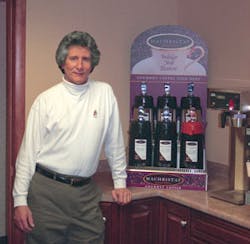
Chris Nachtrieb, owner of Chris' Coffee Service in Albany, N.Y., has weathered the changes that have battered the OCS industry since the early days of easy growth. Rising from a single-man operation in 1978 to a company that has in excess of $6 million in annual sales has been an ongoing learning experience — one that has required commitment to service, a willingness to learn new ideas, tireless focus on financial management, and a passion for coffee excellence.
Entrepreneur's success bodes well for the industry
Nachtrieb has proven that coffee service still offers opportunity to entrepreneurs willing to dedicate themselves to mastering their trade. The company has doubled its sales in the last four years in a region with a less than vibrant economy.
Automatic Merchandiser has reported for years the importance of higher quality products and equipment in the OCS industry. In recent years, delivery systems that can provide better quality and more variety have driven additional growth, but this growth has mainly occurred in markets where specialty coffee stores have raised demand for better quality coffee.
A passionate student of coffee
Nachtrieb has carefully studied these developments, and then some. Having built his business in both the office and foodservice markets, he has educated himself about all aspects of coffee, and uses this expertise as a tool for both selling and satisfying customers.
"The man is a walking encyclopedia," observed Bob Richter, co-owner of Empire Coffee Co. Inc., a roaster in Port Chester, N.Y., Nachtrieb's private label roaster. "He is obsessed with quality, service and delivering a quality product. His customers believe he's an expert on coffee, and he has earned their loyalty."
Nachtrieb first learned the importance of customer service selling precast concrete steps for single-family homes following his military service in the early 1970s. A trained welder, he was able to sell the product to homeowners knowing that he could guarantee a high level of craftsmanship — his own.
He also worked part time in a golf pro shop, where he learned about merchandising. One of his pro shop customers had a small OCS business and made him an offer. Nachtrieb would purchase all his coffee and machines from him, and at the end of six months, if he didn't want to keep the business, he could sell back all the machines and inventory.
Nachtrieb quickly realized that OCS was a growing business, so he gave up the concrete step business to start his own OCS operation. He stored coffee in his parents' basement and made deliveries in a red 1975 El Camino SS with a cap on it so the coffee wouldn't get wet if it rained while he was inside making a delivery.
The company grew largely by word-of-mouth in its first five years. Nachtrieb became active in local charities, providing free coffee at public events. While the industry was relatively young back then, these were challenging times nonetheless, as roasters were diluting pack weights to save costs.
Nachtrieb resisted these attempts and continued to sell 2-ounce OCS packs. "I don't sell coffee," Nachtrieb explained. "I sell quality and service second to none. The supermarkets sell coffee."
In 1982, Nachtrieb hired three off-duty policemen to make deliveries on a part-time basis to allow him to focus on sales.
An early private label provider
When Bob Richter and Steve Dunefsky formed Empire Coffee in 1984, Nachtrieb was one of their first customers. He saw private label coffee as an important tool in selling on the basis of quality versus price. Some competitors were underselling him by as much as $5 per case.
Even while the company was small, Nachtrieb sought foodservice accounts as well as offices. Many OCS operators shun these accounts since they demand more service and are more price-sensitive, but Nachtrieb thrived on the challenge of serving these accounts profitably.
He sometimes offered restaurants the option to purchase the brewing equipment. By doing so, he took the equipment value out of the equation, which allowed him to be more competitive with the roasters.
Nachtrieb found that many restaurants were receptive to a provider who could offer good service. The large roasters and foodservice distributors could sometimes offer better pricing, but rarely could they match his service.
High community profile proves key
Servicing restaurants also carried a certain amount of community relations value, Nachtrieb found. He always believed that a high community profile was a strong marketing advantage. He suspects this might be more critical in a smaller community like the Capital District that consists of Albany, Schenectady and Rensselaer County (population: about 500,000) than a larger metropolitan one.
Nachtrieb also made it a point to establish good relations in the local lending community.
"Banking is extremely important in business," he said. He asked lenders what financial information they were most interested in. If a lending officer wasn't forthcoming, he sought out another. He recognized that by giving lenders the right information, they offered more favorable terms.
By 1988, Nachtrieb was able to purchase an 18,000-square-foot building in an industrial park. He secured a favorable loan, thanks to some relationships he had made in local business and civic organizations.
Another big investment came a few years later when he decided it was time to implement management software. By 1990, the company had 12 employees, and keeping track of assets, employees and profitability was becoming more difficult.
Software investment pays dividends
"You need information to manage a business," said Nachtrieb, who always tried to recoup his equipment outlay in 10 months. OCS management software from Metroplex Data Systems gave him the necessary information to run a profitable operation.
Nachtrieb's historical information enables him to compare the long-term return on investment of different types of equipment. He learned early on that the lowest cost equipment isn't always the most profitable. "Any kind of parameter I want to put in, I can narrow it down by," he said of his software.
The investments in warehouse space and software were destined to pay off as the OCS business became more challenging in the early 1990s. The business was maturing, and new customers were becoming scarcer. Product and equipment suppliers were touting specialty coffee, but Albany was not quick to embrace it.
The community is not predominantly white collar, and Starbucks did not open a store there until some time in the late 1990s.
Nachtrieb tested both electronic airpot dispensers and single-cup brewers in the early 1990s. These systems required higher investments than traditional OCS brewers, and Albany did not have a lot of large office accounts that could justify these products. Nachtrieb further noted that the economics of servicing the widely dispersed accounts that characterize his market is different than in big cities. "Each market is different," he said.
But Nachtrieb did see opportunity in the foodservice segment — for espresso. He saw espresso as a way for a restaurant to make extra money. If a restaurant sold 15 espresso-based drinks per day, they could make an extra $50 per night.
"I saw the future," he said. "I always like to think outside the box. I knew who my competition was, and I knew they would never be bothered with it."
Restaurants respond to espresso
Nachtrieb offered restaurants the opportunity to lease commercial espresso brewers and held training for wait staff in his own facility. Restaurants were receptive. "You teach them how to suggestively sell," he said. "It's an education process to teach them to make money."
Servicing these commercial espresso machines created another revenue center. The company marketed its equipment service capabilities to restaurants and coffee retailers. "I saw it as a way to offset a portion of the cost for the help in the service department," Nachtrieb said.
He offered discounted labor rates, travel time charges and faster response times to those restaurants that purchased all their coffee from him, not just espresso. If they did not purchase their drip coffee from him, he would still service their espresso machine, which his competition refused to do, but they would pay a higher price and wait longer.
In 1996, Nachtrieb hosted a reception for Dr. Ernesto Illy, an Italian who is recognized as the world's leading authority on espresso. The event was held at a fine Albany restaurant, and was well attended by local restaurateurs. It received a lot of coverage in the local newspaper.
Consultant offers outside input
While espresso opened some new doors, the growth was not fast, and the mid-1990s was a slow period for Chris' Coffee Service. Nachtrieb realized that he needed more salespeople to grow, but he didn't have the time to manage more salespeople.
In 1994, he was solicited by a business consultancy which offered to provide an outside perspective on his business. Nachtrieb believed in listening to others. After researching the consultancy, George S. May International, he took them up on their offer. The company sent several representatives out to his facility to interview his employees and observe them in action.
"They basically confirmed something I knew I needed to do," Nachtrieb said. "I knew I needed to let go and empower people."
He had a route driver who was capable of running the warehouse and purchasing. The person he had running the warehouse and doing the purchasing was perfect as service department manager. An even bigger need was to have a dedicated sales manager, who could free Nachtrieb to oversee the whole company.
Key change: empowering employees
Making these changes wasn't easy, as many employees, including Nachtrieb, were comfortable doing what they were used to. But once he explained to everyone what the goals were, the employees supported them. The changes increased employees' job satisfaction and productivity.
"If you don't empower people, you're not going to grow," Nachtrieb said.
The sales manager position was particularly critical. Paul Johnson educates the salespeople on the products and on how to sell them.
"You've got to know what your customers are going to ask you before they ask you," Nachtrieb said.
To succeed, they need to have products that will generate sufficient commissions. The high-ticket, commercial espresso machines were key selling incentives to the salespeople, in conjunction with the other products and services.
The company pays its salespeople commission based on gross profit and collections, not sales. Route drivers and inside salespeople are paid on a similar basis: part salary and part commission. Management meetings are held weekly.
Reliability of service has been a key to the company's success, Nachtrieb said. The company calls OCS accounts in advance of delivery, or faxes them an order form to send in.
As the company grew, so did its ability to win business.
Key step: Internet selling
Nachtrieb's expertise in espresso proved especially helpful when he expanded into Internet sales, an area that has seen the fastest growth for his company in the last four years. Nachtrieb first launched a website in 1999 simply as a way to enhance credibility. He had his teenage son, Christian, develop the website, www.chriscoffee.com.
Nachtrieb soon realized that he needed a better website if he wanted to update it frequently without incurring excessive costs, so he hired a professional webmaster.
In the meantime, he began surfing the Internet to learn more about the coffee industry. He quickly discovered that the Internet provided various forums for coffee lovers to compare experiences on all aspects of coffee, and that all types of products were being sold online.
One day, a broker asked him if he would take a look at a new line of semicommercial espresso machines he was representing. Nachtrieb asked him how many he had, and purchased all 30 machines. Nachtrieb then posted photos and a description of the products on his website just to see what would happen.
Nachtrieb also wrote about his espresso machines on websites such as coffeegeek.com and home-barista.com. When espresso lovers offered favorable testimonials about his espresso machines, he received orders. He realized that the homeowner espresso drinker was willing to pay for high-quality machines, and they were interested in buying products from people they felt they could trust.
The Internet, he realized, offered not only a sales forum, but a way for marketers to communicate in greater depth with customers. For a product that required a high level of customer confidence such as an espresso brewer, the Internet was a great tool.
"It (the homeowner espresso market) is much bigger than I ever imagined," Nachtrieb said. "People who enjoy espresso are tired of getting lousy drinks at restaurants, so they buy a $1,000 and up machine for the house."
Internet offers new opportunity
Nachtrieb noticed that other websites selling espresso machines did not offer good aftermarket support, which was important to espresso users. He offered a 30-day full refund policy and made it a point to respond to all e-mail inquiries he received about his offerings. He developed a reputation among espresso lovers as a reputable source.
As Nachtrieb's Internet sales increased, he hired more service techs to provide aftermarket support.
Recognizing the market for home-owner espresso machines, Nachtrieb decided to design his own machines based on user comments. He was able to pinpoint design flaws in existing machines, such as plastic fittings and circuit boards placed too close
to boilers.
"They (customers) give you a road map," Nachtrieb said. In the past two years, he has had two machines custom built by a manufacturer in Italy, and has three more on the way.
The homeowner units he sells have price points in excess of $1,000. He also sells grinders, coffee and accessories.
He noted that 35 percent of his Internet sales, which average 250 pieces per month, are from California, where espresso is most popular.
Nachtrieb now sends a quarterly e-mail newsletter to his customer list of more than 10,000 to introduce new items and unadvertised specials. He recently assigned his accounts receivable manager, Mary DeLong, the additional role of Internet sales manager.
Nachtrieb seeks espresso distributors
Nachtrieb sees the Internet as his best short-term growth opportunity, and is seeking distributors to stock and resell his espresso machines.
Because his espresso orders result in a lot of leasing activity for lending institutions, he is also exploring his own equipment leasing company.
In the meantime, Nachtrieb sees continued growth in the foodservice segment as more restaurants become interested in espresso. He is in the process of installing a micro roaster to roast coffee for foodservice accounts. He said many foodservice customers prefer buying from a source that roasts its own coffee.
The office market continues to be challenging, Nachtrieb said, since operating costs are rising and the number of offices with viable populations is not increasing in his area.
He acknowledged that manual pod machines have created some new opportunities for OCS, but he is uncertain that they offer a significant enough economic advantage over the pourover Keurig brewer. His new micro roaster may provide the means to produce coffee pods for the new manual pod brewers.
In the meantime, Chris' Coffee Service continues to expand in all of its business segments — offices, foodservice and Internet sales — due to the company's hard-earned reputation as an expert on all things related to coffee.
"All businesses nowadays have to be progressive," Nachtrieb said. "You have to be willing to make changes. There's no magic answer for the next 10 years."