Interior Truck Layout: DIY Versus Hiring A Specialist
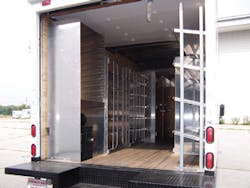
Customizing the interior of a route vehicle to maximize the efficiency of inventory handling is an important element to running an efficient operation. To do this, operators often debate doing the work themselves or utilizing the services of vehicle design specialists.
Whether working with a professional or designing the interior on your own, the first question is, "How much inventory do you need to carry?"
First consideration: Soft drinks
The layout of the interior hinges on the volume of beverages an operator will move on a route. "It all centers around the drinks," Mike Pearson, national sales manager with Hackney Specialized Vehicles Corp., said. Soft drinks take up a lot of room and need to be located for a good weight distribution. A simple rack won't do when there is a mixture of 12-ounce soda cans, 6-ounce Red Bull cans and 16- and 20-ounce soda and water bottles on the same set.
Design specialists encourage operators to only carry what they need on a vehicle. It minimizes weight and extends the life of the truck. "On the majority of routes, over 200 cases is wasteful," said Drew Lindsey, a sales engineer at Equipment Innovators.
"Not only because of the weight factor," he said, "but with today's incredibly thin can walls, proper inventory turnover is one of the essentials to prevent nasty leaks.
"We work very closely with operators to determine their true capacity needs and then design the body so that proper weight distribution is achieved," Lindsey continued. If there's too much weight on the front end of the vehicle, it will wear it out prematurely. If there is too little weight, the vehicle will bounce and the tires will wear early."
Step two: Snack shelves
After the number of beverage racks is determined, the snack shelves are considered. The amount of shelving required will again depend on the quantity of product and variety the company plans to transport.
Chips, for instance, are light. They won't affect the center of gravity or hurt the driver's back, so they can be stacked on higher shelves.
Operators also need to consider if they plan to transport perishable product (which will necessitate coolers) and other items such as office coffee service products and carbon dioxide canisters.
Lindsey recommends a candy cooler be considered for chocolate so operators won't get a "blooming" effect. Blooming, according to chocolate maker Ghirardelli, is the result of temperature changes (i.e., cold chocolate put in a hot environment or chocolate slightly melted that's been cooled quickly).
A place for a hand truck should also be added, so it isn't rolling around the back.
Serious Miscalculation: gross vehicle weight Estimate
The biggest mistake operators make is underestimating their vehicle weight requirements. "As far as GVW (gross vehicle weight) — 10,000 pounds is the low. The average vendor uses 14,000 to 16,000 pounds," said Tony Cox, owner of SpecialtyTrux.
Pearson of Hackney added, "That's where vending people have the most trouble. They overload the trucks." The tendency to get a smaller vehicle because it's cheaper, then to overload it causes wear and tear on everything. "It wears on the chassis, brakes, transmission, and lots of money is spent on repairing," he said.
A truck filled with enough product for a profitable route will weigh more than 10,000 pounds. "What most of our vehicles are and what we recommend is the 14,500-pound GVW rating," said Pearson, although "an office coffee operator can get away with a smaller vehicle."
Cost and configuration control
Cost and the ability to control the configuration of the space are the two major concerns operators shared about getting a "professionally" customized vehicle interior. But beyond these issues, each operator does something different when it comes to installing an interior.
"We make our own configurations," said Joshua Koritz, owner, Dynamic Vending, St. Louis, Mo. Even when Koritz ordered a brand new truck for one of his 55 routes, he planned to customize the inside in-house.
"The manufacturer's price is too high," he said. "We have a full-time mechanic who does the engine and everything. We draw up something and say we want to maximize space. They're not always beautiful, but they work." Dynamic Vending builds its own racks and shelves; although for a cooler, Koritz did purchase an Omnicube.
He also configures 99 percent of his trucks the same way to improve efficiency. If a truck breaks down and a driver has to use a different vehicle, he or she still knows where all the product is located and doesn't lose any time searching for it.
Don McDaniel, McDaniel Snack & Vending, operates seven routes from Albertville, Ala., and buys components from the suppliers for most of his vehicles. "We're installing Hackney beverage racks (and) use Omnicube coolers," said McDaniel. The beverage racks were chosen because they can hold cans and bottles, providing McDaniel with the ability to allocate the quantity of cans and bottles as he sees fit.
Although McDaniel buys the kit from suppliers, he still has the installation done in-house. He purchases most of his vehicles used and feels it makes more sense to buy kits to put into them, as opposed to sending a used vehicle to a manufacturer to get customized. "If we buy a new truck, that's when I let the manufacturer do it," he added. "In the end, we probably don't save money because of labor costs. It probably takes us longer than the manufacturer, but we get exactly what we want."
Randy Munn, director of sales and marketing, CL Swanson Corp., Madison, Wis., said, "We do the customization because it's significantly less expensive, and we can get the exact specification we want. Route drivers have input into what they need and what will make their job easier," he added.
Munn said years ago he built the shelves out of wood, but now he goes to Menards and Home Depot for shelving and anchors it to the vehicle walls. Installation takes a good two hours or so.
For Doug Fezell, chief bottle washer, a.k.a. president of Professional Vending Service, Greenville, Tenn., there is value in having the supplier customize it. "We wouldn't put in the shelves or design the system ourselves. It's all we can do to keep the vending part up. I wouldn't want to install it." Instead, for his seven routes, he had Equipment Innovators design a system for the interior of his vehicles.
"We started prekitting about four years ago," said Fezell, "so the equipment in the van needs to hold the totes."
Equipment Innovators offered to customize a truck to accommodate a system to hold the totes as well as space for refrigeration.
"We shipped them (Equipment Innovators) some containers with approximate amounts of what we needed to haul, with room for growth and estimates for the number of drinks," said Fezell. The engineers responded with quantity totals for what he could haul, including room for cleaning supplies and other nonproduct essentials.
Manufacturers cite benefits of customization
Lindsey at Equipment Innovators understands operators just starting out have limited capital, but he sees that as a reason for them to buy a customized vehicle, not a reason not to. "We help arrange the interior of the vehicle so it can grow with the business," he said. A vehicle with fewer racks, room for refrigeration or a less expensive cooler using ice packs means the same vehicle can be used for years by adding more racks and changing out cooler options.
Homemade shelves, often made out of wood, are not easy to clean, added Lindsey. The wood absorbs smells and stains — not to mention that in certain markets, it is not permitted to keep food on wood shelves. To transport or change the configuration, you have to dismantle the lumber and rebuild, unlike industry-specific shelves where a simple loosening and retightening of a few bolts gives the adjustments needed.
"Our product can be transferred to new vehicles when the truck wears out, or for expansion. It's more practical in ease of use and cleanability," said Lindsey. Also, some operators have won accounts because of the professional appearance of their interior. "It says — ‘we made an investment in our business. We have a truck to service your account," said Lindsey. For the serious business owner, the image to a customer is important.
SpecialtyTrux has operators fax a sketch of what they want. "We might talk back and forth three, four or five times before the work begins," Cox said. He then chooses shelves he's had fabricated in a sheet metal shop. "You can't buy the kind of shelving you need from those places (home improvement stores), he said. "It's trial and error. We've learned how to do it."
"They can get by with it," said Pearson about DIY (do-it-yourself) shelves, "but we feel like the aluminum shelving is infinitely more adjustable because it's on slides. If the packages of snacks or drinks change, you can reset them. They are flexible."
Pearson recognizes that often it is price that lures people to build their own shelves, but this can prove costlier in the long run. According to Pearson, if the operator took into account the time to go to the lumberyard and build the shelves, along with the cost of materials, the operator would realize he or she isn't saving any money. "Also, aluminum shelves are better for the GVW.
Wood shelves weigh more, using up GVW with wood," he concluded.
Operator cites Incremental savings
Fezell claims the incremental costs of each part, the workers' compensation, the efficiency, the gas mileage, the vehicle maintenance costs, etc., all add up. "If you don't analyze the big picture, then you're not going to save," Fezell said. In fact, even with the higher initial investment, Fezell is convinced he's seen savings within the first year.
Cabs aren't customized
Operators and suppliers agree that very little is done to the vehicle cab. "I give them a radio, and now air conditioning because they (the drivers) came in looking like melted candy bars," said Koritz at Dynamic Vending in St. Louis, Mo.
Fezell said, "The drivers don't spend much of their time in the cab, hopefully. I have air conditioning and heating." He wants to make the driver's job as easy as possible, but feels there's little value in cab accessories.
Roll-up side doors, cost versus Convenience
Cox at SpecialtyTrux said he's gotten more requests for roll-up side doors in the last three to five years, but when the operators hear the price, some balk. "It costs around $2,000 to have two doors put in," he said. "And a lot of it has to depend on how the warehouse is set up. If the warehouse has a low dock, it's a disadvantage because the driver has to get off the dock to load from the outside."
Pearson at Hackney argues that the new trucks with the side doors are more efficient, ergonomic and safer. "Putting shelving systems in existing trucks is better than nothing, but you're going to get the full benefits when you have the roll-up side doors," Pearson said. The racks and shelves that Hackney sells are the same design as ones installed on new vehicles.
He has noticed a trend in demand for the custom trucks with roll-up doors. "Our strongest showing is in the medium-sized vending companies. They see the efficiencies. You can save (and this isn't our number, operators have told us this) one to one and a half days at least running this type of truck on a route. Seven trucks can do the work of eight."
Pearson added that there is also a big demand from small companies with few routes because often the owner is running a route and sees the benefit firsthand.
Refrigeration: up and coming
Although coolers are expensive, they are becoming more important in finding and keeping business.
Munn of CL Swanson said, "I believe it's important for milk and other perishable items during summer conditions."
McDaniel also feels refrigeration is important. "We installed candy and cold coolers on every truck," he said. "We use the Omnicube for that." McDaniel also has one truck that powers up at night. It has an isolated cooler inside with a permanent cold plate.
A major problem with typical refrigeration is when the driver opens the cooler, the temperature inside rises. Identifying this problem, Equipment Innovators came up with a combination unit. "We've reduced the amount of heat gain by doing two things," said Lindsey. There's a chocolate compartment, which is usually opened at every stop, and a separate food compartment that might only be opened four or five times on an average route. A freezer compartment is also available if needed.
Furthermore, to allow the driver to more quickly remove food (getting the door open and shut faster), there is a track system that holds trays, either those made by Equipment Innovators or those from commissary or food providers. The trays slide in and out for speed, but also allow the prepacking of food by location or machine.
Dave Coots, vice president of operations for Williams Food Service, Louisville, Ky., said his company is investigating new models of Omnicubes that allow one portion of the chamber to be opened without opening the whole inside. They would use the combination unit by reorganizing their routes to form dedicated food routes. "The concept is sound. That (dedicated food truck) could be a good thing. The technology is just much better than it was 15 years ago."
For operators looking for larger coolers, Hackney offers integral, built-in refrigeration compartments with capacities of 57 to 90 cubic feet. Designed with a cold plate that plugs in at night, they stay cold all day without an outside power source. The design is available in flow-through, walk-in and can have split cooler and freezer combinations.
Future Custom option: vehicle Tracking
One item SpecialtyTrux will soon be offering its clients is a global positioning system (GPS). "We're working on a deal with a company that will lease the systems to the operator," said Cox. The benefit would come from analyzing where the truck has been, how long it was parked, etc., to increase efficiency as well as record suspicious activity.
In the end, customizing the interior of a vehicle with high-quality material meant to take a beating, hold the weight and adjust to a growing business will save cost in the long run. Between product poundage, route driver ergonomics and efficiently servicing a route, a well-designed interior is worth its price. A last parting thought from Fezell: "You've got so much square footage — whether in a truck or the vending machine — so you need to maximize space for sale."