Operators Slow to Invest; Sales Rise 3 Points in 2005
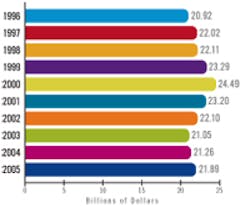
The automatic merchandising industry stands at the bottom of a ladder, ready to climb, but barely moving. The ladder is firm, the rungs all in place, yet the industry hardly raises its foot to take the first step.
Automatic merchandising industry revenue increased by 3 percentage points in 2005, building on a slight movement that began in 2004.
Vending again trailed overall foodservice industry, which grew 5 points, and the convenience store industry, which saw foodservice sales rise by 14.2 points, according to industry sources. Given the competitive pressure, the vending industry continues to lag the competition in a market that promises to remain challenging unless operators become more aggressive about investing in new tools.
There is a variety of tools available to vending operators to improve sales and profitability that operators, for the most part, have not embraced. Tools exist to enhance efficiency and improve sales, such as remote machine monitoring, electronic cash audit, electronic locks and cashless capability. Yet few operators were able and/or willing to make the necessary investments in equipment, training and salaries that will allow them to utilize these advantages.
In the meantime, the operators' fortunes rest mainly on external economic forces, which in the short term can be described as non-threatening, but not generous.
Last two years: work site downsizing ebbs
The best news for vending operators in the last two years has been an end to the employee downsizing that characterized the previous three years. The U.S. economy gained 4.5 million jobs from June of 2003 to November of 2005, according to the Department of Labor.
Vending operator sales posted a 3 percentage point increase 2005, pushing aggregate industry sales to $21.89 billion.
Aggregate sales improved a total 4 percentage points in 2004 and 2005, which hardly compensates for the 14 points lost in the previous three years, when operators pulled machines by the thousands out of locations suffering declining head counts.
Operators took comfort in 2004 and 2005 that locations stopped shedding employees, but work site populations did not come close to pre-2001 levels.
Manual foodservice leads other segments
The 2006 survey found that in 2005, vending operators continued their efforts to raise prices that began in 2004, but once again these efforts did not bear much fruit, as average retail vend prices rose only slightly. A disproportionate amount of the aggregate sales gain in 2005 came from manual foodservice.
This marked the fourth consecutive year that manual foodservice was the largest revenue producer. This finding was consistent with data from the National Restaurant Association, which reported a 14.2 percentage point gain for food and beverage sales for managed services from 2003 to 2005.
Changing work sites don't help
Changes in the nation's work force have hamstrung the vending industry's ability to increase revenue. While the nation's employment has improved since the post 9/11 period -- with unemployment staying below 5 percent through 2005 -- much of the improvement has occurred in sectors where vend product consumption is traditionally less than in blue collar manufacturing accounts, the vending industry's main customer base.
White collar employees typically buy less from vending machines than blue collar workers because they usually have more time for meals and are less inclined to remain on-site.
As technology, finance, health care, distribution and education industries grew at the expense of manufacturing, the market has become more challenging for vending operators.
As the economy becomes more diversified, the non-blue-collar locations have assumed a bigger share of the work force, reducing vending operators' per-location sales and profits.
The Wall Street Journal reported that manufacturing jobs declined by 0.5 percentage points in 2005. By contrast, construction jobs rose by 4.3 points, health care by 2.4 points, leisure and hospitality by 2 points, finance by 1.3 points and education services by 1 point.
The automotive sector, a large manufacturing segment that generates work for thousands of companies, suffered its second straight flat year in 2005, according to the Detroit, Mich.-based Automotive Information Center.
Vending still lags foodservice
While work site demographics have grown less favorable for vending, competing foodservice segments have become more aggressive in seeking consumers' away-from-home spending, reducing the likelihood they will remain on-premises for meals.
Quick-serve restaurants, convenience stores and specialty food and beverage retailers have all expanded at a steady clip in recent years, giving consumers more options than ever for meals and refreshments.
Quick-serve restaurants posted a 4.8-point sales gain in 2005, while convenience stores' in-store foodservice sales jumped 8.9 points, according to industry sources.
Unlike vending operators, many convenience foodservice retailers have upgraded their product offerings, offered creative point-of-sale promotions, and introduced cashless transaction capabilities, all of which allowed for higher prices.
Hence, the commercial foodservice industry as a whole, unlike vending, has been able to take advantage of strong consumer confidence.
The Conference Board, which studies economic trends, reported that consumer confidence levels were high during most of 2005, despite a temporary decline reported following Hurricane Katrina.
The vending industry performed slightly better in 2005 in comparison to the foodservice industry as a whole, but foodservice outpaced vending for the third consecutive year.
Foodservice posted a 5-point aggregate revenue gain in 2005 following a 5.5-point gain in 2004 and 4.4 points in 2003, according to the National Restaurant Association.
The State of the Vending Industry Report did not measure profitability, but other information indicated that operators continued to be challenged in this area.
The National Automatic Merchandising Association's Operating Ratio Report, which tracks financial operating ratios, reported participating members' average pre-tax profit in 2005 at 1.5 percent of sales. While slightly better than 2004's 1.2 percent, vending operator profits remained challenged during the post 9/11 "recovery" period. Pre-tax profit was in the high single digits in 1998 and 1999, by contrast.
NAMA noted that return on assets -- profit before taxes expressed as a percentage of total assets (ROA) -- posted some improvement in 2005 following two years of decline.
The 5.1 percent ROA was the first time in three years it exceeded 5 percentage points. In most industries, a 5 percent ROA represents the lowest level of acceptable return.
Smaller firms gain market share
The NAMA survey and the Automatic Merchandiser survey both reported stronger sales growth among smaller firms; those with less than $1 million in sales. This marked a change from earlier trends. In recent years, the largest firms -- those with sales of more than $10 million -- steadily increased their share of the total market at the expense of smaller firms.
In recent years, the extra large firms have been able to leverage their advantages, such as being able to provide better equipment, use more advanced software, pay better salaries and have more professional marketing tools.
Extra large firms have the ability to offer a wider variety of services, particularly manual foodservice, which has accounted for the largest share of the industry's volume in the last five years.
Extra large operators lose market share in 2005
But 2005 marked the first year in many that the extra large firms did not gain market share. The Automatic Merchandiser survey, which includes a much larger sample than the NAMA survey, found that all firms other than the extra large firms increased market share in 2005, as indicated in chart 2.
The NAMA survey reported that firms with less than $1 million in sales increased sales in the high double digits in 2005 and were the only revenue group to grow in double digits.
One explanation is simply the fact that the extra large firms, which have grown at the expense of other operations in prior years, were unable to continue to win market share.
One reason for this is that the number of large locations has declined in recent years. While employment has increased, labor experts claim more people are working for smaller companies. Technology has made it possible for companies to get more done with fewer people.
Rising operating costs have made it harder for operators to make money in accounts with less than 100 people. Larger operators have higher overhead and thus higher minimum revenue requirements.
The State of the Vending Industry Report noted in recent years that extra large operators responded to the decline in large work sites by expanding into smaller locations. This accounted for the decline in market share of large ($5 million to $9.9 million) and medium ($1 million to $4.9 million) and small (under $1 million) operations in 2004, the report claimed.
In 2005, extra large operations were apparently unable to continue their expansion into smaller work sites.
Operators still slow to invest in technology
Operators have yet to take advantage of some new technologies that offer the vending industry significant growth potential. Remote monitoring and curbside polling offer the ability to schedule service at the most opportune time, increasing per-stop collections and improving return on labor.
Cashless card readers offer the ability to improve customer satisfaction, offer higher priced products and improve machine level accountability.
Line-item tracking allows operators the chance to meet customer demands more accurately and better determine the most popular selling products.
While these technologies offer significant potential, the operator base has barely begun to invest in most of them due to the high capital required, the need to integrate new hardware and software with existing management systems, and the lack of proven return on investment (ROI) for many of these products.
The last new technology that made a big difference to the vending industry was the bill validator, which was a much easier technology to accommodate. The industry adopted this within a few years after its introduction in the early 1980s.
Technologies require compatible hardware and software
To introduce remote monitoring and/or curbside polling, operators need to have machines that are DEX capable, as well as hardware and software that supports this feature.
Depending on the route accountability software used, and the extent of the software features/modules used, operators need to be sure remote data collection software is compatible with existing systems.
Operators using spreadsheets or custom-designed systems may find it easier to rely solely on the remote data collection software or in concert with their existing system.
To introduce cashless capability, an operator needs an MDB-capable machine in addition to the card reader.
Survey examines DEX use
To determine how close operators are to adopting these technologies, the survey asked several questions about computer use. The survey found that 35 percent of all operators are currently using DEX to some degree.
Forty one percent said they do not use DEX but intend to use it in the future, as indicated in chart 5f. Thirteen percent said they have no plan to use it while 11 percent were not certain.
Technology suppliers estimated that between 10 to 20 percent of the operators have all of their machines DEX capable. The suppliers estimate that about 60 percent of the machines in the field are DEX capable.
Last year's report noted that larger operators were in a better financial position to invest in technology that could improve operating efficiencies and offer better customer service.
This year's report found that while few operators are utilizing the newer tools, such as remote machine monitoring, curbside polling, DEX handhelds and cashless systems, the assumption that technology benefits the largest players has not proven completely correct.
Large vendors lead move to cashless
Technology suppliers noted that the larger operators are not leading the growth in every area. The only technology where larger operators clearly outpaced smaller ones is in cashless capabilities.
The survey found an increase in the percentage of accounts equipped with credit and debit card readers in 2005, as indicated in chart 5g. Larger operators accounted for most of this activity.
In remote data collection, however, the larger operators were not the main buyers.
There is a key difference between cashless capability and remote data collection that explains why larger operators might be more inclined to invest in the former and not the latter.
An operator can realize immediate benefits from installing a cashless reader, whereas remote data collection will not yield significant savings unless the majority of machines on a route are equipped with remote data reporting devices.
Larger operators have more machines to equip and cannot accommodate remote data collection without a large upfront investment.
Smaller operators, on the other hand, can incorporate remote data collection fairly quickly and use it to distinguish themselves in the market place.
Health concerns increase
Health and nutrition continued to be a major consumer issue in 2005, much to the vending industry's dismay. The consumer media continued to attack the food industry as government officials called for more restrictive nutrition rules.
While schools did not account for a big percentage of vending sales, the public attention made consumers more aware of the nutritional content of vending products, bringing more requests for healthier products.
The National Automatic Merchandising Association took a proactive stance with its nationally publicized Balanced for Life initiative early in 2005. This helped counteract the negative publicity that some government officials and consumer advocates directed at the industry. It also gave vending operators a way to support nutrition education in their communities.
The survey did not indicate an increase in healthy product sales with the major exception of bottled water, and to a lesser extent, milk and some snacks.
Vending operators faced a unique challenge in responding to these requests due to the limited number of facings they can offer compared to other retail venues. However, operators noted that manufacturers offered more products designed to meet stricter nutrition standards, and more better tasting products.
About the survey
Survey participants were limited to full-line, candy/snack and self-operated vending businesses that sold candy, snacks, confections, cigarettes, hot beverages, cold beverages, refrigerated food, frozen food, ice cream and manually served food. The sampling did not include music and game operators whose main business was not consumable merchandise, soft drink bottlers whose main business was not vending, or ice cream distributors whose main business was not vending.
Aggregate revenue and equipment figures for the report were based on a total operator universe of 9,000 vending operations in the U.S., along with data from government, product suppliers and equipment suppliers.
For the third straight year, Pittsburgh, Pa.-based
Management Science Associates (MSA) Inc. provided input on vending sales for the State of the Vending Industry Report. MSA receives machine level data from Validata Computer & Research Corp. with the goal of analyzing machine activity.
VendScape® machine level sales measures are available through MSA and operational measures through Validata. MSA uses several data sources to report market-wide industry performance. The projected database, ProVen™, is now available through IRI.
The State of the Vending Industry Report's revenue and equipment figures include machines operated by business locations for their own use, known as in-house and self-operated machines. This portion is estimated to be about 5 percent of the total industry.
Following is a more detailed analysis of the major product segments.
Cold beverages grow
Cold beverages were among the better revenue producers in 2005, thanks to the dominance of PET bottles, which command a higher selling price, over cans in recent years. Some of the revenue gain for the segment was also due to higher pricing, although this did not necessarily reflect improved profitability.
The growth of bottles over cans began to subside in 2005. The growth leveled off in 2004 at 76 percent of total beverage sales.
Bottle growth starts to slow down
The NAMA operating ratio report indicated that bottles actually lost a few market share points to cans in 2005. The NAMA report indicated that bottles suffered a 1.4-point decline while cans posted a 1-point gain.
Many vending operators prefer cans to bottles because they are easier to work with and are oftentimes more profitable on a per-unit basis.
Both reports indicated that cold cups continued to decline as a percent of cold drinks sales in 2005.
The 2.28 percentage point gain in cold drink revenue in 2005 marked the second consecutive year for growth in this category, following three consecutive years of loss. This reflected the overall trend for vending sales, although cold drinks at a 2.28-point growth rate did not keep pace with total revenues, which grew 3 points.
Operators noted that competitive pressure kept a lid on price increases in the beverage segment. Supermarkets and other retailers continued to use cold beverages as loss leaders and advertised the low pricing to lure customers into their establishments.
The 2.28-point gain also indicated that vending operators did not match the performance of cold beverages in all retail channels; total retail sales for soda, fruit beverages, ready-to-drink tea, sports drinks and energy drinks rose 2.5 points in 2005, according to beverage industry sources.
The proportionately lower increase in vended cold drinks compared to other retail channels reflected overall foodservice trends in 2005.
Vending lags retail in offering beverage variety
Another reason that vended cold beverages failed to match the overall retail performance is that the vending channel was not able to keep pace with the rising variety offered in other retail venues.
Non-soda categories represented disproportionately higher sales for retail cold drinks sales in 2005, according to The Beverage Marketing Association, which tracks cold drink trends. Regular soda gallonage actually declined by six-tenths of a percentage point in 2005, while energy drinks jumped 80.6 points; sports drinks jumped 20.6 points; bottled water gained 10.7 points; ready-to-drink tea, 2 points. Fruit-based drinks declined 1.63 points.
Non-carbonated drinks have lost market share at the expense of carbonated drinks in recent years.
In 2005, carbonated drink consumption posted its first decline ever since tracking began in 1985, according to beverage industry sources.
Glassfronts keep expanding
Glassfront cold drink machines, the most common tool operators can use to increase product variety, continued to expand at a steady clip in 2005, as indicated in chart 6a, but remained only 1.2 percent of all machines.
Vending operators will need to invest in more glassfronts if they hope to keep pace with other retail competitors. Operators using glassfronts agreed they improved sales, but they also required more frequent service. Hence, glassfronts only made sense in larger locations.
Glassfronts also have higher stocking requirements since they require more product variety.
Candy/snacks/confections grow again
In 2005, candy, snacks and confections sustained the improvement they posted in 2004, following a devastating setback in 2003. This segment, at a 2.8-point revenue gain, almost kept pace with the overall industry growth rate. However, most operators reported higher cost increases in 2005 than in 2004, meaning the segment was more challenged from a profitability standpoint.
Operators reported that some of the largest product suppliers increased prices twice in 2005.
The price increases were particularly noticeable in the candy category, the largest segment in the candy/snack category. One way operators were able to raise prices was to replace traditional size candy bars with large size bars that were introduced in 2004.
The top selling candy/snack/confection products did not change significantly in 2005, based on data provided by Management Science Associates, which tracks machine-level sales. However, many operators reported changing suppliers in order to minimize their exposure to higher prices.
Many operators noticed that requests for healthier products increased in 2005, building on a movement first reported in 2003. While most operators did not find any significant difference in the type of products purchased, they gave manufacturers high marks for improving both the variety and quality of health-oriented products in 2005.
The public's demand for healthier products encouraged product manufacturers to introduce more products with less trans fat, fat or carbohydrates, and fewer calories.
Product introductions increase in 2005
The number of candy/snack product introductions jumped close to 30 percent for the second consecutive year in 2006, as indicated in chart 7e.
Machine level sales data from MSA indicated that some products typically identified as healthy increased placements in 2005, but others did not, as indicated in chart 7b.
Meat snacks once again posted a double digit sales increase in 2005. This marked the third consecutive year this category increased sales. The growth for this product has been attributed to the popularity of low-carbohydrate diets.
However, not all products that fit low-carbohydrate diets performed well in 2005. Nuts and seeds, which increased sales the previous two years, declined 3.94 points in 2005.
Caution urged in evaluating 1-year changes
In reviewing the performances of the various categories, operators should keep in mind that 1-year changes do not necessarily reflect changes in consumer behavior. Oftentimes, category changes simply reflect new product introductions or promotional offerings.
In reviewing the category changes, operators should also consider the category's sales volume. The smaller the volume, the bigger the change will be on a percentage basis.
While candy bars posted a sales decline in 2005, chocolate candy actually increased slightly while non-chocolate candy, gum and mints all declined, as indicated in chart 7b.
Baked goods, another category that witnessed some cost increases in 2005, also posted an overall gain in 2005. Cakes and brownies, cereal snacks, donuts, honey buns, toaster pastries and pies all increased sales. Crème-filled cakes, Danish, muffins, regular cookies, sweet rolls and unfilled cookies all lost sales.
The pastries and cookies in this report do not include freshly-baked items that operators prepare themselves or purchase from local bakers.
Nutritional snacks posted a 2.71-point increase. Within this category, fruit snacks and granola bars both posted double digit gains, while breakfast bars, cereal, functional bars and trail mix all decreased.
Hot beverages decline subsides
The decline that hot beverage vending suffered during 2001 through 2004 largely subsided in 2005, but the segment did not post much recovery. The number of hot beverage machines fell again in 2005, but not nearly as much as in the previous five years. The elimination of tens of thousands of hot drink machines from 2000 to 2004 was driven mainly by the fallout in blue collar locations.
The slight gain in manufacturing locations in 2005 helped vending operators in the hot beverage arena, but the changing demographics in manufacturing is minimizing the improvement. Blue collar manufacturing is declining in relation to the growth in distribution and light assembly accounts, which employ fewer people.
Higher prices helped the hot beverage segment a little in 2005. The average price for a regular cup of coffee increased by 1.6 cents in 2005, which indicates operators raised prices, but not much. This increase was even less than the average 3-cent gain posted in the previous year, which was small compared to the gains in retail coffee prices.
Regular coffee as a percent of total hot drink sales declined in 2005. This indicates that other varieties grew market share at the expense of regular coffee, which is consistent with trends in other retail channels.
The gain reported last year for specialty coffee (the combined total of fresh brew and freeze-dried specialty coffee) decreased slightly in 2005, while fresh-brew decaf and hot chocolate both gained several points.
The economics of hot beverage vending has prevented vending operators from capitalizing on the growing demand for specialty coffee, which has revived coffee sales at retail and even in the office coffee service (OCS) sector. Vending machines designed to meet this demand with more product selections carried higher costs. Operators faced having to invest more money in locations with fewer employees in hopes that a better product selection would improve sales.
Another factor limiting hot beverage vending is competition from OCS. The OCS portion of the vending business was one of the strongest growth areas in 2005, and some of this growth undoubtedly came at the expense of hot beverage vending.
Because of the lower investment required for OCS, vending operators who provided OCS often opted to install an OCS brewer, especially if the population was not large enough to yield a good rate of return on a hot beverage vending machine.
The survey did not ask about the use of branded hot beverage equipment, a tool that the national vending operations have been using for several years. The nationals have claimed that branded machine fronts improve sales.
Informal interviews indicated that few operators are utilizing branded hot drink equipment.
Vendors slow to capitalize on specialty coffee
While the popularity of specialty coffee has revived consumer interest in coffee, the growth has been monopolized by retailers who increasingly target the away-from-home audience.
The National Coffee Association (NCA) reported for the past two years that more at-work coffee is being brought in from outside of the work place. This indicates coffee retailers are winning sales from both OCS and vending operators.
The NCA, which conducts telephone surveys with consumers, found that coffee consumed at work posted a 5-percentage-point gain in a recent 3-year period. More importantly, the percentage of at-work coffee brought from outside the office increased to 45 percent in 2005 from 43 percent in 2004 and 36 percent in 2004.
Large coffee retailers became more aggressive on the coffee front in 2005. Some of the national fast food chains introduced new coffee products supported by major media advertising and free coffee samplings. One even offered customers free taxi rides.
Convenience stores also continued to market coffee aggressively in 2005. According to The National Association of Convenience Stores, retail sales of dispensed hot beverages in convenience stores increased from $5.2 billion in 2004 to $5.47 billion in 2005, a 14 percentage point jump.
OCS outpaces vending
OCS was one of the strongest growth areas for vending in 2005, which makes sense, given the fact that the OCS industry as a whole recovered from the recent recession faster than the vending industry.
The OCS portion of the vending industry grew 12.6 points in 2005, more than twice the rate of the dedicated OCS industry, as reported in the Automatic Merchandiser State of the Coffee Service Industry in July. However, the increase for the vending industry was based on a significantly smaller sales volume. The smaller the sales volume, the greater the percentage point gain for any increase in dollar amount.
The State of the OCS Industry Report included sales of dedicated OCS operators while the State of the Vending Industry Report includes vending operators' OCS sales.
The State of the Vending Industry Report did not ask if operators raised OCS prices in 2005, which could have had a significant impact on their OCS sales. There is a good chance that vending operators did raise OCS prices since the vast majority of OCS operators raised prices in both of the last two 12-month periods.
There are other reasons for the disparity. The two reports measured different 1-year periods; the OCS report included the last half of 2005 and the first half of 2006 while the vending report tracked 2005.
Last year's State of the Vending Industry Report noted that OCS operators were quicker than vending operators to utilize new tools to enable them to capitalize on the consumers' preference for better quality coffee, such as specialty coffee and single-cup brewers.
In 2005, more vending operators reported using single-cup brewers than in previous years.
Vend food erosion subsides
Vend food witnessed its first sales increase in six years in 2005, due mostly to the ebbing of location downsizing that undermined food accounts in the previous five years. The 2.9-point sales gain came closer than most segments to matching the industry's overall 3-point increase.
The subsiding of account downsizing was particularly important to the food segment, since only larger locations can support food machines.
The total number of food machines increased by seven tenths of a percentage point in 2005. A more important factor contributing to the revenue increase, however, was the average price increase for all types of food products, as indicated in chart 9c.
Operators usually find it easier to raise food prices than snack or beverage prices since there are fewer items where consumers can make price comparisons with other retail offerings. Operators can also change their food offerings more easily than snack or beverage products since they buy them in smaller quantities.
While there are certain core menu items that operators need to sustain food machine turns, operators preparing food from scratch can easily adjust their core items, which in turn enables them to raise food prices faster than other vend product segments.
This does not mean that consumers are not price sensitive about food products. Operators reported there were certain barriers that were hard to overcome, even with new products.
Food sales have become harder to measure in recent years due to the mixing of ice cream and food products in frozen food machines.
The survey was unable to determine the amount of duplication of ice cream sales reported in frozen food machines and ice cream machines.
For the first time in five years, frozen food did not gain volume at the expense of freshly-prepared food, as indicated in chart 9b. One reason is that while frozen food machines continued to increase in 2005, the increase in both 2004 and 2005 was much less than in 2002 and 2003.
The rising number of frozen food machines has contributed to the increase in frozen food as a share of all food sold in recent years. Another contributing factor is the improved variety and quality of frozen food products.
Still another contributing factor in the rise of frozen food in recent years was the increase in integrated food systems. These systems which heat and serve food from a frozen state continued to increase in 2005, although they remained small in number. These systems are the most expensive vending machines that operators use, and while they make good selling tools, the return on investment takes much longer than that of other machines.
Frozen food grew as a percent of all food sold from 2000 to 2004, but the trend ended in 2005. Freshly-prepared food made its first comeback in 2005, small as it was.
The recovery of the food segment was not a unanimously welcome development since food in itself is not generally a profitable product segment for vending operators. It was, nevertheless, indicative of the industry's recovery since food is usually required by larger accounts.
Manual foodservice growth continues
For the first year since 2000, manual foodservice did not grab a bigger share of the overall industry revenue in 2005. This is consistent with the reversal of the dominance of the extra large operations in 2005, which dominate the manual foodservice portion of the industry.
The majority of the manual foodservice business is done by the extra large operations. In recessionary periods, extra large operations typically monopolize more of the business.
While manual foodservice did not increase as a percent of sales in 2005, it did not decrease either, and it continued to account for the largest single business segment at 30 percent of all sales.
Rising 2.9 points in 2005, manual foodservice was also one of the strongest growth areas. The only segments to post more growth were OCS, milk and ice cream, which are much smaller segments.
The disproportionate growth of manual foodservice made sense given the superior performance of managed commercial foodservice, as reported by the National Restaurant Association. This refers to onsite foodservice and foodservice contractors. This segment posted an average 7.7 percentage point increase in both 2004 and 2005.
For the second straight year, managed foodservice increased at a faster rate than total foodservice, which grew 5.5 points and 5 points in 2004 and 2005, respectively.
Automatic Merchandiser tracks only manual food sales for companies that also provide vending, which does not include the majority of manual foodservice providers. Vending operators involved in manual feeding did not perform as well as dedicated manual foodservice companies on average.
Milk gains again
Milk posted its third straight revenue gain in 2005, rising on the dairy industry's aggressive marketing. Milk also benefited from its perception as a healthy beverage alternative.
Milk gained 9.75 points in 2005, following an even bigger gain in 2004.
Milk vending has posted a comeback since 2002, partially on account of the popularity of plastic bottles, extended shelf life and more powerful branding.
Still another factor has been improved product distribution. Product availability from dairies was more consistent since 2003 than in prior years.
Matching the rise in milk sales since 2002 has been a similar growth in dedicated milk machines, as indicated in chart 11c.
Besides dedicated milk machines, milk is also sold in cold beverage machines and refrigerated food machines. Milk sales increased in all three types of machines in 2005, but the biggest gain was in cold beverage machines.
Extended shelf life has made it easier for operators to include milk with other beverages. Operators in many instances still needed to activate the machine's health timer when using milk since it is a perishable product.
Many operators noted that milk naturally found a place in glassfront cold beverage machines, which posted a significant gain in 2005, as indicated in chart 6a. Glassfront cold drink machines require more product variety than closed front machines.
Food machines continued to account for the largest percent of milk sales in 2005, but its share has consistently declined since 2002.
Support from milk processors helped increase milk machine placements in 2005.
Operators Lease more milk machines
Information provided by the Milk Processor Education Program (MilkPEP) indicated that more operators took advantage of leased machines in 2005 than in 2004.
The percentage of machines leased by operators doubled from 15.3 percent to 30.6 percent.
In addition, the percent of milk machines provided outright to operators by suppliers increased from 2 percent in 2004 to 8 percent in 2005.
The percent of operators who said national brand vending programs influenced them rose from 15.3 percent in 2004 to 23.7 percent in 2005, MilkPEP reported.
MilkPEP also tracked the type of accounts milk machines were placed in. The largest percent of operators, 94 percent, placed milk machines in factories; followed by business and industry locations, 78 percent; public locations, 46 percent; colleges and universities, 38 percent; schools, 31 percent; and other locations, 8 percent.
Packaging configurations changed in 2005, according to MilkPEP, as indicated in chart 11e. The biggest gain was among operators offering plastic 14-ounce packages. Operators offering this size jumped from 15 percent in 2004 to 29 percent in 2005.
The biggest decline was in the percent offering 16-ounce carton packages, which fell from 53 percent to 19 percent. The percent offering plastic 16-ounce packages declined from 46 percent to 23 percent.
The percent offering traditional 8-ounce cartons fell from 23 percent to 14 percent.
The MilkPEP study found that concerns raised about milk in the past lessened in 2005. MilkPEP identified nine concerns, shown in chart 11f, about milk and found that fewer operators held these concerns in 2005 than in 2004.
Ice cream becomes more available
While a small segment, ice cream posted the biggest 1-year percentage point gain in 2005, due mainly to increased product availability. For the first time ever, ice cream was available to vending operators nationwide in vending distribution warehouses in 2005.
A new crop of dedicated ice cream operators who act as subcontractors for other operators continued to grow in 2005. Dedicated ice cream operators were not new, however, a new wave of dedicated contractors has emerged using the newer machines with expanded product variety and superior merchandising capability.
The increase in glassfront frozen machines and closed-front multiproduct frozen machines has been a factor in ice cream's growth in recent years. Oftentimes, operators place these machines to provide frozen food but usually include some ice cream.
Ice cream prices also increased for the sixth straight year, as indicated in chart 12d.
Outlook for 2006 uncertain
Operators reported that economic conditions remained strong in the first half of 2006, indicating the growth in 2005, small as it was, will continue.
The Department of Labor reported that nonfarm payroll increased every month in the first half of the year and the unemployment rate gradually continued to decline to about 4.6 percent in June. Operators reported no sign of a return to account downsizing and more accounts added workers, although not in large numbers.
Rising employment also carried a downside in that it placed more pressure on wages. Operators noted that in 2006, it was harder than any time since the late Nineties to find qualified help. Hence, the very trend that has increased the demand for vending in the last year at the same time put additional pressures on available labor.
Rising gasoline costs continued to concern operators in 2006. Gasoline prices approached $3 a gallon in June, causing many operators to wonder whether consumers would begin watching their spending more carefully.
Some operators noted that rising gasoline prices encouraged customers to buy more in the break room instead of going out to eat.
Health and nutrition remained a concern in 2006. More states and localities announced school nutrition requirements in 2006. While schools remain a small part of the vending customer base, operators reported that more customers are asking about healthy options than ever before.
The bigger challenge operators face, however, is in making the long-term investments needed to operate more efficiently. Locations may continue to add population, but no one expects these gains to be dramatic. In the meantime, competition from other retail channels will become stronger.
Vending operators need to be willing and able to invest in new tools. They need to invest in salaries, training and new software and technology tools to meet the long-term challenges they face.