Startup Finds A Promising Future in San Antonio
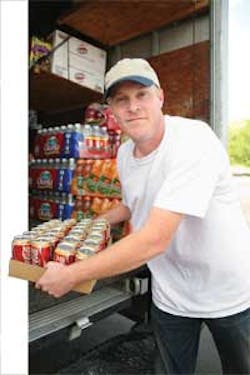
Dave Stevenson never imagined he would be running his own business when he moved to the U.S. from Canada 11 years ago to live with his sister. He didn't have a lot of formal education and was only hoping to find a job that would allow him to pay his bills and help out his sister, a newly-divorced mother.
Today, as the operator of Mission City Vending in San Antonio, Texas, the 34-year-old Stevenson is not only a business owner, but a homeowner and the father of three. In the last 11 years, he has undergone a crash course in vending and is well on his way to meeting his financial goals.
Stevenson still has a lot to learn about the business, working out of his home and 800 square feet of space he rents in an industrial warehouse. But his willingness to learn and not be afraid to make mistakes have served him well to date.
Stevenson presently services about 75 machines; just enough to require some additional help and better operational support. He recently acquired his first liftgate vehicle and is looking at an automated coin counter and industry specific management software.
Stevenson's experience demonstrates that vending still offers a viable opportunity for someone willing to work hard.
He came to the U.S. with limited finances, but strong work ethic. Shortly after his arrival in the U.S., his brother-in-law offered him a job as a vending service technician in San Antonio, Texas. His brother-in-in law was a partner in a vending locator service that also placed vending machines. The company bought machines sold by Perfect Break Systems, which is affiliated with The Wittern Group, the Des Moines, Iowa equipment manufacturer.
Stevenson did have one thing going for him; he is mechanical by nature. After joining his brother-in-law's company, he further honed his equipment repair skills by attending a three-day training seminar at the equipment manufacturer's headquarters in Des Moines, Iowa.
Beginning as a service tech
The company installed vending machines and repaired them on behalf of its operator customers. "I'd go around fixing machines sold by Sam's Club to customers," he said. "I really like working on machines. I don't think I was born for paper work. I like the physical work."
In two years, however, the company dissolved because of some disputes among the owners. Stevenson was able to utilize his relationships with operators to earn a living moving and repairing vending equipment.
Within a few months, one of the vending operators he worked with offered him the chance to buy a stake in his company in exchange for "sweat equity." The operator had 20 locations.
Stevenson and his new partner spent their days knocking on doors and servicing machines. They moved equipment themselves using a truck, a ramp and a dolly.
They continued to use Perfect Break Systems' locator service to find new accounts. They placed and serviced snack, soda, coffee and food machines. "He and I had unbelievable work ethics," Stevenson recalled. "We did janitorial work on the side to make ends meet."
The partners sought locations that could generate a minimum of $600 per month in sales. The locator was oftentimes able to get them locations by offering a food and/or hot beverage machine in addition to snacks and soda. "They had a really good sales staff," he said.
Early challenge: matching equipment to locations
In some situations, the location could not justify this additional equipment. But the location usually agreed to let them "right size" the equipment if they were satisfied with the service they were getting. Stevenson said they were able to keep most of their accounts by providing better service than the competition.
The Sept. 11, 2001 terror attacks brought a difficult period for the company. Many customers stopped buying product for a couple of months. In addition, there were several instances in which people called the police about their truck since it did not have any type of commercial identification. (The partners chose not to identify the truck in order to minimize vehicle break-ins.) "It was paranoia," Stevenson said.
The partners managed to place 300 machines in a 9-year period and did about $800,000 in sales in 2005. They had one full-time driver. But finance payments were high, and combined with locator fees, the business was barely profitable.
Stevenson liked the business, but he didn't like operating with so much debt pressure. He wanted to take a more conservative approach to investing in new equipment. He and his partner decided to separate.
"I like the people," he said of the business in general.
"I like servicing the machines, and I like being on my own."
Going off on his own was a risk, since he still had a fair amount of debt on the portion of the business that he retained. One of the first things he did was find a good accountant. He was referred to one by another vending operator.
The accountant set up Stevenson's company, Mission City Vending, as a "Subchapter S" corporation. The accountant has kept him up to date on when he needs to make payments. This has been helpful, given the fact that he is running the business almost entirely on his own.
In the meantime, Stevenson and his wife, Susan, who have three young children, moved into their first house.
Small business loan provides growth capital Stevenson recently secured a $25,000 SBA (Small Business Administration) loan, and is in the process of applying for a second one. He was made aware of the SBA by the company he rents warehouse space from. The owner of that company helped him apply for the loan, which was approved in less than three weeks.
"I rely on other people's advice; I don't have the greatest education," he noted. "Now I've got working capital; a little breathing room."
Stevenson still uses the Wittern finance program, which allows extended payment plans.
He also continues to use the locator service that Perfect Break Systems provides through a distributor in Albuquerque,
N.M.
While many small vending operators shun locators, Stevenson feels the assistance he gets from the Perfect Break Systems program is helpful.
"I'm not the best salesman in the world," he said. "I don't like to put on a suit and a tie. I don't feel comfortable that way. I can get the ‘lower brow' accounts easily. But when it comes to the high volume locations, I don't have the time or the patience to deal with that."
He noted that for many high volume locations, the sales process can take a few months and numerous meetings. He also noted that the locator service that Perfect Break Systems offers is much more reasonable and reliable than what a lot of other locators provide.
He targets accounts with 50 to 100 people.
Focus on profitability
Stevenson decided to limit his business to about 75 machines, which was as much as he could handle by himself. "I'm trying to fix what I've got," he said of his existing business.
He has acquired several locations from other operators who were servicing the machines on a part-time basis but couldn't give the full-time commitment needed. In these situations, he took over the accounts and assumed responsibility for the unpaid balances on the equipment loans.
He leases two 16-foot box trucks that he fitted with wooden racks, one with a freezer and the other with a refrigerated cooler.
He uses three bill counters but relies on his bank to do all of the coin counting. He plans to buy an automated coin counter.
Stevenson has lost very few accounts since he's been on his own. He said his customers like the personal service he gives. "I know the first and last names of 80 percent of the contacts in my accounts," he said. "I listen to them."
He also listens to product requests. In some cases, he provides products that aren't big sellers just to make the decision makers happy. He has purchased lime popsicles, pecan pies and cinnamon coffee cakes at supermarkets to meet some of these requests.
Stevenson leases about 13 cold drink machines from a local bottler, but prefers to use his own beverage machines. By owning his own machines, he is able to offer a better product selection.
In San Antonio, Big Red, which is offered by the local Dr Pepper/7Up bottler, is a very big seller. Other popular Dr Pepper/7Up products include Sunkist, Welch's Grape, and A&W Root Beer.
The product sourcing challenge
While Sam's Wholesale Club is his main product supplier, Stevenson continues to shop different sources for the best bargains. He noted that prices often vary among different Sam's Club outlets. He also buys product from supermarkets, a C-store and foodservice distributors.
Stevenson secured his largest account, a factory with 300 people, from a locator, shortly after going on his own. This account has three soda machines two snack machines, two frozen food/ice cream machines and a hot beverage machine. He services it every day.
After experiencing three bill validator malfunctions at this account, Stevenson decided to place his first freestanding bill changer. He researched the different models available and chose a unit from American Changer Corp.
"I can keep my sales up with that bill changer," he said.
Like many operators, Stevenson prefers to vend cans instead of bottles, but he always provides what the customers want. He is using a lot of bottle machines.
For accounts that require food, Stevenson has chosen to use frozen food machines instead of refrigerated machines. He encountered some mechanical problems with a refrigerated machine.
Besides eliminating spoilage, the frozen machine allows him to sell ice cream, which he claims is more popular than food in many accounts.
One downside is that if a frozen machine has a mechanical problem, it usually can't be fixed on site.
He has both full-size and satellite frozen machines.
Coffee remains a challenge
The weakest part of the business is the hot beverage portion. These machines require more maintenance than any other machine, and Stevenson claims customers will only pay 25 to 30 cents for a cup of vending coffee. He believes they would pay more if the machines could vend the same quality as what convenience stores offer, but so far, they haven't. He tries to offer pourover brewers whenever an account wants coffee. "If I didn't have to have them, I wouldn't," he said of the hot drink machines.
Stevenson has opted to stay with the same machine manufacturer to simplify his parts orders and repairs. "This (supplier relationship) is what I was dealt," he said.
In the time he's been in the business, Stevenson thinks he has a good idea of how much revenue he needs to be profitable on a per-location basis. Accounts with 100 to 300 people typically require cold drinks, snacks and food.
He believes that by redeploying some of his equipment to better accounts, he can increase his sales by another $4,000 per month.
In the short time he's been in business, Stevenson has realized how fickle accounts can be. His best account brought in $4,500 per month at one time, but it has since downsized and is now doing only $150.
He realizes that it's impossible to know how much business an account will do; some accounts with 50 people do more business than other sites with 200 people. Performance depends more on how many people at the location actually use the machine.
He is also working on raising prices. Stevenson figured that if he could move all of his prices to where he wants them, he would realize an additional $2,000 per month.
Shortly after going off on his own, Stevenson hired a driver on a test basis who is an Iraq war veteran. "I wanted to hire retired and ex-military people," he said. "You're bound to lose money if you just hire people off the street. An all-cash business is very tempting."
The driver did a good job, and he took more chances than Stevenson with product choices in the accounts he serviced. The driver's willingness to try more products resulted in higher sales in some accounts. This taught Stevenson the importance of paying more attention to what the people besides the decision makers want.
Stevenson was forced to take two months off this year after suffering from a hernia from lifting machines. He was fortunate in that he was able to hire a friend as a second part-time driver. "He did it as a favor while I was injured," he said.
Health awareness creates a challenge
Healthy products are a big issue in public locations in San Antonio. Stevenson serviced 19 locations under a city contract that required a certain amount of "healthy" snacks. Some of the locations had to be 100 percent "healthy" while others only had to be 50 percent healthy. These products included Funyuns, pretzels, Rice Krispies Treats, granola bars, Zoo animal crackers and Fruit Snacks.
Several vending operators in San Antonio support a community effort known as "Fit City" to promote healthier lifestyles. The program includes nutritional guidelines for vending machines that were devised by local dietitians. The guidelines list "healthier," "healthiest" and "excluded" items for both the snack machine and the beverage machine. Consumers can go to the "Fit City" website and learn the rationale behind the guidelines.
Stevenson participates in this program in some locations. He estimated his sales were about 75 percent lower than they would normally have been in these locations.
The location manager allowed him to increase his prices in these locations.
The experience did make Stevenson more aware of healthy options that he can offer his accounts. He tells accounts he can offer 30 percent healthy products.
His involvement with "Fit City" also earned him a spot on the local news. This was the second time he made the local news. The first time was for a show on people who work on holidays.
The media exposure was beneficial in that most of his customers saw him.
Overcoming competitors who offer high commission remains a challenge for Stevenson. He lost one account to a competitor who offered a higher commission, but eventually won it back because of the competitor's poor service.
Eye on technology
Stevenson has made significant progress in reducing his finance charges in the last year. He hopes to eventually be able to afford DEX handhelds and curbside polling. DEX would make it possible for him to hire a driver and not have to worry about relying on the driver's judgment for selecting product.
DEX would also allow electronic cash audit, which would give him better cash accountability.
Curbside polling will reduce service time, he believes.
"At every account, I've got to come in twice," he said. "If I could just come in once, it would save time."
Finding reliable help continues to be a challenge. His existing driver is already starting to "slide." "It gets to the point when they run in, fill the equipment and run out," he said.
Stevenson is also wary of vending management companies since they require commissions and make it difficult to raise prices. He has three accounts managed by a vending management firm.
Stevenson's wife, Susan, recently quit her regular job as a nurse's aid to handle his bookkeeping. She also operates a home-based network marketing business, in addition to being a stay-at-home mom.
Stevenson's goal is to reach $800,000 in annual sales. He's already more than half way there. He reasons if he could find two good full-time employees, he would have the time to devote himself to selling full time. At present, he is working from 3 a.m. to 9 p.m. most days.
"I've got to juggle home life, loading, inventory, ordering, the PR, and making sure my route guy is doing a decent job," he noted. "I'm always late on my paperwork."
How soon he reaches his goal relies on when he can find some additional help. "People with a work ethic nowadays are almost impossible to find," he said. "Just trying to find people who can do basic stuff seems really hard."
He is also considering expanding into bulk vending.
One thing he has learned in the last 10 years is not to rush into things.
As difficult as it is to handle so much responsibility on his own, Stevenson said he expects to remain sole owner of the business. Based on past experience, he is wary of partnering with anyone again. "You've got to communicate with everyone in your business or you're going to have a problem," he said.
Perfect Break Systems helps new vending operators get started
Dave Stevenson is one of several vending operators who has found the support program from Perfect Break Systems useful. He presently uses the services of an Albuquerque, N.M. Perfect Break Systems distributor, who himself was once a beneficiary of the program.
That distributor is Bruce Hager, who became a Perfect Break Systems distributor after launching a vending operation two years ago in Albuquerque. The management at Perfect Break Systems was so impressed by Hager's success winning locations that they asked him to become a distributor.
Hager was a former truck driver who got into vending with a couple of used machines. He came across Ron Leutze, the owner of All Star Vending Equipment Co., the Perfect Break Systems distributor in El Paso, Texas. Leutze helped him find locations, sold him machines and educated him about vending.
In two years, Hager built his vending business to 68 machines. He still operates this business, called Ameravend, with the help of his wife.
As a Perfect Break Systems distributor, Hager now helps other operators the way Leutze once helped him. He gets location leads from Perfect Break Systems' telemarketing group, then offers them to local operators. He works with a handful of operators in Albuquerque, N.M., as well as San Antonio, Texas.
Hager negotiates the terms of service for the locations he finds, then offers the location to one of his operator customers. Most of the leads are from locations that already have a vending service but aren't happy with it, he noted. He seeks locations with at least 75 people.
One of his key selling points to locations is that they will be serviced by an owner/operator, not an employee of an owner/operator.
Most of Hager's operator customers take advantage of Perfect Break Systems' financing.
Most operator customers also rely on Hager for new locations. There is a one-time location fee. "This way, people aren't buying equipment based on a promise of getting a location," Hager said.
The system has worked well despite the fact that as a vending operator, Hager might be seen as a competitor for his operator customers in Albuquerque. He assures his customers he will not solicit their accounts.
Besides offering locations, he also provides technical and business advice. He takes novice operators to Sam's Wholesale Club and teaches them what products to buy. "When you don't know anything about vending, it can be very intimidating," he said. "When I first started, I had a hard time."
Hager got most of his operator customers by running newspaper classified ads. He sought operator customers who were willing to buy at least a few machines. He advises them that they won't get rich quick in vending. "I'm not really a locator; I sell a package deal," Hager explained.
Profile: Mission City Vending
Headquarters: San Antonio, Texas
Founded: 2005
Owner: David Stevenson
Number of Routes: 1.5
Number of machines: 75
Main equipment lines: Wittern Group
Annual Sales: $500,000+