Karsay Coffee Builds on its Foodservice Base to Shine in OCS
Fortunate timing and staying on top of trends are twin keys to succeeding in business. Karsay Coffee in Somerset, N.J. offers a case study of a company that shifted its focus in response to changing market conditions in the coffee service industry.
Under its third generation leadership, the family-owned business several years ago recognized the need to move away from its traditional foodservice customer base to the office market. This was at a time when new tools — namely single-cup brewers — were creating new opportunities in OCS. The result has been double digit growth every year for the last 10 years.
Single-cup revolution changes company focus
The company was well positioned to capitalize on single-cup brewers when offices in central New Jersey were switching over from glass pot brewers in the mid 1990s. Having already established a strong presence in restaurants and institutions, Karsay Coffee was familiar with the single-cup concept that was revolutionizing OCS. This change was occurring at a time when the company's traditional foodservice market was changing as well.
"We were programmed to sell the restaurants," said Steve Karsay, the son of company founder Elmer Karsay. However, the restaurant business was changing as the large foodservice distributors, which previously left the coffee side of the business to coffee specialists such as Karsay, were developing dedicated coffee divisions.
The big foodservice distributors were beginning to become more competitive in coffee, making that market less profitable.
Fortunately, the third generation of Karsays — brothers Rich, Tom and Ryan — were managing the company and were up to speed on everything happening in the coffee market.
While the big foodservice companies were gaining more of the coffee business, these companies weren't focusing on the smaller coffee shops that were popping up.
Retail coffee stores emerge
"The street business was changing," said Rich Karsay, the current president. When Rich Karsay came on board in 1987 after studying marketing at Radford University in Radford, Va., there were three coffee shops in downtown New Brunswick, N.J. Today, there are more than 20 coffee shops, some of which are his customers.
The changing market required the company to adapt to serving smaller accounts. To meet the needs of these independent retail accounts, it was necessary to provide equipment in addition to product. This required a new business model for the company, which began as a "coffee wagon jobber" in 1950, selling coffee to locations that owned their own coffee urns.
New customer demographics changes delivery needs
Where the average customer owned its own equipment and purchased 100 to 200 pounds of coffee per week in the old days, the typical "street" account now buys 25 pounds and requires equipment. "We used to turn our nose at 20 pounds; now it's average," Rich Karsay said.
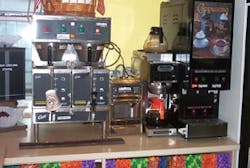
Some "street" accounts now have an automatic, 2- to 6-station coffee brewer; a powdered cappuccino dispenser; a coffee grinder; and an espresso brewer, requiring a total $3,500 equipment investment. The account might spend no more than $450 per month on coffee.
Karsay Coffee was forced to add more warehouse space to inventory equipment in addition to product, and add personnel to provide service. The company now operates from a 5,000-square-foot warehouse on a 15-acre property. Company founder Elmer Karsay, now 93, lives in a house on this property.
Fortunately, this investment positioned the company to expand into the office market, which has proven the most profitable and fastest growing segment.
The company has developed leave-behind literature to educate customers about its services. Management has also learned the importance of making sure its delivery personnel have a personal rapport with on-site managers.
The company has developed a brochure that includes information on its brewers and equipment. Prospective customers are given a list of existing customers to call for referrals.
There is even a brewer feature comparison chart that lists the features, functions, benefits, concerns and average cost per cup for five different delivery systems: glass pots, carafes, hopper systems, Flavia and Keurig.
Dual focus: small retail and office accounts
The dual focus on small retail establishments and offices has proven very successful.
The foodservice foundation was helpful for Karsay Coffee as some of the foodservice coffee brewing technology transitioned to OCS applications in the late 1990s.
Many East Coast restaurants were adding espresso and cappuccino. To meet this need, Karsay Coffee first offered Nestlé Nespresso, a portion controlled, single-cup system, then switched to Lavazza's Espresso Point. "This (cartridge-based espresso) takes all the guess work out (for a restaurant wait staff)" Rich Karsay said.
Karsay Coffee was successful placing Espresso Points in restaurants and delis, particularly in locations that served first-generation Italian and Portuguese immigrants. "That was our first experience with espresso in a cartridge-like machine," Rich Karsay said.
Restaurants have distinct equipment needs
"That began the search for something to help foam the milk (for cappuccino)," he noted. To improve the quality of the cappuccino, Karsay Coffee began adding a dedicated milk steamer next to the Espresso Point. While the Espresso Point has a built-in steamer wand, it was not sufficient for high volume locations that wanted to serve cappuccino.
Lavazza, an Italy-based manufacturer, was just getting started in the U.S. market in the late 1990s and assisted the Karsays finding locations for the Lavazza Espresso Point.
When Lavazza closed its U.S. parts and service operation in 2002, Karsay Coffee purchased the inventory and became a Lavazza master distributor for New Jersey,
Pennsylvania and Delaware. Karsay Coffee now services Lavazza units owned and operated by Karsay and its "subdistributors." Karsay Coffee presently services about 25 Lavazza "subdistributors."
The Lavazza Espresso Point also found a place in some offices. Because the offices did less volume than restaurants, it was not necessary to place a separate milk steamer to provide cappuccino; the Espresso Point steamer wand is sufficient.
While the Espresso Point addressed the espresso/cappuccino market, that market was limited. However, Karsay Coffee's experience placing the Espresso Point prepared it for the cartridge-based coffee brewers that were about to proliferate in offices in the late 1990s.
In 1999, Karsay Coffee became one of the first Keurig distributors in New Jersey. The response was immediate and Karsay Coffee quickly became a leading Keurig distributor in Central New Jersey. The 30- to 50-person office market proved more profitable and less service intensive than the foodservice business. About 75 percent of all of Karsay's office accounts have a single-cup machine.
"That (single-cup brewer) came along right as we were looking to do something different," Rich Karsay surmised.
Foodservice and office synergies
While the biggest growth is currently in the office market, Karsay Coffee continues to service a lot of foodservice accounts. The company has found a strong synergy between the two businesses.
Karsay Coffee runs four trucks a day, each delivering products to offices, retail foodservice and institutional foodservice accounts. Customers fax, phone or e-mail orders to Karsay Coffee, which calls customers two days in advance.
Combined institutional/office accounts are particularly profitable, Rich Karsay noted. Many large institutional accounts have a need for both foodservice and office coffee.
In one hospital, Karsay Coffee handles all the coffee for patient feeding, employee feeding, customer lounges and staff offices. The equipment includes coffee urns, single-cup brewers, liquid-based coffee dispensers, and water soluble coffee systems; a total of 50 machines.
Large institutional accounts often prefer to have one coffee expert handle the cafeteria, catering, retail and employee coffee needs.
The big foodservice distributors, for their part, find it easier to let a coffee specialist such as Karsay Coffee handle all the coffee in accounts with multiple needs. Karsay Coffee employees are on site regularly. Hence, they can provide better service. "They (the site managers) have one contact for all their coffee needs," Rich Karsay said. "They've got one phone call to make."
Karsay Coffee does not provide or service the liquid-based coffee machines in the cafeterias it serves, but they do carry the liquid coffee and they contact the manufacturer or supplier when it's time for machine maintenance.
Profitable sideline: bulk food
Karsay Coffee's relationship with the big foodservice suppliers has also enabled it to become a niche foodservice distributor for bulk food products. Karsay Coffee can offer new products before the foodservice distributor adds them to its regular menu.
"We can market specialty items early on in their sales cycle," Rich Karsay explained. These include cheese sauce, spaghetti sauce, peanuts and instant potatoes. "There is a small window there where new products can be marketed and we can make some money," he said. "There's always new stuff coming and going. It's an ongoing process."
While most of the company's growth comes from referrals, Karsay Coffee mails out post cards, occasionally advertises in the local newspaper, and exhibits at local food fairs. Rich Karsay handles the sales, along with another full-time salesperson.
One successful promotion is a post card that offers customers a chance to win the state lottery for scheduling a free single-cup demonstration.
Single-cup leads in office accounts
The company offers customers a wide range of services. Most office accounts today want cartridge-based, single-cup units, Rich Karsay said. Those that are not large enough for single-cup units are offered three-burner, automatic glass pot systems.
Accounts must purchase a certain amount of coffee to receive a machine free of charge. For those accounts not large enough, Karsay Coffee has a service agreement that offers both rental and purchase terms for three different single-cup brewers.
The company will provide gravity-fed airpot brewers or water soluble single-cup systems to customers that want them, but Rich Karsay said he does not encourage these units since they require more maintenance. In addition, the company needs to streamline its parts inventory. "You can't be all things to everybody," Rich Karsay noted.
Focus on national brands
With cartridge-based, single-cup systems (Keurig and Flavia) driving much of the growth, Karsay Coffee believes more in the power of national brands than in private label coffee. The company takes advantage of the point-of-sale marketing material provided by its coffee suppliers. Point-of-sale material is particularly important in retail accounts such as coffee shops and convenience stores.
Karsay Coffee makes good use of graphic brewer overlays from its roaster partners, particularly Green Mountain Coffee Roasters and Kraft Maxwell House.
The company began offering private label coffee in the 1980s when the market was more cost-driven, but it does not see private label as a growth area. Being primarily a single-cup provider, most of the coffee sold is provided in proprietary portion packs.
Even the fractional pack coffee is predominantly branded coffee. Rich Karsay believes it makes sense to capitalize on the brands that have already been established.
"Without the signs and the promotion with the label on it, we aren't promoting it (private label)," Rich Karsay said. "Why would I want to spend $30,000 on a display box with my name on it? I could get all that from a national supplier (for free)."
The company has tested some of the new manual pod brewers, but it has not seen a demand for them. Demand remains strong for cartridge-based units.
Expansion based on service
While the Karsays are anxious to grow the company, they believe it is important to continue to provide the same high level of customer service. To date, they have been lucky attracting committed employees, and there hasn't been much worker turnover.
The Karsays reward employees with comprehensive medical benefits, a profit sharing plan, two weeks paid vacation and a free tank of gasoline every week.
Management believes success has come from identifying a niche as a coffee specialist and building on their expertise. While they have added water filtration to their services, they have not expanded into vending or office products like some of their competitors have.
In situations where an account needs vending or office products, Karsay Coffee partners with other companies that provide these services.
Coffee service has become a specialty unto itself. Karsay Coffee has recognized the need to continue to invest in employee education and in product and equipment.
To hone his expertise, Rich Karsay recently completed the Quality Coffee Certification Program offered by the National Automatic Merchandising Association. "I got a little polishing in my coffee knowledge," he said. "It's a worthwhile course." He also plans to attend a 2-day
seminar sponsored by Green Mountain Coffee Roasters.
The company recently introduced the OCS training manual provided by Len Rashkin Consulting, based in
Bellerose, N.Y.
Karsay Coffee continues to expand as demand for single-cup shows no sign of letting up. The company has developed a cost effective service model that meets the needs of office and foodservice accounts, based on a strong employee training program and a partnership approach with its key product and equipment suppliers.