Boston Vendor Finds Telemetry Improves Service
New technology promises to make vending more professional. But who will drive this change? With the high investment required and the market more competitive, will it be up to the large operators to take the lead in introducing cashless transactions, remote machine monitoring and Web-based reporting?
Will new business models evolve, whereby technology suppliers partner with machine manufacturers and/or operators in introducing these new customer conveniences?
Will small operators, with their lower overhead and ability to have the owner more closely involved in customer service, recognize the benefits of technology and take the lead in bringing it to market?
Only time will tell.
In the meantime, these new customer conveniences and operating system efficiencies are being introduced to locations by progressive operators. Operators with open minds are introducing cashless transactions, remote machine monitoring and other service enhancing technologies and are using them competitively in their local markets.
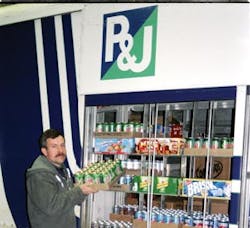
Case in point is P & J's Vending, a 6-route operation in suburban Boston, Mass. that has been using state-of-the-art technology for several years. The 16-year-old company has posted double-digit growth every year, and has used remote machine monitoring to improve customer service and improve profitability.
In many ways, founder/owner Jim Kelly typifies the independent vending operator. He believes that customer service is the foundation of a successful vending business.
Foundation: customer service
"Service is the key," he said. For Kelly, who still fills in for drivers when they get sick, technology is a tool that enables route drivers to service locations more efficiently and provide customers with the products they want.
Kelly, the son of a postal worker, proves that vending still offers a viable opportunity to an ambitious entrepreneur. Perhaps because he entered the vending business with a strong background in accounting, he was faster than most startup operators to embrace vending management software.
Kelly knew from an early age that he wanted to own his own business, but he didn't discover vending as a career until several years after he graduated from Bentley College in Waltham, Mass. with an accounting degree. He worked in accounting for different companies before starting his own accounting business.
Kelly's accounting business mainly served property management companies. In the late 1980s, Kelly became concerned when the real estate market began to suffer due to recession. He explored supplemental income opportunities and decided to try vending. He began with one small soda machine.
Early on, vending gave flexibility
Vending didn't provide fast income, but Kelly realized it offered flexibility. He could keep his regular job and solicit vending accounts as his schedule permitted. "It was a lot of hard work, but the return was there," he said.
For three years, Kelly solicited small locations in suburban Boston. He never used locators to find customers. He purchased snack machines from New England Coin Op Distributing Inc. in Norwood, Mass. and leased beverage machines from bottlers. He operated out of his house and used his personal vehicle for deliveries.
Kelly initially targeted accounts with a minimum of 50 people. Exceptions were made for isolated locations that didn't have a lot of food and refreshment choices.
He recognized the importance of working with suppliers early on. He bought most of his product from Kendall Confections in Belmont, Mass.
He appreciated the fact that this company would deliver product to him on short notice even though he didn't buy huge orders.
First big account: a hospital
One of his bottler suppliers won a hospital account and asked him to provide snack machines, a hot beverage machine and a cold food machine. This was a turning point for Kelly's vending business.
Wanting to make a good impression on the hospital, Kelly purchased new machines from Crane National Vendors, using company financing. "We wanted to get off on the right foot," he said.
The Crane team taught him how to operate the machines when they installed them. Fortunately, Kelly is reasonably mechanical. "I can figure things out," he said.
The hospital had to be serviced three days a week. So Kelly rented a small warehouse, hired a part-time employee and purchased a delivery van.
Kelly was able to buy fresh food from a commissary that Kendall Confections referred him to. He purchased his coffee from New England Coffee Co.
Once he had this first reasonably large account, Kelly realized that it was time to devote himself full-time to vending.
The hospital account provided an excellent referral, and Kelly was soon able to win more of the larger accounts. "We had a track record," he said.
New challenge: tracking cash and inventory
He also realized that he needed to have some way of tracking cash and inventory. He instructed his delivery person to record meter readings.
This was the basis of his first accounting system. He set up spread sheets for all of his machines.
When he reached 100 machines in the early 1990s, Kelly realized he needed new software. He was buried under his numerous machine spread sheets.
Fortunately, a vending management software company was located within driving distance: Streamware Corp., based in Norwood, Mass. Streamware, which is now part of the Crane Co., was a young startup in the early 1990s. The company was still developing its accounting packages, and the partners were anxious to learn the needs of small vending operators.
Kelly was fortunate in that he formed a strong relationship with Streamware early in its development. Streamware principals visited him to find out what his needs were. In exchange, Kelly was among Streamware's first customers. "I helped them," Kelly recalled. "I would tell them what I liked and what I didn't like and what I wanted to see."
Early partnership with Streamware
Streamware was interested in developing tools that would simplify route accounting. Streamware also developed marketing reports to allow operators to identify the best selling items at the machine level.
Kelly was primarily interested in a good accounting system. He wasn't an early convert to the machine planograms and line-item tracking system Streamware was developing. This is because he believed in allowing the driver to select products.
"We didn't want to do the product level (line-item tracking)," Kelly said. "I wanted to give my employees the flexibility to give the customers what they wanted." This was destined to change.
Kelly liked Streamware's basic route accounting program from the get go. "It gave good reliability," he said. The program allowed him to identify product shortages and variances in meter readings.
He did not buy into handhelds. "I didn't see any benefit in it," he said. "I was trying to get my drivers to do the servicing properly, and I didn't want to bog them down."
The investment in route accounting software provided a strong foundation for continued growth.
Kelly changed his mind about machine planograms when he realized that they enabled someone not familiar with a route to step in and provide what the customers want at a location.
Planograms also allowed him to streamline his snack inventory. This has resulted in more efficient buying and it has also improved sales since Kelly now has a tool to ensure that the top selling items are placed in all the machines. "We try to buy what's selling based on what you see in (industry) publications," he said.
Snack machine planograms are now changed quarterly.
Getting the drivers to accept the planogram wasn't easy. "It's still a battle trying to get drivers to switch to planograms," he said.
Finding the right employees was another key building block for the company. Kelly didn't have any special methods for finding good employees. He relied largely on his own instincts. He pays attention to whether or not a person looks him straight in the eye. "It's just a natural feeling you develop with the person," he said.
Willingness to embrace technology
While Kelly has relied on many of the same business strategies as other small independents, one area in which he has been exceptional has been his willingness to embrace new technology.
Several years ago, he heard through an acquaintance about a local company that was trying to develop remote machine monitoring. This company, Arkion Systems in New Bedford, Mass., was developing wireless networks to connect remote entities, such as vending machines and utility meters, to a central database, enabling monitoring and control from an Internet Website.
Kelly contacted this company and they agreed to test five of his machines using their wireless network. They placed receivers in his machines to transmit transaction data to a Website. "I always felt there was a better way to service (vending machines)," Kelly said. "To know what is selling and when you need to service the machine is part of the key to good service."
Arkion Systems eventually decided to focus on public utilities instead of vending. But the experiment convinced Kelly that the concept was sound.
Kelly also began testing a remote monitoring product from USA Technologies, which he learned about from Automatic Merchandiser Magazine. He installed USA Technologies' e-Ports on some of his machines.
Both the Arkion and USA Technologies' systems worked, but Kelly was not ready to invest in receivers for an entire route. He was facing a "Catch 22": He needed to test remote monitoring on an entire route before he could determine whether such an investment was worthwhile.
Expansion into remote monitoring
In 2005, he decided to attend the NAMA Expo in Atlanta, Ga. with the express purpose of reviewing different remote machine monitoring systems. He was impressed by the user friendliness and the economics of the Cantaloupe SEED system.
The Cantaloupe software also interfaced with his existing Streamware software. Cantaloupe's SEED Platform provides wireless monitoring and alert notification of a vender's remote assets, while Streamware's software provides front- and back-office operational management solutions.
Kelly asked Cantaloupe to let him test five SEED boxes. Cantaloupe suggested that he test 25 units for a 90-day period. Kelly agreed to commit to 25 SEED units in exchange for an unconditional full return guarantee.
Kelly installed the SEED boxes on soda, snack, coffee and food machines at a college. All of these machines were fairly new, so there was no need for DEX retrofits. "It went well, and I was impressed with it," Kelly said.
Allen Lwin, a lead support technician for Cantaloupe, visited P & J's Vending to assist with the SEED installations. Lwin said this rollout was among the best that Cantaloupe has been involved with, due in large part to Kelly's involvement with his route drivers.
A hands-on manager
"He's different from other vendors," Lwin said about Kelly. "He knows where every one of his machines is located. He's really hands on."
Lwin said Kelly was an easy customer to work with because he didn't delegate the installation process to middle management. Instead, Kelly was involved in explaining to the drivers why the telemetry system would help them. "He understands the technology, and he knows what he has to do in order to succeed (with the technology)," Lwin said. "Jim's able to work with the drivers personally to show them how it's going to help them. He goes down into the trenches."
The cellular signals were reliable, Kelly noted. Cantaloupe has an amplifier for locations that have weak signals. In locations where even an amplifier won't deliver a signal, a land line can be installed. This hasn't been necessary in Kelly's case.
Telemetry's first benefit: Identifying optimum service time
Kelly personally serviced the machines at the college for about six months to make sure everything worked as planned. The most immediate benefit was being able to know when the machines needed to be serviced.
"I could know if I had to service the machine every 10 days instead of every seven days," Kelly said.
Remote monitoring eliminates the need for dynamic scheduling; determining a route's delivery needs based on historic sales. Dynamic scheduling is another efficiency tool that some software companies have been marketing.
Given the fact that service labor is his highest line-item expense, this has been an important benefit the SEED system has provided. In addition, the machine is never out of stock.
Sales per machine is also higher because the machine is being serviced when there is more money in it, Kelly said.
Driver communication pivotal
Kelly was able to reduce weekly deliveries at one account from eight to five.
With new benefits come some new challenges, Kelly also noted. Less frequent service is more efficient, but it also creates a need to be more proactive with the customer. Customers are used to seeing the delivery person on a regular basis. When this changes, they become concerned. "I think the customer likes stability," Kelly said.
Remote monitoring also increases management's work load. The SEED platform requires someone to monitor the Website consistently. This duty is shared by Kelly and his office management staff, Laura Kelly and Colleen May.
There is also a need to educate the route drivers. The system takes away just about all product selection responsibility from the driver. Kelly said it is important when making a change like this to communicate with the driver. "It's a change in philosophies," he said. "I can tell them what to put in based on sales levels."
Telemetry reports reinforce management decisions
Having the SEED information to back up the decisions helps the driver understand why the changes are being made. Kelly also noted that the return on the remote monitoring is greater in public access locations since they have greater fluctuations in customer traffic flow.
In the past year, Kelly has expanded the SEED from 25 to 300 machines, with plans to eventually bring all of his machines online. He has purchased the SEED boxes in 25- and 50-unit increments.
Each SEED installation costs between $300 and $500, depending on whether or not the machine needs a DEX upgrade. The monthly transmission fee is $6 per machine. Given the fact that most of Kelly's machines are new, he expects to incur a total cost of about $180,000 for installations and $43,200 for signal transmissions.
Once all six routes are converted to SEED, Kelly expects it will take between two and three years to recover his investment through increased sales and reduced labor. "It's not bad," Kelly said.
In the future, he expects the costs to decrease on a per-machine basis.
The SEED reports allow Kelly to analyze data. Here is where there is some overlap between Cantaloupe's and Streamware's software.
Glenn Butler, a former executive at both Streamware and Cantaloupe, said Kelly is using Streamware for "back end" functions such as accounting, and Cantaloupe for "front end" tasks, such as tracking line-item sales. "For a small operator, these two systems complement each other well," Butler said.
Sales analysis proves helpful
Gleaning the benefits of line-item sales analysis is a long-term proposition. Kelly recognizes the importance of this. His wife, Laura, has joined him to manage special projects, such as data analysis, having recently changed careers from her profession as a physical therapist.
Kelly said vending operators have no way of knowing how many sales they lose due to incorrect product choices. While it's easy to know the top sellers, the secondary sellers are not easy to determine. Over a long time period, this can be an important factor.
"We haven't explored the value in that yet," Kelly said. "We're always looking to get more production out of those secondary rows. It (SEED reports) gave me the analytical information at my fingertips."
At one account, for instance, the driver said he was certain a particular item was selling well. After reviewing product sales by machine, however, Kelly realized that the item's performance varied greatly among the different stops on the route.
Given the proliferation of products in both the snack and beverage segments, this is a good time for a vending operator to have strong item-level sales reporting tools.
P & J's Vending has added more glassfront beverage machines in recent years. The performance of some of the newer beverages, such as energy drinks and sports drinks, encouraged Kelly to install dedicated machines for Red Bull, Powerade, Gatorade and Snapple. All have done well in certain locations.
On the confections side, he has some closed-front, refrigerated Reese's candy machines.
Remote monitoring improves customer relations
Remote monitoring has also proven a good customer relations tool for Kelly. While he didn't tout the customer's ability to go onto a secure
Website and review sales activity initially, he has since found that this is a strong selling point. "I have gotten accounts because of it," Kelly said for the Cantaloupe system.
Providing sales reports has also helped customer relations. Kelly said this is an important tool in situations where "lowballers" promise an account lower prices and/or higher commissions. "You'll always get someone breathing down your neck," he said.
Kelly has won accounts serviced by some bottlers because he provides better service. "Being a small company, I can keep my hand on the pulse of it," he said.
Website-based reporting also prevents unscrupulous competitors from promising unrealistic commissions and then misreporting the sales. This practice, known as the "R" factor, is not widespread in his market, Kelly said, but it does happen.
In the past, Kelly invited accounts to review meter readings at any time. Being able to go online and view transactions is a lot easier.
Company tests credit card readers
Kelly's exploration of remote monitoring also introduced him to credit card readers. He became familiar with this through USA Technologies, which provides the necessary hardware and software for a credit and debit card reader.
Kelly is not as enthusiastic about cashless vending, based on his experiences to date. He believes it will take time before the consumer gets used to using credit and debit cards in vending machines.
"Once it becomes more universally accepted, it'll do well," Kelly said. He said it's important to stay on top of this, since the younger generation uses debit cards more than their predecessors.
He still has two MEI credit card readers in operation, one at a golf course and the other at a marina.
The credit transactions are authorized by USA Technologies, which charges a monthly fee for the service. Kelly opted to go with batch purchase authorization, which is more economical than live authorization. With batch authorization, customers can only make a limited number of purchases in a given time period.
The card readers send the transaction data nightly to USA Technologies' Website via a cellular signal. Anyone who is authorized to view the activity can go the Website and review the transactions for the time period the user selects. There is an activity summary that allows the user to see cash total, credit total, refunds total and grand total.
Kelly has also used closed debit card systems in some accounts, where the card reader is hard-wired to a proprietary server.
Nutrition presents a challenge
One of the most challenging areas the company faces is meeting nutrition requirements in certain accounts. Massachusetts schools have been among the most proactive in the nation in requiring vending operators to meet nutrition standards.
Laura Kelly has been actively seeking products that meet the nutrition requirements. (See sidebar, below.) This has been a tedious job.
"We've looked for products that meet the guidelines that kids want to eat," Kelly said. He noted that only about a third of all candy and snack items that the vending industry sells meet the standards.
Accounts that adopt the standards typically do half the sales, he noted.
Laura Kelly also oversaw the redesign of the company's Website. The new Website is more comprehensive and professional than the old one.
Kelly believes he will eventually be able to double the size of his company without losing the personal rapport he has with his customers. "I can't lose control of the service," he said. "The customer needs to feel that they can call me."
Kelly doesn't envision the day that he won't be on call to fill in for a driver. "When you ‘jump' a route, you see what's going on," he said. "That's what makes my service different."
He doesn't intend to expand into other services, such as OCS or manual feeding. "It's not an area where I have any expertise, nor do I want to," he said for the latter area. The company offers OCS to existing accounts that request it.
P & J's Vending has demonstrated that state-of-the-art technology can be used by independent operators to improve customer service. Remote machine monitoring has given owner Jim Kelly a more efficient operation and a new set of selling tools.
Technology promises a brave new world for the vending industry, and the independent operator will clearly be a part of it.